Species · Birds
Olive-bellied Sunbird Cinnyris chloropygius
The scientific name of the Olive-bellied Sunbird is Cinnyris chloropygius. It is a species of bird in the family Nectariniidae (sunbird), order Passeriformes. The name dates from 1842.
- Scientific name
- Cinnyris chloropygius (Jardine, 1842)
- Common name
- Olive-bellied Sunbird
- Genus
- Cinnyris
- Family
- Nectariniidae (Sunbird)
- Order
- Passeriformes
- Class
- Aves
- Red List category
- LC Least Concern
- Recorded in
- 25 countries
- Name status
- accepted in the Catalogue of Life

Overview
The Olive-bellied Sunbird is a small bird in the family Nectariniidae, order Passeriformes and class Aves. It occurs widely across tropical African rainforests, primarily in West and Central Africa, with additional populations in Southern and East Africa. Adult males have metallic green upperparts, a narrow blue breast band, a scarlet breast patch and olive-colored bellies, while females are olive-brown with yellower underparts.
Written 26 November 2026 from the sources listed below. Each statement was checked against the passage it cites; statements that could not be supported were removed.
Similar species
The Olive-bellied Sunbird closely resembles the tiny sunbird but has a larger bill. It lacks the blue bars present among the red breast plumage of the tiny sunbird.[1][2][3]
Appearance
Adult males have metallic green heads, backs and throats, dark brown wings, metallic blue rumps and black tails with a purplish-blue sheen. Their breasts have a narrow blue band above a wider scarlet patch, and their bellies are olive-colored.[4][5][6]
Adult females have olive-brown heads and upperparts, dark brown wings and tails, and olive underparts with a yellow wash. Their underparts are yellower and less streaked than those of tiny sunbirds.[7][8]
Habitat
The Olive-bellied Sunbird is associated with African tropical rainforest.[9]
It occurs widely across tropical African rainforests, primarily in West and Central Africa, with additional populations in Southern and East Africa.[10]
Diet
The Olive-bellied Sunbird forages in the lower canopy and eats caterpillars, beetles, spiders, nectar, flowers and seeds.[11]
Behaviour
Olive-bellied Sunbirds generally move individually or in pairs, but sometimes form groups of approximately six birds.[12]
Male Olive-bellied Sunbirds defend territories against members of their own species and tiny sunbirds.[13]
Reproduction and life cycle
The nest is loosely constructed from grasses, strips of bark and leaves, with a lining of fine material.[14]
Female Olive-bellied Sunbirds perform all incubation.[15]
Conservation
The Olive-bellied Sunbird is common and has a very wide geographic range. It is classified as Least Concern by the International Union for Conservation of Nature.[16][17]
Its population trend is considered declining, partly because of decreasing forest cover. The decline is not considered sufficiently rapid to be alarming, and no specific threats have been identified.[18][19][20]
The species was most recently assessed for the IUCN Red List in 2024.[21]
Classification of the Olive-bellied Sunbird
| Kingdom | Animalia |
|---|---|
| Phylum | Chordata |
| Subphylum | Vertebrata |
| Infraphylum | Gnathostomata |
| Parvphylum | Osteichthyes |
| Megaclass | Tetrapoda |
| Class | Aves (Bird) |
| Order | Passeriformes (Passerine) |
| Family | Nectariniidae (Sunbird) |
| Genus | Cinnyris (Typical Sunbirds) |
| Species | Cinnyris chloropygius (Jardine, 1842) |
Where the Olive-bellied Sunbird is found
Checklists and occurrence records place Cinnyris chloropygius in 25 countries across Africa. GBIF holds 18,754 georeferenced records of it.
Countries
- Angola 315
- Benin 230
- Burundi 33
- Cameroon 933
- Central African Republic 153
- Democratic Republic of the Congo 1,063
- Equatorial Guinea 308
- Ethiopia 3
- Gabon 443
- Ghana 3,296
- Guinea 83
- Guinea-Bissau 153
- Ivory Coast 500
- Kenya 677
- Liberia 606
- Malawi 3
- Nigeria 1,833
- Republic of the Congo 414
- Rwanda 284
- Senegal 11
- Sierra Leone 169
- Tanzania 100
- Togo 46
- Uganda 7,095
- Zambia 3
Regions and cities with the most records
- Kasanje, Uganda 1,778
- Katabi, Uganda 1,776
- Entebbe, Uganda 1,761
- Kajansi, Uganda 1,689
- Rwiimi, Uganda 1,540
- Central, Ghana 1,328
- Western, Ghana 655
- Eastern, Ghana 552
- Ashanti, Ghana 537
- Kakamega County, Kenya 500
- Buhesi, Uganda 471
- Kakamega, Kenya 437
- Anyinam, Ghana 391
- Elubo, Ghana 376
- Kanungu, Uganda 313
- Ntungamo, Uganda 307
- Fort Portal, Uganda 280
- Mpigi, Uganda 246
- Oyo State, Nigeria 242
- Nimba, Liberia 235
- New Yekepa, Liberia 234
- Bunamwaya, Uganda 229
- Centre, Cameroon 227
- South-West, Cameroon 214
- Masindi, Uganda 211
- Lugazi, Uganda 208
- Ondo State, Nigeria 201
- Atlantique, Benin 199
- Ogun State, Nigeria 187
- Cross River State, Nigeria 186
- Kyengera, Uganda 183
- Abidjan, Ivory Coast 182
- Koumassi, Ivory Coast 182
- Marcory, Ivory Coast 182
- Njeru, Uganda 182
- Abobo, Ivory Coast 181
1 more country has a few records outside this range
These countries hold a few records of Cinnyris chloropygius but lie outside the range the checklists give for it. Such records are often zoo or garden specimens, museum material or vagrants, so the species is not counted as occurring there.
Range as the checklists state it
Africa
A number beside a place is its count of GBIF occurrence records. A place without a number comes from a checklist alone. Records show where a species has been observed or collected, which can include escapes and vagrants.
Common names
English
- Olive-bellied Sunbird
- OBSU
Names in 23 other languages
- Catalan
- suimanga de ventre olivaci
- Chinese
- 橄綠腹花蜜鳥, 绿腹花蜜鸟
- Croatian
- maslinastotrbi medosas
- Czech
- strdimil olivovobřichý
- Danish
- Olivenbuget Solfugl
- Dutch
- Olijfbuikhoningzuiger
- Esperanto
- olivoventra nektarinio
- Finnish
- korallipuumedestäjä
- French
- Souimanga à ventre olive
- German
- Olivbauch-Nektarvogel, Olivbauchnektarvogel
- Hungarian
- olajzöldhasú nektármadár
- Italian
- Nettarinia panciaoliva, Nettarinia ventreoliva
- Japanese
- オリーブゴシキタイヨウチョウ
- Lithuanian
- raudonkrūtė spalvingoji nektarina
- Norwegian
- olivenbuksolfugl
- Polish
- nektarnik oliwkowobrzuchy
- Portuguese
- beija-flor-de-barriga-verde, beija-flor-rabiverde, nectarínia-de-barriga-olivácea
- Russian
- Изумрудная нектарница
- Slovak
- nektárovka krovinová
- Spanish
- Suimanga ventrioliva
- Swedish
- olivbukig solfågel
- Turkish
- Zeytuni Karınlı Nektarkuşu
- Ukrainian
- маріка смарагдова
Synonyms
One other scientific name has been used for this species and is now treated as a synonym of Cinnyris chloropygius.
- Nectarinia chloropygia Jardine, 1842
Subspecies and varieties
- Cinnyris chloropygius bineschensis subspecies
- Cinnyris chloropygius chloropygius subspecies
- Cinnyris chloropygius kempi subspecies
- Cinnyris chloropygius orphogaster subspecies
Related species
-
 Palestine SunbirdCinnyris osea
-
 Purple SunbirdCinnyris asiaticus
-
 Garden SunbirdCinnyris jugularis
-
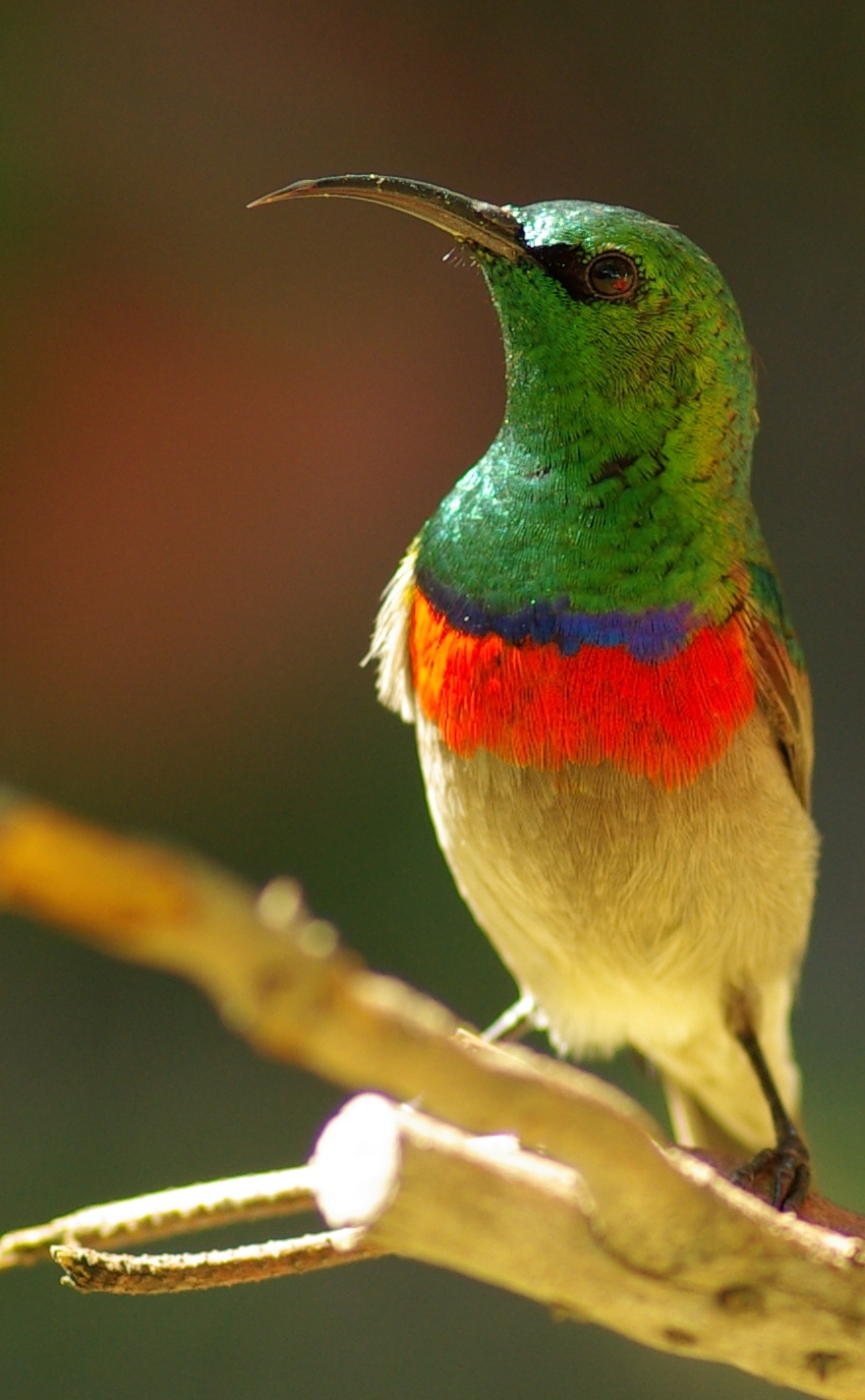 Southern Double-collared SunbirdCinnyris chalybeus
-
 Variable SunbirdCinnyris venustus
-
 Purple-banded SunbirdCinnyris bifasciatus
-
 Souimanga SunbirdCinnyris sovimanga
-
 White-bellied SunbirdCinnyris talatala
Compare
Questions and answers
What is the scientific name of the Olive-bellied Sunbird?
The scientific name of the Olive-bellied Sunbird is Cinnyris chloropygius. Written with its author, the full name is Cinnyris chloropygius (Jardine, 1842).
Which family does the Olive-bellied Sunbird belong to?
Cinnyris chloropygius belongs to the family Nectariniidae, in the order Passeriformes and the class Aves.
Where is the Olive-bellied Sunbird found?
Checklists and occurrence records place Cinnyris chloropygius in 25 countries, including Uganda, Ghana, Nigeria, Democratic Republic of the Congo, Cameroon and Kenya.
What is the conservation status of the Olive-bellied Sunbird?
The IUCN Red List category recorded for Cinnyris chloropygius is Least Concern (LC).
What other names does the Olive-bellied Sunbird have?
Cinnyris chloropygius is also known in English as OBSU.
What does the olive-backed sunbird eat?
It eats caterpillars, beetles, spiders, nectar, flowers and seeds.[11]
Sources
Passages the profile rests on
- The olive-bellied sunbird closely resembles the tiny sunbird in appearance. Source passage: “very similar to the tiny sunbird (Cinnyris minullus) in appearance.” — English Wikipedia
- The olive-bellied sunbird has a larger bill than the slightly smaller tiny sunbird. Source passage: “It differs from the slightly smaller tiny sunbird in having a larger beak” — English Wikipedia
- The olive-bellied sunbird lacks the blue bars present among the red breast plumage of the tiny sunbird. Source passage: “and no blue bars among the red breast plumage.” — English Wikipedia
- Adult males have metallic green heads, backs and throats, dark brown wings, metallic blue rumps, and black tails with purplish-blue sheen. Source passage: “The adult male has a metallic green head, back and throat, dark brown wings, a metallic blue rump and a black tail with a purplish-blue sheen.” — English Wikipedia
- Adult males have a narrow blue breast band above a wider scarlet breast patch. Source passage: “It has a narrow blue breast band above a wider scarlet breast patch” — English Wikipedia
- Adult males have lemon-yellow pectoral tufts and olive-colored bellies. Source passage: “lemon-yellow pectoral tufts and an olive belly.” — English Wikipedia
- Adult females have olive-brown heads and upperparts, dark brown wings and tails, and underparts that are olive with a yellow wash. Source passage: “The adult female has an olive-brown head and upper parts, dark brown wings and dark brown tail. The underparts are olive washed with yellow” — English Wikipedia
- Females have yellower and less streaked underparts than tiny sunbirds. Source passage: “and are yellower and less streaked than the tiny sunbird.” — English Wikipedia
- The species is associated with African tropical rainforest. Source passage: “across the African tropical rainforest” — English Wikipedia
- The olive-bellied sunbird occurs widely across tropical African rainforests, primarily in West and Central Africa, with additional populations in Southern and East Africa. Source passage: “It is widely spread across the African tropical rainforest primarily throughout West and Central Africa, but is also found in Southern and East Africa.” — English Wikipedia
- The species forages in the lower canopy and eats caterpillars, beetles, spiders, nectar, flowers and seeds. Source passage: “It forages in the lower parts of the canopy, feeding on caterpillars, beetles, spiders, nectar, flowers and seeds.” — English Wikipedia
- Olive-bellied sunbirds generally move individually or in pairs, but sometimes form groups of approximately six birds. Source passage: “The olive-bellied sunbird moves about singly or in pairs, or sometimes in groups of about six birds.” — English Wikipedia
- Male olive-bellied sunbirds defend territories against members of their own species and tiny sunbirds. Source passage: “The male is territorial and will drive away members of its species as well as tiny sunbirds.” — English Wikipedia
- The nest is loosely constructed from grasses, strips of bark and leaves, with a lining of fine material. Source passage: “The nest is a straggly affair formed from grasses, strips of bark and leaves, and lined with fine material.” — English Wikipedia
- Female olive-bellied sunbirds perform all incubation. Source passage: “Incubation is done entirely by the female.” — English Wikipedia
- The olive-bellied sunbird is considered common and has a very wide geographic range. Source passage: “The olive-bellied sunbird is a common species with a very wide range.” — English Wikipedia
- The species is classified as Least Concern by the International Union for Conservation of Nature. Source passage: “the International Union for Conservation of Nature has assessed the bird's conservation status as being of "least concern".” — English Wikipedia
- The population trend is considered declining, partly because of decreasing forest cover. Source passage: “Although the population trend is thought to be declining as a result of declinging forest cover” — English Wikipedia
- The population decline is not considered sufficiently rapid to be alarming. Source passage: “the decline is not fast enough to be alarming.” — English Wikipedia
- No specific threats have been identified for the species. Source passage: “No particular threats have been identified” — English Wikipedia
- The species was most recently assessed for the IUCN Red List in 2024. Source passage: “Olive-bellied Sunbird Cinnyris chloropygius has most recently been assessed for The IUCN Red List of Threatened Species in 2024.” — iucnredlist.org
Data
- Catalogue of Life, 2026-10-16 XR cc by
- Global Biodiversity Information Facility CC BY 4.0
- Wikidata CC0
- GeoNames CC BY 4.0
- Wikimedia Commons per image; credit shown with each image
- Within the Catalogue of Life, this name comes from The Integrated Taxonomic Information System cc0
References
- del Hoyo, Josep, Andrew Elliot, and David Christie, eds. (2008). Handbook of the Birds of the World. Vol. 13. Penduline-Tits to Shrikes.
This species in other databases
Page built on 27 November 2026. See how the catalog is made and all sources and licences.
Cite this page
ScientificNames.org. (2026). Cinnyris chloropygius (Olive-bellied Sunbird). Retrieved November 27, 2026, from https://scientificnames.org/species/cinnyris-chloropygius
“Cinnyris chloropygius (Olive-bellied Sunbird).” ScientificNames.org, 2026, scientificnames.org/species/cinnyris-chloropygius. Accessed 27 Nov. 2026.
ScientificNames.org. “Cinnyris chloropygius (Olive-bellied Sunbird).” Accessed November 27, 2026. https://scientificnames.org/species/cinnyris-chloropygius.
@misc{scientificnames_cinnyris_chloropygius_olive_bellied_sunbird,
  author = {{ScientificNames.org}},
  title = {Cinnyris chloropygius (Olive-bellied Sunbird)},
  year = {2026},
  url = {https://scientificnames.org/species/cinnyris-chloropygius},
  note = {Accessed 2026-11-27}
}