Species · Birds
Seychelles Sunbird Cinnyris dussumieri
The scientific name of the Seychelles Sunbird is Cinnyris dussumieri. It is a species of bird in the family Nectariniidae (sunbird), order Passeriformes. The name dates from 1861.
- Scientific name
- Cinnyris dussumieri (Hartlaub, 1861)
- Common name
- Seychelles Sunbird
- Genus
- Cinnyris
- Family
- Nectariniidae (Sunbird)
- Order
- Passeriformes
- Class
- Aves
- Red List category
- LC Least Concern
- Recorded in
- 1 country
- Name status
- accepted in the Catalogue of Life

Overview
The Seychelles Sunbird (Cinnyris dussumieri) is a small passerine bird in the sunbird family, Nectariniidae. It inhabits forests, gardens, scrub vegetation and mangroves in the Seychelles, from sea level to elevations of 900 metres. It has predominantly dull grey plumage, a long, slender, downward-curving bill and, in adult males, an iridescent violet-green sheen and yellow or orange tufts beneath the wings.
Written 26 November 2026 from the sources listed below. Each statement was checked against the passage it cites; statements that could not be supported were removed.
Appearance
The Seychelles Sunbird has predominantly dull grey plumage and a long, slender, downward-curving bill. Adult males have an iridescent violet-green sheen on their heads and throats, with yellow or orange tufts beneath their wings that are more visible during flight.[1][2][3][4]
Females have pale grey underparts and lack the yellow pectoral tufts found in males. The species reaches a body length of approximately 11–12 centimetres.[5][6]
Habitat
The Seychelles Sunbird inhabits forests, gardens, scrub vegetation and mangroves in the Seychelles. It occurs from sea level to elevations of 900 metres.[7][8][9][10][11]
Diet
The Seychelles Sunbird feeds on nectar from hibiscus and other flowers. It also consumes insects.[12][13]
Behaviour
The Seychelles Sunbird is highly active when foraging for food. It flies to flowers using an undulating flight pattern.[14][15]
Male Seychelles Sunbirds produce high-pitched, noisy and harsh songs interspersed with rasping calls. Females also sing.[16][17]
Reproduction and life cycle
The Seychelles Sunbird breeds throughout the year, with September and October being the most favourable breeding months. It lays a single egg per clutch.[18][19]
The species builds pear-shaped nests from grass and moss, held together with spiderwebs. It usually suspends the nest at the end of a twig to protect it from cats and rats.[20][21][22]
Conservation
The Seychelles Sunbird has a limited geographical range and is endemic and native to the Seychelles. It occurs on most of the larger granitic islands of the Seychelles Bank.[23][24][25][26]
The species is described as common and has a stable population. It was assessed as being of Least Concern by the International Union for Conservation of Nature, with its most recent IUCN Red List assessment in 2024.[27][28][29]
Classification of the Seychelles Sunbird
| Kingdom | Animalia |
|---|---|
| Phylum | Chordata |
| Subphylum | Vertebrata |
| Infraphylum | Gnathostomata |
| Parvphylum | Osteichthyes |
| Megaclass | Tetrapoda |
| Class | Aves (Bird) |
| Order | Passeriformes (Passerine) |
| Family | Nectariniidae (Sunbird) |
| Genus | Cinnyris (Typical Sunbirds) |
| Species | Cinnyris dussumieri (Hartlaub, 1861) |
Where the Seychelles Sunbird is found
Checklists and occurrence records place Cinnyris dussumieri in 1 country. GBIF holds 3,675 georeferenced records of it.
Countries
Regions and cities with the most records
- Victoria, Seychelles 1,526
- La Digue and Inner Islands, Seychelles 749
- Baie Sainte Anne, Seychelles 714
- Port Glaud, Seychelles 217
- Mont Fleuri, Seychelles 148
- Roche Caiman, Seychelles 95
- Baie Lazare, Seychelles 86
- Bel Air, Seychelles 75
- Anse Royale, Seychelles 64
- Cascade, Seychelles 63
- Glacis, Seychelles 47
- Beau Vallon, Seychelles 45
- Takamaka, Seychelles 44
- Pointe La Rue, Seychelles 30
- Au Cap, Seychelles 26
- Anse Boileau, Seychelles 20
- Les Mamelles, Seychelles 19
- Plaisance, Seychelles 15
- Anse Etoile, Seychelles 5
A number beside a place is its count of GBIF occurrence records. A place without a number comes from a checklist alone. Records show where a species has been observed or collected, which can include escapes and vagrants.
Common names
English
- Seychelles Sunbird
- SESU
Names in 25 other languages
- Catalan
- suimanga de les Seychelles
- Chinese
- 塞席爾花蜜鳥, 塞舌尔花蜜鸟
- Croatian
- sejšelski medosas
- Czech
- strdimil seychelský
- Danish
- Seychellersolfugl
- Dutch
- Seychellenhoningzuiger
- Esperanto
- sejŝela nektarinio
- Finnish
- seychellienmedestäjä
- French
- Souimanga des Seychelles
- German
- Seychellennektarvogel
- Hungarian
- seychelles-szigeteki nektármadár
- Italian
- Nettarinia delle Seychelles
- Japanese
- セーシェルタイヨウチョウ
- Lithuanian
- seišelinė spalvingoji nektarina
- Norwegian
- seychellsolfugl
- Polish
- nektarnik żółtoplamy
- Portuguese
- beija-flor-das-seicheles, nectarínia-das-seicheles
- Russian
- Сейшельская нектарница
- Serbian
- Sejšelska sunčica
- Slovak
- nektárovka seychelská
- Spanish
- Suimanga de Seychelles
- Swedish
- seychellsolfågel
- Turkish
- Seyşeller Nektarkuşu
- Ukrainian
- маріка сейшельська
- pnb
- سشلز رس پنچھی
Synonyms
2 other scientific names have been used for this species and are now treated as synonyms of Cinnyris dussumieri.
- Cinnyris mahei Nicoll, MJ, 1906
- Nectarinia dussumieri Hartlaub, 1861
Related species
-
 Palestine SunbirdCinnyris osea
-
 Purple SunbirdCinnyris asiaticus
-
 Garden SunbirdCinnyris jugularis
-
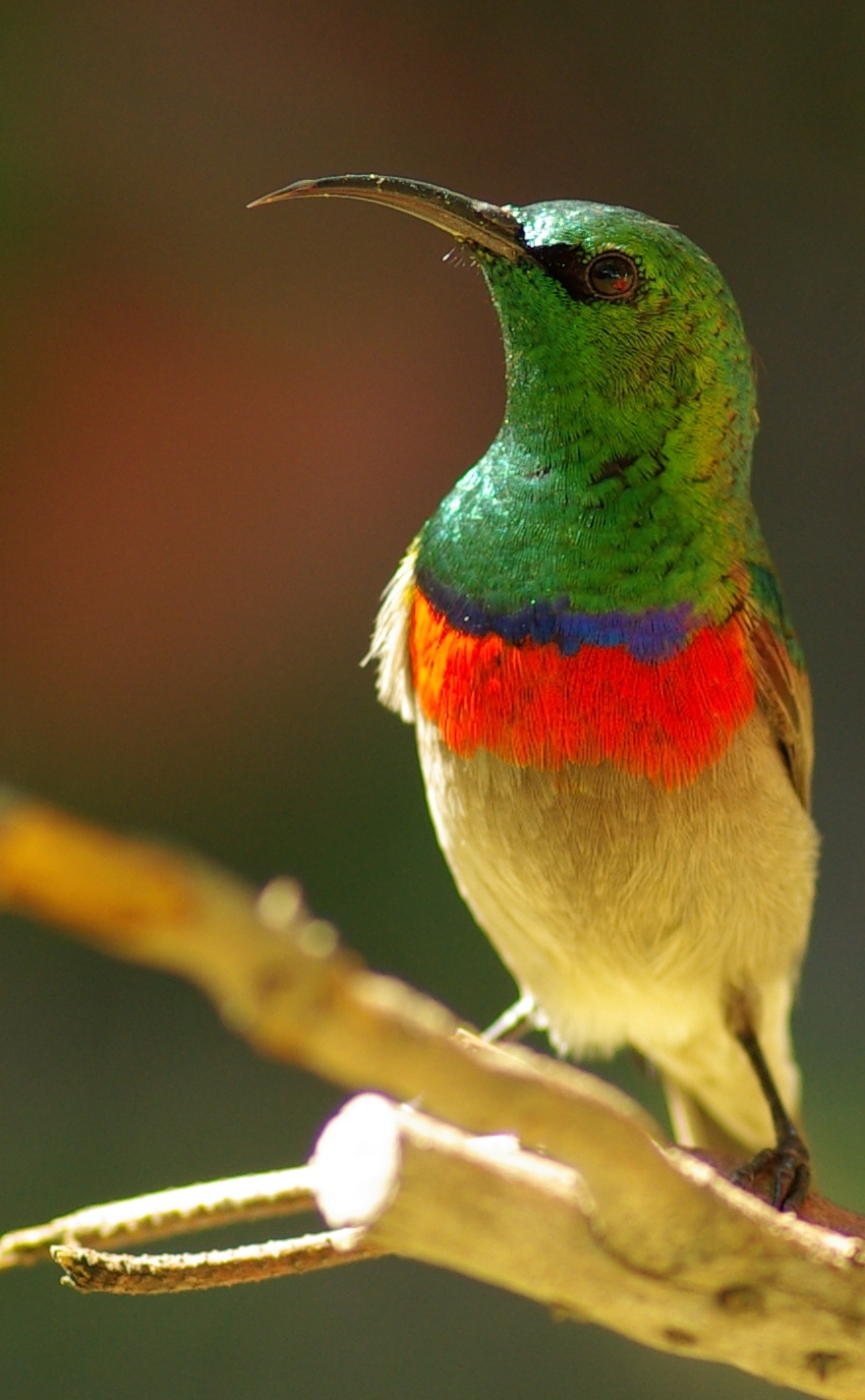 Southern Double-collared SunbirdCinnyris chalybeus
-
 Variable SunbirdCinnyris venustus
-
 Purple-banded SunbirdCinnyris bifasciatus
-
 Souimanga SunbirdCinnyris sovimanga
-
 White-bellied SunbirdCinnyris talatala
Compare
Questions and answers
What is the scientific name of the Seychelles Sunbird?
The scientific name of the Seychelles Sunbird is Cinnyris dussumieri. Written with its author, the full name is Cinnyris dussumieri (Hartlaub, 1861).
Which family does the Seychelles Sunbird belong to?
Cinnyris dussumieri belongs to the family Nectariniidae, in the order Passeriformes and the class Aves.
Where is the Seychelles Sunbird found?
Checklists and occurrence records place Cinnyris dussumieri in 1 country: Seychelles.
What is the conservation status of the Seychelles Sunbird?
The IUCN Red List category recorded for Cinnyris dussumieri is Least Concern (LC).
What other names does the Seychelles Sunbird have?
Cinnyris dussumieri is also known in English as SESU.
Which bird species are endemic to the Seychelles?
The Seychelles Sunbird is endemic to the Seychelles.[24]
Sources
Passages the profile rests on
- The species has predominantly dull grey plumage. Source passage: “The plumage is dull grey.” — English Wikipedia
- Adult males have an iridescent violet-green sheen on their heads and throats. Source passage: “The male exhibits an iridescent violet-green sheen on its head and throat” — English Wikipedia
- Adult males have yellow or orange tufts beneath their wings that are more visible during flight. Source passage: “yellow or orange tufts under its wings, which are more noticeable in flight.” — English Wikipedia
- The species has a long, slender, downward-curving bill. Source passage: “The long slender bill is downcurved.” — English Wikipedia
- Females have pale grey underparts and lack the yellow pectoral tufts found in males. Source passage: “The female is an altogether duller-looking bird with pale grey underparts, and lacks the yellow pectoral tufts.” — English Wikipedia
- The species reaches a body length of approximately 11–12 centimetres. Source passage: “It can reach a length from eleven to twelve centimetres.” — English Wikipedia
- The species inhabits forests in the Seychelles. Source passage: “Its habitat consists of forests, gardens, scrubs, and mangroves” — English Wikipedia
- The species occurs in gardens. Source passage: “Its habitat consists of forests, gardens, scrubs, and mangroves” — English Wikipedia
- The species inhabits scrub vegetation. Source passage: “Its habitat consists of forests, gardens, scrubs, and mangroves” — English Wikipedia
- The species inhabits mangroves. Source passage: “Its habitat consists of forests, gardens, scrubs, and mangroves” — English Wikipedia
- The species occurs from sea level to elevations of 900 metres. Source passage: “from sea level to altitudes of 900 m (2,953 ft).” — English Wikipedia
- The species feeds on nectar from hibiscus and other flowers. Source passage: “flying to hibiscus and other flowers with undulating flight and feeding of nectar and insects.” — English Wikipedia
- The species consumes insects. Source passage: “feeding of nectar and insects.” — English Wikipedia
- The species is highly active when foraging for food. Source passage: “When foraging for food, this sunbird is very active” — English Wikipedia
- The species flies to flowers using an undulating flight pattern while foraging. Source passage: “flying to hibiscus and other flowers with undulating flight” — English Wikipedia
- Male Seychelles sunbirds produce high-pitched, noisy and harsh songs interspersed with rasping calls. Source passage: “The song of the males is high pitched, noisy and harsh, interspersed with various rasping calls.” — English Wikipedia
- Female Seychelles sunbirds also sing. Source passage: “The female also sings.” — English Wikipedia
- The species breeds throughout the year, with September and October being the most favourable breeding months. Source passage: “Breeding is the entire year but the best time is September and October.” — English Wikipedia
- The species lays a single egg per clutch. Source passage: “One single egg is laid in a pear-shaped nest.” — English Wikipedia
- The species builds pear-shaped nests. Source passage: “One single egg is laid in a pear-shaped nest.” — English Wikipedia
- The nest is constructed from grass and moss and held together with spiderwebs. Source passage: “It consists of grass and moss and is bound with spiderwebs.” — English Wikipedia
- The species usually suspends its nest at the end of a twig to protect it from cats and rats. Source passage: “To protect the nest from cats and rats it hangs usually at the end of a twig.” — English Wikipedia
- The species occurs on most of the larger granitic islands of the Seychelles Bank. Source passage: “The Seychelles sunbird occurs on most of the larger granitic islands of the Seychelles Bank.” — English Wikipedia
- The species is endemic to the Seychelles. Source passage: “It belongs to the endemic landbird species of the Seychelles” — English Wikipedia
- The species is native to the Seychelles. Source passage: “It is native to the Seychelles” — English Wikipedia
- The species has a limited geographical range. Source passage: “Although this bird has a limited range” — English Wikipedia
- The species is described as common and has a stable population. Source passage: “it is described as common and has a stable population” — English Wikipedia
- The species was assessed as being of Least Concern by the International Union for Conservation of Nature in the source document. Source passage: “the International Union for Conservation of Nature has rated its conservation status as being of "least concern".” — English Wikipedia
- The species was most recently assessed for the IUCN Red List in 2024. Source passage: “has most recently been assessed for The IUCN Red List of Threatened Species in 2024.” — iucnredlist.org
Data
- Catalogue of Life, 2026-10-16 XR cc by
- Global Biodiversity Information Facility CC BY 4.0
- Wikidata CC0
- GeoNames CC BY 4.0
- Wikimedia Commons per image; credit shown with each image
- Within the Catalogue of Life, this name comes from The Integrated Taxonomic Information System cc0
This species in other databases
Page built on 29 November 2026. See how the catalog is made and all sources and licences.
Cite this page
ScientificNames.org. (2026). Cinnyris dussumieri (Seychelles Sunbird). Retrieved November 29, 2026, from https://scientificnames.org/species/cinnyris-dussumieri
“Cinnyris dussumieri (Seychelles Sunbird).” ScientificNames.org, 2026, scientificnames.org/species/cinnyris-dussumieri. Accessed 29 Nov. 2026.
ScientificNames.org. “Cinnyris dussumieri (Seychelles Sunbird).” Accessed November 29, 2026. https://scientificnames.org/species/cinnyris-dussumieri.
@misc{scientificnames_cinnyris_dussumieri_seychelles_sunbird,
  author = {{ScientificNames.org}},
  title = {Cinnyris dussumieri (Seychelles Sunbird)},
  year = {2026},
  url = {https://scientificnames.org/species/cinnyris-dussumieri},
  note = {Accessed 2026-11-29}
}