Species · Birds
Ludwig's Double-collared Sunbird Cinnyris ludovicensis
The scientific name of the Ludwig's Double-collared Sunbird is Cinnyris ludovicensis. It is a species of bird in the family Nectariniidae (sunbird), order Passeriformes. The name dates from 1868.
- Scientific name
- Cinnyris ludovicensis (Bocage, 1868)
- Common name
- Ludwig's Double-collared Sunbird
- Genus
- Cinnyris
- Family
- Nectariniidae (Sunbird)
- Order
- Passeriformes
- Class
- Aves
- Red List category
- LC Least Concern
- Recorded in
- 5 countries
- Name status
- accepted in the Catalogue of Life

Overview
Ludwig's Double-collared Sunbird is a medium-sized bird. It breeds on the Nyika Plateau in northern Malawi and in northeastern Zambia, in forested mountains above 1,800 metres. The adult male has glossy metallic green plumage with a golden sheen, a scarlet lower breast, and yellow shoulder tufts visible during displays.
Written 27 November 2026 from the sources listed below. Each statement was checked against the passage it cites; statements that could not be supported were removed.
Appearance
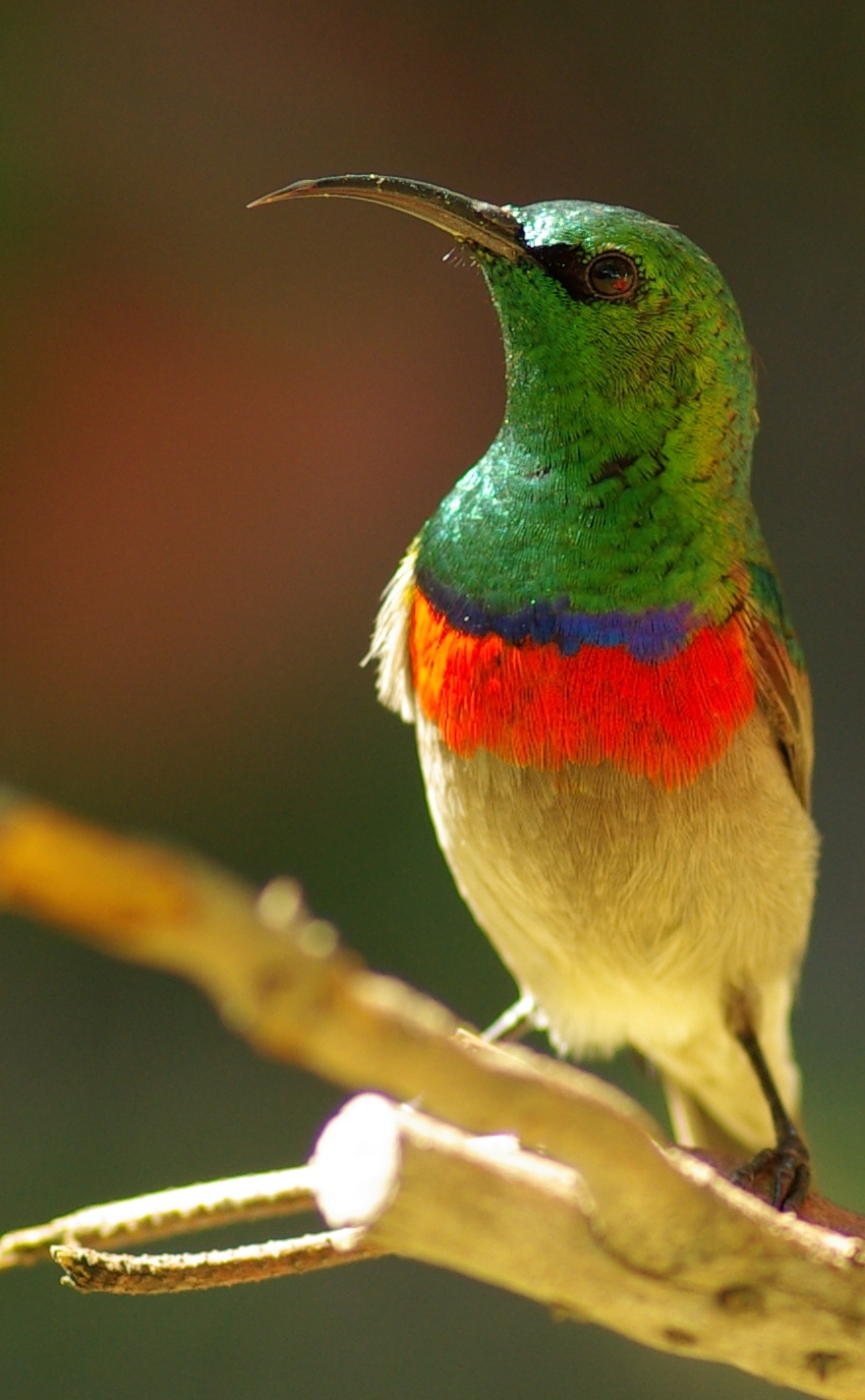
The adult male has a glossy metallic green head, throat, upper breast, and back with a golden sheen. Its upper-tail coverts are metallic blue, and its black tail has a blue gloss.[1][2]
The male has a scarlet lower breast and dark olive remaining underparts. Yellow feather tufts become visible on its shoulders during displays.[3][4]
The species has a long, decurved bill, dark brown eyes, and black beak, legs, and feet.[5][6]
The adult female has dark greyish-brown upperparts and a blackish-brown tail. Its chin and supercilium are greyish-buff, and its underparts are brownish-grey, with a paler or slightly yellowish central lower breast and belly.[7][8][9]
Habitat
The species breeds in forested mountains at elevations above 1,800 metres. Its breeding distribution includes the Nyika Plateau in northern Malawi and northeastern Zambia.[10][11][12]
It occurs along forest edges and in clearings. Its habitats also include montane grassland, plantations, secondary growth, scrubland, and grassland.[13][14]
Diet
The species feeds mainly on flower nectar and also consumes some fruit. It eats insects and spiders, especially when feeding young.[15][16][17]
Behaviour
The species has a fast, direct flight on short wings. It is usually observed alone or in pairs, and males chase away other individuals of their species.[18][19][20]
The species can obtain nectar while hovering like a hummingbird. It usually perches while feeding rather than hovering.[21][22]
Similar species
The species is sometimes considered conspecific with the greater double-collared sunbird (Cinnyris afer).[23]
Classification of the Ludwig's Double-collared Sunbird
| Kingdom | Animalia |
|---|---|
| Phylum | Chordata |
| Subphylum | Vertebrata |
| Infraphylum | Gnathostomata |
| Parvphylum | Osteichthyes |
| Megaclass | Tetrapoda |
| Class | Aves (Bird) |
| Order | Passeriformes (Passerine) |
| Family | Nectariniidae (Sunbird) |
| Genus | Cinnyris (Typical Sunbirds) |
| Species | Cinnyris ludovicensis (Bocage, 1868) |
Where the Ludwig's Double-collared Sunbird is found
Checklists and occurrence records place Cinnyris ludovicensis in 5 countries across Africa. GBIF holds 564 georeferenced records of it.
Countries
Regions and cities with the most records
- Lubango, Angola 109
- Huambo, Angola 95
- Namibe, Angola 89
- Kwanza Sul, Angola 74
- Huíla, Angola 43
- Conda, Angola 32
- Dodoma, Tanzania 31
- Muchinga, Zambia 31
- Capunda, Angola 17
- Malanje, Angola 9
- Zomba, Malawi 8
- Cuanza Norte, Angola 5
- N'dalatando, Angola 5
- Cela, Angola 4
- Iringa, Tanzania 4
- Quissecula, Angola 4
- Uíge, Angola 4
- Mulanje, Malawi 3
A number beside a place is its count of GBIF occurrence records. A place without a number comes from a checklist alone. Records show where a species has been observed or collected, which can include escapes and vagrants.
Common names
English
- Ludwig's Double-collared Sunbird
- MDCS
- Montane Double-collared Sunbird
Names in 25 other languages
- Catalan
- suimanga de Ludwig
- Chinese
- 山林双领花蜜鸟, 蒙田雙領花蜜鳥
- Croatian
- crvenoprsi medosas
- Czech
- strdimil rudoprsý
- Danish
- Højlandssolfugl
- Dutch
- Berghoningzuiger
- Esperanto
- monta nektarinio
- Finnish
- angolanvuorimedestäjä
- French
- Souimanga d'Angola, Souimanga d’Angola
- German
- Bergnektarvogel, Hochlandnektarvogel
- Hungarian
- hegyi kékszalagos-nektármadár
- Italian
- Nettarinia duecollari montana
- Japanese
- アンゴラゴシキタイヨウチョウ
- Lithuanian
- kalninė spalvingoji nektarina
- Norwegian
- bergsolfugl
- Polish
- nektarnik wyżynny
- Portuguese
- beija-flor-das-montanhas, nectarínia-das-montanhas
- Russian
- Ангольская нектарница
- Slovak
- nektárovka angolská
- Spanish
- Suimanga angoleño
- Swedish
- angolasolfågel
- Turkish
- Dağlı Çift Kuşaklı Nektarkuşu
- Ukrainian
- маріка двосмуга
- Welsh
- Aderyn haul deudorchog y mynydd
- pnb
- لڈوگ دوہرے کالروالا رس پنچھی
Synonyms
7 other scientific names have been used for this species and are now treated as synonyms of Cinnyris ludovicensis.
- Cinnyris ludovicensis eriksonni Trimen, R, 1882
- Nectarinea ludovicensis Bocage, JVB, 1868
- Nectarinia afra afra Linnaeus, C, 1766
- Nectarinia afra ludovicensis Bocage, JVB, 1868
- Nectarinia ludovicensis Bocage, 1868
- Nectarinia ludovicensis ludovicensis Bocage, JVB, 1868
- Nectarinia preussi ludovicensis Bocage, JVB, 1868
Subspecies and varieties
- Cinnyris ludovicensis ludovicensis subspecies
- Cinnyris ludovicensis skye subspecies
- Cinnyris ludovicensis whytei (Whyte's Double-collared Sunbird) subspecies
Related species
-
 Palestine SunbirdCinnyris osea
-
 Purple SunbirdCinnyris asiaticus
-
 Garden SunbirdCinnyris jugularis
-
 Southern Double-collared SunbirdCinnyris chalybeus
-
 Variable SunbirdCinnyris venustus
-
 Purple-banded SunbirdCinnyris bifasciatus
-
 Souimanga SunbirdCinnyris sovimanga
-
 White-bellied SunbirdCinnyris talatala
Compare
Questions and answers
What is the scientific name of the Ludwig's Double-collared Sunbird?
The scientific name of the Ludwig's Double-collared Sunbird is Cinnyris ludovicensis. Written with its author, the full name is Cinnyris ludovicensis (Bocage, 1868).
Which family does the Ludwig's Double-collared Sunbird belong to?
Cinnyris ludovicensis belongs to the family Nectariniidae, in the order Passeriformes and the class Aves.
Where is the Ludwig's Double-collared Sunbird found?
Checklists and occurrence records place Cinnyris ludovicensis in 5 countries: Angola, Malawi, Tanzania, Zambia and Democratic Republic of the Congo.
What is the conservation status of the Ludwig's Double-collared Sunbird?
The IUCN Red List category recorded for Cinnyris ludovicensis is Least Concern (LC).
What other names does the Ludwig's Double-collared Sunbird have?
Cinnyris ludovicensis is also known in English as MDCS and Montane Double-collared Sunbird.
Sources
Passages the profile rests on
- The adult male has a glossy metallic green head, throat, upper breast, and back with a golden sheen. Source passage: “The adult male has a glossy, metallic green head, throat upper breast and back with a golden sheen.” — English Wikipedia
- The adult male has metallic blue upper-tail coverts and a black tail with a blue gloss. Source passage: “The upper-tail coverts are metallic blue and the tail black glossed with blue.” — English Wikipedia
- The adult male has a scarlet lower breast and dark olive remaining underparts. Source passage: “the lower breast scarlet and the rest of the underparts are dark olive.” — English Wikipedia
- Yellow feather tufts become visible on the male's shoulders during displays. Source passage: “When displaying, yellow feather tufts are visible on the shoulders.” — English Wikipedia
- The species has a long, decurved bill. Source passage: “As with other sunbirds the bill is long and decurved.” — English Wikipedia
- The bird has dark brown eyes and black beak, legs, and feet. Source passage: “The eye is dark brown while the beak, legs and feet are black.” — English Wikipedia
- The adult female has dark greyish-brown upperparts and a blackish-brown tail. Source passage: “The adult female has dark greyish-brown upper parts and a blackish-brown tail.” — English Wikipedia
- The female has greyish-buff chin and supercilium and brownish-grey underparts. Source passage: “The chin and supercilium are greyish-buff and the underparts brownish-grey” — English Wikipedia
- The female's central lower breast and belly are paler or slightly yellowish. Source passage: “with the central part of the lower breast and belly being paler or slightly yellowish.” — English Wikipedia
- The species breeds in forested mountains at elevations above 1,800 metres. Source passage: “breeds in forested mountains above 1,800 m (5,900 ft)” — English Wikipedia
- The species breeds on the Nyika Plateau in northern Malawi. Source passage: “as well as the Nyika Plateau of northern Malawi” — English Wikipedia
- The species breeds in northeastern Zambia. Source passage: “and northeastern Zambia.” — English Wikipedia
- The species occurs along forest edges and in clearings. Source passage: “It is a bird of forest edges, clearings, montane grassland” — English Wikipedia
- Its habitats include montane grassland, plantations, secondary growth, scrubland, and grassland. Source passage: “montane grassland, plantations, secondary growth, scrubland and grassland.” — English Wikipedia
- The species feeds mainly on flower nectar. Source passage: “It feeds mainly on nectar from flowers” — English Wikipedia
- The species also consumes some fruit. Source passage: “but takes some fruit” — English Wikipedia
- The species consumes insects and spiders, especially when feeding young. Source passage: “especially when feeding young, insects and spiders.” — English Wikipedia
- The species has a fast, direct flight on short wings. Source passage: “This bird's flight is fast and direct on short wings.” — English Wikipedia
- The species is usually observed alone or in pairs. Source passage: “It is usually seen singly or in pairs” — English Wikipedia
- Males chase away other individuals of their species. Source passage: “with the male chasing away conspecifics.” — English Wikipedia
- The species can obtain nectar while hovering like a hummingbird. Source passage: “It can take nectar by hovering like a hummingbird” — English Wikipedia
- The species usually perches while feeding rather than hovering. Source passage: “but usually perches to feed.” — English Wikipedia
- The species is sometimes considered conspecific with the greater double-collared sunbird (Cinnyris afer). Source passage: “This bird is sometimes considered to be con-specific with the greater double-collared sunbird (Cinnyris afer).” — English Wikipedia
Data
- Catalogue of Life, 2026-10-16 XR cc by
- Global Biodiversity Information Facility CC BY 4.0
- Wikidata CC0
- GeoNames CC BY 4.0
- Wikimedia Commons per image; credit shown with each image
- Within the Catalogue of Life, this name comes from The Integrated Taxonomic Information System cc0
This species in other databases
Page built on 29 November 2026. See how the catalog is made and all sources and licences.
Cite this page
ScientificNames.org. (2026). Cinnyris ludovicensis (Ludwig's Double-collared Sunbird). Retrieved November 29, 2026, from https://scientificnames.org/species/cinnyris-ludovicensis
“Cinnyris ludovicensis (Ludwig's Double-collared Sunbird).” ScientificNames.org, 2026, scientificnames.org/species/cinnyris-ludovicensis. Accessed 29 Nov. 2026.
ScientificNames.org. “Cinnyris ludovicensis (Ludwig's Double-collared Sunbird).” Accessed November 29, 2026. https://scientificnames.org/species/cinnyris-ludovicensis.
@misc{scientificnames_cinnyris_ludovicensis_ludwigs_double_collared_sunbird,
  author = {{ScientificNames.org}},
  title = {Cinnyris ludovicensis (Ludwig's Double-collared Sunbird)},
  year = {2026},
  url = {https://scientificnames.org/species/cinnyris-ludovicensis},
  note = {Accessed 2026-11-29}
}