Species · Birds
Tiny Sunbird Cinnyris minullus
The scientific name of the Tiny Sunbird is Cinnyris minullus. It is a species of bird in the family Nectariniidae (sunbird), order Passeriformes. The name dates from 1899.
- Scientific name
- Cinnyris minullus Reichenow, 1899
- Common name
- Tiny Sunbird
- Genus
- Cinnyris
- Family
- Nectariniidae (Sunbird)
- Order
- Passeriformes
- Class
- Aves
- Red List category
- LC Least Concern
- Recorded in
- 14 countries
- Name status
- accepted in the Catalogue of Life

Overview
Cinnyris minullus inhabits primary and secondary forests, forest edges, clearings, scattered trees in savanna country and areas around villages. It is the smallest species in its genus.
Written 26 November 2026 from the sources listed below. Each statement was checked against the passage it cites; statements that could not be supported were removed.
Appearance
Adult males have metallic green heads, backs and throats, metallic blue rumps, and black tails with a purplish-blue sheen. They have narrow blue breast bands above wider scarlet breast bands, lemon-yellow pectoral tufts and dark olive bellies.[1][2][3]
Adult females have olive-brown heads and upperparts, dark brown wings and tails, and grey throats. Their supercilia are olive-yellow, and their underparts are olive with yellow coloration.[4][5]
Both sexes have dark brown eyes and black beaks and legs. Juveniles resemble adult females.[6][7]
Habitat
The Tiny Sunbird inhabits primary and secondary forests and also occurs along forest edges and in clearings.[8][9]
It also occurs among scattered trees in savanna country and around villages.[10]
Diet
The Tiny Sunbird feeds on nectar, insects and spiders.[11]
Behaviour
The Tiny Sunbird forages in the forest canopy, either alone or in pairs. It sometimes joins small mixed-species flocks.[12][13]
Conservation
The Tiny Sunbird is classified as Least Concern by the International Union for Conservation of Nature. Its population trend is considered steady, and no specific threats have been identified.[14][15][16]
The species was most recently assessed for the IUCN Red List in 2018. The IUCN Red List lists it as Least Concern.[17][18]
Similar species
The Tiny Sunbird is extremely similar to the Olive-bellied Sunbird and the Northern Double-collared Sunbird. It co-occurs with both species.[19][20][21]
Classification of the Tiny Sunbird
| Kingdom | Animalia |
|---|---|
| Phylum | Chordata |
| Subphylum | Vertebrata |
| Infraphylum | Gnathostomata |
| Parvphylum | Osteichthyes |
| Megaclass | Tetrapoda |
| Class | Aves (Bird) |
| Order | Passeriformes (Passerine) |
| Family | Nectariniidae (Sunbird) |
| Genus | Cinnyris (Typical Sunbirds) |
| Species | Cinnyris minullus Reichenow, 1899 |
Where the Tiny Sunbird is found
Checklists and occurrence records place Cinnyris minullus in 14 countries. GBIF holds 2,716 georeferenced records of it.
Countries
- Angola 7
- Cameroon 165
- Central African Republic 52
- Democratic Republic of the Congo 248
- Equatorial Guinea 111
- Gabon 150
- Ghana 1,202
- Guinea 52
- Ivory Coast 161
- Liberia 51
- Nigeria 79
- Republic of the Congo 47
- Togo 3
- Uganda 388
Regions and cities with the most records
- Central, Ghana 523
- Western, Ghana 285
- Ashanti, Ghana 233
- Elubo, Ghana 197
- Mai-Ndombe, Democratic Republic of the Congo 181
- Kanungu, Uganda 165
- Ntungamo, Uganda 155
- Effiduase, Ghana 137
- Konongo, Ghana 133
- Eastern, Ghana 125
- Anyinam, Ghana 113
- Rubanda, Uganda 59
- Lagunes District, Ivory Coast 57
- South-West, Cameroon 56
- Nzérékoré Region, Guinea 52
- Sangha-Mbaéré, Central African Republic 49
- Fort Portal, Uganda 48
- Hiré, Ivory Coast 48
- Ogooué-Ivindo, Gabon 44
- Rwiimi, Uganda 43
- Bioko Sur, Equatorial Guinea 40
- Estuaire, Gabon 39
- Buhesi, Uganda 36
- Malabo, Equatorial Guinea 36
- Manjo, Cameroon 36
- Bioko Norte, Equatorial Guinea 35
- Goh-Djiboua, Ivory Coast 33
- Bundibugyo, Uganda 32
- Loum, Cameroon 29
- Tombel, Cameroon 29
- Ciudad de la Paz, Equatorial Guinea 27
- Wele-Nzas, Equatorial Guinea 27
- Abidjan, Ivory Coast 26
- Abobo, Ivory Coast 26
- Cuvette-Ouest, Republic of the Congo 26
- Koumassi, Ivory Coast 26
A number beside a place is its count of GBIF occurrence records. A place without a number comes from a checklist alone. Records show where a species has been observed or collected, which can include escapes and vagrants.
Common names
English
- Tiny Sunbird
- TISU
Names in 22 other languages
- Catalan
- suimanga nan
- Chinese
- 姬花蜜鸟, 極小花蜜鳥
- Croatian
- kratkokljuni medosas
- Czech
- strdimil malinký
- Danish
- Pygmæsolfugl
- Dutch
- Kabouterhoningzuiger
- Esperanto
- nana nektarinio
- Finnish
- guineanpikkumedestäjä
- French
- Souimanga minule, Souimanga minulle
- German
- Zwergnektarvogel
- Italian
- Nettarinia minuscola
- Japanese
- コゴシキタイヨウチョウ
- Lithuanian
- nykštukinė spalvingoji nektarina
- Norwegian
- dvergsolfugl
- Polish
- nektarnik drobny
- Portuguese
- beija-flor-anão, nectarínia-anã
- Russian
- Крошечная нектарница, Нектарница-крошка
- Slovak
- nektárovka trpasličia
- Spanish
- Suimanga enano
- Swedish
- pygmésolfågel
- Turkish
- Ufak Nektarkuşu
- Ukrainian
- маріка-крихітка
Synonyms
6 other scientific names have been used for this species and are now treated as synonyms of Cinnyris minullus.
- Cinnyris chloropygius pauwelsi Dubois, AJC, 1911
- Cinnyris marginatus Ogilvie-Grant, WR, 1907
- Nectarinia minulla (Reichenow, 1899)
- Nectarinia minulla marginatus Ogilvie-Grant, WR, 1907
- Nectarinia minulla minulla Reichenow, A, 1899
- Nectarinia minulla pauwelsi Dubois, AJC, 1911
Subspecies and varieties
- Cinnyris minullus amadoni subspecies
- Cinnyris minullus minullus subspecies
Related species
-
 Palestine SunbirdCinnyris osea
-
 Purple SunbirdCinnyris asiaticus
-
 Garden SunbirdCinnyris jugularis
-
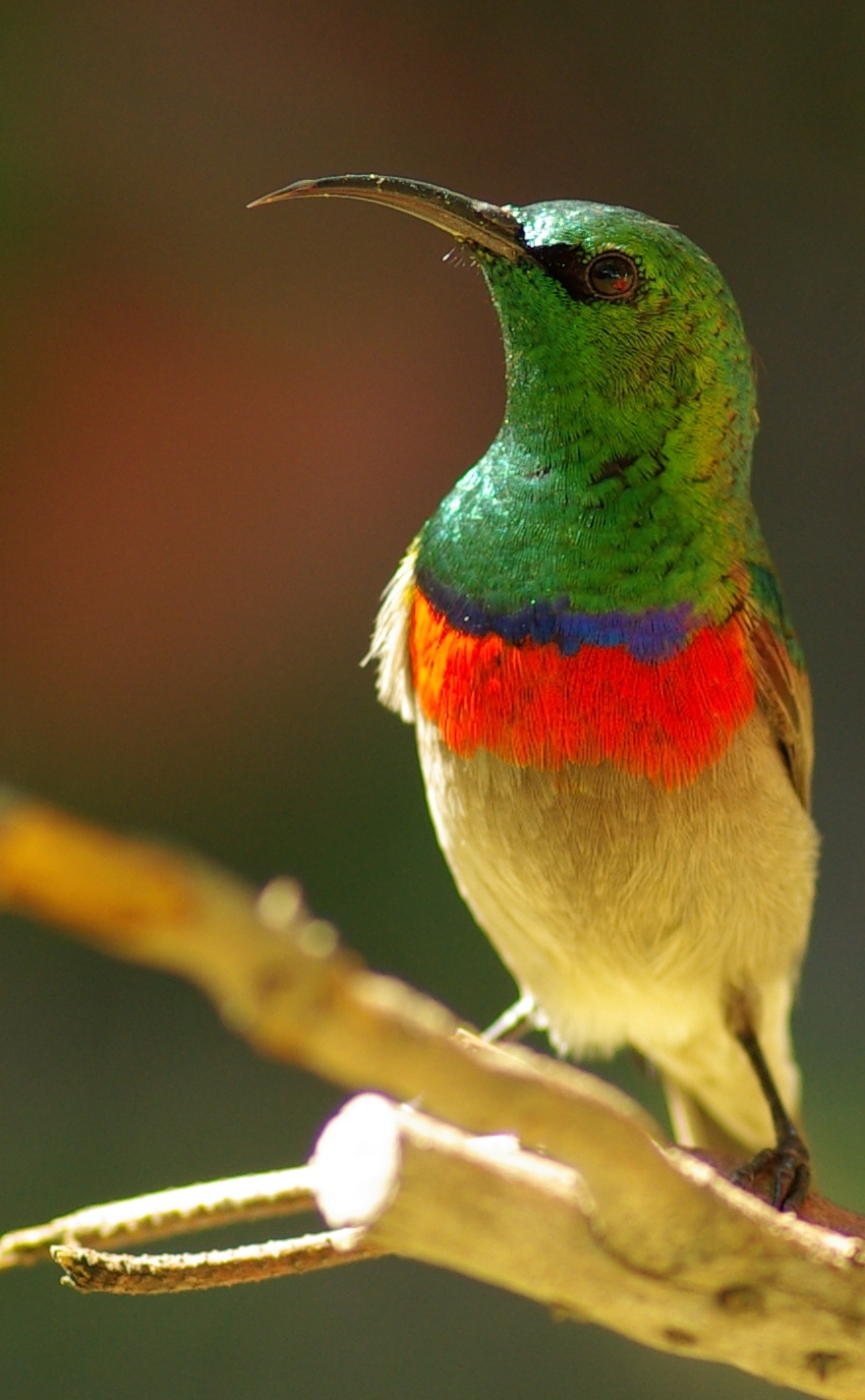 Southern Double-collared SunbirdCinnyris chalybeus
-
 Variable SunbirdCinnyris venustus
-
 Purple-banded SunbirdCinnyris bifasciatus
-
 Souimanga SunbirdCinnyris sovimanga
-
 White-bellied SunbirdCinnyris talatala
Compare
Questions and answers
What is the scientific name of the Tiny Sunbird?
The scientific name of the Tiny Sunbird is Cinnyris minullus. Written with its author, the full name is Cinnyris minullus Reichenow, 1899.
Which family does the Tiny Sunbird belong to?
Cinnyris minullus belongs to the family Nectariniidae, in the order Passeriformes and the class Aves.
Where is the Tiny Sunbird found?
Checklists and occurrence records place Cinnyris minullus in 14 countries, including Ghana, Uganda, Democratic Republic of the Congo, Cameroon, Ivory Coast and Gabon.
What is the conservation status of the Tiny Sunbird?
The IUCN Red List category recorded for Cinnyris minullus is Least Concern (LC).
What other names does the Tiny Sunbird have?
Cinnyris minullus is also known in English as TISU.
What do sunbirds eat?
The Tiny Sunbird feeds on nectar, insects and spiders.[11]
Sources
Passages the profile rests on
- Adult males have metallic green heads, backs and throats, with metallic blue rumps and black tails displaying a purplish-blue sheen. Source passage: “The adult male has a metallic green head, back and throat, dark brown wings, a metallic blue rump and a black tail with a purplish-blue sheen.” — English Wikipedia
- Adult males have narrow blue breast bands above wider scarlet breast bands. Source passage: “It has a narrow blue breast band above a wider scarlet breast band” — English Wikipedia
- Adult males have lemon-yellow pectoral tufts and dark olive bellies. Source passage: “lemon-yellow pectoral tufts and a dark olive belly.” — English Wikipedia
- Adult females have olive-brown heads and upperparts, dark brown wings and tails, and grey throats. Source passage: “The adult female has an olive-brown head and upper parts, dark brown wings and dark brown tail.” — English Wikipedia
- Adult females have olive-yellow supercilia and underparts that are olive with yellow coloration. Source passage: “There is an olive-yellow supercilium over the eye, the throat is grey and the underparts are olive washed with yellow.” — English Wikipedia
- Both sexes have dark brown eyes and black beaks and legs. Source passage: “The eyes in both sexes are dark brown and the beak and legs are black.” — English Wikipedia
- Juveniles resemble adult females. Source passage: “The juvenile resembles the female.” — English Wikipedia
- The species inhabits primary and secondary forests. Source passage: “The tiny sunbird is found in primary and secondary forests” — English Wikipedia
- The species also occurs along forest edges and in clearings. Source passage: “forest edges, clearings” — English Wikipedia
- The species occurs among scattered trees in savanna country and around villages. Source passage: “among scattered trees in savanna country and around villages.” — English Wikipedia
- The Tiny Sunbird feeds on nectar, insects and spiders. Source passage: “It feeds on nectar, insects and spiders.” — English Wikipedia
- The species forages in the forest canopy either alone or in pairs. Source passage: “It forages in the canopy singly or in pairs” — English Wikipedia
- The species sometimes joins small mixed-species flocks. Source passage: “and sometimes joins small, mixed species flocks.” — English Wikipedia
- The population trend of the Tiny Sunbird is considered steady. Source passage: “the population trend is thought to be steady.” — English Wikipedia
- No specific threats to the species have been identified. Source passage: “No particular threats have been identified” — English Wikipedia
- The species is classified as Least Concern by the International Union for Conservation of Nature. Source passage: “the International Union for Conservation of Nature has assessed the bird's conservation status as being of "least concern".” — English Wikipedia
- The species was most recently assessed for the IUCN Red List in 2018. Source passage: “Tiny Sunbird Cinnyris minullus has most recently been assessed for The IUCN Red List of Threatened Species in 2018.” — iucnredlist.org
- The IUCN Red List lists the Tiny Sunbird as Least Concern. Source passage: “Cinnyris minullus is listed as Least” — iucnredlist.org
- The Tiny Sunbird is extremely similar to the Olive-bellied Sunbird. Source passage: “Extremely similar to Olive-bellied Sunbird” — ebird.org
- The Tiny Sunbird is extremely similar to the Northern Double-collared Sunbird. Source passage: “and Northern Double-collared Sunbird” — ebird.org
- The Tiny Sunbird co-occurs with the Olive-bellied Sunbird and Northern Double-collared Sunbird. Source passage: “with which this species co-occurs.” — ebird.org
Data
- Catalogue of Life, 2026-10-16 XR cc by
- Global Biodiversity Information Facility CC BY 4.0
- Wikidata CC0
- GeoNames CC BY 4.0
- Wikimedia Commons per image; credit shown with each image
- Within the Catalogue of Life, this name comes from The Integrated Taxonomic Information System cc0
This species in other databases
Page built on 27 November 2026. See how the catalog is made and all sources and licences.
Cite this page
ScientificNames.org. (2026). Cinnyris minullus (Tiny Sunbird). Retrieved November 27, 2026, from https://scientificnames.org/species/cinnyris-minullus
“Cinnyris minullus (Tiny Sunbird).” ScientificNames.org, 2026, scientificnames.org/species/cinnyris-minullus. Accessed 27 Nov. 2026.
ScientificNames.org. “Cinnyris minullus (Tiny Sunbird).” Accessed November 27, 2026. https://scientificnames.org/species/cinnyris-minullus.
@misc{scientificnames_cinnyris_minullus_tiny_sunbird,
  author = {{ScientificNames.org}},
  title = {Cinnyris minullus (Tiny Sunbird)},
  year = {2026},
  url = {https://scientificnames.org/species/cinnyris-minullus},
  note = {Accessed 2026-11-27}
}