Species · Birds
Moreau's Sunbird Cinnyris moreaui
The scientific name of the Moreau's Sunbird is Cinnyris moreaui. It is a species of bird in the family Nectariniidae (sunbird), order Passeriformes. The name dates from 1933.
- Scientific name
- Cinnyris moreaui W. L. Sclater, 1933
- Common name
- Moreau's Sunbird
- Genus
- Cinnyris
- Family
- Nectariniidae (Sunbird)
- Order
- Passeriformes
- Class
- Aves
- Red List category
- LC Least Concern
- Recorded in
- 1 country
- Name status
- accepted in the Catalogue of Life
Overview
Moreau's Sunbird is a bird approximately 12 cm long. It inhabits montane forests in mountainous parts of Tanzania and is endemic to Kilolo District in Tanzania's Morogoro Region. Adult males have iridescent bronzey-green upperparts and a green throat separated from their red to orange breast by a narrow blue band.
Written 27 November 2026 from the sources listed below. Each statement was checked against the passage it cites; statements that could not be supported were removed.
Appearance
Adult males have iridescent bronzey-green upperparts, a green rump and a dark brown tail. Their green throat is separated from their red to orange breast by a narrow blue band, and they have a yellow belly and yellow sides of the breast.[1][2][3]
Adult males have dark brown or black eyes and black curved bills and legs.[4]
Adult females have olive-green upperparts with metallic greenish-grey fringes on their crown and mantle feathers. Their tails are dark brown with paler outer feathers, and their chins and throats are greyish-yellow, while their breasts and bellies are olive-yellow.[5][6][7]
Adult females have dark brown eyes and black bills and legs.[8]
Juvenile males resemble adult males but lack iridescence and have dusky greyish-olive upperparts. Their underparts are dusky yellowish-olive.[9][10]
Juvenile females resemble adult females but are duller and lack metallic fringes on their crown and mantle feathers. Their underparts are dull yellowish-green.[11][12]
Habitat
Its natural habitat includes subtropical or tropical moist montane forests. It inhabits montane forests in mountainous parts of Tanzania.[13][14]
It occurs in bushes alongside roads and in forest canopies. Its usual altitudinal range is approximately 1,350–1,800 metres.[15][16]
Moreau's Sunbird is endemic to Kilolo District in Tanzania's Morogoro Region. It occurs at elevations up to 2,500 metres in the Udzungwa Mountains, and its recorded range includes the Nguru, Nguu and Uvidunda areas.[17][18][19]
Diet
Moreau's Sunbird feeds on nectar. Its diet probably includes insects.[20][21]
Behaviour
Moreau's Sunbird sometimes participates in mixed flocks of small birds.[22]
Reproduction and life cycle
The female builds a small domed nest with an opening at the top.[23]
Conservation
Moreau's Sunbird is assessed as Near Threatened by the IUCN Red List. Its most recent assessment was in 2016.[24][25][26]
Habitat loss threatens Moreau's Sunbird.[27]
Classification of the Moreau's Sunbird
| Kingdom | Animalia |
|---|---|
| Phylum | Chordata |
| Subphylum | Vertebrata |
| Infraphylum | Gnathostomata |
| Parvphylum | Osteichthyes |
| Megaclass | Tetrapoda |
| Class | Aves (Bird) |
| Order | Passeriformes (Passerine) |
| Family | Nectariniidae (Sunbird) |
| Genus | Cinnyris (Typical Sunbirds) |
| Species | Cinnyris moreaui W. L. Sclater, 1933 |
Where the Moreau's Sunbird is found
Checklists and occurrence records place Cinnyris moreaui in 1 country. GBIF holds 445 georeferenced records of it.
Countries
Regions and cities with the most records
- Morogoro, Tanzania 178
- Iringa, Tanzania 119
- Dodoma, Tanzania 103
- Lubata, Tanzania 41
- Msowero, Tanzania 13
- Kibakwe, Tanzania 8
- Kidatu, Tanzania 8
- Mpwapwa, Tanzania 7
- Geiro, Tanzania 6
- Ruaha, Tanzania 4
- Kidodi, Tanzania 3
- Manyara, Tanzania 3
- Morogoro, Tanzania 3
A number beside a place is its count of GBIF occurrence records. A place without a number comes from a checklist alone. Records show where a species has been observed or collected, which can include escapes and vagrants.
Common names
English
- Moreau's Sunbird
- MOSU
Names in 24 other languages
- Chinese
- 摩氏花蜜鸟, 摩羅氏花蜜鳥
- Croatian
- tanzanski medosas
- Czech
- strdimil tanzanský
- Danish
- Ngurusolfugl
- Dutch
- Moreaus Honingzuiger
- Esperanto
- tanzania nektarinio
- Finnish
- keltakylkimedestäjä
- French
- Souimanga de Moreau
- German
- Moreaunektarvogel
- Hungarian
- Moreau-nektármadár
- Italian
- Nettarinia di Moreau
- Japanese
- タンザニアゴシキタイヨウチョウ
- Lithuanian
- Moro spalvingoji nektarina
- Norwegian
- udzungwasolfugl
- Polish
- nektarnik sawannowy
- Portuguese
- beija-flor-de-moreau, nectarínia-serrana-da-tanzânia
- Russian
- Банановая нектарница, Укагурская нектарница
- Slovak
- nektárovka tanzánijská
- Spanish
- Suimanga de Moreau
- Swedish
- moreausolfågel, ngurusolfågel
- Turkish
- Moreau Nektarkuşu
- Ukrainian
- маріка удзунавійська
- Welsh
- Aderyn haul Moreau
- pnb
- موریو رس پنچھی
Synonyms
4 other scientific names have been used for this species and are now treated as synonyms of Cinnyris moreaui.
- Cinnyris mediocris moreaui Sclater, WL, 1933
- Nectarinia loveridgei moreaui Sclater, WL, 1933
- Nectarinia mediocris moreaui Sclater, WL, 1933
- Nectarinia moreaui (W. L. Sclater, 1933)
Related species
-
 Palestine SunbirdCinnyris osea
-
 Purple SunbirdCinnyris asiaticus
-
 Garden SunbirdCinnyris jugularis
-
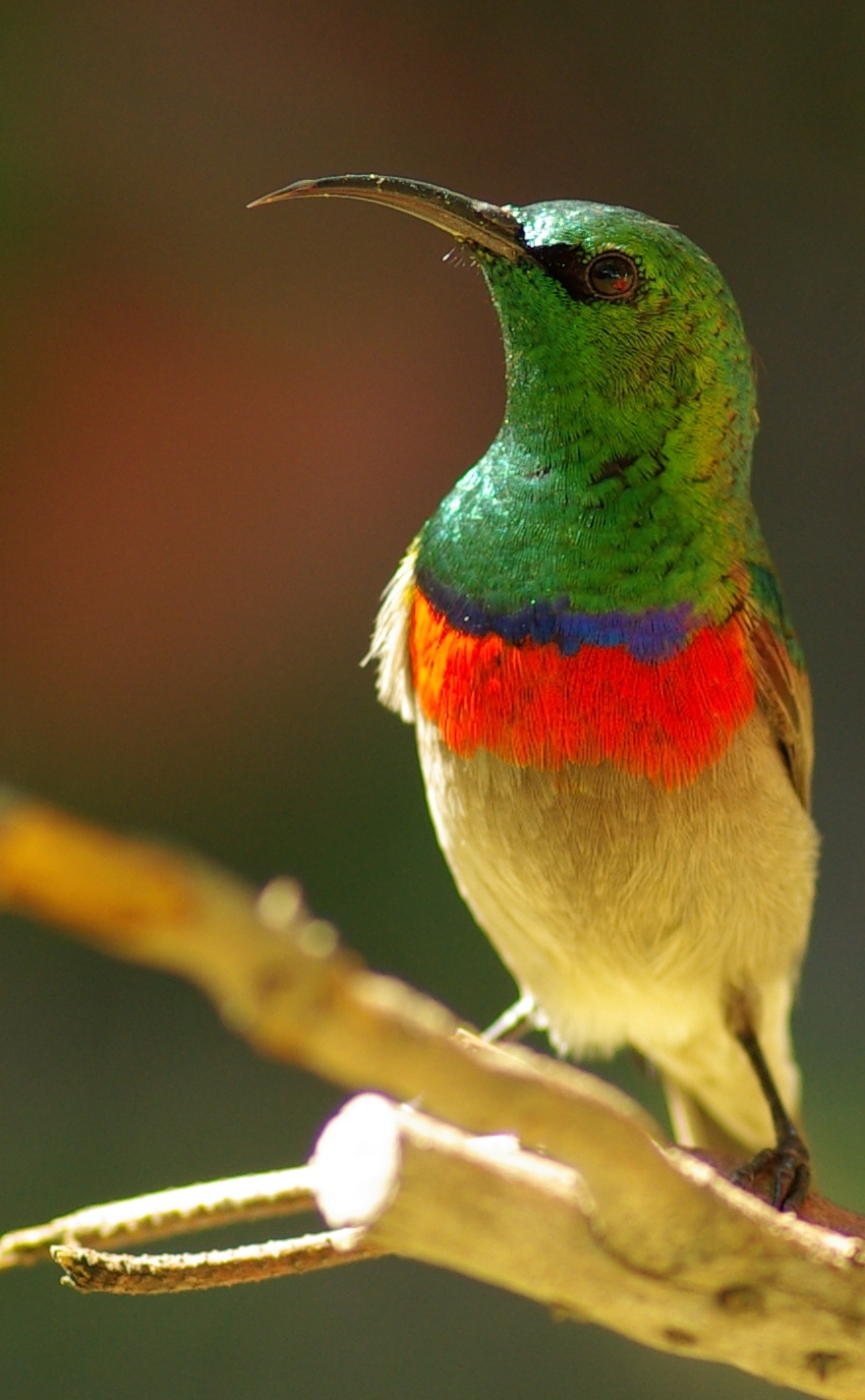 Southern Double-collared SunbirdCinnyris chalybeus
-
 Variable SunbirdCinnyris venustus
-
 Purple-banded SunbirdCinnyris bifasciatus
-
 Souimanga SunbirdCinnyris sovimanga
-
 White-bellied SunbirdCinnyris talatala
Compare
Questions and answers
What is the scientific name of the Moreau's Sunbird?
The scientific name of the Moreau's Sunbird is Cinnyris moreaui. Written with its author, the full name is Cinnyris moreaui W. L. Sclater, 1933.
Which family does the Moreau's Sunbird belong to?
Cinnyris moreaui belongs to the family Nectariniidae, in the order Passeriformes and the class Aves.
Where is the Moreau's Sunbird found?
Checklists and occurrence records place Cinnyris moreaui in 1 country: Tanzania.
What is the conservation status of the Moreau's Sunbird?
The IUCN Red List category recorded for Cinnyris moreaui is Least Concern (LC).
What other names does the Moreau's Sunbird have?
Cinnyris moreaui is also known in English as MOSU.
Sources
Passages the profile rests on
- Adult males have iridescent bronzey-green upperparts, a green rump, and a dark brown tail. Source passage: “The adult male has upper parts an iridescent bronzey-green, with a green rump and dark brown tail.” — English Wikipedia
- Adult males have a green throat separated from their red to orange breast by a narrow blue band. Source passage: “The green throat is separated from the red to orange breast by a narrow blue band.” — English Wikipedia
- Adult males have a yellow belly and yellow sides of the breast. Source passage: “The belly and sides of the breast are yellow.” — English Wikipedia
- Adult males have dark brown or black eyes and black curved bills and legs. Source passage: “The eye is dark brown or black and the curved beak and legs are black.” — English Wikipedia
- Adult females have olive-green upperparts with metallic greenish-grey fringes on their crown and mantle feathers. Source passage: “The adult female has upper parts olive green, with the feathers of crown and mantle fringed with metallic greenish-grey.” — English Wikipedia
- Adult females have dark brown tails with paler outer feathers. Source passage: “The tail is dark brown with paler outer feathers.” — English Wikipedia
- Adult females have greyish-yellow chins and throats and olive-yellow breasts and bellies. Source passage: “The chin and throat are greyish-yellow and the breast and belly olive-yellow.” — English Wikipedia
- Adult females have dark brown eyes and black bills and legs. Source passage: “The eye is dark brown and the beak and legs are black.” — English Wikipedia
- Juvenile males resemble adult males but lack iridescence and have dusky greyish-olive upperparts. Source passage: “The juvenile male is similar to the adult male but the upper parts lack the iridescence and are a dusky greyish-olive” — English Wikipedia
- Juvenile males have dusky yellowish-olive underparts. Source passage: “while the underparts are dusky yellowish-olive.” — English Wikipedia
- Juvenile females resemble adult females but are duller and lack metallic fringes on their crown and mantle feathers. Source passage: “The juvenile female resembles the adult female but is generally duller and lacks the metallic fringes to the feathers of crown and mantle.” — English Wikipedia
- Juvenile females have dull yellowish-green underparts. Source passage: “The underparts are a dull yellowish-green.” — English Wikipedia
- Its natural habitat includes subtropical or tropical moist montane forests. Source passage: “where its natural habitat is subtropical or tropical moist montane forests.” — English Wikipedia
- Moreau's sunbird inhabits montane forests in mountainous parts of Tanzania. Source passage: “Moreau's sunbird is endemic to the mountainous parts of Tanzania where its habitat is montane forest.” — English Wikipedia
- It occurs in bushes alongside roads and in forest canopies. Source passage: “Moreau's sunbird is generally found in bushes alongside roads and in the forest canopy.” — English Wikipedia
- Its usual altitudinal range is approximately 1,350–1,800 metres. Source passage: “Its altitudinal range is between 1,350 and 1,800 m (4,429 and 5,906 ft) in most parts of its range” — English Wikipedia
- Moreau's sunbird is endemic to Kilolo District in Tanzania's Morogoro Region. Source passage: “It is endemic to Kilolo District of Morogoro Region in Tanzania” — English Wikipedia
- It occurs at elevations up to 2,500 metres in the Udzungwa Mountains. Source passage: “but it occurs up to 2,500 m (8,202 ft) in the Udzungwa Mountains in the Eastern Arc Mountains.” — English Wikipedia
- Its recorded range includes the Nguru, Nguu and Uvidunda areas. Source passage: “This species is known from the Nguru, Nguu, Uvidunda ...” — datazone.birdlife.org
- Moreau's sunbird feeds on nectar. Source passage: “It feeds on nectar and probably insects.” — English Wikipedia
- Its diet probably includes insects. Source passage: “It feeds on nectar and probably insects.” — English Wikipedia
- Moreau's sunbird sometimes participates in mixed flocks of small birds. Source passage: “It is sometimes present as part of mixed flocks of small birds.” — English Wikipedia
- The female builds a small domed nest with an opening at the top. Source passage: “The nest is a small domed structure with a top opening, built by the female.” — English Wikipedia
- Moreau's sunbird is assessed as Near Threatened by the IUCN. Source passage: “the International Union for Conservation of Nature has assessed it as being "near-threatened".” — English Wikipedia
- The species was most recently assessed for the IUCN Red List in 2016. Source passage: “Moreau's Sunbird Cinnyris moreaui has most recently been assessed for The IUCN Red List of Threatened Species in 2016.” — iucnredlist.org
- The IUCN Red List classifies Moreau's sunbird as Near Threatened. Source passage: “Cinnyris moreaui is listed as Near ...” — iucnredlist.org
- Habitat loss threatens Moreau's sunbird. Source passage: “It is threatened by habitat loss” — English Wikipedia
Data
- Catalogue of Life, 2026-10-16 XR cc by
- Global Biodiversity Information Facility CC BY 4.0
- Wikidata CC0
- GeoNames CC BY 4.0
- Within the Catalogue of Life, this name comes from The Integrated Taxonomic Information System cc0
This species in other databases
Page built on 29 November 2026. See how the catalog is made and all sources and licences.
Cite this page
ScientificNames.org. (2026). Cinnyris moreaui (Moreau's Sunbird). Retrieved November 29, 2026, from https://scientificnames.org/species/cinnyris-moreaui
“Cinnyris moreaui (Moreau's Sunbird).” ScientificNames.org, 2026, scientificnames.org/species/cinnyris-moreaui. Accessed 29 Nov. 2026.
ScientificNames.org. “Cinnyris moreaui (Moreau's Sunbird).” Accessed November 29, 2026. https://scientificnames.org/species/cinnyris-moreaui.
@misc{scientificnames_cinnyris_moreaui_moreaus_sunbird,
  author = {{ScientificNames.org}},
  title = {Cinnyris moreaui (Moreau's Sunbird)},
  year = {2026},
  url = {https://scientificnames.org/species/cinnyris-moreaui},
  note = {Accessed 2026-11-29}
}