Species · Birds
Northern Double-collared Sunbird Cinnyris reichenowi
The scientific name of the Northern Double-collared Sunbird is Cinnyris reichenowi. It is a species of bird in the family Nectariniidae (sunbird), order Passeriformes. The name dates from 1891.
- Scientific name
- Cinnyris reichenowi Sharpe, 1891
- Common name
- Northern Double-collared Sunbird
- Genus
- Cinnyris
- Family
- Nectariniidae (Sunbird)
- Order
- Passeriformes
- Class
- Aves
- Red List category
- LC Least Concern
- Recorded in
- 12 countries
- Name status
- accepted in the Catalogue of Life

Overview
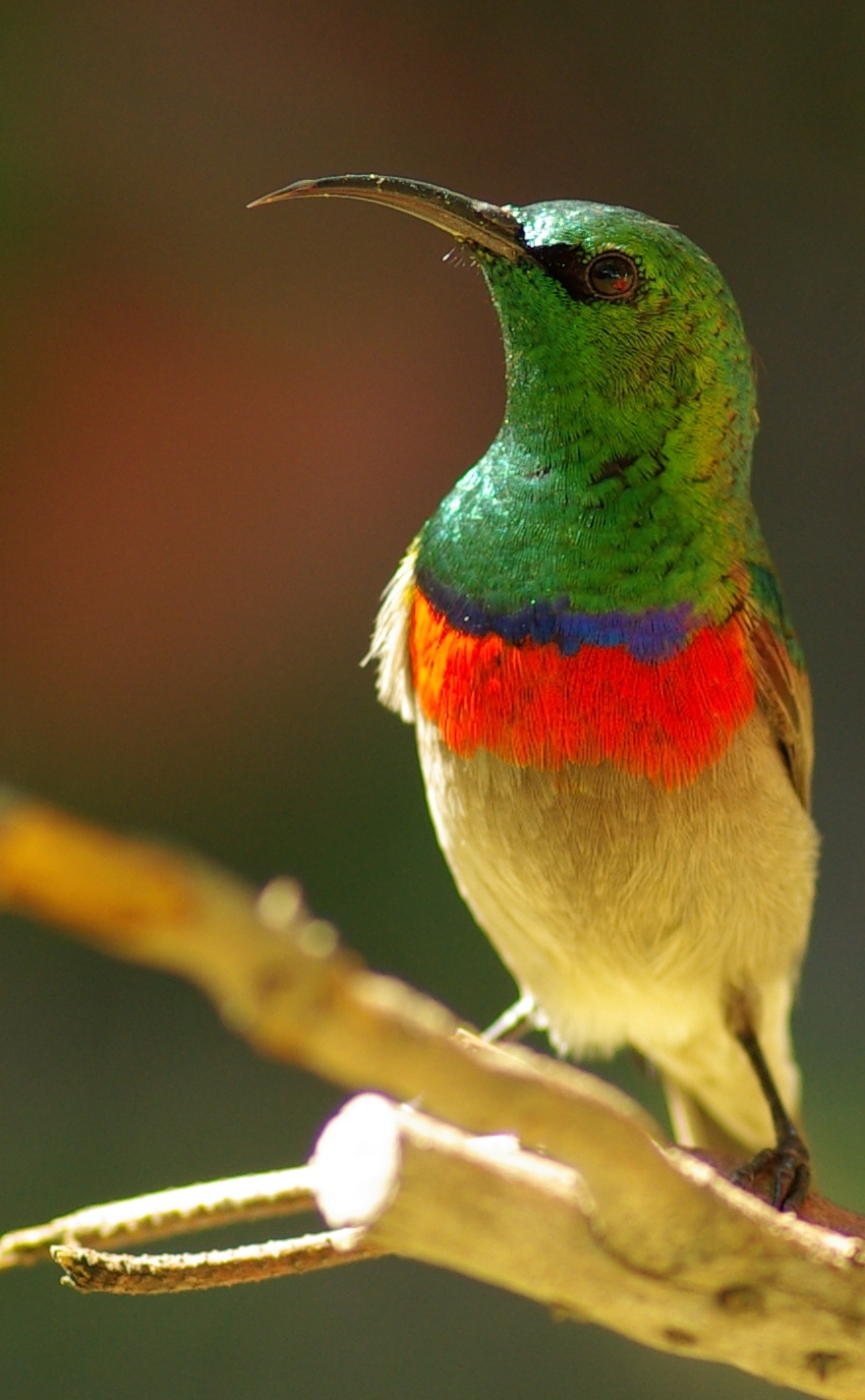
The Northern Double-collared Sunbird is a medium-sized bird belonging to the double-collared sunbird complex within the genus Cinnyris. The species occurs in Burundi, Cameroon, the Central African Republic, the Democratic Republic of the Congo, Equatorial Guinea, Kenya, Nigeria, Rwanda, South Sudan and Uganda. Adult males have metallic green heads and backs, a narrow purple collar, a scarlet breast and a pale brown belly.
Written 26 November 2026 from the sources listed below. Each statement was checked against the passage it cites; statements that could not be supported were removed.
Appearance
Adult males have metallic green heads and backs with a steely-blue sheen in some lighting conditions. Their rumps are greyish-brown, their uppertail coverts are metallic purple, and their black tails are glossed with blue.[1][2]
Adult males have dark brown main flight feathers and a narrow purple collar below the metallic green throat, followed by a scarlet breast and pale brown belly. Their pale yellow pectoral tufts may not always be visible.[3][4][5]
The eyes of adult males are black or dark brown, while their beaks and legs are black.[6]
Adult females have dark olive-green upperparts and dark brown tails. Their underparts are greyish-olive, with yellow-tinged bellies.[7][8]
Juveniles resemble adult females.[9]
Habitat
The species occurs in Burundi, Cameroon, the Central African Republic, the Democratic Republic of the Congo, Equatorial Guinea, Kenya, Nigeria, Rwanda, South Sudan and Uganda.[10]
The nominate subspecies Cinnyris reichenowi reichenowi occurs in Eastern Africa. The subspecies Cinnyris reichenowi preussi occurs in the Cameroon highlands, Adamawa Plateau, Mount Cameroon and Bioko.[11][12]
The volcano sunbird subspecies is found on Bioko, Mount Cameroon and the Cameroonian Highlands.[13]
Diet
The Northern Double-collared Sunbird feeds on nectar, insects, insect larvae and spiders.[14]
Behaviour
The species frequently occurs in small mixed-species flocks with white-eyes and the oriole finch. Individuals tend to perch in the middle layers of trees while looking from side to side.[15][16]
Males defend territories and sing vigorously. The species is aggressive throughout the year and attacks males of its own species.[17][18]
Fights between males of the same species can occur in mid-air and sometimes continue on the ground. The species also fights with the Cameroon sunbird and the olive-bellied sunbird.[19][20]
Similar species
Mitochondrial data indicate that the Northern Double-collared Sunbird is most closely related to the southern double-collared sunbird of South Africa.[21]
Conservation
The Northern Double-collared Sunbird is described as common and having a very wide geographic range. Its population trend is considered stable.[22][23]
No specific threats have been identified for the species. It is assessed as Least Concern by the International Union for Conservation of Nature.[24][25]
The species was assessed for the IUCN Red List in 2024.[26]
Classification of the Northern Double-collared Sunbird
| Kingdom | Animalia |
|---|---|
| Phylum | Chordata |
| Subphylum | Vertebrata |
| Infraphylum | Gnathostomata |
| Parvphylum | Osteichthyes |
| Megaclass | Tetrapoda |
| Class | Aves (Bird) |
| Order | Passeriformes (Passerine) |
| Family | Nectariniidae (Sunbird) |
| Genus | Cinnyris (Typical Sunbirds) |
| Species | Cinnyris reichenowi Sharpe, 1891 |
Where the Northern Double-collared Sunbird is found
Checklists and occurrence records place Cinnyris reichenowi in 12 countries. GBIF holds 13,184 georeferenced records of it.
Countries
- Burundi 23
- Cameroon 641
- Democratic Republic of the Congo 650
- Equatorial Guinea 351
- Kenya 5,860
- Nigeria 179
- Republic of the Congo 16
- Rwanda 1,162
- South Sudan 5
- Sudan 4
- Tanzania 8
- Uganda 4,285
Regions and cities with the most records
- Kanungu, Uganda 2,779
- Ntungamo, Uganda 1,869
- Kikuyu, Kenya 1,824
- Karuri, Kenya 1,720
- Nairobi, Kenya 1,712
- Rubanda, Uganda 1,611
- Imara Daima Estate, Kenya 1,599
- Ongata Rongai, Kenya 1,570
- Nairobi County, Kenya 1,541
- Kiambu, Kenya 1,457
- Ngong, Kenya 1,407
- Western Province, Rwanda 993
- Bushekeri, Rwanda 933
- Cyato, Rwanda 928
- Rangiro, Rwanda 920
- Limuru, Kenya 918
- Githunguri, Kenya 845
- Kiambu County, Kenya 840
- Karengera, Rwanda 803
- Kirambo, Rwanda 791
- Kagano, Rwanda 777
- Kakamega County, Kenya 737
- Kerugoya, Kenya 715
- Kiserian, Kenya 703
- Kirinyaga County, Kenya 698
- Kakamega, Kenya 676
- Maai Mahiu, Kenya 592
- Mai, Kenya 587
- Nyeri County, Kenya 577
- Kisoro, Uganda 551
- Shangi, Rwanda 505
- Bushenge, Rwanda 502
- Nyabitekeli, Rwanda 485
- Karambi, Rwanda 482
- Githunguri, Kenya 471
- Nanyuki, Kenya 405
1 more country has a few records outside this range
These countries hold a few records of Cinnyris reichenowi but lie outside the range the checklists give for it. Such records are often zoo or garden specimens, museum material or vagrants, so the species is not counted as occurring there.
A number beside a place is its count of GBIF occurrence records. A place without a number comes from a checklist alone. Records show where a species has been observed or collected, which can include escapes and vagrants.
Common names
English
- Northern Double-collared Sunbird
- NDCS
Names in 22 other languages
- Chinese
- 北双领花蜜鸟, 北方雙領花蜜鳥
- Croatian
- srednjoafrički medosas
- Czech
- strdimil severní
- Danish
- Nordlig Halsbåndsolfugl
- Dutch
- Preuss' Honingzuiger
- Esperanto
- preŭsa nektarinio
- Finnish
- pikkuvuorimedestäjä
- French
- Souimanga de Preuss, Souimanga de Reichenow, Souimanga à ailes dorées
- German
- Nandinektarvogel, Preussnektarvogel
- Hungarian
- Preuss-nektármadár
- Italian
- Nettarinia duecollari settentrionale
- Japanese
- キタゴシキタイヨウチョウ
- Lithuanian
- Proiso spalvingoji nektarina
- Norwegian
- lundsolfugl
- Polish
- nektarnik złotoboczny
- Portuguese
- beija-flor-de-preuss, nectarínia-de-coleira-dupla-nortenha, nectarínia-de-dupla-coleira-nortenha
- Russian
- Желтоплечая нектарница, Желтоплечая нектраница, Золотокрылая нектарница
- Slovak
- nektárovka kapucňová
- Spanish
- Suimanga de Preuss
- Swedish
- bergsolfågel, preussolfågel
- Turkish
- Kuzeyli Çift Kuşaklı Nektarkuşu
- Ukrainian
- маріка північна
Synonyms
2 other scientific names have been used for this species and are now treated as synonyms of Cinnyris reichenowi.
- Nectarinia preussi preussi Reichenow, A, 1892
- Nectarinia reichenowi Sharpe, RB, 1891
Subspecies and varieties
- Cinnyris reichenowi preussi subspecies
- Cinnyris reichenowi reichenowi subspecies
Related species
-
 Palestine SunbirdCinnyris osea
-
 Purple SunbirdCinnyris asiaticus
-
 Garden SunbirdCinnyris jugularis
-
 Southern Double-collared SunbirdCinnyris chalybeus
-
 Variable SunbirdCinnyris venustus
-
 Purple-banded SunbirdCinnyris bifasciatus
-
 Souimanga SunbirdCinnyris sovimanga
-
 White-bellied SunbirdCinnyris talatala
Compare
Questions and answers
What is the scientific name of the Northern Double-collared Sunbird?
The scientific name of the Northern Double-collared Sunbird is Cinnyris reichenowi. Written with its author, the full name is Cinnyris reichenowi Sharpe, 1891.
Which family does the Northern Double-collared Sunbird belong to?
Cinnyris reichenowi belongs to the family Nectariniidae, in the order Passeriformes and the class Aves.
Where is the Northern Double-collared Sunbird found?
Checklists and occurrence records place Cinnyris reichenowi in 12 countries, including Kenya, Uganda, Rwanda, Democratic Republic of the Congo, Cameroon and Equatorial Guinea.
What is the conservation status of the Northern Double-collared Sunbird?
The IUCN Red List category recorded for Cinnyris reichenowi is Least Concern (LC).
What other names does the Northern Double-collared Sunbird have?
Cinnyris reichenowi is also known in English as NDCS.
What do sunbirds eat?
The Northern Double-collared Sunbird feeds on nectar, insects, insect larvae and spiders.[14]
Sources
Passages the profile rests on
- Adult males have metallic green heads and backs with a steely-blue sheen in some lighting conditions. Source passage: “The adult male's head and back is a metallic green that has a steely-blue sheen in some lights.” — English Wikipedia
- Adult males have greyish-brown rumps, metallic purple uppertail coverts and black tails glossed with blue. Source passage: “The rump is greyish-brown, the uppertail coverts metallic purple and the tail black, glossed blue.” — English Wikipedia
- Adult males have dark brown main flight feathers. Source passage: “The main flight feathers are dark brown.” — English Wikipedia
- Adult males have a narrow purple collar below the metallic green throat, followed by a scarlet breast and pale brown belly. Source passage: “There is a narrow purple collar beneath the metallic green throat, above a scarlet breast and pale brown belly.” — English Wikipedia
- Adult males have pale yellow pectoral tufts that may not always be visible. Source passage: “There are pale yellow pectoral tufts that are not always visible.” — English Wikipedia
- The eyes of adult males are black or dark brown, while their beaks and legs are black. Source passage: “The eye is black or dark brown, and the beak and legs are black.” — English Wikipedia
- Adult females have dark olive-green upperparts and dark brown tails. Source passage: “The adult female is more drab with upper parts dark olive green and a dark brown tail.” — English Wikipedia
- Adult females have greyish-olive underparts with yellow-tinged bellies. Source passage: “The underparts are greyish-olive, the belly being tinged with yellow.” — English Wikipedia
- Juveniles resemble adult females. Source passage: “The juvenile is similar to the adult female.” — English Wikipedia
- The species occurs in Burundi, Cameroon, the Central African Republic, the Democratic Republic of the Congo, Equatorial Guinea, Kenya, Nigeria, Rwanda, South Sudan and Uganda. Source passage: “It is found in Burundi, Cameroon, Central African Republic, Democratic Republic of the Congo, Equatorial Guinea, Kenya, Nigeria, Rwanda, South Sudan, and Uganda.” — English Wikipedia
- The nominate subspecies Cinnyris reichenowi reichenowi occurs in Eastern Africa. Source passage: “Cinnyris reichenowi reichenowi of Eastern Africa” — English Wikipedia
- The subspecies Cinnyris reichenowi preussi occurs in the Cameroon highlands, Adamawa Plateau, Mount Cameroon and Bioko. Source passage: “C. r. preussi of the Cameroon highlands, Adamawa Plateau, Mt. Cameroon, and Bioko.” — English Wikipedia
- The volcano sunbird subspecies is found on Bioko, Mount Cameroon and the Cameroonian Highlands. Source passage: “volcano sunbird C. r. preussi, found on Bioko, Mt. Cameroon, and the Cameroonian Highlands” — English Wikipedia
- The species feeds on nectar, insects, insect larvae and spiders. Source passage: “It feeds on nectar, insects and their larvae, and spiders.” — English Wikipedia
- The species frequently occurs in small mixed-species flocks with white-eyes and the oriole finch. Source passage: “The northern double-collared sunbird is often found in small mixed-species flocks, associating with species like white-eyes (genus Zosterops) and the oriole finch (Linurgus olivaceus).” — English Wikipedia
- Individuals tend to perch in the middle layers of trees while looking from side to side. Source passage: “It tends to perch in the mid-storeys of trees, looking from side to side.” — English Wikipedia
- Males defend territories and sing vigorously. Source passage: “The male is territorial and sings vigorously.” — English Wikipedia
- The species is aggressive throughout the year and attacks males of its own species. Source passage: “It is aggressive throughout the year and attacks con-specific males” — English Wikipedia
- Fights between males of the same species can occur in mid-air and sometimes continue on the ground. Source passage: “sometimes resulting in mid-air fights which may continue on the ground.” — English Wikipedia
- The species also fights with the Cameroon sunbird and the olive-bellied sunbird. Source passage: “It also does battle with the Cameroon sunbird (Cyanomitra oritis) and the olive-bellied sunbird (Cinnyris chloropygia).” — English Wikipedia
- Mitochondrial data indicate that the northern double-collared sunbird is most closely related to the southern double-collared sunbird of South Africa. Source passage: “Mitochondrial data place this species as being most closely related to the southern double-collared sunbird C. chalybea of South Africa” — English Wikipedia
- The northern double-collared sunbird is described as common and having a very wide geographic range. Source passage: “The northern double-collared sunbird is a common species with a very wide range” — English Wikipedia
- The population trend of the species is considered stable. Source passage: “the population trend is thought to be steady.” — English Wikipedia
- No specific threats have been identified for the species. Source passage: “No particular threats have been identified” — English Wikipedia
- The species is assessed as Least Concern by the International Union for Conservation of Nature. Source passage: “the International Union for Conservation of Nature has assessed the bird's conservation status as being of "least concern".” — English Wikipedia
- The species has been assessed for the IUCN Red List in 2024. Source passage: “Northern Double-collared Sunbird Cinnyris reichenowi has most recently been assessed for The IUCN Red List of Threatened Species in 2024.” — iucnredlist.org
Data
- Catalogue of Life, 2026-10-16 XR cc by
- Global Biodiversity Information Facility CC BY 4.0
- Wikidata CC0
- GeoNames CC BY 4.0
- Wikimedia Commons per image; credit shown with each image
- Within the Catalogue of Life, this name comes from The Integrated Taxonomic Information System cc0
References
- Diagnoses of new species of Birds from Central East Africa. (1891). Ibis, 1891, 413–445. https://doi.org/10.1111/j.1474-919x.1891.tb08551.x Link where the name was published
This species in other databases
Page built on 28 November 2026. See how the catalog is made and all sources and licences.
Cite this page
ScientificNames.org. (2026). Cinnyris reichenowi (Northern Double-collared Sunbird). Retrieved November 28, 2026, from https://scientificnames.org/species/cinnyris-reichenowi
“Cinnyris reichenowi (Northern Double-collared Sunbird).” ScientificNames.org, 2026, scientificnames.org/species/cinnyris-reichenowi. Accessed 28 Nov. 2026.
ScientificNames.org. “Cinnyris reichenowi (Northern Double-collared Sunbird).” Accessed November 28, 2026. https://scientificnames.org/species/cinnyris-reichenowi.
@misc{scientificnames_cinnyris_reichenowi_northern_double_collared_sunbird,
  author = {{ScientificNames.org}},
  title = {Cinnyris reichenowi (Northern Double-collared Sunbird)},
  year = {2026},
  url = {https://scientificnames.org/species/cinnyris-reichenowi},
  note = {Accessed 2026-11-28}
}