Overview
The Angel de la Guarda Island Speckled Rattlesnake is a pit viper belonging to the genus Crotalus. It is endemic to Isla Ángel de la Guarda in the Gulf of California, Mexico. It reaches a maximum recorded length of 137 centimetres.
Written 26 November 2026 from the sources listed below. Each statement was checked against the passage it cites; statements that could not be supported were removed.
Appearance
The Angel de la Guarda Island Speckled Rattlesnake is a pit viper.[1]
Habitat
The species inhabits gravelly beaches along the island's shoreline and rocky arroyos and washes on the island.[2][3]
It occupies elevations ranging from sea level to 500 metres.[4]
Conservation
The species is classified as Least Concern on the IUCN Red List of Threatened Species and occurs in a protected area.[5][6]
It is described as very abundant within its restricted geographic range.[7]
Similar species
The species is sometimes classified as a subspecies of Crotalus mitchellii.[8]
Classification of the Angel de la Guarda Island Speckled Rattlesnake
| Kingdom | Animalia |
|---|---|
| Phylum | Chordata |
| Subphylum | Vertebrata |
| Infraphylum | Gnathostomata |
| Parvphylum | Osteichthyes |
| Megaclass | Tetrapoda |
| Class | Reptilia (Reptile) |
| Order | Squamata (Snakes) |
| Suborder | Serpentes (Snakes) |
| Infraorder | Alethinophidia |
| Family | Viperidae (Viper) |
| Subfamily | Crotalinae |
| Genus | Crotalus (Rattlesnakes) |
| Species | Crotalus angelensis Klauber, 1963 |
Where the Angel de la Guarda Island Speckled Rattlesnake is found
Checklists and occurrence records place Crotalus angelensis in 1 country across North America. GBIF holds 72 georeferenced records of it.
Countries
Regions and cities with the most records
Range as the checklists state it
Mexico (Isla Angel de la Guardia)
A number beside a place is its count of GBIF occurrence records. A place without a number comes from a checklist alone. Records show where a species has been observed or collected, which can include escapes and vagrants.
Common names
English
- Angel de la Guarda Island Speckled Rattlesnake
- Isla Angel Rattlesnake
Names in 4 other languages
- German
- Angel-Klapperschlange, Angel-de-la-Guardia-Klapperschlange
- Italian
- Crotalo dell'isola di Ángel de la Guarda, Crotalo di Ángel de la Guarda, Serpente a sonagli dell'isola di Ángel de la Guarda, Serpente a sonagli di Ángel de la Guarda
- Portuguese
- Cascavel-de-Ángel
- Spanish
- Cascabel de Isla Angel de la Guarda, Cascabel de Isla Ángel de la Guarda, Cascabel de isla Angel
Synonyms
One other scientific name has been used for this species and is now treated as a synonym of Crotalus angelensis.
- Crotalus mitchellii angelensis Klauber, 1963
Related species
-
 Timber RattlesnakeCrotalus horridus
-
 Western Diamondback RattlesnakeCrotalus atrox
-
 SidewinderCrotalus cerastes
-
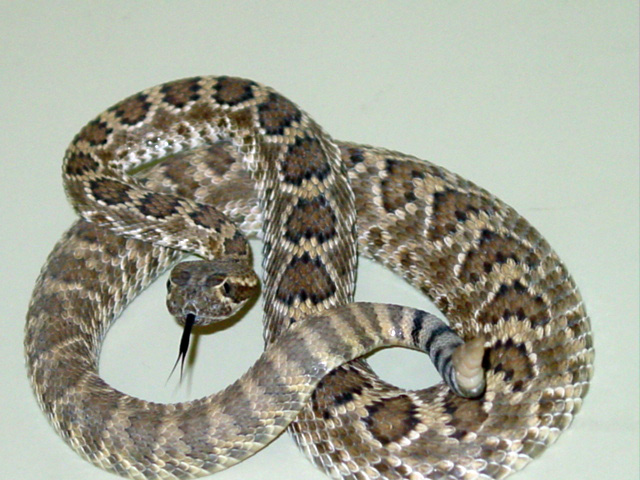 Mojave RattlesnakeCrotalus scutulatus
-
 Prairie RattlesnakeCrotalus viridis
-
 Western RattlesnakeCrotalus oreganus
-
 Tiger RattlesnakeCrotalus tigris
-
 Black-tailed RattlesnakeCrotalus molossus
Compare
- Angel de la Guarda Island Speckled Rattlesnake vs Timber Rattlesnake
- Angel de la Guarda Island Speckled Rattlesnake vs Western Diamondback Rattlesnake
- Angel de la Guarda Island Speckled Rattlesnake vs Sidewinder
- Angel de la Guarda Island Speckled Rattlesnake vs Mojave Rattlesnake
- Angel de la Guarda Island Speckled Rattlesnake vs Prairie Rattlesnake
Questions and answers
What is the scientific name of the Angel de la Guarda Island Speckled Rattlesnake?
The scientific name of the Angel de la Guarda Island Speckled Rattlesnake is Crotalus angelensis. Written with its author, the full name is Crotalus angelensis Klauber, 1963.
Which family does the Angel de la Guarda Island Speckled Rattlesnake belong to?
Crotalus angelensis belongs to the family Viperidae, in the order Squamata and the class Reptilia.
Where is the Angel de la Guarda Island Speckled Rattlesnake found?
Checklists and occurrence records place Crotalus angelensis in 1 country: Mexico.
What is the conservation status of the Angel de la Guarda Island Speckled Rattlesnake?
The IUCN Red List category recorded for Crotalus angelensis is Least Concern (LC).
What other names does the Angel de la Guarda Island Speckled Rattlesnake have?
Crotalus angelensis is also known in English as Isla Angel Rattlesnake.
What is a rattlesnakes scientific name?
The scientific name of this species is Crotalus angelensis Klauber, 1963.[9]
Are crotalus venomous?
The Angel de la Guarda Island Speckled Rattlesnake is venomous.[10]
Sources
Passages the profile rests on
- The species is a pit viper. Source passage: “Crotalus angelensis, or the Ángel de la Guarda Island speckled rattlesnake, is a pit viper species endemic to Isla Ángel de la Guarda” — English Wikipedia
- The species inhabits gravelly beaches along the island's shoreline. Source passage: “Gravelly beaches along the shore;” — English Wikipedia
- The species occurs in rocky arroyos and washes on the island. Source passage: “rocky arroyos, washes, and on the hillsides of the island's interior” — English Wikipedia
- The species occupies elevations ranging from sea level to 500 metres. Source passage: “from sea-level up to 500 m.” — English Wikipedia
- The species is classified as Least Concern on the IUCN Red List of Threatened Species. Source passage: “This species is classified as "Least Concern" (LC) on the IUCN Red List of Threatened Species.” — English Wikipedia
- The species occurs in a protected area. Source passage: “It occurs in a protected area” — English Wikipedia
- The species is described as very abundant within its restricted geographic range. Source passage: “is very abundant within its small range.” — English Wikipedia
- The species is sometimes classified as a subspecies of Crotalus mitchellii. Source passage: “It is sometimes treated as a subspecies of Crotalus mitchellii.” — English Wikipedia
- The species belongs to the genus Crotalus. Source passage: “Rattlesnakes Genus Crotalus. Angel de la Guarda Island Speckled Rattlesnake Crotalus angelensis.” — inaturalist.org
- The species is venomous. Source passage: “Like all other pitvipers, it is venomous.” — English Wikipedia
Data
- Catalogue of Life, 2026-10-16 XR cc by
- Global Biodiversity Information Facility CC BY 4.0
- Wikidata CC0
- GeoNames CC BY 4.0
- Within the Catalogue of Life, this name comes from The Reptile Database cc by
References
- Klauber, Laurence M. (1963). A new insular subspecies of the speckled rattlesnake. Transactions of the San Diego Society of Natural History 13: 73-80.
- Grismer, L. Lee. (1999). An evolutionary classification of reptiles on islands in the Gulf of California, México. Herpetologica 55 (4): 446-469.
- Beaman, K. R., & Hayes, W. K. (2008). Rattlesnakes: Research Trends and Annotated Checklist. In: Hayes et al. (eds), The biology of rattlesnakes. Loma Linda University Press, Pp. 5-16.
- Hoser, R. (2009). A reclassification of the rattlesnakes; species formerly exclusively referred to the genera Crotalus and Sistrurus. Australasian J. Herpetol. 3: 1-21 (Dubious Journal).
- Gottscho, Andrew, Sam Murray, Heather Heinz and Julio A. Lemos-Espinal. (2014). Crotalus angelensis (Isla Ángel de la Guarda rattlesnake) diet and predation. Herpetological Review 45 (3): 514.
- Meik JM, Streicher JW, Lawing AM, Flores-Villela O, & Fujita MK. (2015). Limitations of Climatic Data for Inferring Species Boundaries: Insights from Speckled Rattlesnakes. PLoS One 10 (6): E0131435; Doi:10.1371/Journal.Pone.0131435.
- Kwet, A. (2015). Gefleckte Klapperschlangen sind ein Artenkomplex. Reptilia (Münster) 20 (114): 6-7.
- Meik JM, Makowsky R. (2017). Minimum area thresholds for rattlesnakes and colubrid snakes on islands in the Gulf of California, Mexico. Ecol Evol. 2017;00:1–7.
- GARCÍA-PADILLA, ELI; JORGE H. VALDEZ VILLAVICENCIO, ANNY PERALTA GARCÍA. (2018). Las Serpientes de Cascabel más allá del continente. Especies.
- Meik, Jesse M.; Sarah Schaack, Oscar Flores-Villela & Jeffrey W. Streicher. (2018). Integrative taxonomy at the nexus of population divergence and speciation in insular speckled rattlesnakes. Journal of Natural History 52: 989-1016; DOI: 10.1080/00222933.2018.1429689.
- Reyes-Velasco, J., Cox, C. L., Jones, J. M., Borja, M., & Campbell, J. A. (2022). How many species of rattlesnakes are there in the Crotalus durissus species group (Serpentes: Crotalidae)? Revista Latinoamericana de Herpetología 5 (1): 43-55.
- Peralta-García A, Valdez-Villavicencio JH, Fucsko LA, Hollingsworth BD, Johnson JD, Mata-Silva V, Rocha A, DeSantis DL, Porras LW, and Wilson LD. (2023). The herpetofauna of the Baja California Peninsula and its adjacent islands, Mexico: composition, distribution, and conservation status. Amphibian & Reptile Conservation 17(1&2): 57–142.
- García-Padilla, E., Heredia-López, I., Villalobos-Juárez, I., Lazcano, D., & Fucsko, L. A. (2025). Notes on the Herpetofauna of Mexico 48: From Sacred to Scorned---A Study of the Mexican Rattlesnake’s Changing Status. Bulletin of the Chicago Herpetological Society, 60(3), 25-30.
- Farleigh, K.; D.K. Highland, M.G. Alderman, Y. Francioli, S.R. Hirst, E.M. Faber,B.W. Perry, M.L. Holding, G. Castañeda-Gaytán, M. Borja,H. Franz-Chávez, C.L. Parkinson, J.L. Strickland, M.J. Margres, S.P. Mackessy, J.M. Meik, T.A. Castoe & D.R. Schield. (2026). Evolution of genome-wide barriers to gene flow during complex speciation in rattlesnakes. Proc. Natl. Acad. Sci. U.S.A. 123 (21) E2609058123,.
This species in other databases
Page built on 28 November 2026. See how the catalog is made and all sources and licences.
Cite this page
ScientificNames.org. (2026). Crotalus angelensis (Angel de la Guarda Island Speckled Rattlesnake). Retrieved November 28, 2026, from https://scientificnames.org/species/crotalus-angelensis
“Crotalus angelensis (Angel de la Guarda Island Speckled Rattlesnake).” ScientificNames.org, 2026, scientificnames.org/species/crotalus-angelensis. Accessed 28 Nov. 2026.
ScientificNames.org. “Crotalus angelensis (Angel de la Guarda Island Speckled Rattlesnake).” Accessed November 28, 2026. https://scientificnames.org/species/crotalus-angelensis.
@misc{scientificnames_crotalus_angelensis_angel_de_la_guarda_island_speckled_rattlesnake,
  author = {{ScientificNames.org}},
  title = {Crotalus angelensis (Angel de la Guarda Island Speckled Rattlesnake)},
  year = {2026},
  url = {https://scientificnames.org/species/crotalus-angelensis},
  note = {Accessed 2026-11-28}
}