Species · Reptiles
Tiger Rattlesnake Crotalus tigris
The scientific name of the Tiger Rattlesnake is Crotalus tigris. It is a species of reptile in the family Viperidae (viper), order Squamata. The name dates from 1859.
- Scientific name
- Crotalus tigris Kennicott, 1859
- Common name
- Tiger Rattlesnake
- Genus
- Crotalus
- Family
- Viperidae (Viper)
- Order
- Squamata
- Class
- Reptilia
- Red List category
- LC Least Concern
- Recorded in
- 2 countries
- Name status
- accepted in the Catalogue of Life

Overview
The Tiger Rattlesnake (Crotalus tigris Kennicott, 1859) is a reptile in the family Viperidae, order Squamata, and class Reptilia. It lives from central Arizona through south-central Arizona to southern Sonora, Mexico, and also occurs on Isla Tiburón in the Gulf of California. It has a small, spade-shaped head and a dorsal pattern of 35–52 crossbands, including bands on the anterior portion of its body.
Written 26 November 2026 from the sources listed below. Each statement was checked against the passage it cites; statements that could not be supported were removed.
Appearance
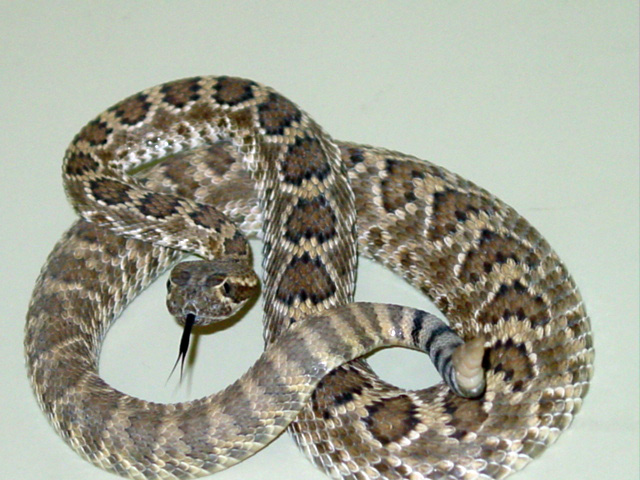
The Tiger Rattlesnake has a small, spade-shaped head measuring approximately one twenty-fifth of its total body length. It has the smallest head among rattlesnakes, and a dark cheek strip is its most distinguishable head marking.[1][2][3]
Its body coloration can include gray, lavender, blue-gray, pink, or buff. Its dorsal pattern includes 35–52 gray, olive, or brown crossbands, and it is the only rattlesnake described as having crossbands on the anterior portion of its body.[4][5][6]
It has six to ten posterior rings. Its dorsal scales are keeled and arranged in 21–27 rows, and its eyes are relatively small with elliptical pupils.[7][8][9]
Adults measure approximately 460–910 mm in total length, with an average body length of approximately 609 mm. Individuals can weigh up to 454 g, and the largest reported specimen measured 91.2 cm in length.[10][11][12][13]
Females have 164–177 ventral scales and 16–21 caudal scales. Males have 158–172 ventral scales and 23–27 caudal scales, and are typically larger than females.[14][15][16][17][18]
Habitat
The Tiger Rattlesnake inhabits rocky desert canyons, foothills, and bajadas. Its habitats include thornscrub, ocotillo-mesquite-creosote bush vegetation, and saguaro-paloverde vegetation.[19][20]
It also occurs in mesquite grassland, chaparral, tropical deciduous forest, and the lower edge of oak woodland. It has been observed at elevations ranging from sea level to approximately 1,465 m.[21][22]
In southeastern Arizona, it uses rocky areas during winter and spring and arroyo edges during summer. It is terrestrial but can climb into low vegetation.[23][24]
Diet
The Tiger Rattlesnake eats rodents and lizards. Its recorded mammalian prey include pocket mice, kangaroo rats, deer mice, and packrats.[25][26]
Juveniles rely heavily on lizards, whereas adults depend more on rodents.[27]
Behaviour
The Tiger Rattlesnake is nocturnal during the hot summer months of June through August. It becomes diurnal and crepuscular during autumn.[28][29]
It hibernates in rock crevices or animal burrows during late autumn and winter. Individuals in southeastern Arizona are mainly active from March through October.[30][31]
Individuals in southeastern Arizona move an average of approximately 33 m per day during the active season. Individuals have also been observed in bushes approximately 60 cm above the ground.[32][33]
Individuals rapidly shake their rattles when disturbed and can strike defensively.[34][35]
Reproduction and life cycle
The Tiger Rattlesnake has a polygynandrous mating system. Females follow a biennial reproductive cycle, whereas males follow a seasonal reproductive cycle and store sperm in their vasa deferentia during winter.[36][37][38]
Breeding occurs from late May to mid-August during the summer monsoon season. The species is ovoviviparous, with a mean litter size of five young.[39][40][41]
The smallest known sexually reproducing female measured 541 mm in snout-vent length. The smallest known mature male measured 512 mm in snout-vent length.[42][43]
Newborn individuals do not initially possess a rattle. A new rattle segment develops after each molt.[44][45]
Conservation
The Tiger Rattlesnake is classified as Least Concern on the IUCN Red List. Its population trend was considered stable in the 2007 assessment.[46][47]
Agricultural intensification may be causing habitat loss in southern populations on the coastal plain of Sonora.[48]
Uses
Tiger Rattlesnakes prey on rodent species regarded as pests by humans.[49]
Similar species
The Tiger Rattlesnake is sometimes confused with the speckled rattlesnake, western rattlesnakes, black-tailed rattlesnakes, western diamondback rattlesnakes, and Mojave rattlesnakes.[50][51][52][53][54]
Classification of the Tiger Rattlesnake
| Kingdom | Animalia |
|---|---|
| Phylum | Chordata |
| Subphylum | Vertebrata |
| Infraphylum | Gnathostomata |
| Parvphylum | Osteichthyes |
| Megaclass | Tetrapoda |
| Class | Reptilia (Reptile) |
| Order | Squamata (Snakes) |
| Suborder | Serpentes (Snakes) |
| Infraorder | Alethinophidia |
| Family | Viperidae (Viper) |
| Subfamily | Crotalinae |
| Genus | Crotalus (Rattlesnakes) |
| Species | Crotalus tigris Kennicott, 1859 |
Where the Tiger Rattlesnake is found
Checklists and occurrence records place Crotalus tigris in 2 countries across North America. GBIF holds 1,435 georeferenced records of it.
Countries
Regions and cities with the most records
- Arizona, United States 1,035
- Casas Adobes, United States 317
- Flowing Wells, United States 306
- Catalina Foothills, United States 294
- Tanque Verde, United States 279
- Tucson, United States 277
- Sonora, Mexico 232
- Oro Valley, United States 224
- Drexel Heights, United States 148
- Green Valley, United States 81
- Rio Rico, United States 72
- Phoenix, United States 46
- Nogales, United States 44
- Scottsdale, United States 44
- Tempe Junction, United States 44
- Marana, United States 43
- Nogales, Mexico 43
- Tempe, United States 40
- Hermosillo, Mexico 32
- Fountain Hills, United States 28
- Glendale, United States 24
- Heroica Guaymas, Mexico 21
- Apache Junction, United States 20
- Mesa, United States 18
- Avondale, United States 17
- Chandler, United States 16
- Gilbert, United States 14
- Empalme, Mexico 13
- Navojoa, Mexico 13
- Sahuarita, United States 12
- Peoria, United States 6
- Maricopa, United States 5
- Agua Prieta, Mexico 4
- Eloy, United States 4
- San Tan Valley, United States 4
- Sun City, United States 4
Range as the checklists state it
USA (SC Arizona), Mexico (Sonora)
A number beside a place is its count of GBIF occurrence records. A place without a number comes from a checklist alone. Records show where a species has been observed or collected, which can include escapes and vagrants.
Common names
English
- Tiger Rattlesnake
Names in 9 other languages
- Chinese
- 虎斑響尾蛇
- Czech
- chřestýš tygří
- German
- Tiger-Klapperschlange
- Hungarian
- tigriscsörgőkígyó
- Italian
- Crotalo tigrato, Crotalo tigre, Serpente a sonagli tigrato, Serpente a sonagli tigre
- Portuguese
- Cascavel-tigre
- Russian
- Тигровый гремучник
- Spanish
- Cascabel Tigre, Víbora de cascabel tigre sonorense, Víbora-cascabel tigre
- sei
- cocázni cahtxima
Related species
-
 Timber RattlesnakeCrotalus horridus
-
 Western Diamondback RattlesnakeCrotalus atrox
-
 SidewinderCrotalus cerastes
-
 Mojave RattlesnakeCrotalus scutulatus
-
 Prairie RattlesnakeCrotalus viridis
-
 Western RattlesnakeCrotalus oreganus
-
 Black-tailed RattlesnakeCrotalus molossus
-
 Red Diamond RattlesnakeCrotalus ruber
Compare
Questions and answers
What is the scientific name of the Tiger Rattlesnake?
The scientific name of the Tiger Rattlesnake is Crotalus tigris. Written with its author, the full name is Crotalus tigris Kennicott, 1859.
Which family does the Tiger Rattlesnake belong to?
Crotalus tigris belongs to the family Viperidae, in the order Squamata and the class Reptilia.
Where is the Tiger Rattlesnake found?
Checklists and occurrence records place Crotalus tigris in 2 countries: United States and Mexico.
What is the conservation status of the Tiger Rattlesnake?
The IUCN Red List category recorded for Crotalus tigris is Least Concern (LC).
What is the diet of a rattlesnake?
The Tiger Rattlesnake eats rodents and lizards. Recorded mammalian prey include pocket mice, kangaroo rats, deer mice, and packrats. Juveniles rely heavily on lizards, whereas adults depend more on rodents.[25][26][27]
What kind of habitat does a rattlesnake live in?
The Tiger Rattlesnake inhabits rocky desert canyons, foothills, and bajadas. Its habitats include thornscrub, ocotillo-mesquite-creosote bush vegetation, saguaro-paloverde vegetation, mesquite grassland, chaparral, tropical deciduous forest, and the lower edge of oak woodland.[19][20][21]
Sources
Passages the profile rests on
- The species has a small, spade-shaped head measuring approximately one twenty-fifth of its total body length. Source passage: “The tiger rattlesnake is easily identified by its small, spade-shaped head, which is about 1/25 of its total body length.” — English Wikipedia
- It has the smallest head among rattlesnakes. Source passage: “It has the smallest head of any rattlesnake, and a large rattle.” — English Wikipedia
- A dark cheek strip is its most distinguishable head marking. Source passage: “The most distinguishable mark on the head is a dark cheek strip.” — English Wikipedia
- Its body coloration can include gray, lavender, blue-gray, pink, or buff. Source passage: “The color pattern consists of a gray, lavender, blue-gray, pink, or buff ground color” — English Wikipedia
- Its dorsal pattern includes 35–52 gray, olive, or brown crossbands. Source passage: “a series of 35 to 52 gray, olive, or brown bands across the dorsum” — English Wikipedia
- It is the only rattlesnake described as having crossbands on the anterior portion of its body. Source passage: “Tiger rattlesnakes are the only rattlesnake with crossbands on the anterior portion of their bodies” — English Wikipedia
- It has six to ten posterior rings. Source passage: “They have six to 10 posterior rings.” — English Wikipedia
- Its dorsal scales are keeled and arranged in 21–27 rows. Source passage: “Dorsal scales are keeled and in 21 to 27 rows.” — English Wikipedia
- Its eyes are relatively small and have elliptical pupils. Source passage: “They have relatively small eyes with elliptical pupils.” — English Wikipedia
- Adults measure approximately 460–910 mm in total length. Source passage: “can range in length from 460 to 910 mm (18 to 36 in)” — English Wikipedia
- The average body length is approximately 609 mm. Source passage: “with an average length of 609 mm (24.0 in).” — English Wikipedia
- Individuals can weigh up to 454 g. Source passage: “individuals can weigh as much as 454 g (16.0 oz)” — English Wikipedia
- The largest reported specimen measured 91.2 cm in length. Source passage: “reported a maximum length of 91.2 cm (35.9 in).” — English Wikipedia
- Females have 164–177 ventral scales. Source passage: “Females have 164 to 177 ventral scales” — English Wikipedia
- Males have 158–172 ventral scales. Source passage: “males have 158 to 172 ventral scales.” — English Wikipedia
- Females have 16–21 caudal scales. Source passage: “Females have 16 to 21 caudal scales” — English Wikipedia
- Males have 23–27 caudal scales. Source passage: “males have 23 to 27 caudal scales” — English Wikipedia
- Males are typically larger than females. Source passage: “and are typically larger than females.” — English Wikipedia
- The species inhabits rocky desert canyons, foothills, and bajadas. Source passage: “Tiger rattlesnakes habitats include rocky desert canyons, foothills, and bajadas” — English Wikipedia
- Its habitats include thornscrub, ocotillo-mesquite-creosote bush vegetation, and saguaro-paloverde vegetation. Source passage: “ranging from thornscrub, ocotillo-mesquite-creosote bush, saguaro-paloverde” — English Wikipedia
- It also occurs in mesquite grassland, chaparral, tropical deciduous forest, and the lower edge of oak woodland. Source passage: “mesquite grassland, and chaparral to tropical deciduous forest (southern Sonora) and the lower edge of oak woodland.” — English Wikipedia
- It has been observed at elevations ranging from sea level to approximately 1,465 m. Source passage: “observed at elevations from sea level to about 1,465 m (4,806 ft)” — English Wikipedia
- In southeastern Arizona, it uses rocky areas during winter and spring and arroyo edges during summer. Source passage: “this snake occurs strictly in rocky areas in winter and spring, but uses edges of arroyos in summer.” — English Wikipedia
- The species is terrestrial but can climb into low vegetation. Source passage: “It is a terrestrial species, but may climb into low vegetation.” — English Wikipedia
- Its diet includes rodents and lizards. Source passage: “Tiger rattlesnakes generally feed on mammals such as rodents, but they have also been known to prey on lizards.” — English Wikipedia
- Its recorded mammalian prey include pocket mice, kangaroo rats, deer mice, and packrats. Source passage: “including pocket mice, kangaroo rats, deer mice, packrats” — English Wikipedia
- Juveniles rely heavily on lizards, whereas adults depend more on rodents. Source passage: “with juveniles relying heavily on lizards and adults depending more on rodents.” — English Wikipedia
- The species is nocturnal during the hot summer months of June through August. Source passage: “are nocturnal during the hot summer (June–August)” — English Wikipedia
- It becomes diurnal and crepuscular during autumn. Source passage: “but become diurnal and crepuscular during the fall season.” — English Wikipedia
- It hibernates in rock crevices or animal burrows during late autumn and winter. Source passage: “They hibernate during the late fall and winter in rock crevices or animal burrows.” — English Wikipedia
- Individuals in southeastern Arizona are mainly active from March through October. Source passage: “In southeastern Arizona, they are active mainly from March to October.” — English Wikipedia
- Individuals have been observed in bushes approximately 60 cm above the ground. Source passage: “have been found in bushes 60 cm (24 in) above the ground.” — English Wikipedia
- Individuals move an average of approximately 33 m per day during the active season in southeastern Arizona. Source passage: “individuals moved an average of 33 m (108 ft) per day during the active season.” — English Wikipedia
- Individuals rapidly shake their rattles when disturbed. Source passage: “If disturbed, they rapidly shake their rattles” — English Wikipedia
- The species can strike defensively when disturbed. Source passage: “and may strike in defense.” — English Wikipedia
- The species has a polygynandrous mating system. Source passage: “Tiger rattlesnakes are polygynandrous” — English Wikipedia
- Females follow a biennial reproductive cycle. Source passage: “Tiger rattlesnake females follow a biennial reproductive cycle.” — English Wikipedia
- Males follow a seasonal reproductive cycle and store sperm in their vasa deferentia during winter. Source passage: “Males follow a seasonal reproductive cycle, where sperm is stored in the vasa deferentia during winter.” — English Wikipedia
- Breeding occurs from late May to mid-August during the summer monsoon season. Source passage: “Breeding occurs from late May to mid-August, during the summer monsoon season.” — English Wikipedia
- The species is ovoviviparous. Source passage: “Like the majority of rattlesnakes, tiger rattlesnakes are ovoviviparous.” — English Wikipedia
- The mean litter size is five young. Source passage: “Mean clutch size for is five young.” — English Wikipedia
- The smallest known sexually reproducing female measured 541 mm in snout-vent length. Source passage: “The smallest known sexually reproducing female measured 541 mm (21.3 in; 54.1 cm) snout-vent length” — English Wikipedia
- The smallest known mature male measured 512 mm in snout-vent length. Source passage: “while the smallest mature male measured 512 mm (20.2 in; 51.2 cm)” — English Wikipedia
- Newborn individuals do not initially possess a rattle. Source passage: “Young tiger rattlesnakes are not born with a rattle.” — English Wikipedia
- A new rattle segment develops after each molt. Source passage: “after every molt, a new rattle segment is added.” — English Wikipedia
- The species is classified as Least Concern on the IUCN Red List. Source passage: “This species is classified as "Least Concern" on the IUCN Red List of Threatened Species.” — English Wikipedia
- Its population trend was considered stable in the 2007 assessment. Source passage: “The population trend was stable when assessed in 2007.” — English Wikipedia
- Agricultural intensification may be causing habitat loss in southern populations on the coastal plain of Sonora. Source passage: “Southern populations on the flatter areas of the coastal plain of Sonora are probably losing habitat due to the intensification of agriculture.” — English Wikipedia
- Tiger rattlesnakes prey on rodent species regarded as pests by humans. Source passage: “tiger rattlesnakes prey upon a number of rodent species considered pests by humans throughout their geographic range.” — English Wikipedia
- The tiger rattlesnake is sometimes confused with the speckled rattlesnake. Source passage: “Tiger rattlesnakes are often confused with speckled rattlesnakes” — animaldiversity.org
- The tiger rattlesnake is sometimes confused with western rattlesnakes. Source passage: “western rattlesnakes” — animaldiversity.org
- The tiger rattlesnake is sometimes confused with black-tailed rattlesnakes. Source passage: “black-tailed rattlesnakes” — animaldiversity.org
- The tiger rattlesnake is sometimes confused with western diamondback rattlesnakes. Source passage: “western diamondback ratttlesnakes” — animaldiversity.org
- The tiger rattlesnake is sometimes confused with Mojave rattlesnakes. Source passage: “and Mojave rattlesnakes.” — animaldiversity.org
- Its range extends from central Arizona through south-central Arizona to southern Sonora, Mexico. Source passage: “The species' range extends from central Arizona south through south-central Arizona in the United States, to southern Sonora, Mexico” — English Wikipedia
- The species occurs on Isla Tiburón in the Gulf of California. Source passage: “including Isla Tiburón in the Gulf of California” — English Wikipedia
- The species has been recorded in the southern Peloncillo Mountains of Arizona. Source passage: “was recently discovered in the southern Peloncillo Mountains of Arizona.” — animaldiversity.org
Data
- Catalogue of Life, 2026-10-16 XR cc by
- Global Biodiversity Information Facility CC BY 4.0
- Wikidata CC0
- GeoNames CC BY 4.0
- Wikimedia Commons per image; credit shown with each image
- Within the Catalogue of Life, this name comes from The Reptile Database cc by
References
- Baird, S. F. (1859). Reptiles of the Boundary. In: United States and Mexican Boundary Survey under the Order of Lieut. Col. W. H. Emory, Major First Cavalry, and United States Commisioner. 2, Rept., Pt.2. Department of the Interior, Washington, 35 Pp.
- Stejneger, L. H. (1893). Annotated list of the reptiles and batrachians collected by the Death Valley Expedition in 1891, with descriptions of new species. North American Fauna, No. 7: 159-228 (+ 14 Plates + 4 Maps).
- Cope, E. D. (1900). The crocodilians, lizards and snakes of North America. Ann. Rep. U.S. Natl. Mus. 1898: 153-1270.
- Van Denburgh, John and Joseph R. Slevin. (1913). A list of the amphibians and reptiles of Arizona, with notes on the species in the collection of the Academy. Proc. Cal. Acad. Sci. 3 (13): 391-454.
- Amaral, & do, A. (1929). Studies of nearctic ophidia III. Notes on Crotalus tigris KENNICOTT, 1839. Bull. Antivenin Inst. America 2 (4): 82-85.
- Klauber, Laurence M. (1931). Crotalus tigris and Crotalus enyo, two little known rattlesnakes of the southwest. Transactions of the San Diego Society of Natural History 6 (24): 353-370.
- Taylor, & Edward Harrison. (1938). Notes on the herpetological fauna of the Mexican state of Sonora. Univ. Kansas Sci. Bull. 24 (19): 475-503 [1936].
- Klauber, Laurence M. (1952). Taxonomic studies on rattlesnakes of Mainland Mexico. Bulletins of the Zoological Society of San Diego (26): 1-143.
- Stebbins, R. C. (1985). A Field Guide to Western Reptiles and Amphibians, 2nd ed. Houghton Mifflin, Boston.
- Campbell, J. A., & Lamar, W. W. (1989). The Venomous Reptiles of Latin America. Comstock Publishing/Cornell University Press, Ithaca.
- Perry-Richardson, J., and C. Ivanyi. (1992). Preliminary analysis of a study on free-ranging rattlesnakes on Arizona-Sonora Desert Museum grounds. Sonoran Herpetologist 5 (6):52-57.
- Painter, Charles W.;Milensky, Christopher M. (1993). Crotalus tigris (tiger rattlesnake). USA: Arizona. Herpetological Review 24 (4): 155-156.
- Hare, T.A., and J.T. McNally. (1997). Evalulation of a rattlesnake relocation program in the Tucson, Arizona, area. Sonoran Herpetologist 10 (3):26-31.
- Perry, J. (1997). Research and publications of the Department of Herpetology at the Arizona-Sonora Desert Museum. Sonoran Herpetologist 10 (12):130-131.
- Holycross, Andrew T. (1998). Geographic Distribution. Crotalus tigris. Herpetological Review 29 (2): 111.
- Parkinson, C. L. (1999). Molecular systematics and biogeographical history of pitvipers as determined by mitochondrial ribosomal DNA sequences. Copeia 1999 (3): 576-586.
- McDiarmid, R.W.; Campbell, J.A. & Touré,T.A. (1999). Snake species of the world. Vol. 1. [type catalogue]. Herpetologists’ League, 511 Pp.
- Ernst, C. H., & Ernst, E. M. (2003). Snakes of the United States and Canada. Smithsonian Inst. Press, Washington, 668 Pp.
- Powell, R.L., C.S. Lieb & E.D. Rael. (2004). Identification of a Neurotoxic Venom Component in the Tiger Rattlesnake, Crotalus tigris. Journal of Herpetology 38 (1): 149-152.
- Douglas, Michael E.; Marlis R. Douglas, Gordon W. Schuett & Louis W. Porras. (2006). Evolution of Rattlesnakes (Viperidae: Crotalus) in the Warm Deserts of Western North America Shaped by Neogene Vicariance and Quaternary Climate Change. Molecular Ecology 15: 3353-3374.
- Pavlik, S. (2007). Arboreal behavior in the Tiger Rattlesnake (Crotalus tigris). Sonoran Herpetologist 20 (5):56.
- Winchell, S. (2007). Klapperschlangen! Die Gattung Crotalus. Reptilia (Münster) 12 (66): 18-25.
- Beaman, K. R., & Hayes, W. K. (2008). Rattlesnakes: Research Trends and Annotated Checklist. In: Hayes et al. (eds), The biology of rattlesnakes. Loma Linda University Press, Pp. 5-16.
- Cundall, D. (2009). Viper Fangs: Functional Limitations of Extreme Teeth. Physiological and Biochemical Zoology: Ecological and Evolutionary Approaches, 82(1), 63–79.
- Meik, & Jesse M and André Pires-daSilva. (2009). Evolutionary morphology of the rattlesnake style. BMC Evolutionary Biology 2009, 9:35.
This species in other databases
Page built on 26 November 2026. See how the catalog is made and all sources and licences.
Cite this page
ScientificNames.org. (2026). Crotalus tigris (Tiger Rattlesnake). Retrieved November 26, 2026, from https://scientificnames.org/species/crotalus-tigris
“Crotalus tigris (Tiger Rattlesnake).” ScientificNames.org, 2026, scientificnames.org/species/crotalus-tigris. Accessed 26 Nov. 2026.
ScientificNames.org. “Crotalus tigris (Tiger Rattlesnake).” Accessed November 26, 2026. https://scientificnames.org/species/crotalus-tigris.
@misc{scientificnames_crotalus_tigris_tiger_rattlesnake,
  author = {{ScientificNames.org}},
  title = {Crotalus tigris (Tiger Rattlesnake)},
  year = {2026},
  url = {https://scientificnames.org/species/crotalus-tigris},
  note = {Accessed 2026-11-26}
}