Species · Reptiles
Sidewinder Crotalus cerastes
The scientific name of the Sidewinder is Crotalus cerastes. It is a species of reptile in the family Viperidae (viper), order Squamata. The name dates from 1854.
- Scientific name
- Crotalus cerastes Hallowell, 1854
- Common name
- Sidewinder
- Genus
- Crotalus
- Family
- Viperidae (Viper)
- Order
- Squamata
- Class
- Reptilia
- Red List category
- LC Least Concern
- Recorded in
- 2 countries
- Name status
- accepted in the Catalogue of Life

Overview
The species occurs in southeastern California, southern Nevada, southwestern Utah, western Arizona, western Sonora, and eastern Baja California, as well as on Isla del Tiburon. The Sidewinder is distinguished by raised horn-like scales above its eyes and sidewinding locomotion on loose sand.
Written 26 November 2026 from the sources listed below. Each statement was checked against the passage it cites; statements that could not be supported were removed.
Conservation
The Sidewinder is classified as Least Concern on the IUCN Red List. Its population trend was assessed as stable in 2007.[1][2]
Vehicle collisions are estimated to kill between 2,383 and 4,000 sidewinders annually.[3]
Appearance
The Sidewinder has raised horn-like supraocular scales above its eyes. Its dorsal coloration can be cream, buff, yellowish-brown, pink, or ash gray, and can also include light brown and gray tones.[4][5][6]
Its body typically has 28–47 subrhombic or subelliptical dorsal blotches. It usually has 21 rows of keeled dorsal scales at midbody.[7][8]
Adult specimens measure 43–80 cm in total length, including the tail. Adult individuals weigh between 93.8 and 304 g, with an average weight of 250 g.[9][10]
Female sidewinders grow larger than males. Adult sidewinders have an average snout-to-vent length of 50 cm, with a reported range of 44.6–61.5 cm.[11][12]
Habitat
The Sidewinder inhabits sandy washes, sand dunes, and open terrain in warm deserts. It occupies sandy flats within creosote and mesquite deserts and occasionally occurs on rocky slopes.[13][14]
Its habitats are characterized by loose soil and windblown sand. Sidewinders are frequently found near mammalian burrows, sandy washes, and densely vegetated areas.[15][16]
The species occupies elevations ranging from below sea level to 1,830 m.[17]
The Sidewinder occurs in southeastern California, southern Nevada, southwestern Utah, and western Arizona. Its Mexican distribution includes western Sonora and eastern Baja California, and it also occurs along the eastern coast of Baja California, the northern coast of the Gulf of California, and on Isla del Tiburon.[18][19][20][21]
Behaviour
Sidewinding is the species' characteristic form of locomotion and provides traction on loose desert sand. It produces J-shaped impressions in loose sand, with the hook pointing in the direction of travel.[22][23]
Sidewinders can use sidewinding to climb sandy slopes without slipping. They also use rectilinear movement and lateral undulation as locomotion methods.[24][25]
Sidewinders are most active at dawn and dusk, although they may become nocturnal during warmer periods. They are nocturnal during hot months and diurnal during cooler months of their activity period.[26][27]
Their activity period is approximately November through March and may extend longer in the southern part of their range. During daytime heat, sidewinders shelter in rodent burrows or bury themselves in sand.[28][29]
Sidewinders are non-gregarious but aggregate during denning. They are sit-and-wait predators.[30][31]
Juveniles use their tails to attract lizard prey through a behavior known as caudal luring.[32]
Reproduction and life cycle
Both sexes reach reproductive maturity at approximately two to three years of age. Sidewinders generally mate between April and May, with occasional mating in autumn.[33][34]
Sidewinders give birth to live young. Female sidewinders typically give birth to four to eleven live offspring per litter, while reported litter sizes can reach 18 young and average approximately 10 offspring.[35][36][37]
Female sidewinders give birth between late summer and early autumn. Newborns remain in their natal burrow for seven to ten days before leaving after their first shed.[38][39]
Female sidewinders may guard their offspring after birth before abandoning them. Males provide no parental care beyond mating.[40][41]
Classification of the Sidewinder
| Kingdom | Animalia |
|---|---|
| Phylum | Chordata |
| Subphylum | Vertebrata |
| Infraphylum | Gnathostomata |
| Parvphylum | Osteichthyes |
| Megaclass | Tetrapoda |
| Class | Reptilia (Reptile) |
| Order | Squamata (Snakes) |
| Suborder | Serpentes (Snakes) |
| Infraorder | Alethinophidia |
| Family | Viperidae (Viper) |
| Subfamily | Crotalinae |
| Genus | Crotalus (Rattlesnakes) |
| Species | Crotalus cerastes Hallowell, 1854 |
Where the Sidewinder is found
Checklists and occurrence records place Crotalus cerastes in 2 countries across North America. GBIF holds 9,916 georeferenced records of it.
Countries
Regions and cities with the most records
- California, United States 5,358
- Arizona, United States 1,775
- Nevada, United States 794
- Desert Hot Springs, United States 554
- Palm Springs, United States 548
- Cathedral City, United States 517
- Rancho Mirage, United States 517
- Palm Desert, United States 512
- Sonora, Mexico 476
- Indio, United States 352
- La Quinta, United States 281
- Marana, United States 259
- Coachella, United States 239
- Baja California, Mexico 173
- Barstow, United States 128
- Twentynine Palms, United States 128
- Somerton, United States 126
- Barstow Heights, United States 117
- Yuma, United States 113
- Banning, United States 112
- San Felipe, Mexico 101
- Fortuna Foothills, United States 99
- Ridgecrest, United States 93
- Yucca Valley, United States 82
- Henderson, United States 81
- Scottsdale, United States 78
- Utah, United States 73
- Florence, United States 71
- San Luis Río Colorado, Mexico 67
- Tempe Junction, United States 67
- Boulder City, United States 66
- Enterprise, United States 66
- Tempe, United States 65
- Adelanto, United States 62
- San Luis, United States 62
- Flowing Wells, United States 59
Range as the checklists state it
USA (SE California, S Nevada, SW Arizona, SW Utah),
A number beside a place is its count of GBIF occurrence records. A place without a number comes from a checklist alone. Records show where a species has been observed or collected, which can include escapes and vagrants.
Common names
English
- Sidewinder
- Sidewinder Rattlesnake
Names in 17 other languages
- Afrikaans
- Skuinsloperslang
- Chinese
- 角響尾蛇
- Czech
- chřestýš rohatý
- French
- Crotale cornu
- German
- Gehörnte Klapperschlange, Seitenwinder
- Hungarian
- szarvas csörgőkígyó
- Italian
- Crotalo ceraste, Serpente a sonagli ceraste
- Japanese
- ヨコバイガラガラヘビ
- Norwegian Bokmål
- Sideruller
- Polish
- grzechotnik rogaty
- Portuguese
- Cascavel-chifruda
- Russian
- Рогатый гремучник
- Spanish
- Cascabel cornuda, Cascabel cornuda del noroeste, Vibora Cornuda, Víbora-cascabel cornuda
- Swedish
- sidvindare
- Thai
- งูหางกระดิ่งไซด์ไวน์เดอร์
- Turkish
- Boynuzlu çıngıraklı yılan
- sei
- ctaamjij
Synonyms
One other scientific name has been used for this species and is now treated as a synonym of Crotalus cerastes.
- Crotalus cerastes cerastes Klauber, 1944 ambiguous synonym
Subspecies and varieties
- Crotalus cerastes cerastes (Mohave Desert Sidewinder) subspecies
- Crotalus cerastes cercobombus (Sonoran Sidewinder) subspecies
- Crotalus cerastes laterorepens (Colorado Desert Sidewinder) subspecies
Related species
-
 Timber RattlesnakeCrotalus horridus
-
 Western Diamondback RattlesnakeCrotalus atrox
-
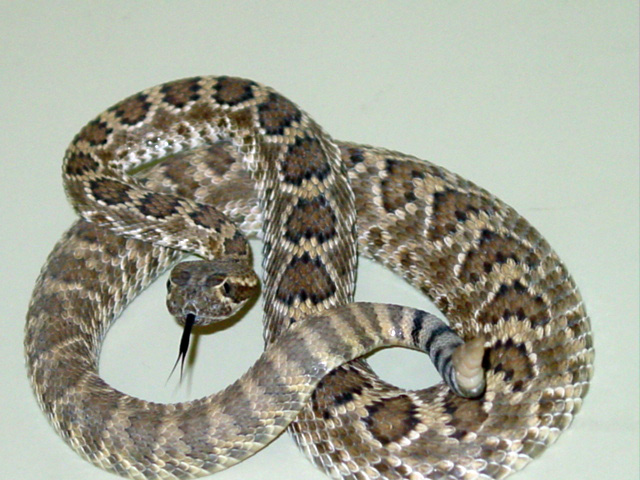 Mojave RattlesnakeCrotalus scutulatus
-
 Prairie RattlesnakeCrotalus viridis
-
 Western RattlesnakeCrotalus oreganus
-
 Tiger RattlesnakeCrotalus tigris
-
 Black-tailed RattlesnakeCrotalus molossus
-
 Red Diamond RattlesnakeCrotalus ruber
Compare
Questions and answers
What is the scientific name of the Sidewinder?
The scientific name of the Sidewinder is Crotalus cerastes. Written with its author, the full name is Crotalus cerastes Hallowell, 1854.
Which family does the Sidewinder belong to?
Crotalus cerastes belongs to the family Viperidae, in the order Squamata and the class Reptilia.
Where is the Sidewinder found?
Checklists and occurrence records place Crotalus cerastes in 2 countries: United States and Mexico.
What is the conservation status of the Sidewinder?
The IUCN Red List category recorded for Crotalus cerastes is Least Concern (LC).
What other names does the Sidewinder have?
Crotalus cerastes is also known in English as Sidewinder Rattlesnake.
Why are they called sidewinders?
The Sidewinder uses sidewinding as its characteristic form of locomotion. This movement provides traction on loose desert sand and produces J-shaped impressions, with the hook pointing in the direction of travel.[22][23]
How venomous is a sidewinder snake?
The Sidewinder is venomous and has front-facing, hinged fangs that fold down inside its mouth.[42]
Sources
Passages the profile rests on
- The species is classified as Least Concern on the IUCN Red List. Source passage: “The species Crotalus cerastes is classified as least concern on the IUCN Red List” — English Wikipedia
- The population trend was assessed as stable in 2007. Source passage: “The population trend was stable when assessed in 2007.” — English Wikipedia
- Vehicle collisions are estimated to kill between 2,383 and 4,000 sidewinders annually. Source passage: “It has been estimated that 2383-4000 sidewinders get killed per year from vehicles.” — animaldiversity.org
- The species has raised horn-like supraocular scales above its eyes. Source passage: “It is sometimes referred to as the horned rattlesnake because of the raised supraocular scales above its eyes.” — English Wikipedia
- Its dorsal coloration can be cream, buff, yellowish-brown, pink, or ash gray. Source passage: “The color pattern consists of a ground color that may be cream, buff, yellowish-brown, pink, or ash gray” — English Wikipedia
- Its coloration can include light brown, gray, and cream tones. Source passage: “Sidewinders are camouflaged in a variety of earthen colors, such as light-brown, grey, and cream depending on their habitats.” — animaldiversity.org
- Its body typically has 28–47 subrhombic or subelliptical dorsal blotches. Source passage: “overlaid with 28–47 dorsal blotches subrhombic or subelliptical in shape.” — English Wikipedia
- The species usually has 21 rows of keeled dorsal scales at midbody. Source passage: “Usually, 21 rows of keeled dorsal scales occur midbody.” — English Wikipedia
- Adult specimens measure 43–80 cm in total length, including the tail. Source passage: “adult specimens of Crotalus cerastes measure between 43 and 80 cm (17 and 31.5 in) in total length (tail included).” — English Wikipedia
- Adult individuals weigh between 93.8 and 304 g, with an average weight of 250 g. Source passage: “Adult can weigh 93.8 - 304 g (average 250 g), with older snakes weighing more than younger snakes.” — animaldiversity.org
- Adult sidewinders have an average snout-to-vent length of 50 cm, with a reported range of 44.6–61.5 cm. Source passage: “Adult sidewinders have a snout-vent length averaging 50 cm (range 44.6 -61.5 cm).” — animaldiversity.org
- Female sidewinders grow larger than males. Source passage: “The females are larger than the males, which is unique among United States rattlesnakes.” — English Wikipedia
- The species inhabits sandy washes, sand dunes, and open terrain in warm deserts. Source passage: “Sidewinders reside in terrestrial, desert landscapes such as sandy washes, sand dunes, and the open terrain of warm deserts.” — animaldiversity.org
- The species occurs in sandy flats within creosote and mesquite deserts and occasionally on rocky slopes. Source passage: “Habitat: sandy flats in creosote and mesquite deserts, occasionally rocky slopes;” — nps.gov
- Sidewinders are frequently found near mammalian burrows, sandy washes, and densely vegetated areas. Source passage: “These snakes are highly concentrated near mammalian burrows—close to sandy washes and thickly vegetated areas.” — animaldiversity.org
- Sidewinders occupy habitats characterized by loose soil and windblown sand. Source passage: “occupy habitats of loose soil and windblown sands.” — usgs.gov
- The species occupies elevations ranging from below sea level to 1,830 m. Source passage: “Sidewinders live in areas ranging from deserts below sea level to 1830 m.” — animaldiversity.org
- The species occurs in southeastern California, southern Nevada, southwestern Utah, and western Arizona. Source passage: “the desert region of southeastern California, southern Nevada, southwestern Utah, and western Arizona.” — English Wikipedia
- Its Mexican distribution includes western Sonora and eastern Baja California. Source passage: “it is found in western Sonora and eastern Baja California.” — English Wikipedia
- Sidewinders occur along the eastern coast of Baja California and the northern coast of the Gulf of California. Source passage: “These reptiles also reside on the eastern coast of Baja California, and the northern coast of Gulf of California” — animaldiversity.org
- The species also occurs on Isla del Tiburon. Source passage: “and the Isla del Tiburon.” — animaldiversity.org
- Sidewinding is the species' characteristic form of locomotion and provides traction on loose desert sand. Source passage: “The common name sidewinder alludes to its unusual form of locomotion, which is thought to give it traction on windblown desert sand” — English Wikipedia
- Sidewinding produces J-shaped impressions in loose sand, with the hook pointing in the direction of travel. Source passage: “it forms a letter J-shaped impression, with the tip of the hook pointing in the direction of travel.” — English Wikipedia
- Sidewinders can use sidewinding to climb sandy slopes without slipping. Source passage: “allowing it to ascend up to the maximum possible sand slope without slip.” — English Wikipedia
- Sidewinders use sidewinding, rectilinear movement, and lateral undulation as locomotion methods. Source passage: “They can travel via their namesake, sidewinding, but also have been observed using rectilinear motions and lateral undulations.” — animaldiversity.org
- The species is nocturnal during hot months and diurnal during cooler months of its activity period. Source passage: “The species is nocturnal during hot months and diurnal during the cooler months of its activity period” — English Wikipedia
- Sidewinders are most active at dawn and dusk, although they may become nocturnal during warmer periods. Source passage: “Sidewinders are crepuscular, meaning they are most active at dawn and dusk.” — nps.gov
- Its activity period is approximately November through March, and may extend longer in the southern part of its range. Source passage: “which is roughly from November to March (probably longer in the southern part of its range).” — English Wikipedia
- During daytime heat, sidewinders shelter in rodent burrows or bury themselves in sand. Source passage: “During the day, they escape the heat by hiding in rodent burrows or staying submerged in the sand.” — nps.gov
- Sidewinders are non-gregarious but aggregate during denning. Source passage: “Sidewinders are non-gregarious snakes, but group together during denning.” — animaldiversity.org
- Sidewinders are sit-and-wait predators. Source passage: “They are a sit-and-wait predator” — usgs.gov
- Juveniles use their tails to attract lizard prey through a behavior known as caudal luring. Source passage: “Juveniles use their tails to attract lizard prey, a behavior termed "caudal luring".” — English Wikipedia
- Both sexes reach reproductive maturity at approximately two to three years of age. Source passage: “Both sexes of the sidewinder mature at 2–3 years of age” — English Wikipedia
- Sidewinders generally mate between April and May, with occasional mating in autumn. Source passage: “Sidewinders mate in April through May and sometimes in fall.” — English Wikipedia
- Female sidewinders can produce litters of up to 18 young, averaging approximately 10 offspring. Source passage: “An adult female Crotalus cerastes may produce up to 18 young, with an average of about 10 per litter.” — English Wikipedia
- Sidewinders give birth to live young. Source passage: “Sidewinders are viviparous rattlesnakes.” — animaldiversity.org
- Female sidewinders typically give birth to four to eleven live offspring per litter. Source passage: “Female sidewinders typically have litters ranging from 4-11 young born alive.” — animaldiversity.org
- Female sidewinders give birth between late summer and early autumn. Source passage: “Females give birth to five to 18 young in late summer to early fall.” — English Wikipedia
- Newborn sidewinders remain in their natal burrow for seven to ten days before leaving after their first shed. Source passage: “The young stay with their mother in a burrow for 7–10 days, shed for the first time, then leave their natal burrow.” — English Wikipedia
- Female sidewinders may guard their offspring after birth before abandoning them. Source passage: “female sidewinders will guard new offspring up to 3 hours after birth before abandoning their young.” — animaldiversity.org
- Male sidewinders provide no parental care beyond mating. Source passage: “Beyond the act of mating, males provide no parental care.” — animaldiversity.org
- The species is venomous and has front-facing, hinged fangs that fold down inside its mouth. Source passage: “Sidewinders and other rattlesnakes are solenoglyphous, meaning they have front-facing, hinged venomous fangs that can fold down in their mouths.” — animaldiversity.org
Data
- Catalogue of Life, 2026-10-16 XR cc by
- Global Biodiversity Information Facility CC BY 4.0
- Wikidata CC0
- GeoNames CC BY 4.0
- Wikimedia Commons per image; credit shown with each image
- Within the Catalogue of Life, this name comes from The Reptile Database cc by
References
- Hallowell, E. (1854). Description of new reptiles from California. Proc. Acad. Nat. Sci. Philad. 7 [1854]: 91-97.
- Cope, E. D. (1900). The crocodilians, lizards and snakes of North America. Ann. Rep. U.S. Natl. Mus. 1898: 153-1270.
- Van Denburgh, John and Joseph R. Slevin. (1913). A list of the amphibians and reptiles of Arizona, with notes on the species in the collection of the Academy. Proc. Cal. Acad. Sci. 3 (13): 391-454.
- Klauber, Lawrence M. (1943). The correlation of variability within and between rattlesnake populations. Copeia 1943 (2): 115-118.
- Stebbins, R. C. (1943). Diurnal Activity of Crotalus cerastes. Copeia 1943 (2): 128-129.
- Klauber, Laurence M. (1944). The sidewinder, Crotalus cerastes, with description of a new subspecies. Transactions of the San Diego Society of Natural History 10 (8): 91-126.
- Klauber, Laurence M. (1952). Taxonomic studies on rattlesnakes of Mainland Mexico. Bulletins of the Zoological Society of San Diego (26): 1-143.
- Savage, J.M. and Cliff, F.S. (1953). A new subspecies of sidewinder, Crotalus cerastes, from Arizona. Nat. Hist. Misc. (Chicago Acad. Sci. J (119): 1-7.
- Funk, R. S. (1965). Food of Crotalus cerastes laterorepens in Yuma County, Arizona. Herpetologica 21 (1): 15-17.
- Cunningham, John D. (1966). Field Observations on the Thermal Relations of Rattlesnakes. Southwestern Naturalist 11 (1): 140-142.
- Loomis, Richard B.;Stephens, Robert C. (1967). Additional notes on snakes taken in or near Joshua Tree National Monument, California. Bulletin of the Southern California Academy of Sciences 66 (1): 1-22.
- Cohen, A.C. & B.C. Myres. (1970). A function of the horns (Supraocular scales) in the sidewinder rattlesnake, Crotalus cerastes, with comments on other horned snakes. Copeia 1970 (3): 574-575.
- Moore, R. G. (1978). Seasonal and Daily Activity Patterns and Thermoregulation in the Southwestern Speckled Rattlesnake (Crotalus mitchelli pyrrhus) and the Colorado Desert Sidewinder (Crotalus cerastes laterorepens). Copeia 1978 (3): 439-442.
- Stebbins, R. C. (1985). A Field Guide to Western Reptiles and Amphibians, 2nd ed. Houghton Mifflin, Boston.
- Stille, B. (1987). Dorsal scale microdermatoglyphics and rattlesnake (Crotalus and Sistrurus) phylogeny (Reptilia: Viperidae: Crotalinae). Herpetologica 43: 98-104.
- González-Romero, A., & Alvarez-Cárdenas, S. (1989). Herpetofauna de la Region del Pinacate, Sonora, Mexico: Un Inventario. The Southwestern Naturalist, 34(4), 519–526.
- Campbell, J. A., & Lamar, W. W. (1989). The Venomous Reptiles of Latin America. Comstock Publishing/Cornell University Press, Ithaca.
- Powell, R.; Inboden, M. & Smith, D.B. (1990). Erstnachweis von Hybriden zwischen den Klapperschlangen Crotalus cerastes laterorepens KLAUBER 1944 und Crotalus scutulatus scutulatus (KENNICOTT 1861). Salamandra 26 (4): 319-320.
- Perry-Richardson, J., and C. Ivanyi. (1992). Preliminary analysis of a study on free-ranging rattlesnakes on Arizona-Sonora Desert Museum grounds. Sonoran Herpetologist 5 (6):52-57.
- Strimple, & Pete. (1993). Crotalus cerastes, the Sidewinder. Litteratura Serpentium 13 (6): 180-183.
- Secor, S. M. (1994). Ecological Significance of Movements and Activity Range for the Sidewinder, Crotalus cerastes. Copeia 1994 (3): 631-645.
- McDiarmid, R.W.; Campbell, J.A. & Touré,T.A. (1999). Snake species of the world. Vol. 1. [type catalogue]. Herpetologists’ League, 511 Pp.
- Sievert, J. (2002). Crotalus cerastes HALLOWELL. Sauria (Suppl.) 24 (3): 559-564.
- Sievert, J. (2002). Beobachtungen bei der Vergesellschaftung von männlichen Crotalus cerastes cerastes HALLOWELL 1854 im Terrarium. Sauria 24 (3): 45-46.
- Aldridge, R. D., & Duvall, D. (2002). Evolution of the mating season in the pitvipers of North America. Herpetological Monographs 16: 1-25.
This species in other databases
Page built on 27 November 2026. See how the catalog is made and all sources and licences.
Cite this page
ScientificNames.org. (2026). Crotalus cerastes (Sidewinder). Retrieved November 27, 2026, from https://scientificnames.org/species/crotalus-cerastes
“Crotalus cerastes (Sidewinder).” ScientificNames.org, 2026, scientificnames.org/species/crotalus-cerastes. Accessed 27 Nov. 2026.
ScientificNames.org. “Crotalus cerastes (Sidewinder).” Accessed November 27, 2026. https://scientificnames.org/species/crotalus-cerastes.
@misc{scientificnames_crotalus_cerastes_sidewinder,
  author = {{ScientificNames.org}},
  title = {Crotalus cerastes (Sidewinder)},
  year = {2026},
  url = {https://scientificnames.org/species/crotalus-cerastes},
  note = {Accessed 2026-11-27}
}