Species · Reptiles
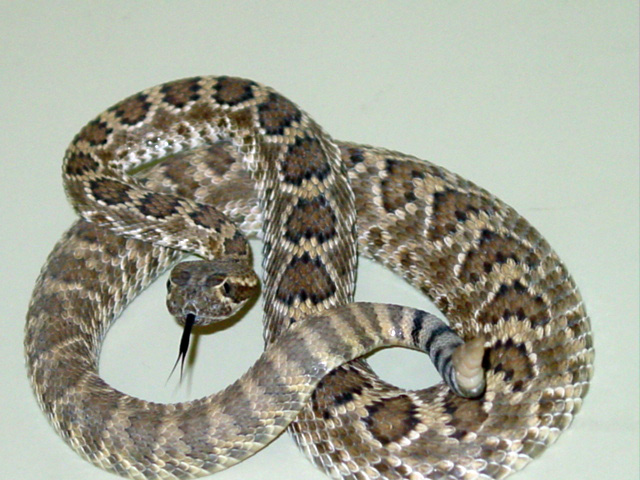
Western Diamondback Rattlesnake Crotalus atrox
The scientific name of the Western Diamondback Rattlesnake is Crotalus atrox. It is a species of reptile in the family Viperidae (viper), order Squamata. The name dates from 1853.
- Scientific name
- Crotalus atrox Baird & Girard, 1853
- Common name
- Western Diamondback Rattlesnake
- Genus
- Crotalus
- Family
- Viperidae (Viper)
- Order
- Squamata
- Class
- Reptilia
- Red List category
- LC Least Concern
- Recorded in
- 3 countries
- Name status
- accepted in the Catalogue of Life

Overview
The western diamondback rattlesnake (Crotalus atrox) or western diamond-backed rattlesnake, is a rattlesnake species and member of the viper family, found in the southwestern United States and Mexico. Like all other rattlesnakes and all other vipers, it is venomous. It is likely responsible for the majority of snakebite fatalities in northern Mexico and the greatest number of snakebites in the U.S.
Classification of the Western Diamondback Rattlesnake
| Kingdom | Animalia |
|---|---|
| Phylum | Chordata |
| Subphylum | Vertebrata |
| Infraphylum | Gnathostomata |
| Parvphylum | Osteichthyes |
| Megaclass | Tetrapoda |
| Class | Reptilia (Reptile) |
| Order | Squamata (Snakes) |
| Suborder | Serpentes (Snakes) |
| Infraorder | Alethinophidia |
| Family | Viperidae (Viper) |
| Subfamily | Crotalinae |
| Genus | Crotalus (Rattlesnakes) |
| Species | Crotalus atrox Baird & Girard, 1853 |
Where the Western Diamondback Rattlesnake is found
Checklists and occurrence records place Crotalus atrox in 3 countries across North America. GBIF holds 32,599 georeferenced records of it.
Countries
Regions and cities with the most records
- Texas, United States 11,499
- Arizona, United States 9,513
- New Mexico, United States 3,696
- Oro Valley, United States 2,042
- Casas Adobes, United States 2,006
- Catalina Foothills, United States 1,728
- Tucson, United States 1,328
- Oklahoma, United States 1,033
- Chihuahua, Mexico 694
- Sonora, Mexico 618
- California, United States 441
- Austin, United States 440
- Coahuila, Mexico 356
- Cedar Park, United States 331
- Georgetown, United States 325
- Round Rock, United States 320
- Nuevo León, Mexico 310
- Pflugerville, United States 301
- Leander, United States 298
- Las Cruces, United States 243
- Scottsdale, United States 235
- Corpus Christi, United States 184
- Tamaulipas, Mexico 167
- Mesa, United States 162
- Durango, Mexico 140
- San Antonio, United States 139
- Albuquerque, United States 135
- El Paso, United States 128
- Tempe Junction, United States 123
- Tempe, United States 120
- Phoenix, United States 119
- San Marcos, United States 116
- Surprise, United States 111
- Cedar Hill, United States 108
- Coachella, United States 105
- Gilbert, United States 105
1 more country has a few records outside this range
These countries hold a few records of Crotalus atrox but lie outside the range the checklists give for it. Such records are often zoo or garden specimens, museum material or vagrants, so the species is not counted as occurring there.
Range as the checklists state it
USA (SE California, S Nevada [A Heindl, pers. comm.], Arizona, New Mexico, Texas, Oklahoma, Arkansas),
A number beside a place is its count of GBIF occurrence records. A place without a number comes from a checklist alone. Records show where a species has been observed or collected, which can include escapes and vagrants.
Common names
English
- Western Diamondback Rattlesnake
- Tortuga Island Rattlesnake
- Tortuga Island Rattlesnake (tortugensis)
- Western Diamond-back Rattlesnake
- Western Diamond-backed Rattlesnake
Names in 15 other languages
- Chinese
- 西部菱背響尾蛇
- Czech
- chřestýš západní
- Danish
- Vestlig Diamantklapperslange
- Dutch
- Texaanse ratelslang
- French
- Crotale du Texas
- German
- Texas-Klapperschlange, Westliche Diamantklapperschlange
- Hungarian
- texasi csörgőkígyó
- Italian
- Crotalo adamantino occidentale, Crotalo atroce, Crotalo diamantino occidentale, Serpente a sonagli adamantino occidentale, Serpente a sonagli atroce, Serpente a sonagli diamantino occidentale
- Japanese
- セイブダイヤガラガラヘビ, ニシダイヤガラガラヘビ
- Polish
- grzechotnik teksaski
- Portuguese
- Cascavel-de-Tortuga, Cascavel-diamante ocidental
- Russian
- Островной гремучник, Техасский гремучник
- Spanish
- Cascabel de Diamantes, Cascabel de la Isla Tortuga, Cascabel diamantina del oeste, Víbora-cascabel de diamantes, chilladora, víbora de cascabel de diamantes de occidente
- Turkish
- Batılı elmas sırtlı
- sei
- cocázni
Synonyms
5 other scientific names have been used for this species and are now treated as synonyms of Crotalus atrox.
- Caudisona atrox sonoraensis Kennicott, 1861
- Crotalus cinereous Le Conte In Hallowell, 1852
- Crotalus confluentus Boulenger, 1896
- Crotalus confluentus Say, 1822
- Crotalus tortugensis Van Denburgh & Slevin, 1921
Related species
-
 Timber RattlesnakeCrotalus horridus
-
 SidewinderCrotalus cerastes
-
 Mojave RattlesnakeCrotalus scutulatus
-
 Hopi RattlesnakeCrotalus viridis
-
 Western RattlesnakeCrotalus oreganus
-
 Tiger RattlesnakeCrotalus tigris
-
 Black-tailed RattlesnakeCrotalus molossus
-
 Red Diamond RattlesnakeCrotalus ruber
Compare
Questions and answers
What is the scientific name of the Western Diamondback Rattlesnake?
The scientific name of the Western Diamondback Rattlesnake is Crotalus atrox. Written with its author, the full name is Crotalus atrox Baird & Girard, 1853.
Which family does the Western Diamondback Rattlesnake belong to?
Crotalus atrox belongs to the family Viperidae, in the order Squamata and the class Reptilia.
Where is the Western Diamondback Rattlesnake found?
Checklists and occurrence records place Crotalus atrox in 3 countries: United States, Mexico and Canada.
What is the conservation status of the Western Diamondback Rattlesnake?
The IUCN Red List category recorded for Crotalus atrox is Least Concern (LC).
What other names does the Western Diamondback Rattlesnake have?
Crotalus atrox is also known in English as Tortuga Island Rattlesnake, Tortuga Island Rattlesnake (tortugensis), Western Diamond-back Rattlesnake and Western Diamond-backed Rattlesnake.
Sources
Data
- Catalogue of Life, 2026-10-16 XR cc by
- Global Biodiversity Information Facility CC BY 4.0
- Wikidata CC0
- English Wikipedia CC BY-SA 4.0
- GeoNames CC BY 4.0
- Wikimedia Commons per image; credit shown with each image
- Within the Catalogue of Life, this name comes from The Reptile Database cc by
References
- Say, T. (1822). In James, E. Account of an expedition from Pittsburgh to the Rocky Mountains, performed in the years 1819, ’20, by order of the Hon. J. C. Calhoun, Secretary of War, under the command of Major Stephen H. Long. Vol. 2. Philadelphia, H. C. Carey & I. Lea. [1823, Fide Woodman 2010].
- Baird, S. F. and C. Girard. (1853). Catalogue of North American Reptiles in the Museum of the Smithsonian Institution. Part 1.-Serpents. Smithsonian Inst., Washington, Xvi + 172 Pp.
- Duméril, A. M. C., Bibron, G. & DUMÉRIL, A. H. A.,. (1854). Erpétologie générale ou histoire naturelle complète des reptiles. Tome septième. Deuxième partie, comprenant l’histoire des serpents venimeux. Paris, Librairie Encyclopédique de Roret: I-Xii + 781-1536.
- Trécul, M. A. (1876). On the capture of rattlesnakes, and on the association of these serpents with a small owl and a little marmot. Ann. Mag. Nat. Hist. (4) 18: 439.
- Garman, S. (1887). Reptiles and batrachians from Texas and Mexico. Bull. Essex Institute 19: 119-138.
- Van Denburgh, J. (1895). A review of the herpetology of Lower California. Part I - Reptiles. Proc. Cal. Acad. Sci. (2) 5: 77-163.
- Cope, E. D. (1900). The crocodilians, lizards and snakes of North America. Ann. Rep. U.S. Natl. Mus. 1898: 153-1270.
- Stejneger, L. (1902). The reptiles of the Huachuca Mountains, Arizona. Proc. US Natl. Mus. 25 [1902]: 149-158.
- Thompson, J. C. (1913). Contributions to the Anatomy of the Ophidia. Proc. Zool. Soc. London 1913: 414-426.
- Van Denburgh, John and Joseph R. Slevin. (1913). A list of the amphibians and reptiles of Arizona, with notes on the species in the collection of the Academy. Proc. Cal. Acad. Sci. 3 (13): 391-454.
- Van Denburgh, J., & Slevin, J. R. (1921). Preliminary diagnoses of more new species of reptiles from islands in the gulf of California, Mexico. Proc. Cal. Acad. Sci. (4) 11 (17): 395-398.
- Amaral, & do, A. (1929). Studies of nearctic ophidia IV. On Crotalus tortugensis VANDENBURGH AND SLEVIN, 1921, Crotalus atrox elegans SCHMIDT, 1922, and Crotalus atrox lucasensis (VANDEBURGH, 1920). Bull. Antivenin Inst. America 2 (4): 85-86.
- Klauber, Laurence M. (1930). Differential characteristics of Southwestern rattlesnakes allied to Crotalus atrox. Bulletins of the Zoological Society of San Diego (6): 1-74.
- Burt, Charles E. (1935). Further records of the ecology and distribution of amphibians and reptiles in the middle west. American Midland Naturalist 16 (3): 311-336.
- Taylor, W. (1935). Notes on Crotalus atrox near Tucson, Arizona, with Special Reference to Its Breeding Habits. Copeia, 1935(3), 154-155.
- Smith, Hobart M. (1939). An annotated list of the Mexican amphibians and reptiles in the Carnegie Museum. Annals of the Carnegie Museum 27: 311-320.
- Bogert, C. M. (1942). Field Notes on the Copulation of Crotalus atrox in California. Copeia 1942 (4): 262.
- Klauber, Lawrence M. (1943). The correlation of variability within and between rattlesnake populations. Copeia 1943 (2): 115-118.
- Jameson, David H.;Flury, Alvin G. (1949). The reptiles and amphibians of the Sierra Vieja Range of southwestern Texas. Texas Journal of Science 1 (2): 54-77.
- Klauber, Laurence M. (1952). Proposed use of the plenary powers to preserve for the Western Diamond Rattlesnake the trivial name “atrox” Baird & Girard, 1853 (as published in the combination “Crotalus atrox”) by suppressing the trivial name “cinereous” Le Conte in Hallowell, 1852 (as published in combination “Crotalus cinereous”) (Class Reptilia, order Squamata). Bull. Zool. Nomenclature 6: 234-238.
- Klauber, Laurence M. (1952). Taxonomic studies on rattlesnakes of Mainland Mexico. Bulletins of the Zoological Society of San Diego (26): 1-143.
- Milstead, William W. (1953). Ecological distribution of the lizards of the La Mota Mountain Region of Trans-Pecos Texas. Texas Journal of Science 5 (4): 403-415.
- Brattstrom, Bayard H. (1954). Amphibians and reptiles from Gypsum Cave, Nevada. Bulletin of the Southern California Academy of Sciences 53 (1): 8-12.
- Cliff, Frank S. (1954). Snakes of the islands in the Gulf of California, Mexico. Transactions of the San Diego Society of Natural History 12 (5): 67-98. Link
- Minton, S.A., Jr. (1957). Variation in Yield and Toxicity of Venom from a Rattlesnake (Crotalus atrox). Copeia 1957 (4): 265-268.
This species in other databases
Page built on 25 November 2026. See how the catalog is made and all sources and licences.
Cite this page
ScientificNames.org. (2026). Crotalus atrox (Western Diamondback Rattlesnake). Retrieved November 25, 2026, from https://scientificnames.org/species/crotalus-atrox
“Crotalus atrox (Western Diamondback Rattlesnake).” ScientificNames.org, 2026, scientificnames.org/species/crotalus-atrox. Accessed 25 Nov. 2026.
ScientificNames.org. “Crotalus atrox (Western Diamondback Rattlesnake).” Accessed November 25, 2026. https://scientificnames.org/species/crotalus-atrox.
@misc{scientificnames_crotalus_atrox_western_diamondback_rattlesnake,
  author = {{ScientificNames.org}},
  title = {Crotalus atrox (Western Diamondback Rattlesnake)},
  year = {2026},
  url = {https://scientificnames.org/species/crotalus-atrox},
  note = {Accessed 2026-11-25}
}