Species · Reptiles
Prairie Rattlesnake Crotalus viridis
The scientific name of the Prairie Rattlesnake is Crotalus viridis. It is a species of reptile in the family Viperidae (viper), order Squamata. The name dates from 1818.
- Scientific name
- Crotalus viridis (Rafinesque, 1818)
- Common name
- Prairie Rattlesnake
- Genus
- Crotalus
- Family
- Viperidae (Viper)
- Order
- Squamata
- Class
- Reptilia
- Red List category
- LC Least Concern
- Recorded in
- 3 countries
- Name status
- accepted in the Catalogue of Life

Overview
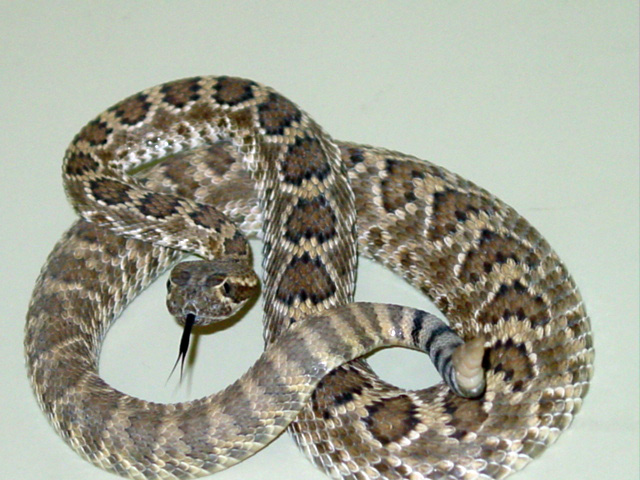
The species occurs in southwestern Canada, the western United States, and northern Mexico. It generally has light brown coloration with dark brown patches along its back, a triangular-shaped head, and sensory pits on both sides of its head.
Written 26 November 2026 from the sources listed below. Each statement was checked against the passage it cites; statements that could not be supported were removed.
Appearance
The Prairie Rattlesnake generally has light brown coloration with dark brown patches arranged along its back. Its dorsal coloration ranges from light brown to black, while its ventral coloration commonly includes tan, yellowish, or gray shades.[1][2]
The species has a triangular-shaped head and sensory pits on both sides of its head. Individuals typically possess at least three internasal scales, most commonly four, and have two internasal scales that contact the rostral scale.[3][4][5]
Its body may have patterned stripes or blotches that contribute to camouflage.[6]
The species commonly exceeds 100 cm in length, and its maximum recorded length is 151.5 cm.[7][8]
In Montana, individuals occasionally exceed 120 cm in length. Reported adult lengths range from 45.3–165 cm, with weights of 227–361 g.[9][10]
Male juveniles average 28.5 cm in length, while female juveniles average 28.2 cm.[11]
Habitat
The Prairie Rattlesnake occupies dry areas with moderate vegetation cover. Its habitats include rocky terrain, open fields, and forests with protective ground debris.[12][13]
Individuals commonly occupy rocky habitats where outcrops can provide den sites. The species also uses burrows made by other animals.[14][15]
Its habitat can include chaparral with shrubs and vegetation that provide camouflage.[16]
Diet
The Prairie Rattlesnake commonly eats small mammals, including ground squirrels, mice, rats, rabbits, and prairie dogs. Its prey also includes ground-nesting birds.[17][18]
The species occasionally consumes amphibians and reptiles. Juveniles are more commonly reported to consume other snakes.[19][20]
Behaviour
The Prairie Rattlesnake is primarily terrestrial but sometimes climbs trees or bushes. Individuals sometimes rest in caves or rock crevices.[21][22]
The species is generally active during daylight in cooler weather and at night during hot weather. Individuals hibernate during winter and may travel up to 10 km to reach a hibernation den.[23][24][25]
Individuals vibrate their tails to produce a rattling sound that warns intruders. The species generally displays aggression only when threatened.[26][27]
Individuals use tongue flicking to detect chemical cues left by prey and predators. The species can also perceive infrared radiation from its surroundings.[28][29]
Reproduction and life cycle
The Prairie Rattlesnake is viviparous and can produce between one and 25 offspring per reproductive event. A typical litter contains four to 12 young.[30][31]
Females give birth in late summer or early autumn. Newborn individuals measure approximately 22–28 cm in length and possess venom from birth.[32][33][34]
Conservation
The Prairie Rattlesnake is classified as Least Concern on the IUCN Red List. Its population trend was stable when assessed in 2006.[35][36]
Iowa lists the species as endangered and reports a single remnant population in the Loess Hills region.[37]
In Canada, the species is listed as being of special concern because of population declines associated with habitat loss and road mortality.[38]
Classification of the Prairie Rattlesnake
| Kingdom | Animalia |
|---|---|
| Phylum | Chordata |
| Subphylum | Vertebrata |
| Infraphylum | Gnathostomata |
| Parvphylum | Osteichthyes |
| Megaclass | Tetrapoda |
| Class | Reptilia (Reptile) |
| Order | Squamata (Snakes) |
| Suborder | Serpentes (Snakes) |
| Infraorder | Alethinophidia |
| Family | Viperidae (Viper) |
| Subfamily | Crotalinae |
| Genus | Crotalus (Rattlesnakes) |
| Species | Crotalus viridis (Rafinesque, 1818) |
Where the Prairie Rattlesnake is found
Checklists and occurrence records place Crotalus viridis in 3 countries across North America. GBIF holds 18,423 georeferenced records of it.
Countries
Regions and cities with the most records
- Colorado, United States 3,767
- New Mexico, United States 3,112
- South Dakota, United States 1,206
- California, United States 1,186
- Texas, United States 1,002
- Kansas, United States 926
- Montana, United States 858
- Evans, United States 768
- Arizona, United States 661
- Alberta, Canada 545
- Wyoming, United States 497
- Saskatchewan, Canada 489
- Dakota Ridge, United States 336
- Nevada, United States 321
- Golden, United States 295
- Lakewood, United States 286
- Nebraska, United States 280
- Boulder, United States 263
- Columbine, United States 262
- Ken Caryl, United States 260
- Arvada, United States 255
- Wheat Ridge, United States 252
- Littleton, United States 249
- Albuquerque, United States 233
- Englewood, United States 229
- Utah, United States 229
- Washington, United States 228
- Louisville, United States 222
- South Valley, United States 216
- Lafayette, United States 200
- Oklahoma, United States 199
- Broomfield, United States 194
- Greenwood Village, United States 190
- Longmont, United States 186
- Westminster, United States 186
- Highlands Ranch, United States 179
Range as the checklists state it
SW Canada (S Alberta, Saskatchewan), W USA (E Idaho, Montana, South Dakota, Nebraska, S Utah, Iowa, New Mexico, Texas, Colorado),
Middle America
North America
A number beside a place is its count of GBIF occurrence records. A place without a number comes from a checklist alone. Records show where a species has been observed or collected, which can include escapes and vagrants.
Common names
English
- Prairie Rattlesnake
- Green Prairie Rattlesnake
- Hopi Rattlesnake
Names in 12 other languages
- Chinese
- 草原響尾蛇
- Czech
- chřestýš zelený
- Danish
- Prærieklapperslange
- French
- crotale des prairies
- German
- Prärie-Klapperschlange
- Italian
- Crotalo delle Grandi Pianure, Crotalo verde di prateria, Serpente a sonagli delle Grandi Pianure, Serpente a sonagli verde di prateria
- Japanese
- プレーリーガラガラヘビ
- Polish
- grzechotnik preriowy
- Portuguese
- Cascavel-das-pradarias
- Russian
- Зелёный гремучник
- Spanish
- Cascabel de pradera, Serpiente de Cascabel de la Pradera, Víbora de cascabel de pradera, Víbora-cascabel occidental
- Turkish
- Bozkır çıngıraklı yılanı
Synonyms
5 other scientific names have been used for this species and are now treated as synonyms of Crotalus viridis.
- Crotalinus viridis Rafinesque, 1818
- Crotalus confluentus nuntius Klauber, 1935
- Crotalus confluentus pulverulentus Cope, 1883
- Crotalus lecontei Hallowell, 1852
- Crotalus viridis nuntius Klauber, 1935
Subspecies and varieties
- Crotalus viridis viridis (Prairie Rattlesnake) subspecies
Related species
-
 Timber RattlesnakeCrotalus horridus
-
 Western Diamondback RattlesnakeCrotalus atrox
-
 SidewinderCrotalus cerastes
-
 Mojave RattlesnakeCrotalus scutulatus
-
 Western RattlesnakeCrotalus oreganus
-
 Tiger RattlesnakeCrotalus tigris
-
 Black-tailed RattlesnakeCrotalus molossus
-
 Red Diamond RattlesnakeCrotalus ruber
Compare
Questions and answers
What is the scientific name of the Prairie Rattlesnake?
The scientific name of the Prairie Rattlesnake is Crotalus viridis. Written with its author, the full name is Crotalus viridis (Rafinesque, 1818).
Which family does the Prairie Rattlesnake belong to?
Crotalus viridis belongs to the family Viperidae, in the order Squamata and the class Reptilia.
Where is the Prairie Rattlesnake found?
Checklists and occurrence records place Crotalus viridis in 3 countries: United States, Canada and Mexico.
What is the conservation status of the Prairie Rattlesnake?
The IUCN Red List category recorded for Crotalus viridis is Least Concern (LC).
What other names does the Prairie Rattlesnake have?
Crotalus viridis is also known in English as Green Prairie Rattlesnake and Hopi Rattlesnake.
What is a rattlesnake's diet?
The Prairie Rattlesnake commonly eats small mammals, including ground squirrels, mice, rats, rabbits, and prairie dogs. It also eats ground-nesting birds and occasionally consumes amphibians and reptiles.[17][18][19]
Sources
Passages the profile rests on
- The species generally has light brown coloration with dark brown patches arranged along its back. Source passage: “Generally, prairie rattlesnakes are usually lightly colored in hues of brown. Patches of dark brown are often distributed in a dorsal pattern.” — English Wikipedia
- Its dorsal coloration ranges from light brown to black, and its ventral coloration commonly includes tan, yellowish, or gray shades. Source passage: “They possess a light brown to black tint on their dorsum and a yellow stripe located on their head. The prairie rattlesnakes' ventral side often blends with the ground to serve as camouflage. The most common colors found on their ventral sides are tan, a yellowish shade, or gray.” — animaldiversity.org
- The species has a triangular-shaped head and sensory pits on both sides of its head. Source passage: “The prairie rattlesnake group carries the distinctive triangle-shaped head and pit sensory organs on either side of the head.” — English Wikipedia
- Individuals typically possess at least three internasal scales, most commonly four. Source passage: “One of the most characteristic features is the presence of three or more, usually four, internasal scales.” — English Wikipedia
- The species has two internasal scales that contact the rostral scale. Source passage: “A key characteristic that can help differentiate a prairie rattlesnake from other rattlesnakes is the presence of two internasals contacting the rostral.” — English Wikipedia
- Its body may have patterned stripes or blotches that contribute to camouflage. Source passage: “to help complement this camouflage, there can also be patterned stripes or blotches on their body.” — animaldiversity.org
- The species commonly exceeds 100 cm in length. Source passage: “This species commonly grows to more than 100 cm (3.3 ft) in length.” — English Wikipedia
- The maximum recorded length is 151.5 cm. Source passage: “The maximum recorded size is 151.5 cm (4.97 ft).” — English Wikipedia
- In Montana, individuals occasionally exceed 120 cm in length. Source passage: “In Montana, specimens occasionally exceed 120 cm (3.9 ft) in length;” — English Wikipedia
- Adult individuals have reported lengths of 45.3–165 cm and weights of 227–361 g. Source passage: “Prairie rattlesnake adults range between 45.3 and 165 cm in length and weigh 227 to 361 g.” — animaldiversity.org
- Male juveniles average 28.5 cm in length, while female juveniles average 28.2 cm. Source passage: “Male juveniles have an average size of 28.5cm in length, and females have an average size of 28.2cm.” — animaldiversity.org
- The species occupies dry areas with moderate vegetation cover. Source passage: “They seem to prefer dry areas with moderate vegetation coverage, which varies depending on region and subspecies.” — English Wikipedia
- Its habitats include rocky terrain, open fields, and forests with protective ground debris. Source passage: “Prairie rattlesnakes are found in environments ranging from 100 to 2700 feet in elevation and in settings that are rocky or rugged, as well as open fields that are heavily populated with prey. Prairie rattlesnakes are also found in forests because of the forest debris on the ground that can be used for protection.” — animaldiversity.org
- Individuals commonly occupy rocky habitats where outcrops can provide den sites. Source passage: “Many subspecies occupy somewhat rocky areas with outcrops serving as den sites.” — English Wikipedia
- The species uses burrows made by other animals. Source passage: “Prairie rattlesnakes have been known to occupy burrows of other animals.” — English Wikipedia
- Its habitat can include chaparral with shrubs and vegetation that provide camouflage. Source passage: “The chaparrals have various amounts of shrubs and vegetation that can be used to help prairie rattlesnakes be camouflaged for hunting.” — animaldiversity.org
- The species commonly eats small mammals, including ground squirrels, mice, rats, rabbits, and prairie dogs. Source passage: “Generally, this species prefers small mammals, such as ground squirrels, ground-nesting birds, mice, rats, small rabbits, and prairie dogs.” — English Wikipedia
- Its prey also includes ground-nesting birds. Source passage: “Generally, this species prefers small mammals, such as ground squirrels, ground-nesting birds, mice, rats, small rabbits, and prairie dogs.” — English Wikipedia
- The species occasionally consumes amphibians and reptiles. Source passage: “They occasionally feed on amphibians and reptiles, and sometimes even other snakes, more commonly seen in juveniles.” — English Wikipedia
- Juveniles are more commonly reported to consume other snakes. Source passage: “They occasionally feed on amphibians and reptiles, and sometimes even other snakes, more commonly seen in juveniles.” — English Wikipedia
- The species is primarily terrestrial but sometimes climbs trees or bushes. Source passage: “Prairie rattlesnakes are primarily terrestrial, but occasionally climb in trees or bushes.” — English Wikipedia
- Individuals sometimes rest in caves or rock crevices. Source passage: “Some even rest in crevices or caves.” — English Wikipedia
- The species is generally active during daylight in cooler weather and at night during hot weather. Source passage: “They are typically active diurnally in cooler weather and nocturnally during hot weather.” — English Wikipedia
- Individuals hibernate during winter. Source passage: “In winter months prairie rattlesnakes hibernate.” — animaldiversity.org
- Individuals may travel up to 10 km to reach a hibernation den. Source passage: “Prairie rattlesnakes are not migratory but travel as far as 10 kilometers for a den in which to hibernate.” — animaldiversity.org
- Individuals vibrate their tails to produce a rattling sound that warns intruders. Source passage: “As with other rattlesnake species, prairie rattlesnakes rapidly vibrate their tails, which produces a unique rasping sound (rattle) to warn intruders.” — English Wikipedia
- The species generally displays aggression only when threatened. Source passage: “Prairie rattlesnakes only show aggression when they are threatened.” — animaldiversity.org
- Individuals use tongue flicking to detect chemical cues left by prey and predators. Source passage: “To detect if there are prey or predators in the area, prairie rattlesnakes use tongue flicking to pick up on chemical cues left behind.” — animaldiversity.org
- The species can perceive infrared radiation from its surroundings. Source passage: “They also perceive in infrared spectrum and can see the heat that radiates from their surroundings.” — animaldiversity.org
- The species is viviparous and can produce between one and 25 offspring per reproductive event. Source passage: “Prairie rattlesnakes are viviparous and produce one to 25 young per reproduction event.” — English Wikipedia
- A typical litter contains four to 12 young. Source passage: “The typical number of young ranges from four to 12, but can vary greatly due to availability of food and environmental conditions.” — English Wikipedia
- Females give birth in late summer or early autumn. Source passage: “They give birth in late summer or early fall, female rattlesnakes coming together to birth and care for their young in communal dens.” — English Wikipedia
- Newborn individuals measure approximately 22–28 cm in length. Source passage: “Snakelets are 22–28 cm long and are toxic as soon as they are born.” — English Wikipedia
- Newborn individuals possess venom from birth. Source passage: “Snakelets are 22–28 cm long and are toxic as soon as they are born.” — English Wikipedia
- The species is classified as Least Concern on the IUCN Red List. Source passage: “This species is classified as least concern on the IUCN Red List of Threatened Species (v3.1, 2001).” — English Wikipedia
- The species had a stable population trend when assessed in 2006. Source passage: “The population trend was stable when assessed in 2006.” — English Wikipedia
- Iowa lists the species as endangered and reports a single remnant population in the Loess Hills region. Source passage: “The state of Iowa lists it as an endangered species, with only a single remnant population in the Loess Hills region.” — English Wikipedia
- In Canada, the species is listed as being of special concern because of population declines associated with habitat loss and road mortality. Source passage: “In Canada it is listed as a species of special concern due to steady declines since the 1930s, largely from large-scale habitat loss from cultivation and road mortality.” — English Wikipedia
Data
- Catalogue of Life, 2026-10-16 XR cc by
- Global Biodiversity Information Facility CC BY 4.0
- Wikidata CC0
- GeoNames CC BY 4.0
- Wikimedia Commons per image; credit shown with each image
- Within the Catalogue of Life, this name comes from The Reptile Database cc by
References
- Rafinesque, C. S. (1818). Further accounts of discoveries in natural history in the western states. American Month. Mag. Crit. Rev. 4 (1): 41.
- Hallowell, E. (1852). Descriptions of new species of reptiles inhabiting North America. Proc. Acad. Nat. Sci. Philadelphia 6: 177-182.
- Cope, E. D. (1900). The crocodilians, lizards and snakes of North America. Ann. Rep. U.S. Natl. Mus. 1898: 153-1270.
- Klauber, Laurence M. (1935). A new subspecies of Crotalus confluentus, the prairie rattlesnake. Transactions of the San Diego Society of Natural History 8 (13): 75-90 + 1 Plate. Link
- Klauber, Laurence M. (1938). Notes from a herpetological diary, I. Copeia 1938 (4): 191-197.
- Smith, H. M. (1943). The Validity of Crotalus viridis decolor Klauber. Copeia 1943 (4): 251.
- Jameson, David H.;Flury, Alvin G. (1949). The reptiles and amphibians of the Sierra Vieja Range of southwestern Texas. Texas Journal of Science 1 (2): 54-77.
- Klauber, Laurence M. (1952). Taxonomic studies on rattlesnakes of Mainland Mexico. Bulletins of the Zoological Society of San Diego (26): 1-143.
- Schmidt, Karl P. (1953). A Checklist of North American Amphibians and Reptiles. 6th ed. American Society of Ichthyologists and Herpetologists, Chicago, 280 Pp.
- Cook, S.F., Jr. (1955). Rattlesnake hybrids: Crotalus viridis x Crotalus scutulatus. Copeia 1955 (2): 139-141.
- Ferguson, Denzel E.;Payne, K. Ellsworth;Storm, Robert M. (1958). Notes on the herpetology of Baker County, Oregon. Great Basin Naturalist 18 (2): 63-65.
- Cunningham, John D. (1966). Field Observations on the Thermal Relations of Rattlesnakes. Southwestern Naturalist 11 (1): 140-142.
- Chace, G.E. & H.M. Smith. (1968). Two Additional Examples of Gloyd’s Linked Albinism in the Prairie Rattlesnake, Crotalus viridis. Journal of Herpetology 2 (3/4): 165-166.
- Powers, A. (1972). An Instance of Cannibalism in Captive Crotalus viridis helleri with a Brief Review of Cannibalism in Rattlesnakes. Bull. Maryland Herpetol. Soc., 8(3): 60-61.
- Aldridge, R. D. (1975). Environmental control of spermatogenesis in the rattlesnake Crotalus viridis. Copeia 1975 (3): 493-496.
- Carpenter, Charles C. (1977). Communication and Displays of Snakes. American Zoologist 17: 217-223.
- McCranie, J. R., & Wilson, L. D. (1979). Commentary on taxonomic practice in regional herpetological publications: a review of the rattlesnakes with the description of four new subspecies [by HARRIS & SIMMONS 1978]. Herpetological Review 10 (1): 18-21.
- Aldridge, R. D. (1979). Seasonal Spermatogenesis in Sympatric Crotalus viridis and Arizona elegans in New Mexico. Journal of Herpetology 13 (2): 187-192.
- Jacob, J.S. & C.W. Painter. (1980). Overwinter Thermal Ecology of Crotalus viridis in the North-Central Plains of New Mexico. Copeia 1980 (4): 799-805.
- Golan, L., C. Radcliffe, T. Miller, B. O’Connell & D. Chiszar. (1982). Trailing Behavior in Prairie Rattlesnakes (Crotalus viridis). Journal of Herpetology 16 (3): 287-293.
- O’Connell, B., D. Chiszar & H.M. Smith. (1982). Single vs Multiple Predatory Strikes by Prairie Rattlesnakes (Crotalus viridis). Bull. Maryland Herpetol. Soc., 18(1): 1-6.
- Lillywhite, H. B. (1982). Cannibalistic Carrion Ingestion by the Rattlesnake, Crotalus viridis. Journal of Herpetology 16 (1): 95.
- O’Connell, B., D. Chiszar & H.M. Smith. (1983). Strike-Induced Chemosensory Searcing in Prairie Rattlesnakes (Crotalus viridis) during Daytime and at Night. Journal of Herpetology 17 (2): 193-196.
- Hayes, W.K. & J.G. Galusha. (1984). Effects of Rattlesnake (Crotalus viridis oreganus) Envenomation upon mobility of male wild and laboratory mice (Mus musculus). Bull. Maryland Herpetol. Soc., 20(4): 135-144.
- Diller, L.V. & R.L. Wallace. (1984). Reproductive Biology of the Northern Pacific Rattlesnake (Crotalus viridis oreganus) in Northern Idaho. Herpetologica 40 (2): 182-193.
This species in other databases
Page built on 26 November 2026. See how the catalog is made and all sources and licences.
Cite this page
ScientificNames.org. (2026). Crotalus viridis (Prairie Rattlesnake). Retrieved November 26, 2026, from https://scientificnames.org/species/crotalus-viridis
“Crotalus viridis (Prairie Rattlesnake).” ScientificNames.org, 2026, scientificnames.org/species/crotalus-viridis. Accessed 26 Nov. 2026.
ScientificNames.org. “Crotalus viridis (Prairie Rattlesnake).” Accessed November 26, 2026. https://scientificnames.org/species/crotalus-viridis.
@misc{scientificnames_crotalus_viridis_prairie_rattlesnake,
  author = {{ScientificNames.org}},
  title = {Crotalus viridis (Prairie Rattlesnake)},
  year = {2026},
  url = {https://scientificnames.org/species/crotalus-viridis},
  note = {Accessed 2026-11-26}
}