Species · Reptiles
Mexican Dusky Rattlesnake Crotalus armstrongi
The scientific name of the Mexican Dusky Rattlesnake is Crotalus armstrongi. It is a species of reptile in the family Viperidae (viper), order Squamata. The name dates from 1979.

Overview
Crotalus armstrongi, the western dusky rattlesnake, is a species of pit viper in the family Viperidae. The species is endemic to Mexico. It is a relatively small venomous snake and is known for its distinctive dusky coloration. No subspecies are recognized.
Classification of the Mexican Dusky Rattlesnake
| Kingdom | Animalia |
|---|---|
| Phylum | Chordata |
| Subphylum | Vertebrata |
| Infraphylum | Gnathostomata |
| Parvphylum | Osteichthyes |
| Megaclass | Tetrapoda |
| Class | Reptilia (Reptile) |
| Order | Squamata (Snakes) |
| Suborder | Serpentes (Snakes) |
| Infraorder | Alethinophidia |
| Family | Viperidae (Viper) |
| Subfamily | Crotalinae |
| Genus | Crotalus (Rattlesnakes) |
| Species | Crotalus armstrongi Campbell, 1979 |
Where the Mexican Dusky Rattlesnake is found
Checklists and occurrence records place Crotalus armstrongi in 1 country across North America. GBIF holds 130 georeferenced records of it.
Countries
Regions and cities with the most records
- Jalisco, Mexico 55
- Michoacán, Mexico 24
- Sayula, Mexico 14
- Huejotzingo, Mexico 6
- Moyotzingo, Mexico 6
- Puebla, Mexico 6
- San Martin Texmelucan de Labastida, Mexico 6
- San Rafael Tlanalapan, Mexico 6
- Santa Ana Xalmimilulco, Mexico 6
- Zacoalco de Torres, Mexico 6
- México, Mexico 5
- Morelia, Mexico 4
- Paracho de Verduzco, Mexico 4
- Amecameca, Mexico 3
- Chalco de Díaz Covarrubias, Mexico 3
- Ixtapaluca, Mexico 3
- Morelos, Mexico 3
- Peribán de Ramos, Mexico 3
- San Buenaventura, Mexico 3
- San Francisco Acuautla, Mexico 3
- San Jerónimo Cuatro Vientos, Mexico 3
- San Martín Cuautlalpan, Mexico 3
- San Miguel Ajusco, Mexico 3
- San Rafael, Mexico 3
- Xalatlaco, Mexico 3
- Nayarit, Mexico
Range as the checklists state it
Mexico (Jalisco, Nayarit)
A number beside a place is its count of GBIF occurrence records. A place without a number comes from a checklist alone. Records show where a species has been observed or collected, which can include escapes and vagrants.
Common names
English
- Mexican Dusky Rattlesnake
Names in 3 other languages
- German
- Armstrongs Dunkle Klapperschlange, Armstrongs Plateau-Klapperschlange
- Italian
- Crotalo di Armstrong, Serpente a sonagli di Armstrong
- Spanish
- Cascabel de Jalisco, Chiauhcoatl de Armstrong
Synonyms
One other scientific name has been used for this species and is now treated as a synonym of Crotalus armstrongi.
- Crotalus triseriatus armstrongi Campbell, 1979
Related species
-
 Timber RattlesnakeCrotalus horridus
-
 Western Diamondback RattlesnakeCrotalus atrox
-
 SidewinderCrotalus cerastes
-
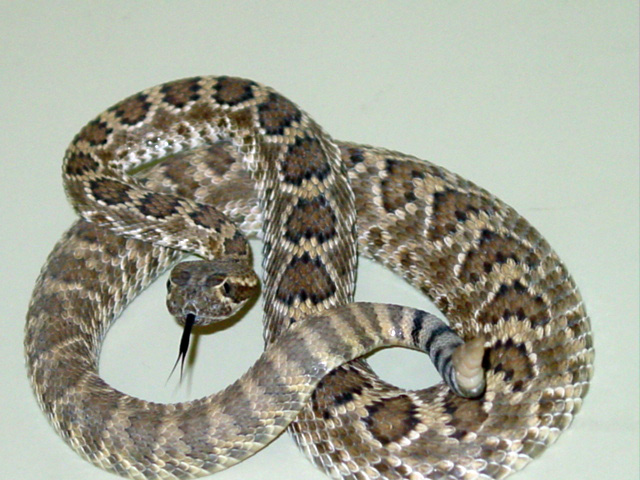 Mojave RattlesnakeCrotalus scutulatus
-
 Prairie RattlesnakeCrotalus viridis
-
 Western RattlesnakeCrotalus oreganus
-
 Tiger RattlesnakeCrotalus tigris
-
 Black-tailed RattlesnakeCrotalus molossus
Compare
Questions and answers
What is the scientific name of the Mexican Dusky Rattlesnake?
The scientific name of the Mexican Dusky Rattlesnake is Crotalus armstrongi. Written with its author, the full name is Crotalus armstrongi Campbell, 1979.
Which family does the Mexican Dusky Rattlesnake belong to?
Crotalus armstrongi belongs to the family Viperidae, in the order Squamata and the class Reptilia.
Where is the Mexican Dusky Rattlesnake found?
Checklists and occurrence records place Crotalus armstrongi in 1 country: Mexico.
Sources
Data
- Catalogue of Life, 2026-10-16 XR cc by
- Global Biodiversity Information Facility CC BY 4.0
- Wikidata CC0
- English Wikipedia CC BY-SA 4.0
- GeoNames CC BY 4.0
- Wikimedia Commons per image; credit shown with each image
- Within the Catalogue of Life, this name comes from The Reptile Database cc by
References
- Campbell, J. A. (1979). A new rattlesnake (Reptilia, Serpentes, Viperidae) from Jalisco, Mexico. Transactions of the Kansas Academy of Science, 81 (4): 365–370.
- Beaman, K. R., & Hayes, W. K. (2008). Rattlesnakes: Research Trends and Annotated Checklist. In: Hayes et al. (eds), The biology of rattlesnakes. Loma Linda University Press, Pp. 5-16.
- Goyenechea Mayer-Goyenechea, Irene, & Martha Gual-Díaz. (2014). Reptilies en el Bosques mesófilos de Montaña de México. In: Gual-Diaz & Rendón-Correa, Bosques Mesófilos de Montaña de México, CONABIO, Pp. 263-278.
- BRYSON, ROBERT W.; JR., CHARLES W. LINKEM, MICHAEL E. DORCAS, AMY LATHROP, JASON M. JONES, JAVIER ALVARADO-DÍAZ, CHRISTOPH I. GRÜNWALD & ROBERT W. MURPHY. (2014). Multilocus species delimitation in the Crotalus triseriatus species group (Serpentes: Viperidae: Crotalinae), with the description of two new species. Zootaxa 3826 (3): 475–496. Link
- Gual-Diaz, M., & Rendón-Correa, A. (2014). Bosques mesófilos de Montaña de México. CONABIO (Comisión Nacional Para El Conocimiento Y Uso de La Biodiversidad), México. 352 Pp.
- Woolrich-Piña, Guillermo A, Paulino Ponce-Campos, Jesús Loc-Barragán, Juan Pablo Ramírez-Silva, Vicente Mata-Silva, Jerry D. Johnson, Elí García-Padilla and Larry David Wilson. (2016). The herpetofauna of Nayarit, Mexico: composition, distribution, and conservation status. Mesoamerican Herpetology 3 (2): 376-448.
- Maritz, Bryan; Johannes Penner, Marcio Martins, Jelka Crnobrnja-Isailović, Stephen Spear, Laura R.V. Alencar, Jesús Sigala-Rodriguez, Kevin Messenger, Rulon W. Clark, Pritpal Soorae, Luca Luiselli, Chris Jenkins, Harry W. Greene. (2016). Identifying global priorities for the conservation of vipers. Biological Conservation, Doi:10.1016/J.Biocon.2016.05.004.
- Heimes, P. (2016). Snakes of Mexico. Chimaira, Frankfurt, 572 Pp.
- Blair C, Bryson RW Jr, Linkem CW, Lazcano D, Klicka J, McCormack JE. (2018). Cryptic diversity in the Mexican highlands: Thousands of UCE loci help illuminate phylogenetic relationships, species limits and divergence times of montane rattlesnakes (Viperidae: Crotalus). Molecular Ecology Resources 19: 349–365 [2019].
- Reyes-Velasco, J., Cox, C. L., Jones, J. M., Borja, M., & Campbell, J. A. (2022). How many species of rattlesnakes are there in the Crotalus durissus species group (Serpentes: Crotalidae)? Revista Latinoamericana de Herpetología 5 (1): 43-55.
- Loc-Barragán JA, Smith GR, Woolrich-Piña GA, & Lemos-Espinal JA. (2024). An updated checklist of the amphibians and reptiles of Nayarit, Mexico with conservation status and comparison with adjoining States. Herpetozoa 37: 25-42.
- Rubio-Blanco, T., Martínez-Díaz-González, R., Heredia-Bobadilla, R. L., Guido-Patiño, J. C., Arenas, S., Caballero-Viñas, C., ... & Sunny, A. (2024). Predicting the effects of climate and land use changes on small rattlesnakes in central Mexico: Insights for conservation planning. Journal for Nature Conservation, 126607.
- García-Padilla, E., Heredia-López, I., Villalobos-Juárez, I., Lazcano, D., & Fucsko, L. A. (2025). Notes on the Herpetofauna of Mexico 48: From Sacred to Scorned---A Study of the Mexican Rattlesnake’s Changing Status. Bulletin of the Chicago Herpetological Society, 60(3), 25-30.
This species in other databases
Page built on 26 November 2026. See how the catalog is made and all sources and licences.
Cite this page
ScientificNames.org. (2026). Crotalus armstrongi (Mexican Dusky Rattlesnake). Retrieved November 26, 2026, from https://scientificnames.org/species/crotalus-armstrongi
“Crotalus armstrongi (Mexican Dusky Rattlesnake).” ScientificNames.org, 2026, scientificnames.org/species/crotalus-armstrongi. Accessed 26 Nov. 2026.
ScientificNames.org. “Crotalus armstrongi (Mexican Dusky Rattlesnake).” Accessed November 26, 2026. https://scientificnames.org/species/crotalus-armstrongi.
@misc{scientificnames_crotalus_armstrongi_mexican_dusky_rattlesnake,
  author = {{ScientificNames.org}},
  title = {Crotalus armstrongi (Mexican Dusky Rattlesnake)},
  year = {2026},
  url = {https://scientificnames.org/species/crotalus-armstrongi},
  note = {Accessed 2026-11-26}
}