Overview
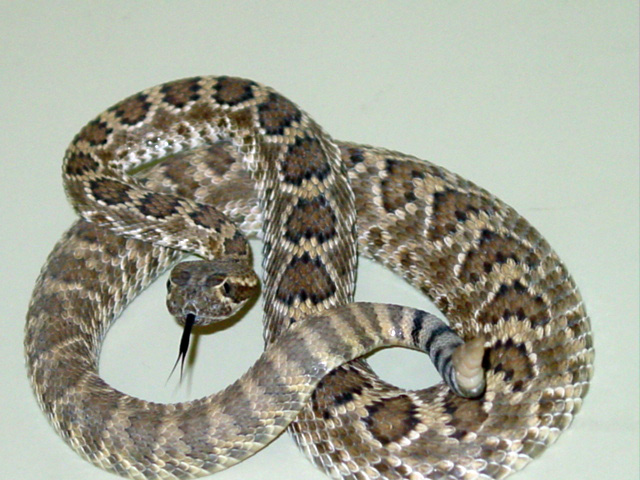
Crotalus campbelli occurs in the Trans-Mexican Volcanic Belt, also locally known as the Sierra Nevada, and is recorded from Jalisco, Colima, and Nayarit. It has a small rattle, a long tail, pale interspaces between its dorsal and lateral blotches, and heavy mottling on its underside.
Written 26 November 2026 from the sources listed below. Each statement was checked against the passage it cites; statements that could not be supported were removed.
Appearance
Campbell's Rattlesnake has a small rattle and a long tail. Its dorsal and lateral blotches are separated by pale interspaces, and its underside has heavy mottling.[1][2][3]
The proximal portion of the rattle and the underside of the tail are dark. Intercanthals and an infrequently divided upper preocular help distinguish it from other members of the C. triseriatus species group.[4][5]
Males typically have 150–154 ventral scales, while females typically have 147–152.[6][7]
Habitat
Campbell's Rattlesnake inhabits open rocky areas near montane forests. It occurs at middle to high elevations.[8][9]
Diet
Campbell's Rattlesnake likely feeds on small mammals and lizards.[10][11]
Classification of the Campbell's Rattlesnake
| Kingdom | Animalia |
|---|---|
| Phylum | Chordata |
| Subphylum | Vertebrata |
| Infraphylum | Gnathostomata |
| Parvphylum | Osteichthyes |
| Megaclass | Tetrapoda |
| Class | Reptilia (Reptile) |
| Order | Squamata (Snakes) |
| Suborder | Serpentes (Snakes) |
| Infraorder | Alethinophidia |
| Family | Viperidae (Viper) |
| Subfamily | Crotalinae |
| Genus | Crotalus (Rattlesnakes) |
| Species | Crotalus campbelli Bryson Jr, Linkem, Dorcas, Lathrop, Jones, Alvarado-Díaz, Grünwald & Murphy, 2014 |
Origin of the name. Etymology. The specific epithet is a patronym honoring Jonathan A. Campbell for his many years of field research on Mexican rattlesnakes and for his decades of unwavering support to students of Mexican herpetology. Habitat and distribution. Crotalus campbelli is found in rocky open breaks within montane forest (Fig. 9) along the far western regions of the Trans-Mexican Volcanic Belt. Much of this forest is covered with remnant patches of cloud forest (Ponce-Reyes et al. 2012). This species is known from western Jalisco and the Sierra de Manantlan in southern Jalisco / northwestern Colima. A narrow low-elevation valley appears to separate the range of C. campbelli from C. armstrongi to the east (Fig. 3).
Where the Campbell's Rattlesnake is found
Checklists and occurrence records place Crotalus campbelli in 1 country across North America. GBIF holds 62 georeferenced records of it.
Countries
Regions and cities with the most records
Range as the checklists state it
Mexico (W Jalisco, NW Colima, Nayarit), elevation up to 2515 m.
A number beside a place is its count of GBIF occurrence records. A place without a number comes from a checklist alone. Records show where a species has been observed or collected, which can include escapes and vagrants.
Common names
English
- Campbell's Rattlesnake
Names in 3 other languages
- Italian
- Crotalo di Campbell, Serpente a sonagli di Campbell
- Portuguese
- Cascavel-de-Campbell
- Spanish
- Cascabel, Cascabel de Campbell
Related species
-
 Timber RattlesnakeCrotalus horridus
-
 Western Diamondback RattlesnakeCrotalus atrox
-
 SidewinderCrotalus cerastes
-
 Mojave RattlesnakeCrotalus scutulatus
-
 Prairie RattlesnakeCrotalus viridis
-
 Western RattlesnakeCrotalus oreganus
-
 Tiger RattlesnakeCrotalus tigris
-
 Black-tailed RattlesnakeCrotalus molossus
Compare
Questions and answers
What is the scientific name of the Campbell's Rattlesnake?
The scientific name of the Campbell's Rattlesnake is Crotalus campbelli. Written with its author, the full name is Crotalus campbelli Bryson Jr, Linkem, Dorcas, Lathrop, Jones, Alvarado-Díaz, Grünwald & Murphy, 2014.
Which family does the Campbell's Rattlesnake belong to?
Crotalus campbelli belongs to the family Viperidae, in the order Squamata and the class Reptilia.
Where is the Campbell's Rattlesnake found?
Checklists and occurrence records place Crotalus campbelli in 1 country: Mexico.
Sources
Passages the profile rests on
- The species has a small rattle and a long tail. Source passage: “The species features a small rattle, a long tail” — English Wikipedia
- The species has pale interspaces between its dorsal and lateral blotches. Source passage: “pale interspaces between dorsal and lateral blotches” — English Wikipedia
- The species has heavy mottling on its underside. Source passage: “heavy venter mottling” — English Wikipedia
- Crotalus campbelli has intercanthals and an infrequently divided upper preocular that help distinguish it from other members of the C. triseriatus species group. Source passage: “by the presence of intercanthals, an infrequently divided upper preocular, and a combination of other morphological characters.” — English Wikipedia
- The proximal portion of the rattle and the underside of the tail are dark. Source passage: “a dark proximal rattle and underside of the tail.” — English Wikipedia
- Male Crotalus campbelli typically have 150–154 ventral scales. Source passage: “Males typically have 150–154 ventrals” — English Wikipedia
- Female Crotalus campbelli typically have 147–152 ventral scales. Source passage: “while females have 147–152 ventrals” — English Wikipedia
- Crotalus campbelli inhabits open rocky areas near montane forests. Source passage: “It inhabits open rocky areas near montane forests” — English Wikipedia
- The species occurs at middle to high elevations. Source passage: “at middle to high elevations.” — English Wikipedia
- Crotalus campbelli likely feeds on small mammals. Source passage: “This species likely feeds on small mammals and lizards.” — English Wikipedia
- Crotalus campbelli likely feeds on lizards. Source passage: “This species likely feeds on small mammals and lizards.” — English Wikipedia
Data
- Catalogue of Life, 2026-10-16 XR cc by
- Global Biodiversity Information Facility CC BY 4.0
- Wikidata CC0
- GeoNames CC BY 4.0
- Within the Catalogue of Life, this name comes from The Reptile Database cc by
References
- BRYSON, ROBERT W.; JR., CHARLES W. LINKEM, MICHAEL E. DORCAS, AMY LATHROP, JASON M. JONES, JAVIER ALVARADO-DÍAZ, CHRISTOPH I. GRÜNWALD & ROBERT W. MURPHY. (2014). Multilocus species delimitation in the Crotalus triseriatus species group (Serpentes: Viperidae: Crotalinae), with the description of two new species. Zootaxa 3826 (3): 475–496. Link where the name was published
- Woolrich-Piña, Guillermo A, Paulino Ponce-Campos, Jesús Loc-Barragán, Juan Pablo Ramírez-Silva, Vicente Mata-Silva, Jerry D. Johnson, Elí García-Padilla and Larry David Wilson. (2016). The herpetofauna of Nayarit, Mexico: composition, distribution, and conservation status. Mesoamerican Herpetology 3 (2): 376-448.
- Flores-Guerrero, Ubaldo Sebastián and Janin Sujey Sánchez-González. (2016). Crotalus campbelli Bryson Jr, Linkem, Dorcas, Lathrop, Jones, Alvarado-Díaz, Grünwald, and Murphy, 2014. Mesoamerican Herpetology 3 (2): 524-525.
- Heimes, P. (2016). Snakes of Mexico. Chimaira, Frankfurt, 572 Pp.
- Luja VH, López JA, Cruz-Elizalde R, & Ramírez-Bautista A. (2017). Herpetofauna inside and outside from a natural protected area: the case of Reserva Estatal de la Biósfera Sierra San Juan, Nayarit, Mexico. Nature Conservation 21: 15-38.
- Blair C, Bryson RW Jr, Linkem CW, Lazcano D, Klicka J, McCormack JE. (2018). Cryptic diversity in the Mexican highlands: Thousands of UCE loci help illuminate phylogenetic relationships, species limits and divergence times of montane rattlesnakes (Viperidae: Crotalus). Molecular Ecology Resources 19: 349–365 [2019].
- Lemos-Espinal JA, Smith GR, Pierce LJS, & Painter CW. (2020). The amphibians and reptiles of Colima, Mexico, with a summary of their conservation status. ZooKeys 927: 99-125.
- Carbajal-Márquez, Rubén Alonso; J. Jesús Sigala-Rodríguez, Jaime A. Escoto-Moreno, Jason M. Jones, Carlos Montaño-Ruvalcaba. (2022). New prey items of Crotalus campbelli (Serpentes: Viperidae) from Mexico. Phyllomedusa 21(2): 95-98.
- OLIVEIRA-DALLAND, LUIS G.; LAURA R.V. ALENCAR, LEANDRO R. TAMBOSI, PAOLA A. CARRASCO, RHETT M. RAUTSAW, JESUS SIGALA-RODRIGUEZ, GUSTAVO SCROCCHI & MARCIO MARTINS. (2022). Conservation gaps for Neotropical vipers: Mismatches between protected areas, species richness and evolutionary distinctiveness. Biological Conservation 275(109750).
- Reyes-Velasco, J., Cox, C. L., Jones, J. M., Borja, M., & Campbell, J. A. (2022). How many species of rattlesnakes are there in the Crotalus durissus species group (Serpentes: Crotalidae)? Revista Latinoamericana de Herpetología 5 (1): 43-55.
- Loc-Barragán JA, Smith GR, Woolrich-Piña GA, & Lemos-Espinal JA. (2024). An updated checklist of the amphibians and reptiles of Nayarit, Mexico with conservation status and comparison with adjoining States. Herpetozoa 37: 25-42.
- García-Padilla, E., Heredia-López, I., Villalobos-Juárez, I., Lazcano, D., & Fucsko, L. A. (2025). Notes on the Herpetofauna of Mexico 48: From Sacred to Scorned---A Study of the Mexican Rattlesnake’s Changing Status. Bulletin of the Chicago Herpetological Society, 60(3), 25-30.
This species in other databases
Page built on 27 November 2026. See how the catalog is made and all sources and licences.
Cite this page
ScientificNames.org. (2026). Crotalus campbelli (Campbell's Rattlesnake). Retrieved November 27, 2026, from https://scientificnames.org/species/crotalus-campbelli
“Crotalus campbelli (Campbell's Rattlesnake).” ScientificNames.org, 2026, scientificnames.org/species/crotalus-campbelli. Accessed 27 Nov. 2026.
ScientificNames.org. “Crotalus campbelli (Campbell's Rattlesnake).” Accessed November 27, 2026. https://scientificnames.org/species/crotalus-campbelli.
@misc{scientificnames_crotalus_campbelli_campbells_rattlesnake,
  author = {{ScientificNames.org}},
  title = {Crotalus campbelli (Campbell's Rattlesnake)},
  year = {2026},
  url = {https://scientificnames.org/species/crotalus-campbelli},
  note = {Accessed 2026-11-27}
}