Species · Reptiles
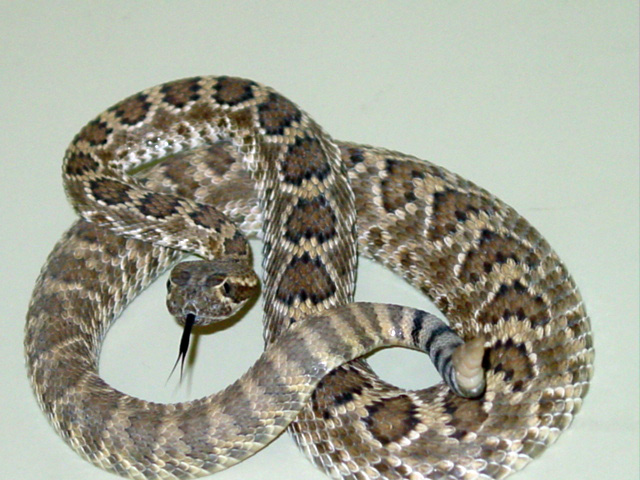
Arizona Black Rattlesnake Crotalus cerberus
The scientific name of the Arizona Black Rattlesnake is Crotalus cerberus. It is a species of reptile in the family Viperidae (viper), order Squamata. The name dates from 1875.
- Scientific name
- Crotalus cerberus (Coues, 1875)
- Common name
- Arizona Black Rattlesnake
- Genus
- Crotalus
- Family
- Viperidae (Viper)
- Order
- Squamata
- Class
- Reptilia
- Recorded in
- 2 countries
- Name status
- accepted in the Catalogue of Life

Overview
Crotalus cerberus is a venomous pit viper species found in the southwestern United States. It is known as the Arizona black rattlesnake, black rattlesnake, and several other common names.
Classification of the Arizona Black Rattlesnake
| Kingdom | Animalia |
|---|---|
| Phylum | Chordata |
| Subphylum | Vertebrata |
| Infraphylum | Gnathostomata |
| Parvphylum | Osteichthyes |
| Megaclass | Tetrapoda |
| Class | Reptilia (Reptile) |
| Order | Squamata (Snakes) |
| Suborder | Serpentes (Snakes) |
| Infraorder | Alethinophidia |
| Family | Viperidae (Viper) |
| Subfamily | Crotalinae |
| Genus | Crotalus (Rattlesnakes) |
| Species | Crotalus cerberus (Coues, 1875) |
Where the Arizona Black Rattlesnake is found
Checklists and occurrence records place Crotalus cerberus in 2 countries across North America. GBIF holds 868 georeferenced records of it.
Countries
Regions and cities with the most records
- Arizona, United States 747
- New Mexico, United States 40
- Catalina Foothills, United States 29
- Oro Valley, United States 20
- Flagstaff, United States 12
- Tucson, United States 8
- Casas Adobes, United States 6
- Chandler, United States 6
- Gilbert, United States 6
- Mesa, United States 6
- Phoenix, United States 6
- Scottsdale, United States 6
- Tempe, United States 6
- Tempe Junction, United States 6
- Sonora, Mexico 3
Range as the checklists state it
USA (C Arizona to W New Mexico)
A number beside a place is its count of GBIF occurrence records. A place without a number comes from a checklist alone. Records show where a species has been observed or collected, which can include escapes and vagrants.
Common names
English
- Arizona Black Rattlesnake
Names in 4 other languages
- German
- Schwarze Arizona-Klapperschlange
- Italian
- Crotalo nero d'Arizona, Crotalo nero dell'Arizona, Serpente a sonagli nero d'Arizona, Serpente a sonagli nero dell'Arizona
- Portuguese
- Cascavel-negra-do-Arizona
- Spanish
- Cascabel negra de Arizona
Synonyms
4 other scientific names have been used for this species and are now treated as synonyms of Crotalus cerberus.
- Caudisona lucifer cerberus Coues in Wheeler, 1875
- Caudisona lucifer var. cerberus Coues, 1875
- Crotalus oreganus cerberus (Coues in Wheeler, 1875)
- Crotalus viridis cerberus (Coues in Wheeler, 1875)
Related species
-
 Timber RattlesnakeCrotalus horridus
-
 Western Diamondback RattlesnakeCrotalus atrox
-
 SidewinderCrotalus cerastes
-
 Mojave RattlesnakeCrotalus scutulatus
-
 Hopi RattlesnakeCrotalus viridis
-
 Western RattlesnakeCrotalus oreganus
-
 Tiger RattlesnakeCrotalus tigris
-
 Black-tailed RattlesnakeCrotalus molossus
Compare
Questions and answers
What is the scientific name of the Arizona Black Rattlesnake?
The scientific name of the Arizona Black Rattlesnake is Crotalus cerberus. Written with its author, the full name is Crotalus cerberus (Coues, 1875).
Which family does the Arizona Black Rattlesnake belong to?
Crotalus cerberus belongs to the family Viperidae, in the order Squamata and the class Reptilia.
Where is the Arizona Black Rattlesnake found?
Checklists and occurrence records place Crotalus cerberus in 2 countries: United States and Mexico.
Sources
Data
- Catalogue of Life, 2026-10-16 XR cc by
- Global Biodiversity Information Facility CC BY 4.0
- Wikidata CC0
- English Wikipedia CC BY-SA 4.0
- GeoNames CC BY 4.0
- Wikimedia Commons per image; credit shown with each image
- Within the Catalogue of Life, this name comes from The Reptile Database cc by
References
- Wheeler, 1875 where the name was published
- Coues, & Elliott. (1875). Synopsis of the Reptiles and Batrachians of Arizona; with critical and field notes, and an extensive synonymy. Chapter IV. Reports upon the Collections Obtained from Portions of Nevada, Utah, California, Colorado, New Mexico, and Arizona, during the Years 1871, 1872, 1873, and 1874 by Dr. H.C. Yarrow. Report upon Geographical and Geological Explorations and Surveys West of the One Hundredth Meridian. Volume V. Zoology: : 509-633 + 10 Lithographic Plates (3 Are Chromolithographs).
- Klauber, Laurence M. (1949). Some new and revived subspecies of rattlesnakes. Transactions of the San Diego Society of Natural History 11 (6): 61-116. Link
- Jones, K.B.; Abbas, D.R. & Bergstedt, T. (1981). Herpetological records from Central and Northeastern Arizona. Herpetological Review 12 (1): 16.
- Stebbins, R. C. (1985). A Field Guide to Western Reptiles and Amphibians, 2nd ed. Houghton Mifflin, Boston.
- Campbell, J. A., & Lamar, W. W. (1989). The Venomous Reptiles of Latin America. Comstock Publishing/Cornell University Press, Ithaca.
- Crother, B. I. (2000). Scientific and standard English names of amphibians and reptiles of North America north of Mexico, with comments regarding confidence in our understanding. Herpetological Circular 29: 1-82.
- Pook, Catherine E., Wolfgang Wüster and Roger S. Thorpe. (2000). Historical biogeography of the western rattlesnake (Serpentes: Viperidae: Crotalus viridis), inferred from mitochondrial DNA sequence information. Molecular Phylogenetics and Evolution. 15(2):269-282.
- Ashton, Kyle G.; de Queiroz, Alan. (2001). Molecular systematics of the Western Rattlesnake, Crotalus viridis (Viperidae), with comments on the utility of the D-Loop in phylogenetic studies of snakes. Molecular Phylogenetics and Evolution 21(2):176-189.
- Douglas, Michael E.; Douglas, Marlis R.; Schuett, Gordon W.; Porras, Louis W.; Holycross, Andrew T. (2002). Phylogeography of the western rattlesnake (Crotalus viridis) complex, with emphasis on the Colorado Plateau. In Biology of the Vipers, edited by Gordon W. Schuett et al. Eagle Mountain Publishing, Pp. 11-50.
- Beaman, K. R., & Hayes, W. K. (2008). Rattlesnakes: Research Trends and Annotated Checklist. In: Hayes et al. (eds), The biology of rattlesnakes. Loma Linda University Press, Pp. 5-16.
- Hoser, R. (2009). A reclassification of the rattlesnakes; species formerly exclusively referred to the genera Crotalus and Sistrurus. Australasian J. Herpetol. 3: 1-21 (Dubious Journal).
- FLESCH, AARON D.; DON E. SWANN, DALE S. TURNER, AND BRIAN F. POWELL. (2010). HERPETOFAUNA OF THE RINCON MOUNTAINS, ARIZONA. Southwestern Naturalist 55(2):240–253.
- Repp, R. (2010). Herping Arizona—August 2009—Black Velvet. Sonoran Herpetologist 23 (8):108-115.
- Wüster, W., & Bérnils, R. S. (2011). On the generic classification of the rattlesnakes, with special reference to the Neotropical Crotalus durissus complex (Squamata: Viperidae). Zoologia 28 (4): 417–419.
- Beolens, B., & Michael Watkins, a. M. G. (2011). The Eponym Dictionary of Reptiles. Johns Hopkins University Press, Baltimore, USA.
- Skubowius, & Bernd. (2012). Some encounter with the Arizona Black Rattlesnake Crotalus cerberus (Coues, 1875). Litteratura Serpentium 32 (4): 165-175.
- Werning, & Heiko. (2012). Die Reptilien und Amphibien des Südwestens. Draco 13 (50): 18-60.
- Bezy, Robert L. and Charles J. Cole. (2014). Amphibians and Reptiles of the Madrean Archipelago of Arizona and New Mexico. American Museum Novitates (3810): 1-24.
- Lillywhite, Harvey B. (2014). How Snakes Work: Structure, Function and Behavior of the World’s Snakes. Oxford University Press, New York, 256 Pp.
- Wallach, Van; Kenneth L. Williams, Jeff Boundy. (2014). Snakes of the World: A Catalogue of Living and Extinct Species. [type catalogue]. Taylor and Francis, CRC Press, 1237 Pp.
- Mocarski, Zenon R. and Randall D. Babb. (2015). Geographic Distribution: Crotalus cerberus (Arizona black rattlesnake). Herpetological Review 46 (1): 61.
- Davis MA, Douglas MR, Collyer ML, & Douglas ME. (2016). Deconstructing a Species-Complex: Geometric Morphometric and Molecular Analyses Define Species in the Western Rattlesnake (Crotalus viridis). PLoS One 11 (1): E0146166.Doi:10.1371/Journal.Pone.0146166.
- Spinner, L. (2017). Die Klapperschlangen der USA in Natur und Terrarium. Reptilia (Münster) 22 (124): 18-33.
- Vogrinc, Philip N., Files, Tyler and Berven, Jenny. (2017). Crotalus cerberus (Arizona Black Rattlesnake) Diet. Herpetological Review 48 (1): 207-208.
This species in other databases
Page built on 25 November 2026. See how the catalog is made and all sources and licences.
Cite this page
ScientificNames.org. (2026). Crotalus cerberus (Arizona Black Rattlesnake). Retrieved November 25, 2026, from https://scientificnames.org/species/crotalus-cerberus
“Crotalus cerberus (Arizona Black Rattlesnake).” ScientificNames.org, 2026, scientificnames.org/species/crotalus-cerberus. Accessed 25 Nov. 2026.
ScientificNames.org. “Crotalus cerberus (Arizona Black Rattlesnake).” Accessed November 25, 2026. https://scientificnames.org/species/crotalus-cerberus.
@misc{scientificnames_crotalus_cerberus_arizona_black_rattlesnake,
  author = {{ScientificNames.org}},
  title = {Crotalus cerberus (Arizona Black Rattlesnake)},
  year = {2026},
  url = {https://scientificnames.org/species/crotalus-cerberus},
  note = {Accessed 2026-11-25}
}