Species · Reptiles
Northwestern Neotropical Rattlesnake Crotalus culminatus
The scientific name of the Northwestern Neotropical Rattlesnake is Crotalus culminatus. It is a species of reptile in the family Viperidae (viper), order Squamata. The name dates from 1952.

Overview
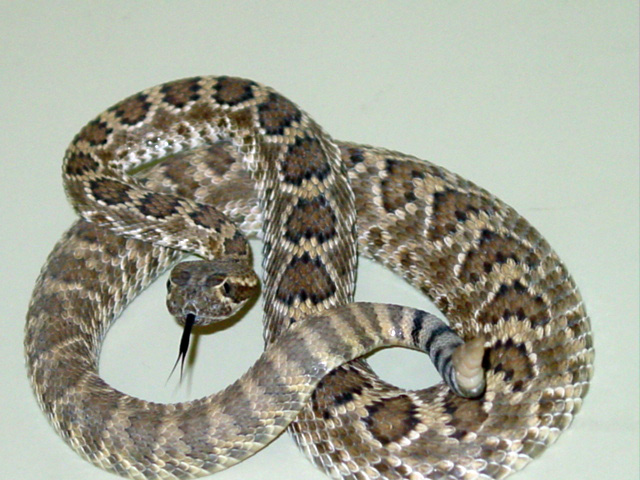
The Northwestern Neotropical Rattlesnake occurs across much of southwestern Mexico. It has a heavy body with strongly keeled scales, black diamond-shaped back markings, longitudinal neck lines, and a prominent vertebral ridge.
Written 26 November 2026 from the sources listed below. Each statement was checked against the passage it cites; statements that could not be supported were removed.
Uses
The Northwestern Neotropical Rattlesnake has myotoxic-hemotoxic venom capable of causing hemorrhaging and localized paralysis through muscle damage. Although less deadly to humans than some closely related species, its venom can still cause significant harm.[1][2]
Appearance
Adult individuals reach lengths of 100 to 180 cm. The species has a heavy body covered in strongly keeled scales.[3][4]
Its coloration ranges from creamy yellow to gray toward the tail. Its back bears black diamond-shaped markings, and its neck has longitudinal lines.[5][6]
The specific name culminatus derives from Latin words for ridge and provided with, referring to the species' prominent vertebral ridge.[7]
Habitat
The species occupies elevations ranging from near sea level to 2,285 meters in the Sierra de Coalcomán. Its habitats include arid environments, tropical scrub forests, savannas, and mesic forests.[8][9]
Rocky outcroppings are an important component of its habitat requirements.[10]
Diet
The Northwestern Neotropical Rattlesnake is considered a likely generalist predator. Reported prey include rodents, lizards, and small birds.[11][12]
Classification of the Northwestern Neotropical Rattlesnake
| Kingdom | Animalia |
|---|---|
| Phylum | Chordata |
| Subphylum | Vertebrata |
| Infraphylum | Gnathostomata |
| Parvphylum | Osteichthyes |
| Megaclass | Tetrapoda |
| Class | Reptilia (Reptile) |
| Order | Squamata (Snakes) |
| Suborder | Serpentes (Snakes) |
| Infraorder | Alethinophidia |
| Family | Viperidae (Viper) |
| Subfamily | Crotalinae |
| Genus | Crotalus (Rattlesnakes) |
| Species | Crotalus culminatus Klauber, 1952 |
Where the Northwestern Neotropical Rattlesnake is found
Checklists and occurrence records place Crotalus culminatus in 1 country across North America. GBIF holds 255 georeferenced records of it.
Countries
Regions and cities with the most records
- Guerrero, Mexico 64
- Oaxaca, Mexico 50
- Morelos, Mexico 46
- Michoacán, Mexico 28
- Zumpango del Río, Mexico 20
- Chilpancingo, Mexico 18
- Santa Rosa Treinta, Mexico 16
- Tixtla de Guerrero, Mexico 16
- Jiutepec, Mexico 15
- Xochitepec, Mexico 15
- Emiliano Zapata, Mexico 14
- Xoxocotla, Mexico 14
- Zacatepec de Hidalgo, Mexico 14
- México, Mexico 13
- Puente de Ixtla, Mexico 13
- Temixco, Mexico 13
- Tlaquiltenango, Mexico 13
- Tres de Mayo, Mexico 13
- Yautepec, Mexico 13
- Jojutla, Mexico 12
- Puebla, Mexico 12
- Cuernavaca, Mexico 11
- Taxco de Alarcón, Mexico 9
- Axochiapan, Mexico 8
- Cuautla, Mexico 8
- Ciudad de Huajuapan de León, Mexico 7
- Santo Domingo Tehuantepec, Mexico 7
- Crucecita, Mexico 6
- Salina Cruz, Mexico 6
- Arcelia, Mexico 4
- Uruapan, Mexico 4
- Iguala de la Independencia, Mexico 3
- Nueva Italia de Ruiz, Mexico 3
- Valle de Bravo, Mexico 3
Range as the checklists state it
Mexico (Michoacan, Oaxaca, Morelos, México, Puebla, Guerrero)
A number beside a place is its count of GBIF occurrence records. A place without a number comes from a checklist alone. Records show where a species has been observed or collected, which can include escapes and vagrants.
Common names
English
- Northwestern Neotropical Rattlesnake
- Tehuantepec Isthmus Neotropical Rattlesnake [ehecatl]
Names in 6 other languages
- Chinese
- 西北部響尾蛇
- Danish
- Nordvestlig Neotropisk Klapperslange
- German
- Nordwestliche Schauerklappschlange
- Italian
- Crotalo neotropicale nord-occidentale, Serpente a sonagli neotropicale nord-occidentale
- Portuguese
- Cascavel-tropical-do-Pacífico
- Spanish
- Cascabel tropical del Pacífico, Shunu
Synonyms
3 other scientific names have been used for this species and are now treated as synonyms of Crotalus culminatus.
- Crotalus durissus culminatus Klauber, 1952
- Crotalus loeflingii Humboldt, 1811
- Crotalus simus culminatus Klauber, 1952
Related species
-
 Timber RattlesnakeCrotalus horridus
-
 Western Diamondback RattlesnakeCrotalus atrox
-
 SidewinderCrotalus cerastes
-
 Mojave RattlesnakeCrotalus scutulatus
-
 Prairie RattlesnakeCrotalus viridis
-
 Western RattlesnakeCrotalus oreganus
-
 Tiger RattlesnakeCrotalus tigris
-
 Black-tailed RattlesnakeCrotalus molossus
Compare
Questions and answers
What is the scientific name of the Northwestern Neotropical Rattlesnake?
The scientific name of the Northwestern Neotropical Rattlesnake is Crotalus culminatus. Written with its author, the full name is Crotalus culminatus Klauber, 1952.
Which family does the Northwestern Neotropical Rattlesnake belong to?
Crotalus culminatus belongs to the family Viperidae, in the order Squamata and the class Reptilia.
Where is the Northwestern Neotropical Rattlesnake found?
Checklists and occurrence records place Crotalus culminatus in 1 country: Mexico.
What other names does the Northwestern Neotropical Rattlesnake have?
Crotalus culminatus is also known in English as Tehuantepec Isthmus Neotropical Rattlesnake [ehecatl].
Sources
Passages the profile rests on
- The species has myotoxic-hemotoxic venom capable of causing hemorrhaging and localized paralysis through muscle damage. Source passage: “This species has a myotoxic-hemotoxic venom, which can cause hemorrhaging and induce localized paralysis via muscle damage.” — English Wikipedia
- Although less deadly to humans than some closely related species, its venom can still cause significant harm. Source passage: “While it is less deadly to humans than some of its close relatives, it can still cause significant harm.” — English Wikipedia
- Adult individuals reach lengths of 100 to 180 cm. Source passage: “adults reaching lengths of 100 to 180 cm (approximately 39 to 71 inches).” — English Wikipedia
- The species has a heavy body covered in strongly keeled scales. Source passage: “It has a heavy body with strongly keeled scales.” — English Wikipedia
- Its coloration ranges from creamy yellow to gray toward the tail. Source passage: “The coloration is creamy yellow, becoming gray towards the tail” — English Wikipedia
- Its back bears black diamond-shaped markings and its neck has longitudinal lines. Source passage: “with diamond-shaped black markings on the back and longitudinal lines on the neck.” — English Wikipedia
- The specific name culminatus derives from the Latin words for ridge and provided with, referring to the species' prominent vertebral ridge. Source passage: “The specific name, culminatus, comes from the Latin words "culmen" (ridge) and "-atus" (provided with), referring to this snake's strong vertebral ridge.” — English Wikipedia
- The species occupies elevations ranging from near sea level to 2,285 meters in the Sierra de Coalcomán. Source passage: “inhabiting a wide range of elevations from near sea level up to 2285 meters in the Sierra de Coalcomán.” — English Wikipedia
- Its habitats include arid environments, tropical scrub forests, savannas, and mesic forests. Source passage: “It can be found in arid environments, tropical scrub forests, savannas, and mesic forests” — English Wikipedia
- Rocky outcroppings are an important component of the species' habitat requirements. Source passage: “with rocky outcroppings being central to its habitat needs.” — English Wikipedia
- The species is considered a likely generalist predator. Source passage: “This species is likely a generalist predator” — English Wikipedia
- Reported prey include rodents, lizards, and small birds. Source passage: “with reported prey items including rodents, lizards, and small birds.” — English Wikipedia
Data
- Catalogue of Life, 2026-10-16 XR cc by
- Global Biodiversity Information Facility CC BY 4.0
- Wikidata CC0
- GeoNames CC BY 4.0
- Wikimedia Commons per image; credit shown with each image
- Within the Catalogue of Life, this name comes from The Reptile Database cc by
References
- Klauber, Laurence M. (1941). A new species of rattlesnake from Venezuela. Transactions of the San Diego Society of Natural History 9 (30): 333-336.
- Smith, Hobart M. & Taylor, Edward H. (1950). Type localities of Mexican reptiles and amphibians. Univ. Kansas Sci. Bull. 33 (8): 313-380.
- Klauber, Laurence M. (1952). Taxonomic studies on rattlesnakes of Mainland Mexico. Bulletins of the Zoological Society of San Diego (26): 1-143.
- Davis, William B.; Smith, Hobart M. (1953). Snakes of the Mexican state of Morelos. Herpetologica 8: 133-149.
- Armstrong, B.L., & Murphy, J.B. (1979). The natural history of Mexican rattlesnakes. Univ. Kansas Publ. Mus. Nat. Hist. (5): 88 Pp.
- Camarillo Rangel, J. L. (1983). New herpetological records from the state of Mexico. Bull. Maryland Herp. Soc. 19(2):39-46.
- McCranie J R. (1993). Crotalus durissus Linnaeus, Neotropical rattlesnake. Catalogue of American Amphibians and Reptiles 577: 1-11.
- Campbell, Jonathan A. and William W. Lamar. (2004). The Venomous Reptiles of the Western Hemisphere, 2 vols. Comstock (Cornell University Press), Ithaca, NY, 962 Pp. [Review in Science 305: 182].
- WÜSTER, WOLFGANG; JULIA E. FERGUSON; J. ADRIAN QUIJADA-MASCAREÑAS; CATHARINE E. POOK; MARIA DA GRAÇA SALOMÃO and ROGER S. THORPE. (2005). Tracing an invasion: landbridges, refugia, and the phylogeography of the Neotropical rattlesnake (Serpentes: Viperidae: Crotalus durissus). Molecular Ecology 14: 1095–1108.
- Savage, J. M., Campbell, J. A., & Lamar, W. W. (2005). On names for neotropical rattlesnakes. Herpetological Review 36: 369– 371.
- Quijada-Mascareñas & Wüster, W. (2006). On the Origins and Dispersal of Neotropical Rattlesnakes in South America. CAH/ACH Bulletin 14 (1): 6-12.
- Quijada-Mascareñas & Wüster, W. (2006). Crotalus durissus complex: from Yucatan to Patagonia: the natural history of the Neotropical rattlesnake. Reptilia (GB) (49): 66-73.
- Beaman, K. R., & Hayes, W. K. (2008). Rattlesnakes: Research Trends and Annotated Checklist. In: Hayes et al. (eds), The biology of rattlesnakes. Loma Linda University Press, Pp. 5-16.
- Hoser, R. (2009). A reclassification of the rattlesnakes; species formerly exclusively referred to the genera Crotalus and Sistrurus. Australasian J. Herpetol. 3: 1-21 (Dubious Journal).
- Wüster, W., & Bérnils, R. S. (2011). On the generic classification of the rattlesnakes, with special reference to the Neotropical Crotalus durissus complex (Squamata: Viperidae). Zoologia 28 (4): 417–419.
- Wallach, Van; Kenneth L. Williams, Jeff Boundy. (2014). Snakes of the World: A Catalogue of Living and Extinct Species. [type catalogue]. Taylor and Francis, CRC Press, 1237 Pp.
- Peralta-Fonseca, Zabdiel A. and Elí García-Padilla. (2015). Crotalus culminatus (Klauber, 1952). Mesoamerican Herpetology 2 (2): 208.
- Mata-Silva, Vicente, Jerry D. Johnson, Larry David Wilson and Elí García-Padilla. (2015). The herpetofauna of Oaxaca, Mexico: composition, physiographic distribution, and conservation status. Mesoamerican Herpetology 2 (1): 6–62.
- Heimes, P. (2016). Snakes of Mexico. Chimaira, Frankfurt, 572 Pp.
- Palacios-Aguilar, Ricardo, Thalia E. Cruz-Machuca and J. Diego Arias-Montiel. (2016). Crotalus culminatus (Klauber, 1952). Mexico, Estado de México. Mesoamerican Herpetology 3(4): 1067–1068.
- Riaño-García, M., E. García-Padilla, V. Mata-Silva, D. L. DeSantis, and L. D. Wilson. (2017). Crotalus culminatus Klauber, 1952. Mexico, Oaxaca. Mesoamerican Herpetology 4 (1): 202–203.
- Woolrich-Piña, G. A., E. García-Padilla, D. L. DeSantis, J. D. Johnson, V. Mata-Silva, and L. D. Wilson. (2017). The herpetofauna of Puebla, Mexico: composition, distribution, and conservation status. Mesoamerican Herpetology 4 (4): 791–884.
- Palacios-Aguilar, Ricardo, & OSCAR FLORES-VILLELA. (2018). An updated checklist of the herpetofauna from Guerrero, Mexico. Zootaxa 4422 (1): 1-24.
- Mata-Silva, V; Rocha, A; Mata-González, S; Ramírez-Bautista, A; Berriozabal-Islas, C; García-Padilla, E; Johnson, J D & Wilson, L D; (2019). First municipality records and additional information on the herpetofauna of Oaxaco, Mexico. Herpetological Review 50 (3): 533-536.
- Lemos-Espinal JA, & Smith GR. (2020). A conservation checklist of the amphibians and reptiles of the State of Mexico, Mexico with comparisons with adjoining states. ZooKeys 953: 137-159.
This species in other databases
Page built on 28 November 2026. See how the catalog is made and all sources and licences.
Cite this page
ScientificNames.org. (2026). Crotalus culminatus (Northwestern Neotropical Rattlesnake). Retrieved November 28, 2026, from https://scientificnames.org/species/crotalus-culminatus
“Crotalus culminatus (Northwestern Neotropical Rattlesnake).” ScientificNames.org, 2026, scientificnames.org/species/crotalus-culminatus. Accessed 28 Nov. 2026.
ScientificNames.org. “Crotalus culminatus (Northwestern Neotropical Rattlesnake).” Accessed November 28, 2026. https://scientificnames.org/species/crotalus-culminatus.
@misc{scientificnames_crotalus_culminatus_northwestern_neotropical_rattlesnake,
  author = {{ScientificNames.org}},
  title = {Crotalus culminatus (Northwestern Neotropical Rattlesnake)},
  year = {2026},
  url = {https://scientificnames.org/species/crotalus-culminatus},
  note = {Accessed 2026-11-28}
}