Species · Reptiles
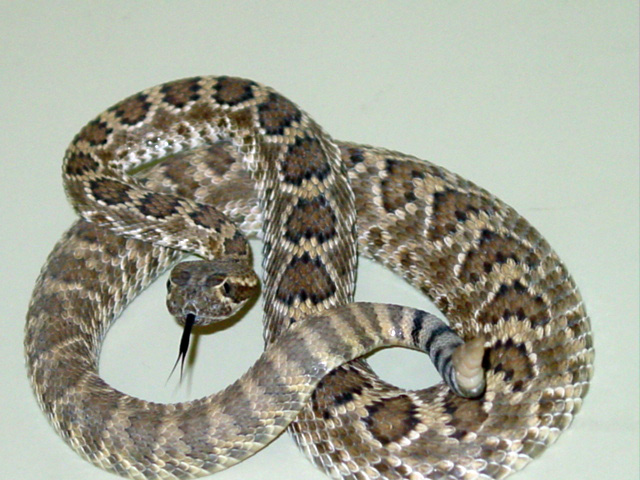
Baja California Rattlesnake Crotalus enyo
The scientific name of the Baja California Rattlesnake is Crotalus enyo. It is a species of reptile in the family Viperidae (viper), order Squamata. The name dates from 1861.
- Scientific name
- Crotalus enyo (Cope, 1861)
- Common name
- Baja California Rattlesnake
- Genus
- Crotalus
- Family
- Viperidae (Viper)
- Order
- Squamata
- Class
- Reptilia
- Red List category
- LC Least Concern
- Recorded in
- 2 countries
- Name status
- accepted in the Catalogue of Life

Overview
Crotalus enyo, commonly known as the Baja California rattlesnake or Lower California rattlesnake, is a pit viper species native to the coast and islands of northwestern Mexico. Like all other pit vipers, it is venomous. Three subspecies are currently recognized, including the nominate subspecies described here.
Classification of the Baja California Rattlesnake
| Kingdom | Animalia |
|---|---|
| Phylum | Chordata |
| Subphylum | Vertebrata |
| Infraphylum | Gnathostomata |
| Parvphylum | Osteichthyes |
| Megaclass | Tetrapoda |
| Class | Reptilia (Reptile) |
| Order | Squamata (Snakes) |
| Suborder | Serpentes (Snakes) |
| Infraorder | Alethinophidia |
| Family | Viperidae (Viper) |
| Subfamily | Crotalinae |
| Genus | Crotalus (Rattlesnakes) |
| Species | Crotalus enyo (Cope, 1861) |
Where the Baja California Rattlesnake is found
Checklists and occurrence records place Crotalus enyo in 2 countries across North America. GBIF holds 711 georeferenced records of it.
Countries
Regions and cities with the most records
- Baja California Sur, Mexico 432
- Baja California, Mexico 155
- Colonia del Sol, Mexico 67
- Cabo San Lucas, Mexico 66
- La Paz, Mexico 35
- San José del Cabo, Mexico 23
Range as the checklists state it
Mexico (Baja California)
A number beside a place is its count of GBIF occurrence records. A place without a number comes from a checklist alone. Records show where a species has been observed or collected, which can include escapes and vagrants.
Common names
English
- Baja California Rattlesnake
- Lower California Rattlesnake
Names in 7 other languages
- Chinese
- 女神響尾蛇
- German
- Baja-Klapperschlange, Kalifornische Klapperschlange
- Italian
- Crotalo della Bassa California, Serpente a sonagli della Bassa California
- Polish
- grzechotnik półwyspowy
- Portuguese
- Cascavel-da-Baja-Califórnia
- Russian
- Гремучник нижней Калифорнии
- Spanish
- Cascabel de Baja California, Víbora-cascabel bajacaliforniana
Synonyms
2 other scientific names have been used for this species and are now treated as synonyms of Crotalus enyo.
- Caudisona enyo Cope, 1861
- Crotalus enyo enyo Lowe & Norris, 1954 ambiguous synonym
Subspecies and varieties
- Crotalus enyo cerralvensis (Cerralvo Rattlesnake) subspecies
- Crotalus enyo enyo (Baja California Rattlesnake) subspecies
- Crotalus enyo furvus (Rosario Rattlesnake) subspecies
Related species
-
 Timber RattlesnakeCrotalus horridus
-
 Western Diamondback RattlesnakeCrotalus atrox
-
 SidewinderCrotalus cerastes
-
 Mojave RattlesnakeCrotalus scutulatus
-
 Hopi RattlesnakeCrotalus viridis
-
 Western RattlesnakeCrotalus oreganus
-
 Tiger RattlesnakeCrotalus tigris
-
 Black-tailed RattlesnakeCrotalus molossus
Compare
Questions and answers
What is the scientific name of the Baja California Rattlesnake?
The scientific name of the Baja California Rattlesnake is Crotalus enyo. Written with its author, the full name is Crotalus enyo (Cope, 1861).
Which family does the Baja California Rattlesnake belong to?
Crotalus enyo belongs to the family Viperidae, in the order Squamata and the class Reptilia.
Where is the Baja California Rattlesnake found?
Checklists and occurrence records place Crotalus enyo in 2 countries: Mexico and United States.
What is the conservation status of the Baja California Rattlesnake?
The IUCN Red List category recorded for Crotalus enyo is Least Concern (LC).
What other names does the Baja California Rattlesnake have?
Crotalus enyo is also known in English as Lower California Rattlesnake.
Sources
Data
- Catalogue of Life, 2026-10-16 XR cc by
- Global Biodiversity Information Facility CC BY 4.0
- Wikidata CC0
- English Wikipedia CC BY-SA 4.0
- GeoNames CC BY 4.0
- Wikimedia Commons per image; credit shown with each image
- Within the Catalogue of Life, this name comes from The Reptile Database cc by
References
- Cope, E. D. (1861). Contributions to the ophiology of Lower California, Mexico and Central America. Proc. Acad. Nat. Sci. Philadelphia 13: 292-306.
- Van Denburgh, J. (1895). A review of the herpetology of Lower California. Part I - Reptiles. Proc. Cal. Acad. Sci. (2) 5: 77-163.
- Cope, E. D. (1900). The crocodilians, lizards and snakes of North America. Ann. Rep. U.S. Natl. Mus. 1898: 153-1270.
- Cliff, Frank S. (1954). Snakes of the islands in the Gulf of California, Mexico. Transactions of the San Diego Society of Natural History 12 (5): 67-98. Link
- Lowe, Charles H., Jr & Norris, Kenneth S. (1954). Analysis of the herpetofauna of Baja California, Mexico. Transactions of the San Diego Society of Natural History 12 (4): 47-64. Link
- Murphy, R. W., & Ottley, J. R. (1984). Distribution of amphibians and reptiles on islands in the Gulf of California. Annals of the Carnegie Museum 53 (8): 207-230.
- Stebbins, R. C. (1985). A Field Guide to Western Reptiles and Amphibians, 2nd ed. Houghton Mifflin, Boston.
- Campbell, J. A., & Lamar, W. W. (1989). The Venomous Reptiles of Latin America. Comstock Publishing/Cornell University Press, Ithaca.
- Beaman K R, & Grismer L L. (1994). Crotalus enyo (Cope), Baja California rattlesnake. Catalogue of American Amphibians and Reptiles 589: 1-6.
- Grismer, L. L., McGuire, J. A., & Hollingsworth, B. D. (1994). A report on the herpetofauna of the Vizcaino Peninsula, Baja California, Mexico, with a discussion of its biogeographic and taxonomic implications. Bull. Southern California Acad. Sci. 93 (2): 45-80.
- Grismer, L. Lee. (1999). An evolutionary classification of reptiles on islands in the Gulf of California, México. Herpetologica 55 (4): 446-469.
- McDiarmid, R.W.; Campbell, J.A. & Touré,T.A. (1999). Snake species of the world. Vol. 1. [type catalogue]. Herpetologists’ League, 511 Pp.
- Taylor, E. N. (2001). Diet of the Baja California Rattlesnake, Crotalus enyo (Viperidae). Copeia 2001 (2): 553-555.
- Rodríguez-Robles, Javier A., Good, David A., Wake, David B. (2003). Brief History of Herpetology in the Museum of Vertebrate Zoology, University of California, Berkeley, with a List of Type Specimens of Recent Amphibians and Reptiles. UC Publications in Zoology, 119 Pp.
- Schmidt, D., & Kunz, K. (2005). Ernährung von Schlangen. Natur Und Tier Verlag, Münster, 159 Pp.
- Winchell, S. (2007). Klapperschlangen! Die Gattung Crotalus. Reptilia (Münster) 12 (66): 18-25.
- Beaman, K. R., & Hayes, W. K. (2008). Rattlesnakes: Research Trends and Annotated Checklist. In: Hayes et al. (eds), The biology of rattlesnakes. Loma Linda University Press, Pp. 5-16.
- Olivier, R. (2008). Da Baja California ratelslang, Crotalus enyo en een kweekverslag van de Rosario ratelslang, Crotalus enyo furvus. Lacerta 66 (1-3): 30-39.
- Meik, & Jesse M and André Pires-daSilva. (2009). Evolutionary morphology of the rattlesnake style. BMC Evolutionary Biology 2009, 9:35.
- Hoser, R. (2009). A reclassification of the rattlesnakes; species formerly exclusively referred to the genera Crotalus and Sistrurus. Australasian J. Herpetol. 3: 1-21 (Dubious Journal).
- Akeret, B. (2010). Sukkulenten und andere Pflanzen für das Trockenterrarium. Draco 11 (41): 44-53.
- Wüster, W., & Bérnils, R. S. (2011). On the generic classification of the rattlesnakes, with special reference to the Neotropical Crotalus durissus complex (Squamata: Viperidae). Zoologia 28 (4): 417–419.
- Wallach, Van; Kenneth L. Williams, Jeff Boundy. (2014). Snakes of the World: A Catalogue of Living and Extinct Species. [type catalogue]. Taylor and Francis, CRC Press, 1237 Pp.
- Akeret, & Beat. (2015). Sukkulenten als Terrarienpflanzen. Draco 16 (62): 28-38.
- Heimes, P. (2016). Snakes of Mexico. Chimaira, Frankfurt, 572 Pp.
This species in other databases
Page built on 25 November 2026. See how the catalog is made and all sources and licences.
Cite this page
ScientificNames.org. (2026). Crotalus enyo (Baja California Rattlesnake). Retrieved November 25, 2026, from https://scientificnames.org/species/crotalus-enyo
“Crotalus enyo (Baja California Rattlesnake).” ScientificNames.org, 2026, scientificnames.org/species/crotalus-enyo. Accessed 25 Nov. 2026.
ScientificNames.org. “Crotalus enyo (Baja California Rattlesnake).” Accessed November 25, 2026. https://scientificnames.org/species/crotalus-enyo.
@misc{scientificnames_crotalus_enyo_baja_california_rattlesnake,
  author = {{ScientificNames.org}},
  title = {Crotalus enyo (Baja California Rattlesnake)},
  year = {2026},
  url = {https://scientificnames.org/species/crotalus-enyo},
  note = {Accessed 2026-11-25}
}