Overview
Crotalus estebanensis, commonly known as the San Esteban Island rattlesnake, is a pit viper species endemic to San Estéban Island, Mexico. Like all other pit vipers, it is venomous.
Classification of the San Esteban Island Rattlesnake
| Kingdom | Animalia |
|---|---|
| Phylum | Chordata |
| Subphylum | Vertebrata |
| Infraphylum | Gnathostomata |
| Parvphylum | Osteichthyes |
| Megaclass | Tetrapoda |
| Class | Reptilia (Reptile) |
| Order | Squamata (Snakes) |
| Suborder | Serpentes (Snakes) |
| Infraorder | Alethinophidia |
| Family | Viperidae (Viper) |
| Subfamily | Crotalinae |
| Genus | Crotalus (Rattlesnakes) |
| Species | Crotalus estebanensis Klauber, 1949 |
Where the San Esteban Island Rattlesnake is found
Checklists and occurrence records place Crotalus estebanensis in 1 country across North America. GBIF holds 9 georeferenced records of it.
Countries
Regions and cities with the most records
Range as the checklists state it
Mexico (Sonora: Isla San Esteban)
Middle America
A number beside a place is its count of GBIF occurrence records. A place without a number comes from a checklist alone. Records show where a species has been observed or collected, which can include escapes and vagrants.
Common names
English
- San Esteban Island Rattlesnake
Names in 3 other languages
- German
- San Esteban-Klapperschlange
- Italian
- Crotalo dell'isola di San Esteban, Crotalo di San Esteban, Serpente a sonagli dell'isola di San Esteban, Serpente a sonagli di San Esteban
- Spanish
- Cascabel de San Esteban, Cascabel de cola negra de la isla San Esteban, Cascabel de la Isla San Estéban, Cascabel de la isla San Esteban
Synonyms
One other scientific name has been used for this species and is now treated as a synonym of Crotalus estebanensis.
- Crotalus molossus estebanensis Klauber, 1949
Related species
-
 Timber RattlesnakeCrotalus horridus
-
 Western Diamondback RattlesnakeCrotalus atrox
-
 SidewinderCrotalus cerastes
-
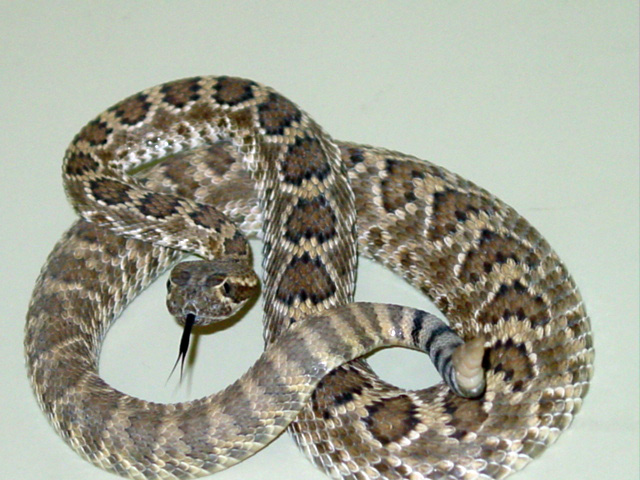 Mojave RattlesnakeCrotalus scutulatus
-
 Prairie RattlesnakeCrotalus viridis
-
 Western RattlesnakeCrotalus oreganus
-
 Tiger RattlesnakeCrotalus tigris
-
 Black-tailed RattlesnakeCrotalus molossus
Compare
Questions and answers
What is the scientific name of the San Esteban Island Rattlesnake?
The scientific name of the San Esteban Island Rattlesnake is Crotalus estebanensis. Written with its author, the full name is Crotalus estebanensis Klauber, 1949.
Which family does the San Esteban Island Rattlesnake belong to?
Crotalus estebanensis belongs to the family Viperidae, in the order Squamata and the class Reptilia.
Where is the San Esteban Island Rattlesnake found?
Checklists and occurrence records place Crotalus estebanensis in 1 country: Mexico.
Sources
Data
- Catalogue of Life, 2026-10-16 XR cc by
- Global Biodiversity Information Facility CC BY 4.0
- Wikidata CC0
- English Wikipedia CC BY-SA 4.0
- GeoNames CC BY 4.0
- Within the Catalogue of Life, this name comes from The Reptile Database cc by
References
- Klauber, Laurence M. (1949). Some new and revived subspecies of rattlesnakes. Transactions of the San Diego Society of Natural History 11 (6): 61-116. Link
- Cliff, Frank S. (1954). Snakes of the islands in the Gulf of California, Mexico. Transactions of the San Diego Society of Natural History 12 (5): 67-98. Link
- Liner, E. A. (1994). Scientific and common names for the Amphibians and Reptiles of Mexico in English and Spanish. Herpetological Circular 23: 1-113.
- Grismer, L. Lee. (1999). An evolutionary classification of reptiles on islands in the Gulf of California, México. Herpetologica 55 (4): 446-469.
- Beaman, K. R., & Hayes, W. K. (2008). Rattlesnakes: Research Trends and Annotated Checklist. In: Hayes et al. (eds), The biology of rattlesnakes. Loma Linda University Press, Pp. 5-16.
- Hoser, R. (2009). A reclassification of the rattlesnakes; species formerly exclusively referred to the genera Crotalus and Sistrurus. Australasian J. Herpetol. 3: 1-21 (Dubious Journal).
- Enderson, Erik F.; Adrian Quijada-Mascareñas; Dale S. Turner; Philip C. Rosen & Robert L. Bezy. (2009). The herpetofauna of Sonora, Mexico, with comparisons to adjoining states. Check List 5 (3): 632–672.
- Wallach, Van; Kenneth L. Williams, Jeff Boundy. (2014). Snakes of the World: A Catalogue of Living and Extinct Species. [type catalogue]. Taylor and Francis, CRC Press, 1237 Pp.
- Heimes, P. (2016). Snakes of Mexico. Chimaira, Frankfurt, 572 Pp.
- Díaz de la Vega-Pérez, Aníbal H., Víctor H. Jimenez-Arcos, Rafael A. Lara-Resendiz, Fausto R. Méndez-de la Cruz and Ali Rabatsky. (2016). Crotalus estebanensis. Activity and thermoregulation. Mesoamerican Herpetology 3 (3): 739–741.
- Johnson, J. D., L. D. Wilson, V. Mata-Silva, E. García-Padilla, and D. L. DeSantis. (2017). The endemic herpetofauna of Mexico: organisms of global significance in severe peril. Mesoamerican Herpetology 4 (3): 544–620.
- GARCÍA-PADILLA, ELI; JORGE H. VALDEZ VILLAVICENCIO, ANNY PERALTA GARCÍA. (2018). Las Serpientes de Cascabel más allá del continente. Especies.
- Lemos-Espinal JA, Smith GR, & Rorabaugh JC. (2019). A conservation checklist of the amphibians and reptiles of Sonora, Mexico, with updated species lists. ZooKeys 829: 131-160.
- Reyes-Velasco, J., Cox, C. L., Jones, J. M., Borja, M., & Campbell, J. A. (2022). How many species of rattlesnakes are there in the Crotalus durissus species group (Serpentes: Crotalidae)? Revista Latinoamericana de Herpetología 5 (1): 43-55.
- García-Padilla, E., Heredia-López, I., Villalobos-Juárez, I., Lazcano, D., & Fucsko, L. A. (2025). Notes on the Herpetofauna of Mexico 48: From Sacred to Scorned---A Study of the Mexican Rattlesnake’s Changing Status. Bulletin of the Chicago Herpetological Society, 60(3), 25-30.
This species in other databases
Page built on 26 November 2026. See how the catalog is made and all sources and licences.
Cite this page
ScientificNames.org. (2026). Crotalus estebanensis (San Esteban Island Rattlesnake). Retrieved November 26, 2026, from https://scientificnames.org/species/crotalus-estebanensis
“Crotalus estebanensis (San Esteban Island Rattlesnake).” ScientificNames.org, 2026, scientificnames.org/species/crotalus-estebanensis. Accessed 26 Nov. 2026.
ScientificNames.org. “Crotalus estebanensis (San Esteban Island Rattlesnake).” Accessed November 26, 2026. https://scientificnames.org/species/crotalus-estebanensis.
@misc{scientificnames_crotalus_estebanensis_san_esteban_island_rattlesnake,
  author = {{ScientificNames.org}},
  title = {Crotalus estebanensis (San Esteban Island Rattlesnake)},
  year = {2026},
  url = {https://scientificnames.org/species/crotalus-estebanensis},
  note = {Accessed 2026-11-26}
}