Overview
Wikidata describes Crotalus exiguus as “species of reptile”.
Classification of the Guerreran Pygmy Rattlesnake
| Kingdom | Animalia |
|---|---|
| Phylum | Chordata |
| Subphylum | Vertebrata |
| Infraphylum | Gnathostomata |
| Parvphylum | Osteichthyes |
| Megaclass | Tetrapoda |
| Class | Reptilia (Reptile) |
| Order | Squamata (Snakes) |
| Suborder | Serpentes (Snakes) |
| Infraorder | Alethinophidia |
| Family | Viperidae (Viper) |
| Subfamily | Crotalinae |
| Genus | Crotalus (Rattlesnakes) |
| Species | Crotalus exiguus Campbell & Armstrong, 1979 |
Where the Guerreran Pygmy Rattlesnake is found
Checklists and occurrence records place Crotalus exiguus in 1 country across North America. GBIF holds 39 georeferenced records of it.
Countries
Regions and cities with the most records
Range as the checklists state it
Mexico (Guerrero: Sierra Madre del Sur)
Middle America
A number beside a place is its count of GBIF occurrence records. A place without a number comes from a checklist alone. Records show where a species has been observed or collected, which can include escapes and vagrants.
Common names
English
- Guerreran Pygmy Rattlesnake
Names in 1 other language
- Italian
- Crotalo esiguo, Serpente a sonagli esiguo
Synonyms
2 other scientific names have been used for this species and are now treated as synonyms of Crotalus exiguus.
- Crotalus ravus exiguus (Campbell & Armstrong, 1979)
- Sistrurus ravus exiguus Campbell & Armstrong, 1979
Related species
-
 Timber RattlesnakeCrotalus horridus
-
 Western Diamondback RattlesnakeCrotalus atrox
-
 SidewinderCrotalus cerastes
-
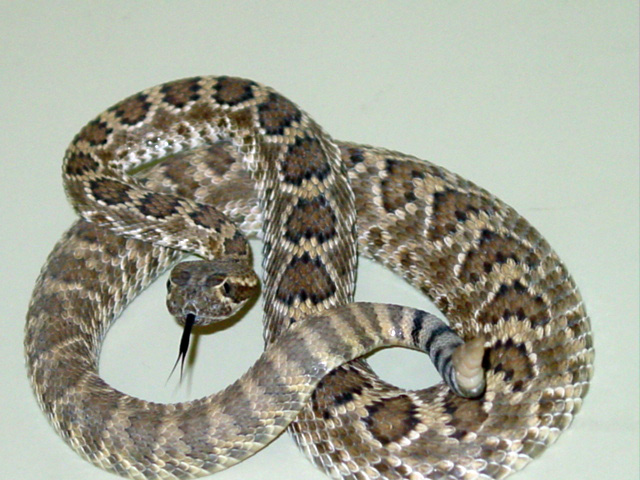 Mojave RattlesnakeCrotalus scutulatus
-
 Prairie RattlesnakeCrotalus viridis
-
 Western RattlesnakeCrotalus oreganus
-
 Tiger RattlesnakeCrotalus tigris
-
 Black-tailed RattlesnakeCrotalus molossus
Compare
Questions and answers
What is the scientific name of the Guerreran Pygmy Rattlesnake?
The scientific name of the Guerreran Pygmy Rattlesnake is Crotalus exiguus. Written with its author, the full name is Crotalus exiguus Campbell & Armstrong, 1979.
Which family does the Guerreran Pygmy Rattlesnake belong to?
Crotalus exiguus belongs to the family Viperidae, in the order Squamata and the class Reptilia.
Where is the Guerreran Pygmy Rattlesnake found?
Checklists and occurrence records place Crotalus exiguus in 1 country: Mexico.
Sources
Data
- Catalogue of Life, 2026-10-16 XR cc by
- Global Biodiversity Information Facility CC BY 4.0
- Wikidata CC0
- GeoNames CC BY 4.0
- Within the Catalogue of Life, this name comes from The Reptile Database cc by
References
- Cope, E. D. (1866). Third contribution to the herpetology of tropical America. Proc. Acad. Nat. Sci. Philadelphia 17: 185-198 [1865].
- Klauber, Laurence M. (1952). Taxonomic studies on rattlesnakes of Mainland Mexico. Bulletins of the Zoological Society of San Diego (26): 1-143.
- Davis, William B.; Smith, Hobart M. (1953). Snakes of the Mexican state of Morelos. Herpetologica 8: 133-149.
- Harris, Herbert S. & Simmons, Robert S. (1978). A preliminary account of the rattlesnakes with the descriptions of four new subspecies. Bull. Maryland Herp. Soc. 14 (3): 105-211 [1977].
- Campbell, J. A., & Armstrong, B. L. (1979). Geographic variation in the Mexican Pygmy rattlesnake, Sistrurus ravus, with the description of a new subspecies. Herpetologica 35 (4): 304-317.
- McCranie, J. R., & Wilson, L. D. (1979). Commentary on taxonomic practice in regional herpetological publications: a review of the rattlesnakes with the description of four new subspecies [by HARRIS & SIMMONS 1978]. Herpetological Review 10 (1): 18-21.
- Kisser, P. (1980). Zur Kernntnis der Klapperschlangen. Herpetofauna 2 (5): 6-10.
- Stille, B. (1987). Dorsal scale microdermatoglyphics and rattlesnake (Crotalus and Sistrurus) phylogeny (Reptilia: Viperidae: Crotalinae). Herpetologica 43: 98-104.
- Campbell, J. A., & Lamar, W. W. (1989). The Venomous Reptiles of Latin America. Comstock Publishing/Cornell University Press, Ithaca.
- Parkinson, C. L. (1999). Molecular systematics and biogeographical history of pitvipers as determined by mitochondrial ribosomal DNA sequences. Copeia 1999 (3): 576-586.
- McDiarmid, R.W.; Campbell, J.A. & Touré,T.A. (1999). Snake species of the world. Vol. 1. [type catalogue]. Herpetologists’ League, 511 Pp.
- Murphy, Robert W.; Fu, Jinzhong; Lathrop, Amy; Feltham, Joshua V.; Kovac, Viera. (2002). Phylogeny of the rattlesnakes (Crotalus and Sistrurus) inferred from sequences of five mitochondrial DNA genes. In Biology of the Vipers, edited by Gordon W. Schuett et al. Eagle Mountain Publishing, Pp. 69-92.
- Peterson, A.T. et al. (2004). A preliminary biological survey of Cerro Piedra Larga, Oaxaca, Mexico: Birds, mammals, reptiles, amphibians, and plants. Anales Del Instituto de Biología, Universidad Nacional Autónoma de México, Serie Zoología 75(2): 439-466.
- Casas-Andreu, G., F.R. Méndez-De la Cruz and X. Aguilar-Miguel. (2004). Anfibios y Reptiles; pp. 375–390, in A.J.M. García-Mendoza, J. Ordoñez and M. Briones-Salas (ed.). Biodiversidad de Oaxaca. Instituto de Biología, UNAM-Fondo Oaxaqueño Para La Conservación de La Naturaleza-World Wildlife Fund, México, D. F.
- Bryson, R. W. (2007). Fotopirsch auf Gebirgsklapperschlangen. Reptilia (Münster) 12 (66): 32-37.
- VALENCIA-HERNÁNDEZ, Ángel Alberto; Irene GOYENECHEA & Jesús Martín CASTILLO-CERÓN. (2007). NOTES ON SCUTELLATION, LENGTH, AND DISTRIBUTION OF RATTLESNAKES (SERPENTES: VIPERIDADE: CROTALUS) IN THE STATE OF HIDALGO, MEXICO. Acta Zoológica Mexicana (N.S.) 23 (3):29-33.
- Meik, & Jesse M and André Pires-daSilva. (2009). Evolutionary morphology of the rattlesnake style. BMC Evolutionary Biology 2009, 9:35.
- Hoser, R. (2009). A reclassification of the rattlesnakes; species formerly exclusively referred to the genera Crotalus and Sistrurus. Australasian J. Herpetol. 3: 1-21 (Dubious Journal).
- Canseco-Márquez, L., & Gutiérrrez-Mayén, M.G. (2010). Anfibios y reptiles del Valle de Tehuacán-Cuicatlán. Comisión Nacional Para El Conocimiento Y Uso de La Biodiversidad, México D.F., Mexico, 302 Pp.
- Bryson Jr, Robert W.; Robert W. Murphy, Amy Lathrop and David Lazcano-Villareal. (2011). Evolutionary drivers of phylogeographical diversity in the highlands of Mexico: a case study of the Crotalus triseriatus species group of montane rattlesnakes. Journal of Biogeography 38: 697–710.
- Wüster, W., & Bérnils, R. S. (2011). On the generic classification of the rattlesnakes, with special reference to the Neotropical Crotalus durissus complex (Squamata: Viperidae). Zoologia 28 (4): 417–419.
- Bryson, Robert W., Jr., Jason M. Jones and Christoph Grünwald. (2011). Geographic Distribution: Crotalus ravus ravus (central plateau pygmy rattlesnake). Herpetological Review 42 (3): 393.
- Wallach, Van; Kenneth L. Williams, Jeff Boundy. (2014). Snakes of the World: A Catalogue of Living and Extinct Species. [type catalogue]. Taylor and Francis, CRC Press, 1237 Pp.
- BRYSON, ROBERT W.; JR., CHARLES W. LINKEM, MICHAEL E. DORCAS, AMY LATHROP, JASON M. JONES, JAVIER ALVARADO-DÍAZ, CHRISTOPH I. GRÜNWALD & ROBERT W. MURPHY. (2014). Multilocus species delimitation in the Crotalus triseriatus species group (Serpentes: Viperidae: Crotalinae), with the description of two new species. Zootaxa 3826 (3): 475–496. Link
- Arenas, Carlos Yañez; A. Townsend Peterson, Pierre Mokondoko, Octavio Rojas-Soto, Enrique Martínez-Meyer. (2014). The Use of Ecological Niche Modeling to Infer Potential Risk Areas of Snakebite in the Mexican State of Veracruz. PLoS One 9 (6): E100957. Doi:10.1371/Journal.Pone.0100957.
This species in other databases
Page built on 27 November 2026. See how the catalog is made and all sources and licences.
Cite this page
ScientificNames.org. (2026). Crotalus exiguus (Guerreran Pygmy Rattlesnake). Retrieved November 27, 2026, from https://scientificnames.org/species/crotalus-exiguus
“Crotalus exiguus (Guerreran Pygmy Rattlesnake).” ScientificNames.org, 2026, scientificnames.org/species/crotalus-exiguus. Accessed 27 Nov. 2026.
ScientificNames.org. “Crotalus exiguus (Guerreran Pygmy Rattlesnake).” Accessed November 27, 2026. https://scientificnames.org/species/crotalus-exiguus.
@misc{scientificnames_crotalus_exiguus_guerreran_pygmy_rattlesnake,
  author = {{ScientificNames.org}},
  title = {Crotalus exiguus (Guerreran Pygmy Rattlesnake)},
  year = {2026},
  url = {https://scientificnames.org/species/crotalus-exiguus},
  note = {Accessed 2026-11-27}
}