Species · Reptiles
Eastern Black-tailed Rattlesnake Crotalus ornatus
The scientific name of the Eastern Black-tailed Rattlesnake is Crotalus ornatus. It is a species of reptile in the family Viperidae (viper), order Squamata. The name dates from 1854.
- Scientific name
- Crotalus ornatus Hallowell, 1854
- Common name
- Eastern Black-tailed Rattlesnake
- Genus
- Crotalus
- Family
- Viperidae (Viper)
- Order
- Squamata
- Class
- Reptilia
- Recorded in
- 2 countries
- Name status
- accepted in the Catalogue of Life

Overview
Crotalus ornatus occurs east of the Continental Divide in the southwestern United States, including the Trans-Pecos ecoregion of Texas. It preferentially uses rocky and vegetated microhabitats and shows innate preferences for native small mammal and lizard prey.
Written 28 November 2026 from the sources listed below. Each statement was checked against the passage it cites; statements that could not be supported were removed.
Similar species
Eastern populations in Texas and central and eastern New Mexico are recognized as a distinct species separate from Crotalus molossus.[1]
Habitat
The species occurs in the Trans-Pecos ecoregion of Texas. It is most likely to occur in arroyo and rocky slope habitats.[2][3]
It preferentially uses microhabitats consisting primarily of rock and vegetative ground cover. It takes refuge in rocky structures or beneath dense vegetation.[4][5]
Diet
The species demonstrates innate preferences for native small mammal and lizard prey. Neonate individuals showed a preference for these prey over larger native mammals, amphibians, invertebrates, and non-native small mammals.[6][7]
Behaviour
The mean home range size of monitored individuals was 22.84 hectares, with a standard error of 4.49 hectares. The mean movement frequency was 0.73, with a standard error of 0.03.[8][9]
The mean daily movement rate of monitored individuals was 9.28 metres per day, with a standard error of 0.93 metres.[10]
Male individuals have larger home ranges and core use areas than females. They also have higher movement frequencies and movement rates than females.[11][12]
Female movement rates peaked in June, although differences among months were not statistically significant. Male movement rates were significantly higher during August.[13][14]
Classification of the Eastern Black-tailed Rattlesnake
| Kingdom | Animalia |
|---|---|
| Phylum | Chordata |
| Subphylum | Vertebrata |
| Infraphylum | Gnathostomata |
| Parvphylum | Osteichthyes |
| Megaclass | Tetrapoda |
| Class | Reptilia (Reptile) |
| Order | Squamata (Snakes) |
| Suborder | Serpentes (Snakes) |
| Infraorder | Alethinophidia |
| Family | Viperidae (Viper) |
| Subfamily | Crotalinae |
| Genus | Crotalus (Rattlesnakes) |
| Species | Crotalus ornatus Hallowell, 1854 |
Where the Eastern Black-tailed Rattlesnake is found
Checklists and occurrence records place Crotalus ornatus in 2 countries across North America. GBIF holds 1,850 georeferenced records of it.
Countries
Regions and cities with the most records
- Texas, United States 1,263
- New Mexico, United States 461
- Sunland Park, United States 79
- El Paso, United States 78
- Chihuahua, Mexico 55
- Ciudad Juárez, Mexico 50
- Coahuila, Mexico 36
- Albuquerque, United States 27
- Las Cruces, United States 23
- Nuevo León, Mexico 21
- Rio Rancho, United States 20
- Enchanted Hills, United States 14
- Alamogordo, United States 13
- García, Mexico 9
- South Valley, United States 9
- Canyon Lake, United States 8
- Parque Industrial Ciudad Mitras, Mexico 8
- Santa Catarina, Mexico 8
- Horizon City, United States 7
- Mitras Poniente, Mexico 7
- Ramos Arizpe, Mexico 7
- Saltillo, Mexico 6
- Hidalgo, Mexico 4
- Manuel Ojinaga, Mexico 4
- Socorro, United States 4
- Monterrey, Mexico 3
- New Braunfels, United States 3
- San Antonio, United States 3
- San Pedro Garza García, Mexico 3
- Zacatecas, Mexico 1
Range as the checklists state it
USA (Texas, New Mexico), Mexico (Chihuahua, Nuevo León, Coahuila, Zacatecas)
A number beside a place is its count of GBIF occurrence records. A place without a number comes from a checklist alone. Records show where a species has been observed or collected, which can include escapes and vagrants.
Common names
English
- Eastern Black-tailed Rattlesnake
- Black-tailed Rattlesnake
- Ornate Black- Tailed Rattlesnake
Names in 5 other languages
- Chinese
- 飾紋響尾蛇
- German
- Östliche Schwarzschwanz-Klapperschlange
- Italian
- Crotalo coda nera orientale, Serpente a sonagli coda nera orientale
- Portuguese
- Cascavel-de-cauda-negra-oriental
- Spanish
- Cascabel de cola negra ornamental
Related species
-
 Timber RattlesnakeCrotalus horridus
-
 Western Diamondback RattlesnakeCrotalus atrox
-
 SidewinderCrotalus cerastes
-
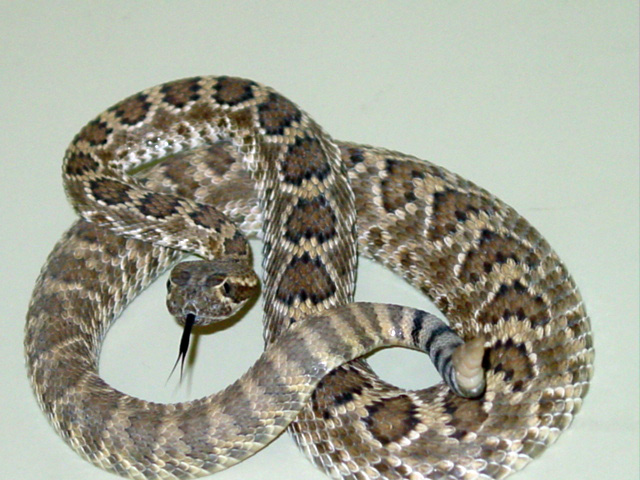 Mojave RattlesnakeCrotalus scutulatus
-
 Prairie RattlesnakeCrotalus viridis
-
 Western RattlesnakeCrotalus oreganus
-
 Tiger RattlesnakeCrotalus tigris
-
 Black-tailed RattlesnakeCrotalus molossus
Compare
Questions and answers
What is the scientific name of the Eastern Black-tailed Rattlesnake?
The scientific name of the Eastern Black-tailed Rattlesnake is Crotalus ornatus. Written with its author, the full name is Crotalus ornatus Hallowell, 1854.
Which family does the Eastern Black-tailed Rattlesnake belong to?
Crotalus ornatus belongs to the family Viperidae, in the order Squamata and the class Reptilia.
Where is the Eastern Black-tailed Rattlesnake found?
Checklists and occurrence records place Crotalus ornatus in 2 countries: United States and Mexico.
What other names does the Eastern Black-tailed Rattlesnake have?
Crotalus ornatus is also known in English as Black-tailed Rattlesnake and Ornate Black- Tailed Rattlesnake.
What is a rattlesnake's diet?
The Eastern Black-tailed Rattlesnake demonstrates innate preferences for native small mammal and lizard prey. Neonate individuals preferred these prey over larger native mammals, amphibians, invertebrates, and non-native small mammals.[6][7]
What kind of habitat does a rattlesnake live in?
The Eastern Black-tailed Rattlesnake is most likely to occur in arroyo and rocky slope habitats. It preferentially uses microhabitats consisting primarily of rock and vegetative ground cover, taking refuge in rocky structures or beneath dense vegetation.[3][4][5]
Sources
Passages the profile rests on
- Eastern populations in Texas and central and eastern New Mexico are recognized as a distinct species separate from Crotalus molossus. Source passage: “eastern populations from Texas and central and eastern New Mexico form a distinct species separate from C. molossus” — English Wikipedia
- The species occurs in the Trans-Pecos ecoregion of Texas. Source passage: “on Indio Mountains Research Station (IMRS) in the Trans-Pecos ecoregion of Texas” — scholarworks.utep.edu
- The species is most likely to occur in arroyo and rocky slope habitats. Source passage: “Models predicted that snakes were most likely to be found in arroyo and rocky slope habitats” — scholarworks.utep.edu
- The species preferentially uses microhabitats consisting primarily of rock and vegetative ground cover. Source passage: “C. ornatus preferring areas composed primarily of rock and vegetative ground cover” — scholarworks.utep.edu
- The species takes refuge in rocky structures or beneath dense vegetation. Source passage: “seeking refuge in rocky structure or under dense vegetation.” — scholarworks.utep.edu
- Neonate individuals showed a preference for native small mammals and lizards over larger native mammals, amphibians, invertebrates, and non-native small mammals. Source passage: “Snakes showed preference for native small mammal and lizard prey over larger native mammals, native amphibians, native invertebrates, and non-native small mammals.” — scholarworks.utep.edu
- The species demonstrates innate preferences for native small mammal and lizard prey. Source passage: “their preference for native small mammals and lizards indicates an innate basis for prey preference.” — scholarworks.utep.edu
- The mean home range size of monitored individuals was 22.84 hectares, with a standard error of 4.49 hectares. Source passage: “Mean (±1 SE) home range size for all individuals was 22.84 ± 4.49 ha” — scholarworks.utep.edu
- The mean movement frequency of monitored individuals was 0.73, with a standard error of 0.03. Source passage: “mean movement frequency was 0.73 ± 0.03” — scholarworks.utep.edu
- The mean daily movement rate of monitored individuals was 9.28 metres per day, with a standard error of 0.93 metres. Source passage: “mean daily movement rate was 9.28 ± 0.93 m/day.” — scholarworks.utep.edu
- Male individuals have larger home ranges and core use areas than females. Source passage: “Male snakes had larger home range sizes, larger core use areas” — scholarworks.utep.edu
- Male individuals have higher movement frequencies and movement rates than females. Source passage: “higher movement frequencies, and higher movement rates than female snakes.” — scholarworks.utep.edu
- Female movement rates peaked in June, although differences among months were not statistically significant. Source passage: “Female movement rates peaked in June, although movement rates were statistically similar for all months.” — scholarworks.utep.edu
- Male movement rates were significantly higher during August. Source passage: “Male movement rates were significantly greater during August” — scholarworks.utep.edu
- Crotalus ornatus occurs east of the Continental Divide in the southwestern United States. Source passage: “Crotalus ornatus, which was recently revalidated, occurring east of the Continental Divide” — scholarworks.utep.edu
Data
- Catalogue of Life, 2026-10-16 XR cc by
- Global Biodiversity Information Facility CC BY 4.0
- Wikidata CC0
- GeoNames CC BY 4.0
- Wikimedia Commons per image; credit shown with each image
- Within the Catalogue of Life, this name comes from The Reptile Database cc by
References
- Hallowell, E. (1854). Notices of new reptiles from Texas. Proc. Acad. Nat. Sci. Philad. 1854: 192-193.
- Anderson, Christopher G. and Eli Greenbaum. (2012). Phylogeography of Northern Populations of the Black-Tailed Rattlesnake (Crotalus molossus Baird And Girard, 1853), With the Revalidation of C. ornatus Hallowell, 1854. Herpetological Monographs 26 (1): 19-57.
- Wallach, Van; Kenneth L. Williams, Jeff Boundy. (2014). Snakes of the World: A Catalogue of Living and Extinct Species. [type catalogue]. Taylor and Francis, CRC Press, 1237 Pp.
- García-Padilla, Elí, Gerson Josué Herrera-Enríquez, Manuel Nevárez de los Reyes, David Lazcano, Vicente Mata-Silva, Jerry D. Johnson and Larry David Wilson. (2016). Crotalus ornatus Hallowell, 1854. Mexico, Nuevo León. Mesoamerican Herpetology 3 (3): 778.
- Nevárez-de-los-Reyes, Manuel, David Lazcano, Elí García-Padilla, Vicente Mata-Silva, Jerry D. Johnson and Larry David Wilson. (2016). The Herpetofauna of Nuevo León, Mexico: Composition, Distribution, and Conservation. Mesoamerican Herpetology 3 (3): 558–638.
- Nevárez de Los Reyes, Manuel, David Lazcano and Javier Banda-Leal. (2016). Geographic Distribution: Crotalus ornatus (Eastern Black-tailed Rattlesnake). Herpetological Review 47 (2): 261.
- Heimes, P. (2016). Snakes of Mexico. Chimaira, Frankfurt, 572 Pp.
- Spinner, L. (2017). Die Klapperschlangen der USA in Natur und Terrarium. Reptilia (Münster) 22 (124): 18-33.
- Davis DR, & LaDuc TJ. (2018). Amphibians and reptiles of C. E. Miller Ranch and the Sierra Vieja, Chihuahuan Desert, Texas, USA. ZooKeys 735: 97-130.
- Hernandez T, Herr MW, Stevens S, Cork K, Medina-Nava C, Vialpando CJ, Warfel T, Fields N, Brodie C, & Graham SP. (2019). New distribution records for amphibians and reptiles in eastern Chihuahua, Mexico. Check List 15(1): 79-86.
- Lazcano D, Nevárez-de los Reyes M, García-Padilla E, Johnson JD, Mata-Silva V, DeSantis DL, Wilson LD. (2019). The herpetofauna of Coahuila, Mexico: composition, distribution, and conservation status. Amphibian & Reptile Conservation 13(2) [General Section]: 31–94 (E189).
- EMERSON, JAMES D.; DOMINIC L. DESANTIS, VICENTE MATA-SILVA, AMY E. WAGLER & JERRY D. JOHNSON. (2022). Movement, Home Range Size, and Habitat Use of Eastern Black-Tailed Rattlesnakes (Crotalus ornatus) in the Northern Chihuahuan Desert. Herpetologica 78(2): 110–118.
- Price, Michael S. (2022). Reptiles of the Trans-Pecos Texas. ECO Natural History Series, ECO Publishing, Rodeo, New Mexico, 210 Pp., ISBN: 978-1938- 85041-7. [Review in HR 54 (1): 152].
- Muñoz-Mora, V. H., Suárez-Atilano, M., Maltagliati, F., Ramírez-Corona, F., Carbajal-Saucedo, A., Percino-Daniel, R., ... & Sunny, A. (2022). A tale about vipers’ tails: phylogeography of black-tailed rattlesnakes. Herpetozoa, 35, 141-153.
- Bassett, L., & Pandelis, G. (2024). Updated geographic distributions for Texas reptiles. Reptiles & Amphibians, 31(1): E21492-E21492.
- García-Padilla, E., Heredia-López, I., Villalobos-Juárez, I., Lazcano, D., & Fucsko, L. A. (2025). Notes on the Herpetofauna of Mexico 48: From Sacred to Scorned---A Study of the Mexican Rattlesnake’s Changing Status. Bulletin of the Chicago Herpetological Society, 60(3), 25-30.
- Maag, Dylan W.; Ryan J. Hanscom, Craig G. Fischer, Vincent P. Marcantonio, Emma C. McAndrews, Kristin L. Kabat, Jessica L. Hill & Rulon W. Clark. (2025). Spatial Ecology of North American Pitvipers (Viperidae: Crotalinae): A Review and Meta-Analysis. Herpetological Monographs Mar 2025 Vol. 39, No. 1: 35-55.
- Baeza-Tarín, F., Hernández, T., Herr, M., Giovanetto, L., Lazcano, D., & Graham, S. P. (2025). NEW DISTRIBUTION RECORDS OF AMPHIBIANS AND REPTILES OF MADERAS DEL CARMEN, COAHUILA, MEXICO. The Southwestern Naturalist, 68(4), 257-262.
- Sigala-Rodríguez JJ, Carbajal-Márquez RA, Encarnación-Luévano A, Lara-Galván JL, Bañuelos-Alamillo JA, Centenero-Alcalá E, Ahumada-Carrillo IT, & Carmona-Torres FH. (2026). Annotated checklist of the amphibians and reptiles of Zacatecas, Mexico. ZooKeys 1281: 21-48.
This species in other databases
Page built on 29 November 2026. See how the catalog is made and all sources and licences.
Cite this page
ScientificNames.org. (2026). Crotalus ornatus (Eastern Black-tailed Rattlesnake). Retrieved November 29, 2026, from https://scientificnames.org/species/crotalus-ornatus
“Crotalus ornatus (Eastern Black-tailed Rattlesnake).” ScientificNames.org, 2026, scientificnames.org/species/crotalus-ornatus. Accessed 29 Nov. 2026.
ScientificNames.org. “Crotalus ornatus (Eastern Black-tailed Rattlesnake).” Accessed November 29, 2026. https://scientificnames.org/species/crotalus-ornatus.
@misc{scientificnames_crotalus_ornatus_eastern_black_tailed_rattlesnake,
  author = {{ScientificNames.org}},
  title = {Crotalus ornatus (Eastern Black-tailed Rattlesnake)},
  year = {2026},
  url = {https://scientificnames.org/species/crotalus-ornatus},
  note = {Accessed 2026-11-29}
}