Species · Reptiles
Twin-spotted Rattlesnake Crotalus pricei
The scientific name of the Twin-spotted Rattlesnake is Crotalus pricei. It is a species of reptile in the family Viperidae (viper), order Squamata. The name dates from 1895.
- Scientific name
- Crotalus pricei Van Denburgh, 1895
- Common name
- Twin-spotted Rattlesnake
- Genus
- Crotalus
- Family
- Viperidae (Viper)
- Order
- Squamata
- Class
- Reptilia
- Red List category
- LC Least Concern
- Recorded in
- 2 countries
- Name status
- accepted in the Catalogue of Life

Overview
The Twin-spotted Rattlesnake (Crotalus pricei Van Denburgh, 1895) is a venomous pit viper belonging to the family Viperidae. It occurs in southeastern Arizona in the United States and in Sonora, Chihuahua, Durango, southeastern Coahuila, Nuevo León, Tamaulipas, San Luis Potosí, and Aguascalientes in Mexico. Its dorsal blotches are commonly divided along the midline into 39–64 pairs.
Written 26 November 2026 from the sources listed below. Each statement was checked against the passage it cites; statements that could not be supported were removed.
Appearance
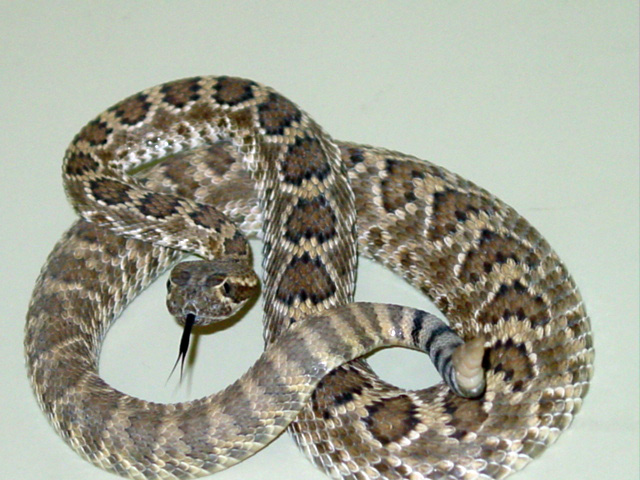
The Twin-spotted Rattlesnake has a gray, bluish-gray, brownish-gray, or medium- to reddish-brown ground color, usually with fine brown speckling.[1]
Its dorsal blotches are commonly divided along the midline into 39–64 pairs.[2]
Habitat
The species inhabits high-elevation areas in southeastern Arizona. A studied population occupied elevations between 2,530 and 2,900 m in Arizona's Chiricahua Mountains.[3][4]
The species occurs in southeastern Arizona in the United States. In northern Mexico, it occurs in Sonora, Chihuahua, and Durango in the Sierra Madre Occidental, and in southeastern Coahuila, Nuevo León, and Tamaulipas in the Sierra Madre Oriental.[5][6][7]
Isolated records exist in San Luis Potosí and Aguascalientes, Mexico. The type locality is the Huachuca Mountains in Cochise County, Arizona, United States.[8][9]
Diet
Lizards constituted 74% of the prey identified through fecal analyses. The diet also includes mammals, birds, and other individuals of the same species.[10][11]
Behaviour
The snake may rattle intensely at passing humans in its mountain-rock habitat. It seeks small rodents and lizards for food.[12][13]
Male movement distances per week during the 1998 monsoon season were more than six times those recorded during the 1997 monsoon season.[14]
During dry years, males may leave talus slopes and move into cooler microclimates where resources are less concentrated. Males used talus slopes less frequently during the 1998 study year.[15][16]
Gravid females maintain warmer body temperatures relative to the substrate than males and nongravid females, apparently through increased basking.[17]
Reproduction and life cycle
Mating is concentrated in August and early September. Parturition occurs in late July and August.[18][19]
The mean number of embryos per female was 3.94, with a range of one to six.[20]
Female reproduction appears to occur every two years or less frequently. Females develop embryos beginning at approximately four to five years of age.[21][22]
Conservation
The species is classified as Least Concern on the IUCN Red List. Its population trend was assessed as stable in 2007.[23][24]
Classification of the Twin-spotted Rattlesnake
| Kingdom | Animalia |
|---|---|
| Phylum | Chordata |
| Subphylum | Vertebrata |
| Infraphylum | Gnathostomata |
| Parvphylum | Osteichthyes |
| Megaclass | Tetrapoda |
| Class | Reptilia (Reptile) |
| Order | Squamata (Snakes) |
| Suborder | Serpentes (Snakes) |
| Infraorder | Alethinophidia |
| Family | Viperidae (Viper) |
| Subfamily | Crotalinae |
| Genus | Crotalus (Rattlesnakes) |
| Species | Crotalus pricei Van Denburgh, 1895 |
Where the Twin-spotted Rattlesnake is found
Checklists and occurrence records place Crotalus pricei in 2 countries across North America. GBIF holds 1,494 georeferenced records of it.
Countries
Regions and cities with the most records
- Chihuahua, Mexico 369
- Arizona, United States 319
- Durango, Mexico 161
- Coahuila, Mexico 55
- Sierra Vista, United States 42
- El Salto, Mexico 39
- Nuevo León, Mexico 38
- Madera, Mexico 25
- Sonora, Mexico 16
- Saltillo, Mexico 9
- Sinaloa, Mexico 9
- Green Valley, United States 7
- San Luis Potosí, Mexico 7
- Tamaulipas, Mexico 6
- Casas Adobes, United States 4
- Catalina Foothills, United States 4
- Flowing Wells, United States 4
- Jalisco, Mexico 4
- Oro Valley, United States 4
- Tanque Verde, United States 4
- Tucson, United States 4
- Drexel Heights, United States 3
- Matehuala, Mexico 3
- Pueblo Nuevo, Mexico 3
- Victoria de Durango, Mexico 3
- Aguascalientes, Mexico 2
- Zacatecas, Mexico 2
- Nayarit, Mexico 1
Range as the checklists state it
USA (SE Arizona), Mexico (W Sonora, E Chihuahua, W Durango, SE Coahuila, S Nuevo Leon, SW Tamaulipas, San Luis Potosí, Aguascalientes, Jalisco, Nayarit, Zacatecas, NE Sinaloa)
A number beside a place is its count of GBIF occurrence records. A place without a number comes from a checklist alone. Records show where a species has been observed or collected, which can include escapes and vagrants.
Common names
English
- Twin-spotted Rattlesnake
Names in 7 other languages
- Chinese
- 孿斑響尾蛇
- Danish
- Dobbeltplettet Klapperslange
- German
- Prices Klapperschlange
- Italian
- Crotalo di Price, Crotalo di Price occidentale, Serpente a sonagli di Price
- Portuguese
- Cascavel-de-manchas-geminadas
- Russian
- Аризонский гремучник
- Spanish
- Cascabel de Manchas-gemelas, Cascabel de manchas gemelas, Víbora de cascabel de manchas gemelas, Víbora-cascabel motas gemelas, cascabel pigmea
Synonyms
2 other scientific names have been used for this species and are now treated as synonyms of Crotalus pricei.
- Crotalus triseriatus miquihuanus Gloyd, 1940
- Crotalus pricei pricei Smith, 1946 ambiguous synonym
Subspecies and varieties
- Crotalus pricei miquihuanus (Eastern Twin Spotted Rattlesnake) subspecies
- Crotalus pricei pricei (Arizona Twin Spotted Rattlesnake) subspecies
Related species
-
 Timber RattlesnakeCrotalus horridus
-
 Western Diamondback RattlesnakeCrotalus atrox
-
 SidewinderCrotalus cerastes
-
 Mojave RattlesnakeCrotalus scutulatus
-
 Prairie RattlesnakeCrotalus viridis
-
 Western RattlesnakeCrotalus oreganus
-
 Tiger RattlesnakeCrotalus tigris
-
 Black-tailed RattlesnakeCrotalus molossus
Compare
Questions and answers
What is the scientific name of the Twin-spotted Rattlesnake?
The scientific name of the Twin-spotted Rattlesnake is Crotalus pricei. Written with its author, the full name is Crotalus pricei Van Denburgh, 1895.
Which family does the Twin-spotted Rattlesnake belong to?
Crotalus pricei belongs to the family Viperidae, in the order Squamata and the class Reptilia.
Where is the Twin-spotted Rattlesnake found?
Checklists and occurrence records place Crotalus pricei in 2 countries: Mexico and United States.
What is the conservation status of the Twin-spotted Rattlesnake?
The IUCN Red List category recorded for Crotalus pricei is Least Concern (LC).
Sources
Passages the profile rests on
- The species has a gray, bluish-gray, brownish-gray, or medium- to reddish-brown ground color, usually with fine brown speckling. Source passage: “The color pattern consists of a gray, bluish-gray, brownish-gray, or medium- to reddish-brown ground color, usually with a fine brown speckling.” — English Wikipedia
- Its dorsal blotches are commonly divided along the midline into 39–64 pairs. Source passage: “This is overlaid with a series of dorsal blotches that tend to be divided down the median line to form 39–64 pairs.” — English Wikipedia
- The species inhabits high-elevation areas in southeastern Arizona. Source passage: “The species reaches the northern limit of its range in southeastern Arizona, where it inhabits higher elevations than any of the state's 10 other rattlesnake species.” — pubs.usgs.gov
- The studied population occupied elevations between 2,530 and 2,900 m in Arizona's Chiricahua Mountains. Source passage: “in Arizona's Chiricahua Mountains between 2530 and 2900 m elevation.” — pubs.usgs.gov
- The species occurs in southeastern Arizona in the United States. Source passage: “C. pricei is found in the United States in southeastern Arizona.” — English Wikipedia
- In northern Mexico, the species occurs in Sonora, Chihuahua, and Durango in the Sierra Madre Occidental. Source passage: “In northern Mexico, it occurs in the Sierra Madre Occidental in Sonora, Chihuahua, and Durango.” — English Wikipedia
- The species also occurs in southeastern Coahuila, Nuevo León, and Tamaulipas in the Sierra Madre Oriental. Source passage: “It has also been found in the Sierra Madre Oriental in southeastern Coahuila, Nuevo León, and Tamaulipas” — English Wikipedia
- Isolated records of the species exist in San Luis Potosí and Aguascalientes, Mexico. Source passage: “with isolated records in San Luis Potosí and Aguascalientes.” — English Wikipedia
- The type locality is the Huachuca Mountains in Cochise County, Arizona, United States. Source passage: “The type locality given is "Huachuca Mts., Arizona" (Cochise County, Arizona, United States).” — English Wikipedia
- Lizards constituted 74% of the prey identified through fecal analyses. Source passage: “Based on fecal analyses, lizards constituted the bulk of prey (74%)” — pubs.usgs.gov
- The diet includes mammals, birds, and other individuals of the same species in addition to lizards. Source passage: “but the diet of C. pricei also included mammals, birds, and a conspecific.” — pubs.usgs.gov
- The snake may rattle intensely at passing humans in its mountain-rock habitat. Source passage: “Amid the mountain rocks where it lives, this small snake may rattle furiously at passing humans yet never be heard.” — English Wikipedia
- The species seeks small rodents and lizards for food. Source passage: “It is driven by hunger, seeking out small rodents and lizards.” — English Wikipedia
- Male movement distances per week during the 1998 monsoon season were more than six times those recorded during the 1997 monsoon season. Source passage: “as males moved over six times farther per week during the 1998 monsoon season (July to September) than during the 1997 monsoon season.” — pubs.usgs.gov
- Males used talus slopes less frequently during the 1998 study year. Source passage: “Additionally, use of talus slopes by males decreased during 1998.” — pubs.usgs.gov
- During dry years, males may leave talus slopes and move into cooler microclimates where resources are less concentrated. Source passage: “During dry years, such as 1998, males may be forced off talus into cooler microclimates where resources are less concentrated than on talus.” — pubs.usgs.gov
- Gravid females maintain warmer body temperatures relative to the substrate than males and nongravid females, apparently through increased basking. Source passage: “Gravid females maintained warmer body temperatures relative to substrate temperature than nongravid females or males, presumably by spending more time basking than other snakes.” — pubs.usgs.gov
- Mating is concentrated in August and early September. Source passage: “Mating was concentrated in August and early September” — pubs.usgs.gov
- Parturition occurs in late July and August. Source passage: “parturition took place during late July and August.” — pubs.usgs.gov
- The mean number of embryos per female was 3.94, with a range of one to six. Source passage: “Mean number of embryos was 3.94 ± 0.34 (range = 1–6)” — pubs.usgs.gov
- Female reproduction appears to occur every two years or less frequently. Source passage: “female reproduction appeared biennial or less frequent.” — pubs.usgs.gov
- Females develop embryos beginning at approximately four to five years of age. Source passage: “female C. pricei develop embryos at 4–5 years of age.” — pubs.usgs.gov
- The species is classified as Least Concern on the IUCN Red List. Source passage: “This species, C. pricei, is classified as Least Concern on the IUCN Red List of Threatened Species (v3.1, 2001).” — English Wikipedia
- The population trend was assessed as stable in 2007. Source passage: “The population trend was stable when assessed in 2007.” — English Wikipedia
Data
- Catalogue of Life, 2026-10-16 XR cc by
- Global Biodiversity Information Facility CC BY 4.0
- Wikidata CC0
- GeoNames CC BY 4.0
- Wikimedia Commons per image; credit shown with each image
- Within the Catalogue of Life, this name comes from The Reptile Database cc by
References
- Van Denburgh, & John. (1895). Description of a new rattlesnake (Crotalus pricei) from Arizona. Proc. Cal. Acad. Sci. (2) 5: 856-857.
- Cope, E. D. (1900). The crocodilians, lizards and snakes of North America. Ann. Rep. U.S. Natl. Mus. 1898: 153-1270.
- Stejneger, L. (1902). The reptiles of the Huachuca Mountains, Arizona. Proc. US Natl. Mus. 25 [1902]: 149-158.
- Van Denburgh, John and Joseph R. Slevin. (1913). A list of the amphibians and reptiles of Arizona, with notes on the species in the collection of the Academy. Proc. Cal. Acad. Sci. 3 (13): 391-454.
- Gloyd, Howard K. (1940). The rattlesnakes, genera Sistrurus and Crotalus. The Chicago Academy of Sciences (Special Publication Number 4): 1-270.
- Klauber, Laurence M. (1952). Taxonomic studies on rattlesnakes of Mainland Mexico. Bulletins of the Zoological Society of San Diego (26): 1-143.
- Axtell, Ralph W.;Sabath, Michael D. (1963). Crotalus pricei miquihuanus from the Sierra Madre of Coahuila, Mexico. Copeia 1963 (1): 161-164.
- Van Devender, Thomas R.; Lowe, Charles H. Lowe, Jr. (1977). Amphibians and reptiles of Yepomera, Chihuahua, Mexico. Journal of Herpetology 11 (1): 41-50.
- McCranie J R. (1981). Crotalus pricei van Denburgh. Twin spotted rattlesnake. Catalogue of American Amphibians and Reptiles ( 266 1980[1981]: 1-2.
- Stebbins, R. C. (1985). A Field Guide to Western Reptiles and Amphibians, 2nd ed. Houghton Mifflin, Boston.
- Tanner, Wilmer W. (1985). Snakes of Western Chihuahua. Great Basin Naturalist 45 (4): 615-676.
- Stille, B. (1987). Dorsal scale microdermatoglyphics and rattlesnake (Crotalus and Sistrurus) phylogeny (Reptilia: Viperidae: Crotalinae). Herpetologica 43: 98-104.
- Campbell, J. A., & Lamar, W. W. (1989). The Venomous Reptiles of Latin America. Comstock Publishing/Cornell University Press, Ithaca.
- Strimple, & Pete. (1994). Crotalus pricei, the Twin-spotted rattlesnake. Litteratura Serpentium 14 (4): 98-101.
- Goode, M. J. (1995). Microhabitat destruction caused by unethical collectors: effects on reptile abundance in Arizona. Sonoran Herpetologist 8 (4):32-36.
- McDiarmid, R.W.; Campbell, J.A. & Touré,T.A. (1999). Snake species of the world. Vol. 1. [type catalogue]. Herpetologists’ League, 511 Pp.
- Prival, D. (2000). No Pricei is too high - ecology and conservation of the Twin-spotted Rattlesnake. Sonoran Herpetologist 13 (3):14-18.
- Prival, D. (2001). Trolling for twinspots. Sonoran Herpetologist 14 (5):52-53.
- Ivanyi, C. (2001). Cannibalism by Crotalus pricei (Twin-spotted Rattlesnake). Sonoran Herpetologist 14 (5):52.
- Prival, D.B. et al. (2002). Natural history of a northern population of Twin-spotted Rattlesnake, Crotalus pricei. Journal of Herpetology 36 (4): 598-607.
- Bryson, R. W., & Lazcano, D. (2003). Crotalus pricei miquihuanus. Reptilia (GB) (28): 43-46.
- Ernst, C. H., & Ernst, E. M. (2003). Snakes of the United States and Canada. Smithsonian Inst. Press, Washington, 668 Pp.
- Moll, E. O. (2004). Crotalus pricei, Van Denburgh, 1895 – Twin-spotted rattlenake. Patronyms of the Pioneer West. Sonoran Herpetologist 16 (12):110-112.
- Alvarado-Diaz, J., & Campbell, J. A. (2004). A new montane rattlesnake (Viperidae) from Michoacán, Mexico. Herpetologica 60 (2): 281-286.
- Vázquez Díaz, Joel;Quintero Díaz, Gustavo E. (2005). Anfibios y Reptiles de Aguascalientes [2nd ed.]. CONABIO, CIEMA, 318 Pp.
This species in other databases
Page built on 29 November 2026. See how the catalog is made and all sources and licences.
Cite this page
ScientificNames.org. (2026). Crotalus pricei (Twin-spotted Rattlesnake). Retrieved November 29, 2026, from https://scientificnames.org/species/crotalus-pricei
“Crotalus pricei (Twin-spotted Rattlesnake).” ScientificNames.org, 2026, scientificnames.org/species/crotalus-pricei. Accessed 29 Nov. 2026.
ScientificNames.org. “Crotalus pricei (Twin-spotted Rattlesnake).” Accessed November 29, 2026. https://scientificnames.org/species/crotalus-pricei.
@misc{scientificnames_crotalus_pricei_twin_spotted_rattlesnake,
  author = {{ScientificNames.org}},
  title = {Crotalus pricei (Twin-spotted Rattlesnake)},
  year = {2026},
  url = {https://scientificnames.org/species/crotalus-pricei},
  note = {Accessed 2026-11-29}
}