Species · Reptiles
Tancitaran Dusky Rattlesnake Crotalus pusillus
The scientific name of the Tancitaran Dusky Rattlesnake is Crotalus pusillus. It is a species of reptile in the family Viperidae (viper), order Squamata. The name dates from 1952.

Overview
Crotalus pusillus, or the Tancitaran Dusky Rattlesnake, is a venomous pit viper species found in west-central Mexico. No subspecies are currently recognized.
Classification of the Tancitaran Dusky Rattlesnake
| Kingdom | Animalia |
|---|---|
| Phylum | Chordata |
| Subphylum | Vertebrata |
| Infraphylum | Gnathostomata |
| Parvphylum | Osteichthyes |
| Megaclass | Tetrapoda |
| Class | Reptilia (Reptile) |
| Order | Squamata (Snakes) |
| Suborder | Serpentes (Snakes) |
| Infraorder | Alethinophidia |
| Family | Viperidae (Viper) |
| Subfamily | Crotalinae |
| Genus | Crotalus (Rattlesnakes) |
| Species | Crotalus pusillus Klauber, 1952 |
Where the Tancitaran Dusky Rattlesnake is found
Checklists and occurrence records place Crotalus pusillus in 1 country. GBIF holds 146 georeferenced records of it.
Countries
Regions and cities with the most records
Range as the checklists state it
WC Mexico (NE Michoacan, S Jalisco, Colima)
A number beside a place is its count of GBIF occurrence records. A place without a number comes from a checklist alone. Records show where a species has been observed or collected, which can include escapes and vagrants.
Common names
English
- Tancitaran Dusky Rattlesnake
Names in 4 other languages
- Chinese
- 灰黑響尾蛇
- Italian
- Crotalo scuro di Tancítaro, Serpente a sonagli scuro di Tancítaro
- Portuguese
- Cascavel-escura-de-Tancítaro
- Spanish
- Cascabel Oscura del Tancítaro, Cascabel de Tancítaro, Víbora-cascabel de Tancítaro, cascabel oscura de Tancítaro
Related species
-
 Timber RattlesnakeCrotalus horridus
-
 Western Diamondback RattlesnakeCrotalus atrox
-
 SidewinderCrotalus cerastes
-
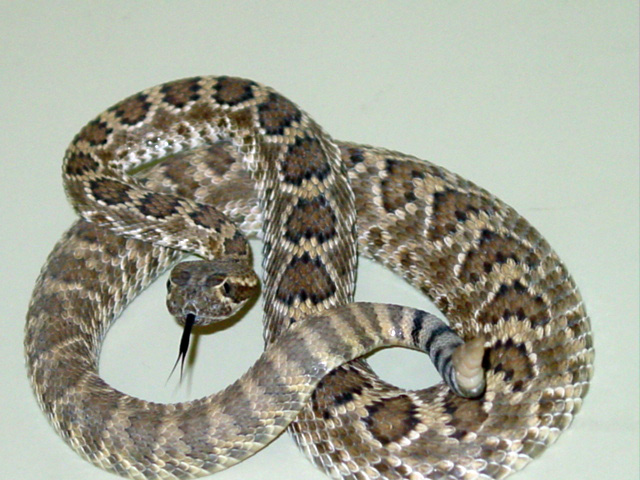 Mojave RattlesnakeCrotalus scutulatus
-
 Hopi RattlesnakeCrotalus viridis
-
 Western RattlesnakeCrotalus oreganus
-
 Tiger RattlesnakeCrotalus tigris
-
 Black-tailed RattlesnakeCrotalus molossus
Compare
Questions and answers
What is the scientific name of the Tancitaran Dusky Rattlesnake?
The scientific name of the Tancitaran Dusky Rattlesnake is Crotalus pusillus. Written with its author, the full name is Crotalus pusillus Klauber, 1952.
Which family does the Tancitaran Dusky Rattlesnake belong to?
Crotalus pusillus belongs to the family Viperidae, in the order Squamata and the class Reptilia.
Where is the Tancitaran Dusky Rattlesnake found?
Checklists and occurrence records place Crotalus pusillus in 1 country: Mexico.
What is the conservation status of the Tancitaran Dusky Rattlesnake?
The IUCN Red List category recorded for Crotalus pusillus is Endangered (EN).
Sources
Data
- Catalogue of Life, 2026-10-16 XR cc by
- Global Biodiversity Information Facility CC BY 4.0
- Wikidata CC0
- English Wikipedia CC BY-SA 4.0
- GeoNames CC BY 4.0
- Wikimedia Commons per image; credit shown with each image
- Within the Catalogue of Life, this name comes from The Reptile Database cc by
References
- Klauber, Laurence M. (1952). Taxonomic studies on rattlesnakes of Mainland Mexico. Bulletins of the Zoological Society of San Diego (26): 1-143.
- McCranie J R. (1983). Crotalus pusillus Klauber. Southwestern Mexico dusky rattlesnake. Catalogue of American Amphibians and Reptiles ( 313: 1-2.
- Campbell, J. A., & Lamar, W. W. (1989). The Venomous Reptiles of Latin America. Comstock Publishing/Cornell University Press, Ithaca.
- McDiarmid, R.W.; Campbell, J.A. & Touré,T.A. (1999). Snake species of the world. Vol. 1. [type catalogue]. Herpetologists’ League, 511 Pp.
- Bryson, R. W. (2007). Fotopirsch auf Gebirgsklapperschlangen. Reptilia (Münster) 12 (66): 32-37.
- Meik, & Jesse M and André Pires-daSilva. (2009). Evolutionary morphology of the rattlesnake style. BMC Evolutionary Biology 2009, 9:35.
- Hoser, R. (2009). A reclassification of the rattlesnakes; species formerly exclusively referred to the genera Crotalus and Sistrurus. Australasian J. Herpetol. 3: 1-21 (Dubious Journal).
- Bryson Jr, Robert W.; Robert W. Murphy, Amy Lathrop and David Lazcano-Villareal. (2011). Evolutionary drivers of phylogeographical diversity in the highlands of Mexico: a case study of the Crotalus triseriatus species group of montane rattlesnakes. Journal of Biogeography 38: 697–710.
- Wüster, W., & Bérnils, R. S. (2011). On the generic classification of the rattlesnakes, with special reference to the Neotropical Crotalus durissus complex (Squamata: Viperidae). Zoologia 28 (4): 417–419.
- Wallach, Van; Kenneth L. Williams, Jeff Boundy. (2014). Snakes of the World: A Catalogue of Living and Extinct Species. [type catalogue]. Taylor and Francis, CRC Press, 1237 Pp.
- BRYSON, ROBERT W.; JR., CHARLES W. LINKEM, MICHAEL E. DORCAS, AMY LATHROP, JASON M. JONES, JAVIER ALVARADO-DÍAZ, CHRISTOPH I. GRÜNWALD & ROBERT W. MURPHY. (2014). Multilocus species delimitation in the Crotalus triseriatus species group (Serpentes: Viperidae: Crotalinae), with the description of two new species. Zootaxa 3826 (3): 475–496. Link
- Muñoz-Nolasco, F. J., & Daniel Cruz-Sáenz, O. J. R.-R. a. I. E. T.-F. (2015). Notes on the Herpetofauna of Western Mexico 12: Herpetofauna of a Temperate Forest in Mazamitla, Southeastern Jalisco, Mexico. Bull. Chicago Herp. Soc. 50 (4):45-50.
- Maritz, Bryan; Johannes Penner, Marcio Martins, Jelka Crnobrnja-Isailović, Stephen Spear, Laura R.V. Alencar, Jesús Sigala-Rodriguez, Kevin Messenger, Rulon W. Clark, Pritpal Soorae, Luca Luiselli, Chris Jenkins, Harry W. Greene. (2016). Identifying global priorities for the conservation of vipers. Biological Conservation, Doi:10.1016/J.Biocon.2016.05.004.
- Heimes, P. (2016). Snakes of Mexico. Chimaira, Frankfurt, 572 Pp.
- Blair C, Bryson RW Jr, Linkem CW, Lazcano D, Klicka J, McCormack JE. (2018). Cryptic diversity in the Mexican highlands: Thousands of UCE loci help illuminate phylogenetic relationships, species limits and divergence times of montane rattlesnakes (Viperidae: Crotalus). Molecular Ecology Resources 19: 349–365 [2019].
- Lemos-Espinal JA, Smith GR, Pierce LJS, & Painter CW. (2020). The amphibians and reptiles of Colima, Mexico, with a summary of their conservation status. ZooKeys 927: 99-125.
- Reyes-Velasco, J., Cox, C. L., Jones, J. M., Borja, M., & Campbell, J. A. (2022). How many species of rattlesnakes are there in the Crotalus durissus species group (Serpentes: Crotalidae)? Revista Latinoamericana de Herpetología 5 (1): 43-55.
- García-Padilla, E., Heredia-López, I., Villalobos-Juárez, I., Lazcano, D., & Fucsko, L. A. (2025). Notes on the Herpetofauna of Mexico 48: From Sacred to Scorned---A Study of the Mexican Rattlesnake’s Changing Status. Bulletin of the Chicago Herpetological Society, 60(3), 25-30.
This species in other databases
Page built on 25 November 2026. See how the catalog is made and all sources and licences.
Cite this page
ScientificNames.org. (2026). Crotalus pusillus (Tancitaran Dusky Rattlesnake). Retrieved November 25, 2026, from https://scientificnames.org/species/crotalus-pusillus
“Crotalus pusillus (Tancitaran Dusky Rattlesnake).” ScientificNames.org, 2026, scientificnames.org/species/crotalus-pusillus. Accessed 25 Nov. 2026.
ScientificNames.org. “Crotalus pusillus (Tancitaran Dusky Rattlesnake).” Accessed November 25, 2026. https://scientificnames.org/species/crotalus-pusillus.
@misc{scientificnames_crotalus_pusillus_tancitaran_dusky_rattlesnake,
  author = {{ScientificNames.org}},
  title = {Crotalus pusillus (Tancitaran Dusky Rattlesnake)},
  year = {2026},
  url = {https://scientificnames.org/species/crotalus-pusillus},
  note = {Accessed 2026-11-25}
}