Species · Reptiles
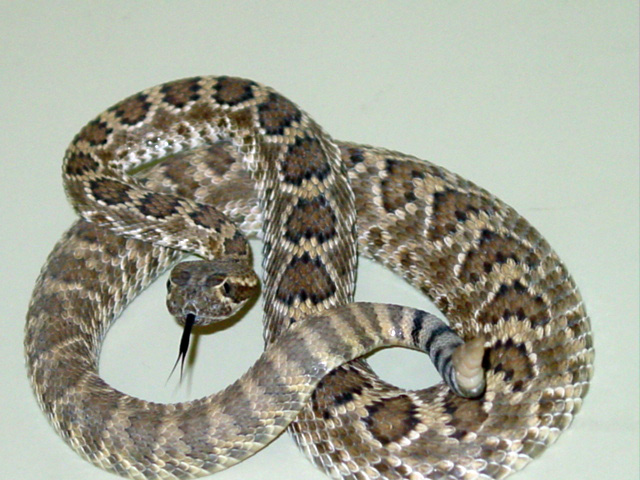
Mexican Pygmy Rattlesnake Crotalus ravus
The scientific name of the Mexican Pygmy Rattlesnake is Crotalus ravus. It is a species of reptile in the family Viperidae (viper), order Squamata. The name dates from 1865.
- Scientific name
- Crotalus ravus Cope, 1865
- Common name
- Mexican Pygmy Rattlesnake
- Genus
- Crotalus
- Family
- Viperidae (Viper)
- Order
- Squamata
- Class
- Reptilia
- Red List category
- LC Least Concern
- Recorded in
- 2 countries
- Name status
- accepted in the Catalogue of Life

Overview
Crotalus ravus, commonly known as the Mexican pigmy rattlesnake or Mexican pygmy rattlesnake, is a venomous pit viper species, found only in Mexico. Three subspecies are currently recognized.
Classification of the Mexican Pygmy Rattlesnake
| Kingdom | Animalia |
|---|---|
| Phylum | Chordata |
| Subphylum | Vertebrata |
| Infraphylum | Gnathostomata |
| Parvphylum | Osteichthyes |
| Megaclass | Tetrapoda |
| Class | Reptilia (Reptile) |
| Order | Squamata (Snakes) |
| Suborder | Serpentes (Snakes) |
| Infraorder | Alethinophidia |
| Family | Viperidae (Viper) |
| Subfamily | Crotalinae |
| Genus | Crotalus (Rattlesnakes) |
| Species | Crotalus ravus Cope, 1865 |
Where the Mexican Pygmy Rattlesnake is found
Checklists and occurrence records place Crotalus ravus in 2 countries across North America. GBIF holds 1,121 georeferenced records of it.
Countries
Regions and cities with the most records
- Puebla, Mexico 259
- Xochimilco, Mexico 176
- Tlalpan, Mexico 168
- Coyoacán, Mexico 164
- Tlaxcala, Mexico 158
- Magdalena Contreras, Mexico 156
- México, Mexico 138
- Iztapalapa, Mexico 128
- Tláhuac, Mexico 124
- Benito Juarez, Mexico 116
- Villa Vicente Guerrero, Mexico 103
- Amozoc de Mota, Mexico 97
- Delegación Cuajimalpa de Morelos, Mexico 92
- Puebla, Mexico 90
- Iztacalco, Mexico 85
- San Bernardino Tlaxcalancingo, Mexico 83
- Huixquilucan, Mexico 76
- Miguel Hidalgo, Mexico 76
- Xico, Mexico 76
- Chalco de Díaz Covarrubias, Mexico 66
- Mexico City, Mexico 65
- Apizaco, Mexico 59
- Veracruz, Mexico 58
- Naucalpan de Juárez, Mexico 54
- Huamantla, Mexico 53
- Santa Ana Chiautempan, Mexico 53
- Cuauhtémoc, Mexico 51
- Morelos, Mexico 50
- Cuernavaca, Mexico 48
- Tlaxcala, Mexico 48
- Ixtapaluca, Mexico 43
- San Buenaventura, Mexico 41
- Azcapotzalco, Mexico 37
- Los Reyes Acaquilpan, Mexico 37
- Tehuacán, Mexico 31
- Chicoloapan de Juárez, Mexico 30
Range as the checklists state it
Mexico (WC Puebla, Veracruz, Morelos, Tlaxcala, S Hidalgo)
A number beside a place is its count of GBIF occurrence records. A place without a number comes from a checklist alone. Records show where a species has been observed or collected, which can include escapes and vagrants.
Common names
English
- Mexican Pygmy Rattlesnake
Names in 6 other languages
- Chinese
- 墨西哥侏儒響尾蛇
- German
- Mexikanische Zwergklapperschlange
- Italian
- Crotalo pigmeo messicano, Serpente a sonagli pigmeo messicano
- Portuguese
- Cascavel-anã-mexicana
- Russian
- Мексиканский карликовый гремучник
- Spanish
- Cascabel Enana, Cascabel pigmea mexicana, Víbora de cascabel pigmea mexicana, Víbora-cascabel pigmea-mexicana
Synonyms
2 other scientific names have been used for this species and are now treated as synonyms of Crotalus ravus.
- Sistrurus ravus (Cope, 1865)
- Sistrurus ravus lutescens Harris & Simmons, 1978
Subspecies and varieties
- Crotalus ravus ravus (Central Plateau Pygmy Rattlesnake) subspecies
Related species
-
 Timber RattlesnakeCrotalus horridus
-
 Western Diamondback RattlesnakeCrotalus atrox
-
 SidewinderCrotalus cerastes
-
 Mojave RattlesnakeCrotalus scutulatus
-
 Hopi RattlesnakeCrotalus viridis
-
 Western RattlesnakeCrotalus oreganus
-
 Tiger RattlesnakeCrotalus tigris
-
 Black-tailed RattlesnakeCrotalus molossus
Compare
Questions and answers
What is the scientific name of the Mexican Pygmy Rattlesnake?
The scientific name of the Mexican Pygmy Rattlesnake is Crotalus ravus. Written with its author, the full name is Crotalus ravus Cope, 1865.
Which family does the Mexican Pygmy Rattlesnake belong to?
Crotalus ravus belongs to the family Viperidae, in the order Squamata and the class Reptilia.
Where is the Mexican Pygmy Rattlesnake found?
Checklists and occurrence records place Crotalus ravus in 2 countries: Mexico and United States.
What is the conservation status of the Mexican Pygmy Rattlesnake?
The IUCN Red List category recorded for Crotalus ravus is Least Concern (LC).
Sources
Data
- Catalogue of Life, 2026-10-16 XR cc by
- Global Biodiversity Information Facility CC BY 4.0
- Wikidata CC0
- English Wikipedia CC BY-SA 4.0
- GeoNames CC BY 4.0
- Wikimedia Commons per image; credit shown with each image
- Within the Catalogue of Life, this name comes from The Reptile Database cc by
References
- Cope, E. D. (1866). Third contribution to the herpetology of tropical America. Proc. Acad. Nat. Sci. Philadelphia 17: 185-198 [1865].
- Klauber, Laurence M. (1952). Taxonomic studies on rattlesnakes of Mainland Mexico. Bulletins of the Zoological Society of San Diego (26): 1-143.
- Davis, William B.; Smith, Hobart M. (1953). Snakes of the Mexican state of Morelos. Herpetologica 8: 133-149.
- Harris, Herbert S. & Simmons, Robert S. (1978). A preliminary account of the rattlesnakes with the descriptions of four new subspecies. Bull. Maryland Herp. Soc. 14 (3): 105-211 [1977].
- Campbell, J. A., & Armstrong, B. L. (1979). Geographic variation in the Mexican Pygmy rattlesnake, Sistrurus ravus, with the description of a new subspecies. Herpetologica 35 (4): 304-317.
- McCranie, J. R., & Wilson, L. D. (1979). Commentary on taxonomic practice in regional herpetological publications: a review of the rattlesnakes with the description of four new subspecies [by HARRIS & SIMMONS 1978]. Herpetological Review 10 (1): 18-21.
- Kisser, P. (1980). Zur Kernntnis der Klapperschlangen. Herpetofauna 2 (5): 6-10.
- Stille, B. (1987). Dorsal scale microdermatoglyphics and rattlesnake (Crotalus and Sistrurus) phylogeny (Reptilia: Viperidae: Crotalinae). Herpetologica 43: 98-104.
- Campbell, J. A., & Lamar, W. W. (1989). The Venomous Reptiles of Latin America. Comstock Publishing/Cornell University Press, Ithaca.
- Parkinson, C. L. (1999). Molecular systematics and biogeographical history of pitvipers as determined by mitochondrial ribosomal DNA sequences. Copeia 1999 (3): 576-586.
- McDiarmid, R.W.; Campbell, J.A. & Touré,T.A. (1999). Snake species of the world. Vol. 1. [type catalogue]. Herpetologists’ League, 511 Pp.
- Murphy, Robert W.; Fu, Jinzhong; Lathrop, Amy; Feltham, Joshua V.; Kovac, Viera. (2002). Phylogeny of the rattlesnakes (Crotalus and Sistrurus) inferred from sequences of five mitochondrial DNA genes. In Biology of the Vipers, edited by Gordon W. Schuett et al. Eagle Mountain Publishing, Pp. 69-92.
- Peterson, A.T. et al. (2004). A preliminary biological survey of Cerro Piedra Larga, Oaxaca, Mexico: Birds, mammals, reptiles, amphibians, and plants. Anales Del Instituto de Biología, Universidad Nacional Autónoma de México, Serie Zoología 75(2): 439-466.
- Casas-Andreu, G., F.R. Méndez-De la Cruz and X. Aguilar-Miguel. (2004). Anfibios y Reptiles; pp. 375–390, in A.J.M. García-Mendoza, J. Ordoñez and M. Briones-Salas (ed.). Biodiversidad de Oaxaca. Instituto de Biología, UNAM-Fondo Oaxaqueño Para La Conservación de La Naturaleza-World Wildlife Fund, México, D. F.
- Bryson, R. W. (2007). Fotopirsch auf Gebirgsklapperschlangen. Reptilia (Münster) 12 (66): 32-37.
- VALENCIA-HERNÁNDEZ, Ángel Alberto; Irene GOYENECHEA & Jesús Martín CASTILLO-CERÓN. (2007). NOTES ON SCUTELLATION, LENGTH, AND DISTRIBUTION OF RATTLESNAKES (SERPENTES: VIPERIDADE: CROTALUS) IN THE STATE OF HIDALGO, MEXICO. Acta Zoológica Mexicana (N.S.) 23 (3):29-33.
- Meik, & Jesse M and André Pires-daSilva. (2009). Evolutionary morphology of the rattlesnake style. BMC Evolutionary Biology 2009, 9:35.
- Hoser, R. (2009). A reclassification of the rattlesnakes; species formerly exclusively referred to the genera Crotalus and Sistrurus. Australasian J. Herpetol. 3: 1-21 (Dubious Journal).
- Canseco-Márquez, L., & Gutiérrrez-Mayén, M.G. (2010). Anfibios y reptiles del Valle de Tehuacán-Cuicatlán. Comisión Nacional Para El Conocimiento Y Uso de La Biodiversidad, México D.F., Mexico, 302 Pp.
- Bryson Jr, Robert W.; Robert W. Murphy, Amy Lathrop and David Lazcano-Villareal. (2011). Evolutionary drivers of phylogeographical diversity in the highlands of Mexico: a case study of the Crotalus triseriatus species group of montane rattlesnakes. Journal of Biogeography 38: 697–710.
- Wüster, W., & Bérnils, R. S. (2011). On the generic classification of the rattlesnakes, with special reference to the Neotropical Crotalus durissus complex (Squamata: Viperidae). Zoologia 28 (4): 417–419.
- Bryson, Robert W., Jr., Jason M. Jones and Christoph Grünwald. (2011). Geographic Distribution: Crotalus ravus ravus (central plateau pygmy rattlesnake). Herpetological Review 42 (3): 393.
- Wallach, Van; Kenneth L. Williams, Jeff Boundy. (2014). Snakes of the World: A Catalogue of Living and Extinct Species. [type catalogue]. Taylor and Francis, CRC Press, 1237 Pp.
- BRYSON, ROBERT W.; JR., CHARLES W. LINKEM, MICHAEL E. DORCAS, AMY LATHROP, JASON M. JONES, JAVIER ALVARADO-DÍAZ, CHRISTOPH I. GRÜNWALD & ROBERT W. MURPHY. (2014). Multilocus species delimitation in the Crotalus triseriatus species group (Serpentes: Viperidae: Crotalinae), with the description of two new species. Zootaxa 3826 (3): 475–496. Link
- Arenas, Carlos Yañez; A. Townsend Peterson, Pierre Mokondoko, Octavio Rojas-Soto, Enrique Martínez-Meyer. (2014). The Use of Ecological Niche Modeling to Infer Potential Risk Areas of Snakebite in the Mexican State of Veracruz. PLoS One 9 (6): E100957. Doi:10.1371/Journal.Pone.0100957.
This species in other databases
Page built on 25 November 2026. See how the catalog is made and all sources and licences.
Cite this page
ScientificNames.org. (2026). Crotalus ravus (Mexican Pygmy Rattlesnake). Retrieved November 25, 2026, from https://scientificnames.org/species/crotalus-ravus
“Crotalus ravus (Mexican Pygmy Rattlesnake).” ScientificNames.org, 2026, scientificnames.org/species/crotalus-ravus. Accessed 25 Nov. 2026.
ScientificNames.org. “Crotalus ravus (Mexican Pygmy Rattlesnake).” Accessed November 25, 2026. https://scientificnames.org/species/crotalus-ravus.
@misc{scientificnames_crotalus_ravus_mexican_pygmy_rattlesnake,
  author = {{ScientificNames.org}},
  title = {Crotalus ravus (Mexican Pygmy Rattlesnake)},
  year = {2026},
  url = {https://scientificnames.org/species/crotalus-ravus},
  note = {Accessed 2026-11-25}
}