Species · Reptiles
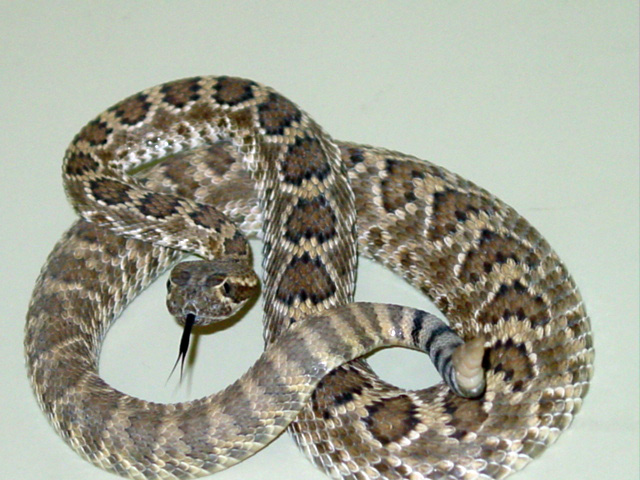
Middle American Rattlesnake Crotalus simus
The scientific name of the Middle American Rattlesnake is Crotalus simus. It is a species of reptile in the family Viperidae (viper), order Squamata. The name dates from 1801.
- Scientific name
- Crotalus simus Latreille, 1801
- Common name
- Middle American Rattlesnake
- Genus
- Crotalus
- Family
- Viperidae (Viper)
- Order
- Squamata
- Class
- Reptilia
- Red List category
- LC Least Concern
- Recorded in
- 6 countries
- Name status
- accepted in the Catalogue of Life

Overview
Common names: Middle American rattlesnake, Central American rattlesnake, tzabcan (local name for subspecies C. s. tzabcan)
Classification of the Middle American Rattlesnake
| Kingdom | Animalia |
|---|---|
| Phylum | Chordata |
| Subphylum | Vertebrata |
| Infraphylum | Gnathostomata |
| Parvphylum | Osteichthyes |
| Megaclass | Tetrapoda |
| Class | Reptilia (Reptile) |
| Order | Squamata (Snakes) |
| Suborder | Serpentes (Snakes) |
| Infraorder | Alethinophidia |
| Family | Viperidae (Viper) |
| Subfamily | Crotalinae |
| Genus | Crotalus (Rattlesnakes) |
| Species | Crotalus simus Latreille, 1801 |
Where the Middle American Rattlesnake is found
Checklists and occurrence records place Crotalus simus in 6 countries across North America. GBIF holds 447 georeferenced records of it.
Countries
Regions and cities with the most records
- Guanacaste Province, Costa Rica 110
- Chiapas, Mexico 61
- Francisco Morazán Department, Honduras 43
- Quintana Roo, Mexico 21
- Puntarenas Province, Costa Rica 15
- Cortés Department, Honduras 14
- San Pedro Sula, Honduras 14
- Lempira Department, Honduras 13
- Chetumal, Mexico 12
- Campeche, Mexico 10
- Zacapa, Guatemala 10
- Liberia, Costa Rica 9
- Managua Department, Nicaragua 9
- Chiapa de Corzo, Mexico 8
- Managua, Nicaragua 8
- Tegucigalpa, Honduras 8
- Ciudad Sandino, Nicaragua 7
- Jutiapa, Guatemala 7
- Oaxaca, Mexico 7
- San Marcos, El Salvador 7
- Tuxtla, Mexico 7
- Asunción Mita, Guatemala 6
- El Paraíso Department, Honduras 6
- Cojutepeque, El Salvador 5
- El Progreso, Guatemala 5
- Jalapa, Guatemala 5
- Jalapa, Guatemala 5
- Rivas Department, Nicaragua 5
- San Salvador, El Salvador 5
- San Salvador Department, El Salvador 5
- Santa Tecla, El Salvador 5
- Cabanas, El Salvador 4
- Escuintla, Guatemala 4
- Mateare, Nicaragua 4
- Mejicanos, El Salvador 4
- Santa Ana Department, El Salvador 4
Range as the checklists state it
S Mexico (Chiapas, Oaxaca, Veracruz, maybe Tabasco and Campeche), Guatemala, Honduras, El Salvador, Costa Rica, Nicaragua
A number beside a place is its count of GBIF occurrence records. A place without a number comes from a checklist alone. Records show where a species has been observed or collected, which can include escapes and vagrants.
Common names
English
- Middle American Rattlesnake
- Central American Rattlesnake
Names in 7 other languages
- Chinese
- 中美響尾蛇
- Danish
- Centralamerikansk Klapperslange
- German
- Zentralamerikanische Klapperschlange
- Italian
- Crotalo centroamericano, Crotalo del centro America, Crotalo dell'America centrale, Serpente a sonagli centroamericano, Serpente a sonagli del centro america, Serpente a sonagli dell'America centrale
- Polish
- grzechotnik środkowoamerykański
- Portuguese
- Cascavel-mesoamericana
- Spanish
- Cascabel, Cascabel centroamericana, Cascabel de Ahua-can, Víbora de cascabel centroamericana, cascabel mesoamericana
Synonyms
3 other scientific names have been used for this species and are now treated as synonyms of Crotalus simus.
- Crotalus simus simus Latreille in Sonnini & Latreille, 1801
- Crotalus durissus Linnaeus, 1758 ambiguous synonym
- Crotalus durissus durissus Klauber, 1952 ambiguous synonym
Related species
-
 Timber RattlesnakeCrotalus horridus
-
 Western Diamondback RattlesnakeCrotalus atrox
-
 SidewinderCrotalus cerastes
-
 Mojave RattlesnakeCrotalus scutulatus
-
 Hopi RattlesnakeCrotalus viridis
-
 Western RattlesnakeCrotalus oreganus
-
 Tiger RattlesnakeCrotalus tigris
-
 Black-tailed RattlesnakeCrotalus molossus
Compare
Questions and answers
What is the scientific name of the Middle American Rattlesnake?
The scientific name of the Middle American Rattlesnake is Crotalus simus. Written with its author, the full name is Crotalus simus Latreille, 1801.
Which family does the Middle American Rattlesnake belong to?
Crotalus simus belongs to the family Viperidae, in the order Squamata and the class Reptilia.
Where is the Middle American Rattlesnake found?
Checklists and occurrence records place Crotalus simus in 6 countries: Costa Rica, Mexico, Honduras, Guatemala, El Salvador and Nicaragua.
What is the conservation status of the Middle American Rattlesnake?
The IUCN Red List category recorded for Crotalus simus is Least Concern (LC).
What other names does the Middle American Rattlesnake have?
Crotalus simus is also known in English as Central American Rattlesnake.
Sources
Data
- Catalogue of Life, 2026-10-16 XR cc by
- Global Biodiversity Information Facility CC BY 4.0
- Wikidata CC0
- English Wikipedia CC BY-SA 4.0
- GeoNames CC BY 4.0
- Wikimedia Commons per image; credit shown with each image
- Within the Catalogue of Life, this name comes from The Reptile Database cc by
References
- Sonnini and Latreille, 1801 where the name was published
- Linné, C. [= Linnaeus, C.]. (1758). Systema naturæ per regna tria naturæ, secundum classes, ordines, genera, species, cum characteribus, differentiis, synonymis, locis. Tomus I. Editio decima, reformata. Laurentii Salvii, Holmiæ. 10th Edition: 824 Pp.
- Sonnini de Manoncourt, C.S. and Latreille, P.A. (1802). Histoire Naturelle des Reptiles, avec Figures Dessinees d’Apres Nature. 3. Paris, Librairie Encyclopédique de Roret, 332 Pp.
- Boulenger, G. A. (1896). Catalogue of the snakes in the British Museum, Vol. 3. London (Taylor & Francis), Xiv + 727 Pp.
- Klauber, Laurence M. (1952). Taxonomic studies on rattlesnakes of Mainland Mexico. Bulletins of the Zoological Society of San Diego (26): 1-143.
- Campbell, J. A. (1998). Amphibians and reptiles of northern Guatemala, the Yucatán, and Belize. Norman: University of Oklahoma Press, Xiii + 380 Pp.
- Campbell, Jonathan A. and William W. Lamar. (2004). The Venomous Reptiles of the Western Hemisphere, 2 vols. Comstock (Cornell University Press), Ithaca, NY, 962 Pp. [Review in Science 305: 182].
- Porras, L. W., & Solórzano, A. (2006). Costa Rica’s venomous snakes. Reptilia (GB) (48): 11-17.
- Porras, L. W. (2006). Costa Rican snakes of the tropical dry forest. Reptilia (GB) (48): 18-23.
- Quijada-Mascareñas & Wüster, W. (2006). Crotalus durissus complex: from Yucatan to Patagonia: the natural history of the Neotropical rattlesnake. Reptilia (GB) (49): 66-73.
- Cundall, D. (2009). Viper Fangs: Functional Limitations of Extreme Teeth. Physiological and Biochemical Zoology: Ecological and Evolutionary Approaches, 82(1), 63–79.
- Meik, & Jesse M and André Pires-daSilva. (2009). Evolutionary morphology of the rattlesnake style. BMC Evolutionary Biology 2009, 9:35.
- Hoser, R. (2009). A reclassification of the rattlesnakes; species formerly exclusively referred to the genera Crotalus and Sistrurus. Australasian J. Herpetol. 3: 1-21 (Dubious Journal).
- Wirth, & Michael. (2011). Lohnende Reiseziele für Amphibien- und Reptilienfreunde in Costa Rica. Draco 12 (45): 22-39.
- Wüster, W., & Bérnils, R. S. (2011). On the generic classification of the rattlesnakes, with special reference to the Neotropical Crotalus durissus complex (Squamata: Viperidae). Zoologia 28 (4): 417–419.
- McCranie J R. (2011). The snakes of Honduras. SSAR, Salt Lake City, 725 Pp.
- Guerra Centeno, Dennis; Héctor Fuentes Rousselin & David Morán Villatoro. (2012). Serpientes de Guatemala: Guía para didentificación de especies. Universidad de San Carlos de Guatemala, 186 Pp.
- Percino-Daniel, R., & Erika Cruz-Ocaña, W. P.-V. y. E. V.-V. (2013). Diversidad de reptiles en dos microcuencas del río Grijalva, Chiapas, México. Revista Mexicana de Biodiversidad 84: 938-948.
- Sunyer, & Javier. (2014). An updated checklist of the amphibians and reptiles of Nicaragua. Mesoamerican Herpetology 1 (2): 186–202.
- Wallach, Van; Kenneth L. Williams, Jeff Boundy. (2014). Snakes of the World: A Catalogue of Living and Extinct Species. [type catalogue]. Taylor and Francis, CRC Press, 1237 Pp.
- García-Padilla, & Elí and Vicente Mata-Silva. (2014). Noteworthy distributional records for the herpetofauna of Chiapas, Mexico. Mesoamerican Herpetology 1 (2): 293.
- Solís, J. M., L. D. Wilson, and J. H. Townsend. (2014). An updated list of the amphibians and reptiles of Honduras, with comments on their nomenclature. Mesoamerican Herpetology 1: 123–144.
- Arenas, Carlos Yañez; A. Townsend Peterson, Pierre Mokondoko, Octavio Rojas-Soto, Enrique Martínez-Meyer. (2014). The Use of Ecological Niche Modeling to Infer Potential Risk Areas of Snakebite in the Mexican State of Veracruz. PLoS One 9 (6): E100957. Doi:10.1371/Journal.Pone.0100957.
- Colston, Timothy J.; José António L. Barão-Nóbrega, Ryan Manders, Alice Lett, Jamie Wilmott, Gavin Cameron, Sidony Hunter, Adam Radage, Etienne Littlefair, Robert J. Williams, Antonio Lopez Cen, Kathy Slater. (2015). Amphibians and reptiles of the Calakmul Biosphere Reserve, México, with new records. Check List 11 (5): 1759.
- McCranie, James R. (2015). A checklist of the amphibians and reptiles of Honduras, with additions, comments on taxonomy, some recent taxonomic decisions, and areas of further studies needed. Zootaxa 3931 (3): 352–386.
This species in other databases
Page built on 24 November 2026. See how the catalog is made and all sources and licences.
Cite this page
ScientificNames.org. (2026). Crotalus simus (Middle American Rattlesnake). Retrieved November 24, 2026, from https://scientificnames.org/species/crotalus-simus
“Crotalus simus (Middle American Rattlesnake).” ScientificNames.org, 2026, scientificnames.org/species/crotalus-simus. Accessed 24 Nov. 2026.
ScientificNames.org. “Crotalus simus (Middle American Rattlesnake).” Accessed November 24, 2026. https://scientificnames.org/species/crotalus-simus.
@misc{scientificnames_crotalus_simus_middle_american_rattlesnake,
  author = {{ScientificNames.org}},
  title = {Crotalus simus (Middle American Rattlesnake)},
  year = {2026},
  url = {https://scientificnames.org/species/crotalus-simus},
  note = {Accessed 2026-11-24}
}