Species · Reptiles
Long-tailed Rattlesnake Crotalus stejnegeri
The scientific name of the Long-tailed Rattlesnake is Crotalus stejnegeri. It is a species of reptile in the family Viperidae (viper), order Squamata. The name dates from 1919.

Overview
The Long-tailed rattlesnake is a venomous pit viper belonging to the family Viperidae. It occurs in the mountains and foothills of eastern Sinaloa, western Durango, and small areas of northern Nayarit in western Mexico. The species has a relatively long tail compared with its total body length.
Written 26 November 2026 from the sources listed below. Each statement was checked against the passage it cites; statements that could not be supported were removed.
Appearance
The Long-tailed rattlesnake has a relatively long tail compared with its total body length. It also has a very small rattle that was suggested to be probably inaudible.[1][2]
Adults generally do not exceed 60 cm in total length, including the tail. The greatest recorded total length is 72.4 cm.[3][4]
Habitat
The Long-tailed rattlesnake inhabits pine-oak forest, subtropical dry forest, and tropical deciduous forest.[5][6][7]
The species occurs at elevations between 500 and 1,200 metres.[8]
Conservation
The Long-tailed rattlesnake is classified as Vulnerable on the IUCN Red List. It is considered to face a high risk of extinction in the wild.[9][10]
Its population trend was decreasing when assessed in 2007. Its estimated extent of occurrence is less than 20,000 square kilometres, and it is known to exist at no more than ten locations or is severely fragmented.[11][12][13]
A continuing decline has been observed, inferred, or projected in the species' habitat area, extent, or quality.[14]
Classification of the Long-tailed Rattlesnake
| Kingdom | Animalia |
|---|---|
| Phylum | Chordata |
| Subphylum | Vertebrata |
| Infraphylum | Gnathostomata |
| Parvphylum | Osteichthyes |
| Megaclass | Tetrapoda |
| Class | Reptilia (Reptile) |
| Order | Squamata (Snakes) |
| Suborder | Serpentes (Snakes) |
| Infraorder | Alethinophidia |
| Family | Viperidae (Viper) |
| Subfamily | Crotalinae |
| Genus | Crotalus (Rattlesnakes) |
| Species | Crotalus stejnegeri Dunn, 1919 |
Where the Long-tailed Rattlesnake is found
Checklists and occurrence records place Crotalus stejnegeri in 1 country across North America. GBIF holds 28 georeferenced records of it.
Countries
Regions and cities with the most records
Range as the checklists state it
Mexico (Sierra Madre Occidental in W Durango [ca. 6 mi N Yamoriba, 24° 12.5’ N, 105° 47’ W] and S Sinaloa), elevation 2500-3000 ft
A number beside a place is its count of GBIF occurrence records. A place without a number comes from a checklist alone. Records show where a species has been observed or collected, which can include escapes and vagrants.
Common names
English
- Long-tailed Rattlesnake
- Longtail Rattlesnake
- Sinaloan Long-tailed Rattlesnake
Names in 6 other languages
- Chinese
- 史氏響尾蛇
- German
- Langschwanzklapperschlange
- Italian
- Crotalo coda lunga di Sinaloa, Crotalo di Sinaloa, Serpente a sonagli coda lunga di Sinaloa, Serpente a sonagli di Sinaloa
- Portuguese
- Cascavel-de-Sinaloa
- Russian
- Гремучник Штейнегера
- Spanish
- Cascabel Cola-larga de Sinaloa, Cascabel cola larga sinaloense, Víbora-cascabel cola larga
Related species
-
 Timber RattlesnakeCrotalus horridus
-
 Western Diamondback RattlesnakeCrotalus atrox
-
 SidewinderCrotalus cerastes
-
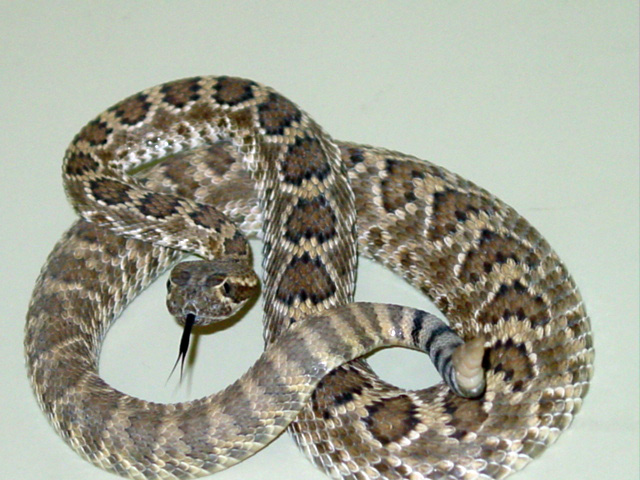 Mojave RattlesnakeCrotalus scutulatus
-
 Prairie RattlesnakeCrotalus viridis
-
 Western RattlesnakeCrotalus oreganus
-
 Tiger RattlesnakeCrotalus tigris
-
 Black-tailed RattlesnakeCrotalus molossus
Compare
Questions and answers
What is the scientific name of the Long-tailed Rattlesnake?
The scientific name of the Long-tailed Rattlesnake is Crotalus stejnegeri. Written with its author, the full name is Crotalus stejnegeri Dunn, 1919.
Which family does the Long-tailed Rattlesnake belong to?
Crotalus stejnegeri belongs to the family Viperidae, in the order Squamata and the class Reptilia.
Where is the Long-tailed Rattlesnake found?
Checklists and occurrence records place Crotalus stejnegeri in 1 country: Mexico.
What is the conservation status of the Long-tailed Rattlesnake?
The IUCN Red List category recorded for Crotalus stejnegeri is Vulnerable (VU).
What other names does the Long-tailed Rattlesnake have?
Crotalus stejnegeri is also known in English as Longtail Rattlesnake and Sinaloan Long-tailed Rattlesnake.
Sources
Passages the profile rests on
- The species has a relatively long tail compared with its total body length. Source passage: “The tail is relatively long, representing 11.0-14.8% of the total length of adult male snakes and 9.8-12.5% in females.” — English Wikipedia
- The species has a very small rattle that was suggested to be probably inaudible. Source passage: “Klauber (1940) suggested that since the rattle is tiny, it is probably not audible.” — English Wikipedia
- Adults generally do not exceed 60 cm in total length, including the tail. Source passage: “Adults of C. stejnegeri do not usually grow to more than 60 cm (24 in) in total length (including tail).” — English Wikipedia
- The greatest recorded total length of the species is 72.4 cm. Source passage: “The greatest total length recorded for a specimen is 72.4 cm (28.5 in).” — English Wikipedia
- The species inhabits pine-oak forest. Source passage: “It occurs in pine-oak forest, subtropical dry forest, and tropical deciduous forest.” — English Wikipedia
- The species inhabits subtropical dry forest. Source passage: “It occurs in pine-oak forest, subtropical dry forest, and tropical deciduous forest.” — English Wikipedia
- The species inhabits tropical deciduous forest. Source passage: “It occurs in pine-oak forest, subtropical dry forest, and tropical deciduous forest.” — English Wikipedia
- The species occurs at elevations between 500 and 1,200 metres. Source passage: “between 500 and 1,200 metres (1,600 and 3,900 ft) in altitude.” — English Wikipedia
- The species is classified as Vulnerable on the IUCN Red List. Source passage: “C. stejnegeri is classified as Vulnerable on the IUCN Red List of Threatened Species” — English Wikipedia
- The species is considered to face a high risk of extinction in the wild. Source passage: “Therefore, it is considered to be facing a high risk of extinction in the wild.” — English Wikipedia
- The species' population trend was decreasing when assessed in 2007. Source passage: “The population trend was down when assessed in 2007.” — English Wikipedia
- The species' estimated extent of occurrence is less than 20,000 square kilometres. Source passage: “its extent of occurrence is estimated to be less than 20,000 km2 (7,720 mi2)” — English Wikipedia
- The species is known to exist at no more than ten locations or is severely fragmented. Source passage: “estimates indicate it is severely fragmented or known to exist at no more than 10 locations” — English Wikipedia
- A continuing decline has been observed, inferred, or projected in the species' habitat area, extent, or quality. Source passage: “a continuing decline has been observed, inferred, or projected in its area, extent, and/or quality of habitat.” — English Wikipedia
- The species is a venomous pit viper belonging to the family Viperidae. Source passage: “Crotalus stejnegeri, commonly known as the Sinaloan long-tailed rattlesnake or just long-tailed rattlesnake, is a venomous pit viper species in the family Viperidae.” — English Wikipedia
- The species is identified as Crotalus stejnegeri in the United States Fish and Wildlife Service species record. Source passage: “Scientific Name. Crotalus stejnegeri.” — fws.gov
- The species is identified as a venomous pit viper occurring in western Mexico. Source passage: “Crotalus stejnegeri is a venomous pit viper species found in western Mexico.” — inaturalist.org
Data
- Catalogue of Life, 2026-10-16 XR cc by
- Global Biodiversity Information Facility CC BY 4.0
- Wikidata CC0
- GeoNames CC BY 4.0
- Wikimedia Commons per image; credit shown with each image
- Within the Catalogue of Life, this name comes from The Reptile Database cc by
References
- Dunn, E. R. (1919). Two new crotaline snakes from western Mexico. Proc. Biol. Soc. Washington 32: 213-216.
- Klauber, Laurence M. (1952). Taxonomic studies on rattlesnakes of Mainland Mexico. Bulletins of the Zoological Society of San Diego (26): 1-143.
- Tanner, W. W. (1966). A new rattlesnake from western Mexico. Herpetologica 22 (4): 298-302.
- Hardy, L.M., & McDiarmid, R.W. (1969). The amphibians and reptiles of Sinaloa, Mexico. Univ. Kansas Publ. Mus. Nat. Hist. 18 (3): 39-252.
- Collins J T. (1982). Crotalus stejnegeri. Longtail rattlesnake. Catalogue of American Amphibians and Reptiles ( 303: 1-2.
- Webb, R. G. (1984). Herpetogeography in the Mazatlán-Durango Region of the Sierra Madre Occidental, Mexico. Vetrebrate Ecology and Systematics - A Ribute to Henry S. Fitch; Museum of Natural History, University of Kansas, Lawrence, Pp. 217-241.
- Stille, B. (1987). Dorsal scale microdermatoglyphics and rattlesnake (Crotalus and Sistrurus) phylogeny (Reptilia: Viperidae: Crotalinae). Herpetologica 43: 98-104.
- Campbell, J. A., & Lamar, W. W. (1989). The Venomous Reptiles of Latin America. Comstock Publishing/Cornell University Press, Ithaca.
- McDiarmid, R.W.; Campbell, J.A. & Touré,T.A. (1999). Snake species of the world. Vol. 1. [type catalogue]. Herpetologists’ League, 511 Pp.
- Campbell, Jonathan A. and Oscar Flores-Villela. (2008). A New Long-Tailed Rattlesnake (Viperidae) From Guerrero, Mexico. Herpetologica 64 (2): 246-257.
- Meik, & Jesse M and André Pires-daSilva. (2009). Evolutionary morphology of the rattlesnake style. BMC Evolutionary Biology 2009, 9:35.
- Hoser, R. (2009). A reclassification of the rattlesnakes; species formerly exclusively referred to the genera Crotalus and Sistrurus. Australasian J. Herpetol. 3: 1-21 (Dubious Journal).
- Jadin, Robert C.; Jacobo Reyes Velasco and Eric N. Smith. (2010). Hemipenes of the long-tailed rattlesnakes (Serpentes: Viperidae) from Mexico. Phyllomedusa 9 (1): 69-74.
- Wüster, W., & Bérnils, R. S. (2011). On the generic classification of the rattlesnakes, with special reference to the Neotropical Crotalus durissus complex (Squamata: Viperidae). Zoologia 28 (4): 417–419.
- Beolens, B., & Michael Watkins, a. M. G. (2011). The Eponym Dictionary of Reptiles. Johns Hopkins University Press, Baltimore, USA.
- Reyes-Velasco, Jacobo; Jesse M. Meik, Eric N. Smith, Todd A. Castoe. (2013). Phylogenetic relationships of the enigmatic longtailed rattlesnakes (Crotalus ericsmithi, C. lannomi, and C. stejnegeri). Molecular Phylogenetics and Evolution 69 (3): 524–534.
- Valdez-Lares, R.; R. Muñiz-Martínez; E.Gadsden; G. Aguirre-León; G. Castañeda-Gaytán; R. Gonzalez-Trápaga. (2013). Checklist of amphibians and reptiles of the state of Durango, México. Check List 9 (4):714-724.
- Wilson, Larry David; Vicente Mata-Silva, Jerry D. Johnson. (2013). A conservation reassessment of the reptiles of Mexico based on the EVS measure. Amphibian & Reptile Conservation 7 (1): 1–47.
- Wallach, Van; Kenneth L. Williams, Jeff Boundy. (2014). Snakes of the World: A Catalogue of Living and Extinct Species. [type catalogue]. Taylor and Francis, CRC Press, 1237 Pp.
- Heimes, P. (2016). Snakes of Mexico. Chimaira, Frankfurt, 572 Pp.
- Lemos-Espinal JA, Smith GR, Gadsden-Esparza H, Valdez-Lares R, & Woolrich-Piña GA. (2018). Amphibians and reptiles of the state of Durango, Mexico, with comparisons with adjoining states. ZooKeys 748: 65-87.
- Lemos-Espinal JA, & Smith GR. (2020). A checklist of the amphibians and reptiles of Sinaloa, Mexico with a conservation status summary and comparisons with neighboring states. ZooKeys 931: 85-114.
- OLIVEIRA-DALLAND, LUIS G.; LAURA R.V. ALENCAR, LEANDRO R. TAMBOSI, PAOLA A. CARRASCO, RHETT M. RAUTSAW, JESUS SIGALA-RODRIGUEZ, GUSTAVO SCROCCHI & MARCIO MARTINS. (2022). Conservation gaps for Neotropical vipers: Mismatches between protected areas, species richness and evolutionary distinctiveness. Biological Conservation 275(109750).
- MAURO AGUIRRE-ZAZUETA; ISABEL RAMÍREZ-OCHOA, JESÚS A. LOC-BARRAGÁN, & GUILLERMO A. WOOLRICH-PIÑA. (2022). Natural history observations of the rare Long-tailed Rattlesnake (Crotalus stejnegeri) in Sinaloa, México. Sonoran Herpetologist 35(1): 15–16.
- Reyes-Velasco, J., Cox, C. L., Jones, J. M., Borja, M., & Campbell, J. A. (2022). How many species of rattlesnakes are there in the Crotalus durissus species group (Serpentes: Crotalidae)? Revista Latinoamericana de Herpetología 5 (1): 43-55.
This species in other databases
Page built on 27 November 2026. See how the catalog is made and all sources and licences.
Cite this page
ScientificNames.org. (2026). Crotalus stejnegeri (Long-tailed Rattlesnake). Retrieved November 27, 2026, from https://scientificnames.org/species/crotalus-stejnegeri
“Crotalus stejnegeri (Long-tailed Rattlesnake).” ScientificNames.org, 2026, scientificnames.org/species/crotalus-stejnegeri. Accessed 27 Nov. 2026.
ScientificNames.org. “Crotalus stejnegeri (Long-tailed Rattlesnake).” Accessed November 27, 2026. https://scientificnames.org/species/crotalus-stejnegeri.
@misc{scientificnames_crotalus_stejnegeri_long_tailed_rattlesnake,
  author = {{ScientificNames.org}},
  title = {Crotalus stejnegeri (Long-tailed Rattlesnake)},
  year = {2026},
  url = {https://scientificnames.org/species/crotalus-stejnegeri},
  note = {Accessed 2026-11-27}
}