Overview
Tlaloc's Rattlesnake is a venomous reptile. It occurs in Mexico. It has a dark narrowing marking near its eye.
Written 27 November 2026 from the sources listed below. Each statement was checked against the passage it cites; statements that could not be supported were removed.
Similar species
Tlaloc's Rattlesnake can be distinguished from Crotalus triseriatus by its scale counts, smaller proportional rattle, and longer proportional tail.[1]
Appearance
Tlaloc's Rattlesnake has a dark narrowing marking near its eye.[2]
Habitat
Tlaloc's Rattlesnake inhabits open areas in cloud forests and humid oak-pine forests.[3]
It usually inhabits areas with broad-leaf oaks and dense undergrowth.[4]
Classification of the Tlaloc's Rattlesnake
| Kingdom | Animalia |
|---|---|
| Phylum | Chordata |
| Subphylum | Vertebrata |
| Infraphylum | Gnathostomata |
| Parvphylum | Osteichthyes |
| Megaclass | Tetrapoda |
| Class | Reptilia (Reptile) |
| Order | Squamata (Snakes) |
| Suborder | Serpentes (Snakes) |
| Infraorder | Alethinophidia |
| Family | Viperidae (Viper) |
| Subfamily | Crotalinae |
| Genus | Crotalus (Rattlesnakes) |
| Species | Crotalus tlaloci Bryson, Linkem, Dorcas, Lathrop, Jones, Alvarado-Díaz, Grünwald & Murphy, 2014 |
Origin of the name. Etymology. This species is named for Tlaloc, the Aztec god of rain. Habitat and distribution. Crotalus tlaloci inhabits open areas in cloud forest and humid oak-pine forest along the lower slopes of the Trans-Mexican Volcanic Belt. Although one record in the Sierra de Taxco (" Arroyo las Damas ") is at 1850 m (Flores-Villela & Sanchez-H 2003), most records are at around 2000 - 2400 m asl. This species is known from the states of Guerrero, Estado de Mexico, Michoacan, and Morelos, and may range into western Puebla. The vegetation where C. tlaloci is found is characterized by broad-leaf oaks, such as Quercus candicans and Q. laurina, and dense undergrowth (Fig. 6), and is distinctly different than the drier pine-oak forest inhabited by C. triseriatus. The distribution of C. tlaloci overlaps the ranges of two alligator lizards, Barisia herrerae Zaldivar-Riveron & Nieto-Montes de Oca 2002 and B. rudicollis (Wiegmann 1828) (Zaldivar-Riveron & Nieto-Montes de Oca 2002). Interestingly, both of these alligator lizards occur in similar humid forest habitat at elevations of 2000 - 2500 m asl, and appear ecologically isolated from B. imbricata (Wiegmann 1828), which inhabits the surrounding drier pine-oak forest (Zaldivar-Riveron & Nieto-Montes de Oca 2001, 2002). Specimens of C. tlaloci are generally found in rocky open forest breaks and edges of cloud or humid oak-pine forest. However, we found an adult gravid female and juvenile (HINIRENA 725, 726) under logs in a clearing relatively devoid of rocky habitat.
Where the Tlaloc's Rattlesnake is found
Checklists and occurrence records place Crotalus tlaloci in 1 country across North America. GBIF holds 44 georeferenced records of it.
Countries
Regions and cities with the most records
- México, Mexico 35
- Valle de Bravo, Mexico 28
- Guerrero, Mexico 4
- Taxco de Alarcón, Mexico 4
- Heróica Zitácuaro, Mexico 3
- Michoacán, Mexico 2
- Morelos, Mexico
Range as the checklists state it
Mexico (Guerrero, Estado de México, Michoacán, Morelos, possibly W Puebla)
A number beside a place is its count of GBIF occurrence records. A place without a number comes from a checklist alone. Records show where a species has been observed or collected, which can include escapes and vagrants.
Common names
English
- Tlaloc's Rattlesnake
Names in 4 other languages
- German
- Tlaloc-Klapperschlange
- Italian
- Crotalo di Tlaloc, Serpente a sonagli di Tlaloc
- Portuguese
- Cascavel-tlaloc
- Spanish
- Cascabel Tlaloc, Cascabel de Tlaloc
Related species
-
 Timber RattlesnakeCrotalus horridus
-
 Western Diamondback RattlesnakeCrotalus atrox
-
 SidewinderCrotalus cerastes
-
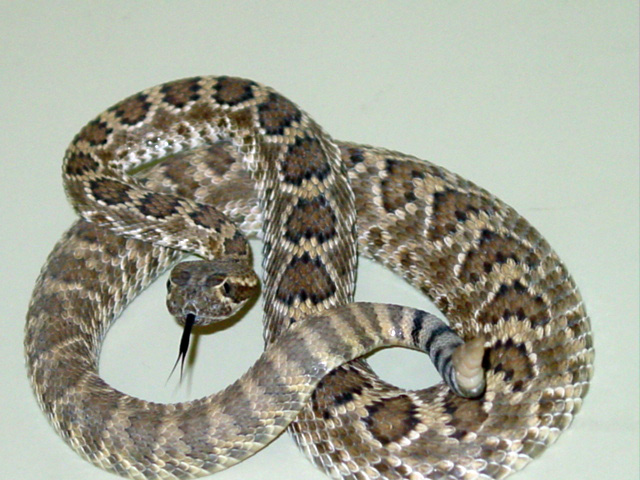 Mojave RattlesnakeCrotalus scutulatus
-
 Prairie RattlesnakeCrotalus viridis
-
 Western RattlesnakeCrotalus oreganus
-
 Tiger RattlesnakeCrotalus tigris
-
 Black-tailed RattlesnakeCrotalus molossus
Compare
Questions and answers
What is the scientific name of the Tlaloc's Rattlesnake?
The scientific name of the Tlaloc's Rattlesnake is Crotalus tlaloci. Written with its author, the full name is Crotalus tlaloci Bryson, Linkem, Dorcas, Lathrop, Jones, Alvarado-Díaz, Grünwald & Murphy, 2014.
Which family does the Tlaloc's Rattlesnake belong to?
Crotalus tlaloci belongs to the family Viperidae, in the order Squamata and the class Reptilia.
Where is the Tlaloc's Rattlesnake found?
Checklists and occurrence records place Crotalus tlaloci in 1 country: Mexico.
Sources
Passages the profile rests on
- Crotalus tlaloci can be distinguished from Crotalus triseriatus by its scale counts, smaller proportional rattle, and longer proportional tail. Source passage: “Crotalus tlaloci can be distinguished from similar species of snakes, such as C. triseriatus, by specific scale counts, a proportionately smaller rattle, and a proportionally longer tail.” — English Wikipedia
- Crotalus tlaloci has a dark narrowing marking near its eye. Source passage: “It can also be told apart by a dark narrowing marking near its eye.” — English Wikipedia
- Crotalus tlaloci inhabits open areas in cloud forests and humid oak-pine forests. Source passage: “Crotalus tlaloci is known to inhabit open areas in cloud forests and humid oak-pine forests.” — English Wikipedia
- Crotalus tlaloci usually inhabits areas with broad-leaf oaks and dense undergrowth. Source passage: “Usually it inhabits areas with broad-leaf oaks and dense undergrowth.” — English Wikipedia
Data
- Catalogue of Life, 2026-10-16 XR cc by
- Global Biodiversity Information Facility CC BY 4.0
- Wikidata CC0
- GeoNames CC BY 4.0
- Within the Catalogue of Life, this name comes from The Reptile Database cc by
References
- BRYSON, ROBERT W.; JR., CHARLES W. LINKEM, MICHAEL E. DORCAS, AMY LATHROP, JASON M. JONES, JAVIER ALVARADO-DÍAZ, CHRISTOPH I. GRÜNWALD & ROBERT W. MURPHY. (2014). Multilocus species delimitation in the Crotalus triseriatus species group (Serpentes: Viperidae: Crotalinae), with the description of two new species. Zootaxa 3826 (3): 475–496. Link where the name was published
- Heimes, P. (2016). Snakes of Mexico. Chimaira, Frankfurt, 572 Pp.
- Palacios-Aguilar, Ricardo, & OSCAR FLORES-VILLELA. (2018). An updated checklist of the herpetofauna from Guerrero, Mexico. Zootaxa 4422 (1): 1-24.
- Blair C, Bryson RW Jr, Linkem CW, Lazcano D, Klicka J, McCormack JE. (2018). Cryptic diversity in the Mexican highlands: Thousands of UCE loci help illuminate phylogenetic relationships, species limits and divergence times of montane rattlesnakes (Viperidae: Crotalus). Molecular Ecology Resources 19: 349–365 [2019].
- Lemos-Espinal JA, & Smith GR. (2020). A conservation checklist of the amphibians and reptiles of the State of Mexico, Mexico with comparisons with adjoining states. ZooKeys 953: 137-159.
- Lemos-Espinal JA, & Smith GR. (2020). A conservation checklist of the herpetofauna of Morelos, with comparisons with adjoining states. ZooKeys 941: 121-144.
- OLIVEIRA-DALLAND, LUIS G.; LAURA R.V. ALENCAR, LEANDRO R. TAMBOSI, PAOLA A. CARRASCO, RHETT M. RAUTSAW, JESUS SIGALA-RODRIGUEZ, GUSTAVO SCROCCHI & MARCIO MARTINS. (2022). Conservation gaps for Neotropical vipers: Mismatches between protected areas, species richness and evolutionary distinctiveness. Biological Conservation 275(109750).
- Reyes-Velasco, J., Cox, C. L., Jones, J. M., Borja, M., & Campbell, J. A. (2022). How many species of rattlesnakes are there in the Crotalus durissus species group (Serpentes: Crotalidae)? Revista Latinoamericana de Herpetología 5 (1): 43-55.
- García-Padilla, E., Heredia-López, I., Villalobos-Juárez, I., Lazcano, D., & Fucsko, L. A. (2025). Notes on the Herpetofauna of Mexico 48: From Sacred to Scorned---A Study of the Mexican Rattlesnake’s Changing Status. Bulletin of the Chicago Herpetological Society, 60(3), 25-30.
This species in other databases
Page built on 28 November 2026. See how the catalog is made and all sources and licences.
Cite this page
ScientificNames.org. (2026). Crotalus tlaloci (Tlaloc's Rattlesnake). Retrieved November 28, 2026, from https://scientificnames.org/species/crotalus-tlaloci
“Crotalus tlaloci (Tlaloc's Rattlesnake).” ScientificNames.org, 2026, scientificnames.org/species/crotalus-tlaloci. Accessed 28 Nov. 2026.
ScientificNames.org. “Crotalus tlaloci (Tlaloc's Rattlesnake).” Accessed November 28, 2026. https://scientificnames.org/species/crotalus-tlaloci.
@misc{scientificnames_crotalus_tlaloci_tlalocs_rattlesnake,
  author = {{ScientificNames.org}},
  title = {Crotalus tlaloci (Tlaloc's Rattlesnake)},
  year = {2026},
  url = {https://scientificnames.org/species/crotalus-tlaloci},
  note = {Accessed 2026-11-28}
}