Species · Reptiles
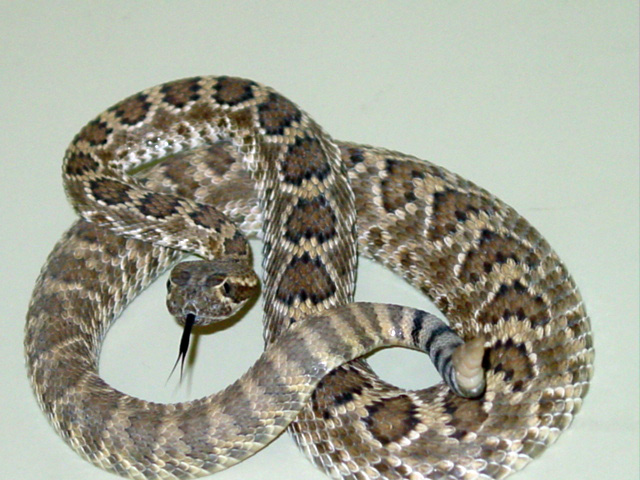
Totonacan Rattlesnake Crotalus totonacus
The scientific name of the Totonacan Rattlesnake is Crotalus totonacus. It is a species of reptile in the family Viperidae (viper), order Squamata. The name dates from 1940.

Overview
Common name: Totonacan rattlesnake
Classification of the Totonacan Rattlesnake
| Kingdom | Animalia |
|---|---|
| Phylum | Chordata |
| Subphylum | Vertebrata |
| Infraphylum | Gnathostomata |
| Parvphylum | Osteichthyes |
| Megaclass | Tetrapoda |
| Class | Reptilia (Reptile) |
| Order | Squamata (Snakes) |
| Suborder | Serpentes (Snakes) |
| Infraorder | Alethinophidia |
| Family | Viperidae (Viper) |
| Subfamily | Crotalinae |
| Genus | Crotalus (Rattlesnakes) |
| Species | Crotalus totonacus Gloyd & Kauffeld, 1940 |
Where the Totonacan Rattlesnake is found
Checklists and occurrence records place Crotalus totonacus in 1 country across North America. GBIF holds 153 georeferenced records of it.
Countries
Regions and cities with the most records
- Tamaulipas, Mexico 61
- Nuevo León, Mexico 29
- Ciudad de Allende, Mexico 17
- San Luis Potosí, Mexico 17
- Santiago, Mexico 16
- Querétaro, Mexico 14
- Ciudad Benito Juárez, Mexico 10
- Guadalupe, Mexico 10
- Jardines de la Silla, Mexico 10
- Monterrey, Mexico 8
- Ciudad Victoria, Mexico 7
- Ciudad Apodaca, Mexico 6
- San Nicolás de los Garza, Mexico 6
- San Pedro Garza García, Mexico 5
- Veracruz, Mexico 5
- Guanajuato, Mexico 4
- Ciudad General Escobedo, Mexico 3
- Hidalgo, Mexico 2
Range as the checklists state it
Mexico (S Tamaulipas, SE San Luis Potosi, N Veracruz, Quéretaro, Hidalgo, Nuevo León)
A number beside a place is its count of GBIF occurrence records. A place without a number comes from a checklist alone. Records show where a species has been observed or collected, which can include escapes and vagrants.
Common names
English
- Totonacan Rattlesnake
Names in 4 other languages
- Chinese
- 托托納克響尾蛇
- Italian
- Crotalo totonaco, Serpente a sonagli totonaco
- Portuguese
- Cascavel-totonaca
- Spanish
- Cascabel totonaca, Tepocolciatl, Vibora de Cascabel, Víbora de cascabel totonaca, cascabel amarilla
Synonyms
2 other scientific names have been used for this species and are now treated as synonyms of Crotalus totonacus.
- Crotalus durissus neoleonensis Harris & Simmons, 1978
- Crotalus durissus totonacus Gloyd & Kauffeld, 1940
Related species
-
 Timber RattlesnakeCrotalus horridus
-
 Western Diamondback RattlesnakeCrotalus atrox
-
 SidewinderCrotalus cerastes
-
 Mojave RattlesnakeCrotalus scutulatus
-
 Prairie RattlesnakeCrotalus viridis
-
 Western RattlesnakeCrotalus oreganus
-
 Tiger RattlesnakeCrotalus tigris
-
 Black-tailed RattlesnakeCrotalus molossus
Compare
Questions and answers
What is the scientific name of the Totonacan Rattlesnake?
The scientific name of the Totonacan Rattlesnake is Crotalus totonacus. Written with its author, the full name is Crotalus totonacus Gloyd & Kauffeld, 1940.
Which family does the Totonacan Rattlesnake belong to?
Crotalus totonacus belongs to the family Viperidae, in the order Squamata and the class Reptilia.
Where is the Totonacan Rattlesnake found?
Checklists and occurrence records place Crotalus totonacus in 1 country: Mexico.
What is the conservation status of the Totonacan Rattlesnake?
The IUCN Red List category recorded for Crotalus totonacus is Least Concern (LC).
Sources
Data
- Catalogue of Life, 2026-10-16 XR cc by
- Global Biodiversity Information Facility CC BY 4.0
- Wikidata CC0
- English Wikipedia CC BY-SA 4.0
- GeoNames CC BY 4.0
- Wikimedia Commons per image; credit shown with each image
- Within the Catalogue of Life, this name comes from The Reptile Database cc by
References
- Gloyd, Howard K.;Kauffeld, Carl F. (1940). A new rattlesnake from Mexico. Bulletin of the Chicago Academy of Sciences 6 (2): 11-14 + 1 Plate.
- Smith, Hobart M. & Taylor, Edward H. (1945). An annotated checklist and key to the snakes of Mexico. Bull. US Natl. Mus. (187): Iv + 1-239.
- Taylor, E. H. (1950). Second contribution to the herpetology of San Luis Potosi. Univ. Kansas Sci. Bull. 33 (11): 441-457.
- Klauber, Laurence M. (1952). Taxonomic studies on rattlesnakes of Mainland Mexico. Bulletins of the Zoological Society of San Diego (26): 1-143.
- Harris, Herbert S. & Simmons, Robert S. (1978). A preliminary account of the rattlesnakes with the descriptions of four new subspecies. Bull. Maryland Herp. Soc. 14 (3): 105-211 [1977].
- Campbell, Jonathan A. and William W. Lamar. (2004). The Venomous Reptiles of the Western Hemisphere, 2 vols. Comstock (Cornell University Press), Ithaca, NY, 962 Pp. [Review in Science 305: 182].
- Quijada-Mascareñas & Wüster, W. (2006). Crotalus durissus complex: from Yucatan to Patagonia: the natural history of the Neotropical rattlesnake. Reptilia (GB) (49): 66-73.
- VALENCIA-HERNÁNDEZ, Ángel Alberto; Irene GOYENECHEA & Jesús Martín CASTILLO-CERÓN. (2007). NOTES ON SCUTELLATION, LENGTH, AND DISTRIBUTION OF RATTLESNAKES (SERPENTES: VIPERIDADE: CROTALUS) IN THE STATE OF HIDALGO, MEXICO. Acta Zoológica Mexicana (N.S.) 23 (3):29-33.
- Meik, & Jesse M and André Pires-daSilva. (2009). Evolutionary morphology of the rattlesnake style. BMC Evolutionary Biology 2009, 9:35.
- Hoser, R. (2009). A reclassification of the rattlesnakes; species formerly exclusively referred to the genera Crotalus and Sistrurus. Australasian J. Herpetol. 3: 1-21 (Dubious Journal).
- Dixon, James R. and Julio A. Lemos-Espinal. (2010). Amphibians and reptiles of the state of Queretaro, Mexico. Tlalnepantla UNAM, 428 Pp.
- Wüster, W., & Bérnils, R. S. (2011). On the generic classification of the rattlesnakes, with special reference to the Neotropical Crotalus durissus complex (Squamata: Viperidae). Zoologia 28 (4): 417–419.
- Anderson, Christopher G. and Eli Greenbaum. (2012). Phylogeography of Northern Populations of the Black-Tailed Rattlesnake (Crotalus molossus Baird And Girard, 1853), With the Revalidation of C. ornatus Hallowell, 1854. Herpetological Monographs 26 (1): 19-57.
- Lemos-Espinal, Julio A. and James R. Dixon. (2013). Amphibians and Reptiles of San Luis Potosí. Eagle Mountain Publishing, Xii + 300 Pp.
- Wallach, Van; Kenneth L. Williams, Jeff Boundy. (2014). Snakes of the World: A Catalogue of Living and Extinct Species. [type catalogue]. Taylor and Francis, CRC Press, 1237 Pp.
- Arenas, Carlos Yañez; A. Townsend Peterson, Pierre Mokondoko, Octavio Rojas-Soto, Enrique Martínez-Meyer. (2014). The Use of Ecological Niche Modeling to Infer Potential Risk Areas of Snakebite in the Mexican State of Veracruz. PLoS One 9 (6): E100957. Doi:10.1371/Journal.Pone.0100957.
- Lemos-Espinal, Julio A., Geoffrey R. Smith. (2015). Amphibians and reptiles of the state of Hidalgo, Mexico. Check List 11 (3): 1642.
- Farr, William L.; Manuel Nevárez de los Reyes, Javier Banda-Leal, and David Lazcano. (2015). The distribution of Crotalus totonacus in Nuevo León, Mexico. Mesoamerican Herpetology 2 (3): 243–251.
- Farr, William L., Manuel Nevárez-De Los Reyes, David Lazcano and Sadot Edgardo Ortiz-Hernández. (2015). Crotalus totonacus (Totonacan rattlesnake) diet. Herpetological Review 46 (1): 103.
- Frías, Josefina Ramos, Leonardo Fernández-Badillo, Melany Aguilar López and Jorge Iván Ángeles Escudero. (2015). Geographic Distribution: Crotalus totonacus (Totonacan rattlesnake). Herpetological Review 46 (2): 219.
- Terán-Juárez, Sergio A.; Elí García-Padilla, Francisco E. Leyto-Delgado, and Leccinum J. García- Morales. (2015). New records and distributional range extensions for amphibians and reptiles from Tamaulipas, Mexico. Mesoamerican Herpetology 2 (2): 208-214.
- Nevárez-de-los-Reyes, Manuel, David Lazcano, Elí García-Padilla, Vicente Mata-Silva, Jerry D. Johnson and Larry David Wilson. (2016). The Herpetofauna of Nuevo León, Mexico: Composition, Distribution, and Conservation. Mesoamerican Herpetology 3 (3): 558–638.
- Heimes, P. (2016). Snakes of Mexico. Chimaira, Frankfurt, 572 Pp.
- Terán-Juárez, Sergio A., Elí García Padilla, Vicente Mata-Silva, Jerry D. Johnson and Larry David Wilson. (2016). The herpetofauna of Tamaulipas, Mexico: composition, distribution, and conservation status. Mesoamerican Herpetology 3 (1): 43–113.
- Carbajal-Márquez, R. A., G. E. Quintero-Díaz, and G. Martínez-De La Vega. (2017). Crotalus totonacus Gloyd and Kauffeld, 1940. Diet. Mesoamerican Herpetology 4 (3): 649–650.
This species in other databases
Page built on 26 November 2026. See how the catalog is made and all sources and licences.
Cite this page
ScientificNames.org. (2026). Crotalus totonacus (Totonacan Rattlesnake). Retrieved November 26, 2026, from https://scientificnames.org/species/crotalus-totonacus
“Crotalus totonacus (Totonacan Rattlesnake).” ScientificNames.org, 2026, scientificnames.org/species/crotalus-totonacus. Accessed 26 Nov. 2026.
ScientificNames.org. “Crotalus totonacus (Totonacan Rattlesnake).” Accessed November 26, 2026. https://scientificnames.org/species/crotalus-totonacus.
@misc{scientificnames_crotalus_totonacus_totonacan_rattlesnake,
  author = {{ScientificNames.org}},
  title = {Crotalus totonacus (Totonacan Rattlesnake)},
  year = {2026},
  url = {https://scientificnames.org/species/crotalus-totonacus},
  note = {Accessed 2026-11-26}
}