Species · Reptiles
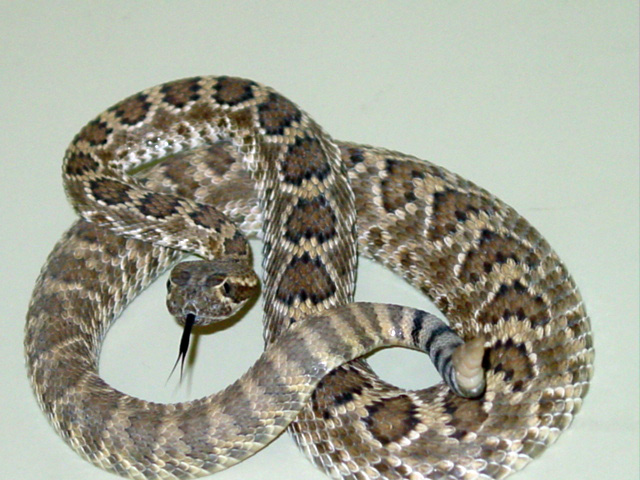
Yucatan Neotropical Rattlesnake Crotalus tzabcan
The scientific name of the Yucatan Neotropical Rattlesnake is Crotalus tzabcan. It is a species of reptile in the family Viperidae (viper), order Squamata. The name dates from 1952.
- Scientific name
- Crotalus tzabcan Klauber, 1952
- Common name
- Yucatan Neotropical Rattlesnake
- Genus
- Crotalus
- Family
- Viperidae (Viper)
- Order
- Squamata
- Class
- Reptilia
- Red List category
- LC Least Concern
- Recorded in
- 3 countries
- Name status
- accepted in the Catalogue of Life
Overview
Crotalus tzabcan, the Yucatán neotropical rattlesnake, is a species of pit viper in the family Viperidae. It was previously thought to be a subspecies of Crotalus durissus, until Wüster elevated it to species status in 2005.
Classification of the Yucatan Neotropical Rattlesnake
| Kingdom | Animalia |
|---|---|
| Phylum | Chordata |
| Subphylum | Vertebrata |
| Infraphylum | Gnathostomata |
| Parvphylum | Osteichthyes |
| Megaclass | Tetrapoda |
| Class | Reptilia (Reptile) |
| Order | Squamata (Snakes) |
| Suborder | Serpentes (Snakes) |
| Infraorder | Alethinophidia |
| Family | Viperidae (Viper) |
| Subfamily | Crotalinae |
| Genus | Crotalus (Rattlesnakes) |
| Species | Crotalus tzabcan Klauber, 1952 |
Where the Yucatan Neotropical Rattlesnake is found
Checklists and occurrence records place Crotalus tzabcan in 3 countries across North America. GBIF holds 734 georeferenced records of it.
Countries
Regions and cities with the most records
- Yucatán, Mexico 367
- Campeche, Mexico 123
- Quintana Roo, Mexico 100
- Mérida, Mexico 27
- Kanasín, Mexico 23
- Valladolid, Mexico 15
- Cayo District, Belize 13
- Tizimín, Mexico 13
- Campeche, Mexico 9
- Corozal District, Belize 8
- Cancún, Mexico 7
- Chiapas, Mexico 7
- Chetumal, Mexico 6
- Petén, Guatemala 6
- Playa del Carmen, Mexico 4
- Tabasco, Mexico 4
- Orange Walk District, Belize 3
Range as the checklists state it
Mexico (Quintana Roo, Yucatan south to El Peten, Campeche), Guatemala, Belize
A number beside a place is its count of GBIF occurrence records. A place without a number comes from a checklist alone. Records show where a species has been observed or collected, which can include escapes and vagrants.
Common names
English
- Yucatan Neotropical Rattlesnake
- Yucatán Neotropical Rattlesnake
Names in 6 other languages
- Chinese
- 尤卡坦響尾蛇
- Danish
- Yucatan-klapperslange
- German
- Yucatán-Schauerklapperschlange, Yucatánklapperschlange
- Italian
- Crotalo neotropicale dello Yucatán, Serpente a sonagli neotropicale dello Yucatán
- Portuguese
- Cascavel-de-Yucatán
- Spanish
- Cascabel Yucateca, Víbora de cascabel yucateca
Synonyms
2 other scientific names have been used for this species and are now treated as synonyms of Crotalus tzabcan.
- Crotalus durissus tzabcan Klauber, 1952
- Crotalus simus tzabcan Klauber, 1952
Related species
-
 Timber RattlesnakeCrotalus horridus
-
 Western Diamondback RattlesnakeCrotalus atrox
-
 SidewinderCrotalus cerastes
-
 Mojave RattlesnakeCrotalus scutulatus
-
 Hopi RattlesnakeCrotalus viridis
-
 Western RattlesnakeCrotalus oreganus
-
 Tiger RattlesnakeCrotalus tigris
-
 Black-tailed RattlesnakeCrotalus molossus
Compare
Questions and answers
What is the scientific name of the Yucatan Neotropical Rattlesnake?
The scientific name of the Yucatan Neotropical Rattlesnake is Crotalus tzabcan. Written with its author, the full name is Crotalus tzabcan Klauber, 1952.
Which family does the Yucatan Neotropical Rattlesnake belong to?
Crotalus tzabcan belongs to the family Viperidae, in the order Squamata and the class Reptilia.
Where is the Yucatan Neotropical Rattlesnake found?
Checklists and occurrence records place Crotalus tzabcan in 3 countries: Mexico, Belize and Guatemala.
What is the conservation status of the Yucatan Neotropical Rattlesnake?
The IUCN Red List category recorded for Crotalus tzabcan is Least Concern (LC).
What other names does the Yucatan Neotropical Rattlesnake have?
Crotalus tzabcan is also known in English as Yucatán Neotropical Rattlesnake.
Sources
Data
- Catalogue of Life, 2026-10-16 XR cc by
- Global Biodiversity Information Facility CC BY 4.0
- Wikidata CC0
- English Wikipedia CC BY-SA 4.0
- GeoNames CC BY 4.0
- Within the Catalogue of Life, this name comes from The Reptile Database cc by
References
- Klauber, Laurence M. (1952). Taxonomic studies on rattlesnakes of Mainland Mexico. Bulletins of the Zoological Society of San Diego (26): 1-143.
- Neill, Wilfred T. and E. Ross Allen. (1959). Studies on the amphibians and reptiles of British Honduras. Publications of the Research Division Ross Allen’s Reptiles Institute. 2 (1): 1-76.
- Campbell, Jonathan A. and William W. Lamar. (2004). The Venomous Reptiles of the Western Hemisphere, 2 vols. Comstock (Cornell University Press), Ithaca, NY, 962 Pp. [Review in Science 305: 182].
- Quijada-Mascareñas & Wüster, W. (2006). On the Origins and Dispersal of Neotropical Rattlesnakes in South America. CAH/ACH Bulletin 14 (1): 6-12.
- Quijada-Mascareñas & Wüster, W. (2006). Crotalus durissus complex: from Yucatan to Patagonia: the natural history of the Neotropical rattlesnake. Reptilia (GB) (49): 66-73.
- Meik, & Jesse M and André Pires-daSilva. (2009). Evolutionary morphology of the rattlesnake style. BMC Evolutionary Biology 2009, 9:35.
- Hoser, R. (2009). A reclassification of the rattlesnakes; species formerly exclusively referred to the genera Crotalus and Sistrurus. Australasian J. Herpetol. 3: 1-21 (Dubious Journal).
- Wüster, W., & Bérnils, R. S. (2011). On the generic classification of the rattlesnakes, with special reference to the Neotropical Crotalus durissus complex (Squamata: Viperidae). Zoologia 28 (4): 417–419.
- Wallach, Van; Kenneth L. Williams, Jeff Boundy. (2014). Snakes of the World: A Catalogue of Living and Extinct Species. [type catalogue]. Taylor and Francis, CRC Press, 1237 Pp.
- Heimes, P. (2016). Snakes of Mexico. Chimaira, Frankfurt, 572 Pp.
- Platt, Steven G., Thomas R. Rainwater, Jan C. Meerman and Stanlee M. Miller. (2016). Nature Notes. Notes on the diet, foraging behavior, and venom of some snakes in Belize. Mesoamerican Herpetology 3 (1): 162–170.
- Carbajal-Márquez, R. A., & José Rogelio Cedeño-Vázquez. (2017). The swimming behaviour of Tzabcan Rattlesnake, Crotalus tzabcan Klauber, 1952 (Squamata: Viperidae). Herpetology Notes 10: 673-674.
- González-Sánchez, V. H., J. D. Johnson, E. García-Padilla, V. Mata-Silva, D. L. DeSantis and L. D. Wilson. (2017). The Herpetofauna of the Mexican Yucatan Peninsula: composition, distribution, and conservation status. Mesoamerican Herpetology 4 (2): 264–380.
- Carbajal-Márquez, R. A., D. González-Solís y J. R. Cedeño-Vázquez. (2018). Endoparasites of Crotalus tzabcan (Serpentes: Viperidae), with a checklist in rattlesnakes. Journal of Parasitic Diseases 42(2): 303-314.
- Carbajal-Márquez, Rubén Alonso; José Rogelio Cedeño-Vázquez, Christian Martin García-Balderas, Tania Ramírez-Valverde, Gustavo Ernesto Quintero-Díaz. (2018). The Defensive Behaviour of Tzabcan Rattlesnake, Crotalus tzabcan Klauber, 1952 (Squamata: Viperidae). Herpetology Notes 11: 429-431.
- Yañez-Arenas, C., S. Castaño-Quintero, R. Rioja-Nieto, K. Rodríguez-Medina & X. Chiappa-Carrara. (2020). Assessing the Relative Role of Environmental Factors That Limit the Distribution of the Yucatan Rattlesnake (Crotalus tzabcan). Journal of Herpetology 54 (2): 216-224.
- Nahuat-Cervera, & Pedro Enrique. (2020). Amphibians and reptiles of the Hobonil Educative Center, Tzucacab, Yucatán, Mexico. Rev. Latinoamer. Herp. 3 (1): 53-65.
- Carbajal-Márquez, Rubén A.; J. Rogelio Cedeño-Vázquez, David González-Solís, Marcio Martins. (2020). Diet and Feeding Ecology of Crotalus tzabcan (Serpentes: Viperidae). South American J. Herp. 15 (1): 9-19.
- Carbajal-Márquez, RUBÉN ALONSO; JOSÉ ROGELIO CEDEÑO-VÁZQUEZ, ARELY MARTÍNEZ-ARCE, EDGAR NERI-CASTRO, SALIMA C. MACHKOUR- M’RABET. (2020). Accessing cryptic diversity in Neotropical rattlesnakes (Serpentes: Viperidae: Crotalus) with the description of two new species. Zootaxa 4729 (4): 451–481.
- Carbajal-Márquez, R. A., J. R. Cedeño-Vázquez, M. Martins, G. Köhler. (2020). Life history, activity pattern and morphology of Crotalus tzabcan (Serpentes: Viperidae). Herpetological Conservation and Biology 15 (1): 228-237.
- Aguilar-López JL, Luría-Manzano R, Pineda E, & Canseco-Márquez L. (2021). Selva Zoque, Mexico: an important Mesoamerican tropical region for reptile species diversity and conservation. ZooKeys 1054: 127-153.
- Reyes-Velasco, J., Cox, C. L., Jones, J. M., Borja, M., & Campbell, J. A. (2022). How many species of rattlesnakes are there in the Crotalus durissus species group (Serpentes: Crotalidae)? Revista Latinoamericana de Herpetología 5 (1): 43-55.
- García-Padilla, E., Heredia-López, I., Villalobos-Juárez, I., Lazcano, D., & Fucsko, L. A. (2025). Notes on the Herpetofauna of Mexico 48: From Sacred to Scorned---A Study of the Mexican Rattlesnake’s Changing Status. Bulletin of the Chicago Herpetological Society, 60(3), 25-30.
This species in other databases
Page built on 26 November 2026. See how the catalog is made and all sources and licences.
Cite this page
ScientificNames.org. (2026). Crotalus tzabcan (Yucatan Neotropical Rattlesnake). Retrieved November 26, 2026, from https://scientificnames.org/species/crotalus-tzabcan
“Crotalus tzabcan (Yucatan Neotropical Rattlesnake).” ScientificNames.org, 2026, scientificnames.org/species/crotalus-tzabcan. Accessed 26 Nov. 2026.
ScientificNames.org. “Crotalus tzabcan (Yucatan Neotropical Rattlesnake).” Accessed November 26, 2026. https://scientificnames.org/species/crotalus-tzabcan.
@misc{scientificnames_crotalus_tzabcan_yucatan_neotropical_rattlesnake,
  author = {{ScientificNames.org}},
  title = {Crotalus tzabcan (Yucatan Neotropical Rattlesnake)},
  year = {2026},
  url = {https://scientificnames.org/species/crotalus-tzabcan},
  note = {Accessed 2026-11-26}
}