Species · Mammals
San Quintin Kangaroo Rat Dipodomys gravipes
The scientific name of the San Quintin Kangaroo Rat is Dipodomys gravipes. It is a species of mammal in the family Heteromyidae (pocket mice), order Rodentia. The name dates from 1925.
- Scientific name
- Dipodomys gravipes Huey, 1925
- Common name
- San Quintin Kangaroo Rat
- Genus
- Dipodomys
- Family
- Heteromyidae (Pocket Mice)
- Order
- Rodentia
- Class
- Mammalia
- Red List category
- CR Critically Endangered
- Recorded in
- 1 country
- Name status
- accepted in the Catalogue of Life

Overview
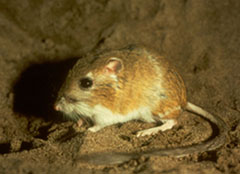
Dipodomys gravipes has pale pinkish-buff fur, powerful hind legs, and a hairy tail longer than its body.
Written 26 November 2026 from the sources listed below. Each statement was checked against the passage it cites; statements that could not be supported were removed.
Appearance
The San Quintin Kangaroo Rat has pale pinkish-buff fur on its head and back, with some longer black hairs. Its underparts are white, and it has a white spot above each eye.[1][2]
Its hairy tail is longer than its body, has a large tuft of hairs at the tip, and has white stripes along both sides. The upper surfaces of its hind feet are white, while their undersides are black.[3][4][5]
The species has powerful hind legs and small front legs. Its head-and-body length is approximately 13 cm, and adults weigh approximately 80–90 g.[6][7][8]
Habitat
The San Quintin Kangaroo Rat inhabits arid lowlands with sparse vegetation. The northern population occupies cactus-covered slopes and neighboring areas with short vegetation, while the southern population inhabits floodplains and flat areas with sparse vegetation among low hills.[9][10][11]
The species lives in burrows with several entrances, which are generally not concealed beneath shrubs. Its burrows can reach approximately 50 cm in depth.[12][13]
Its burrows contain a main passage, several side passages, approximately three nesting chambers, and ten food storage chambers.[14]
Diet
The San Quintin Kangaroo Rat probably feeds on seeds and green shoots.[15]
Behaviour
The San Quintin Kangaroo Rat is nocturnal. It uses its powerful hind legs to move in a series of large bounds.[16][17]
It uses its front legs to manipulate food and clean its cheek pouches. Its tail helps maintain balance while jumping and acts as a prop when the animal is stationary.[18][19]
Reproduction and life cycle
Young individuals have been observed at several times of year, primarily during winter and spring.[20]
Conservation
The San Quintin Kangaroo Rat is endemic to Mexico and is known from western Baja California. Its historical range comprised a coastal strip approximately 20 km wide extending from San Telmo to El Rosario, with two separate populations.[21][22][23]
The species is currently known only from the Valle Tranquilo Nature Reserve, just south of San Quintin. It was rediscovered in 2017 in the Valle Tranquilo Nature Preserve by researchers from the San Diego Natural History Museum.[24][25][26]
Its historical habitat has been extensively converted into agricultural land. Intensive searches conducted during the 1990s failed to find specimens.[27][28]
The IUCN assessed the species as critically endangered and noted that it might be extinct. The IUCN Red List most recently assessed the species in 2026.[29][30]
The rediscovery prompted a proposed conservation plan for the area involving Terra Peninsular A.C. and the University of California Institute for Mexico and the United States.[31]
Classification of the San Quintin Kangaroo Rat
| Kingdom | Animalia |
|---|---|
| Phylum | Chordata |
| Subphylum | Vertebrata |
| Infraphylum | Gnathostomata |
| Parvphylum | Osteichthyes |
| Megaclass | Tetrapoda |
| Class | Mammalia (Mammal) |
| Subclass | Theria |
| Infraclass | Eutheria |
| Order | Rodentia (Rodent) |
| Suborder | Castorimorpha |
| Family | Heteromyidae (Pocket Mice) |
| Subfamily | Dipodomyinae (Kangaroo Mice) |
| Genus | Dipodomys (Kangaroo Rat) |
| Species | Dipodomys gravipes Huey, 1925 |
Where the San Quintin Kangaroo Rat is found
Checklists and occurrence records place Dipodomys gravipes in 1 country across North America. GBIF holds 312 georeferenced records of it.
Countries
Regions and cities with the most records
- Baja California, Mexico 277
- Lázaro Cárdenas, Mexico 95
- La Joya, Mexico 4
- Las Delicias, Mexico 4
- Tijuana, Mexico 4
- Villa del Prado 2da Sección, Mexico 4
Range as the checklists state it
Middle America
A number beside a place is its count of GBIF occurrence records. A place without a number comes from a checklist alone. Records show where a species has been observed or collected, which can include escapes and vagrants.
Common names
English
- San Quintin Kangaroo Rat
- San Quintín Kangaroo Rat
Names in 6 other languages
- Czech
- tarbíkomyš tlustoocasá
- Finnish
- sanquintininkengurotta
- Japanese
- サンキンティンカンガルーネズミ
- Polish
- Szczuroskoczek zaginiony
- Russian
- Санквинтинский кенгуровый прыгун
- Spanish
- Rata canguro de San Quintín
Related species
-
 Merriam's Kangaroo RatDipodomys merriami
-
 Desert Kangaroo RatDipodomys deserti
-
 Ord's Kangaroo RatDipodomys ordii
-
 Giant Kangaroo RatDipodomys ingens
-
 Banner-tailed Kangaroo RatDipodomys spectabilis
-
 California Kangaroo RatDipodomys californicus
-
 Panamint Kangaroo RatDipodomys panamintinus
-
 Agile Kangaroo RatDipodomys agilis
Compare
Questions and answers
What is the scientific name of the San Quintin Kangaroo Rat?
The scientific name of the San Quintin Kangaroo Rat is Dipodomys gravipes. Written with its author, the full name is Dipodomys gravipes Huey, 1925.
Which family does the San Quintin Kangaroo Rat belong to?
Dipodomys gravipes belongs to the family Heteromyidae, in the order Rodentia and the class Mammalia.
Where is the San Quintin Kangaroo Rat found?
Checklists and occurrence records place Dipodomys gravipes in 1 country: Mexico.
What is the conservation status of the San Quintin Kangaroo Rat?
The IUCN Red List category recorded for Dipodomys gravipes is Critically Endangered (CR).
What other names does the San Quintin Kangaroo Rat have?
Dipodomys gravipes is also known in English as San Quintín Kangaroo Rat.
What is the scientific name of a kangaroo rat?
The scientific name of the San Quintin Kangaroo Rat is Dipodomys gravipes Huey, 1925.[32]
Do kangaroo rats still exist?
The San Quintin Kangaroo Rat was rediscovered in 2017 and is currently known only from the Valle Tranquilo Nature Reserve, just south of San Quintin.[24][25]
What is the diet of a kangaroo rat?
The San Quintin Kangaroo Rat probably feeds on seeds and green shoots.[15]
What is the kangaroo rats' habitat?
The San Quintin Kangaroo Rat inhabits arid lowlands with sparse vegetation. Its northern population occupies cactus-covered slopes and neighboring areas with short vegetation, while its southern population inhabits floodplains and flat areas with sparse vegetation among low hills.[9][10][11]
Sources
Passages the profile rests on
- The San Quintin kangaroo rat has pale pinkish-buff fur on its head and back, with some longer black hairs. Source passage: “The fur on the head and back is a pale pinkish-buff, with some longer black hairs.” — English Wikipedia
- The species has white underparts and a white spot above each eye. Source passage: “The underparts are white and a white spot is above the eye” — English Wikipedia
- The species has a hairy tail with a large tuft of hairs at its tip, and the tail is longer than its body. Source passage: “The hairy tail has a large tuft of hairs on the end and is longer than the body.” — English Wikipedia
- White stripes extend along both sides of the species' tail. Source passage: “white stripes run down either side of the tail.” — English Wikipedia
- The upper surfaces of the hind feet are white, whereas their undersides are black. Source passage: “The upper surface of the hind feet is white, while the under surface is black.” — English Wikipedia
- The species has powerful hind legs and small front legs. Source passage: “Like other kangaroo rats, the hind legs are powerful and propel the animal in a series of large bounds. The front legs, however, are small” — English Wikipedia
- The head-and-body length of the San Quintin kangaroo rat is approximately 13 cm. Source passage: “a head-and-body length of about 13 cm (5 in)” — English Wikipedia
- Adults weigh approximately 80–90 g. Source passage: “a weight of 80 to 90 g (2.8 to 3.2 oz).” — English Wikipedia
- The species inhabits arid lowlands with sparse vegetation. Source passage: “Its natural habitat includes arid lowlands with sparse vegetation.” — English Wikipedia
- The northern population occupies cactus-covered slopes and neighboring areas with short vegetation. Source passage: “The northern population occupies cactus-covered slopes and adjacent areas with short vegetation” — English Wikipedia
- The southern population inhabits floodplains and flat areas with sparse vegetation among low hills. Source passage: “the southern population is found in floodplains and flat places with sparse vegetation among low hills.” — English Wikipedia
- The species lives in burrows with several entrances, which are generally not concealed beneath shrubs. Source passage: “The San Quintin kangaroo rat lives in a burrow with several entrances, none of which is usually concealed under shrubs.” — English Wikipedia
- Its burrows can reach approximately 50 cm in depth. Source passage: “The burrow can be 50 cm (20 in) deep” — English Wikipedia
- Its burrows contain a main passage, several side passages, approximately three nesting chambers, and ten food storage chambers. Source passage: “with a main passage and several side passages, and has about three nesting chambers and ten food storage chambers.” — English Wikipedia
- The species probably feeds on seeds and green shoots. Source passage: “The diet of this kangaroo rat is probably seeds and green shoots.” — English Wikipedia
- The San Quintin kangaroo rat is nocturnal. Source passage: “This animal is nocturnal” — English Wikipedia
- The species uses its powerful hind legs to move in a series of large bounds. Source passage: “the hind legs are powerful and propel the animal in a series of large bounds.” — English Wikipedia
- The species uses its front legs to manipulate food and clean its cheek pouches. Source passage: “the front legs, however, are small and are used for manipulating food and cleaning the cheek pouches.” — English Wikipedia
- The tail helps the animal maintain balance while jumping and acts as a prop when it is stationary. Source passage: “The tail provides balance while jumping and is used as a prop when stationary.” — English Wikipedia
- Young individuals have been observed at several times of year, primarily during winter and spring. Source passage: “young have been seen at several different times of year, but mainly in the winter and spring.” — English Wikipedia
- The San Quintin kangaroo rat is endemic to Mexico and is known from western Baja California. Source passage: “It is endemic to Mexico, where it is known only from western Baja California.” — English Wikipedia
- Its historical range comprises a coastal strip approximately 20 km wide extending from San Telmo to El Rosario. Source passage: “It occupies a 20 km (12 mi) wide strip of coastal land from San Telmo to El Rosario” — English Wikipedia
- The historical range contained two separate populations. Source passage: “with two separate populations.” — English Wikipedia
- The species is currently known only from the Valle Tranquilo Nature Reserve, just south of San Quintin. Source passage: “The species is now only known from the Valle Tranquilo Nature Reserve, just south of San Quintin.” — English Wikipedia
- The species was rediscovered in 2017 in the Valle Tranquilo Nature Preserve. Source passage: “in 2017, the species was rediscovered in the Valle Tranquilo Nature Preserve” — English Wikipedia
- Researchers from the San Diego Natural History Museum rediscovered the species in 2017. Source passage: “the species was rediscovered in the Valle Tranquilo Nature Preserve by researchers from the San Diego Natural History Museum” — English Wikipedia
- The species' historical habitat has been extensively converted into agricultural land. Source passage: “Since then, virtually the whole area which they inhabited has been converted into agricultural land.” — English Wikipedia
- Intensive searches conducted during the 1990s failed to find specimens. Source passage: “intensive searches in the 1990s failed to detect any specimens.” — English Wikipedia
- The IUCN assessed the species as critically endangered and noted that it might be extinct. Source passage: “The International Union for Conservation of Nature has assessed their conservation status as "critically endangered" and notes that the species may be extinct.” — English Wikipedia
- The IUCN Red List most recently assessed the San Quintin kangaroo rat in 2026. Source passage: “San Quintin Kangaroo Rat Dipodomys gravipes has most recently been assessed for The IUCN Red List of Threatened Species in 2026.” — iucnredlist.org
- The rediscovery prompted a proposed conservation plan for the area involving Terra Peninsular A.C. and the University of California Institute for Mexico and the United States. Source passage: “has led to a proposed conservation plan for the area by the local organization Terra Peninsular A.C. and University of California Institute for Mexico and the United States.” — English Wikipedia
- The species was first described in 1925 by American zoologist Laurence M. Huey. Source passage: “The first description of this species was made in 1925 by Laurence M. Huey (1892–1963), an American zoologist.” — English Wikipedia
Data
- Catalogue of Life, 2026-10-16 XR cc by
- Global Biodiversity Information Facility CC BY 4.0
- Wikidata CC0
- GeoNames CC BY 4.0
- Wikimedia Commons per image; credit shown with each image
- Within the Catalogue of Life, this name comes from The Integrated Taxonomic Information System cc0
References
- Proc. Biol. Soc. Wash. vol.38 p.83 where the name was published
- Wilson, Don E., and DeeAnn M. Reeder, eds. (1993). Mammal Species of the World: A Taxonomic and Geographic Reference, 2nd Ed., 3rd Printing.
- Wilson, Don E., and F. Russell Cole. (2000). Common Names of Mammals of the World.
- Wilson, Don E., and DeeAnn M. Reeder, eds. (2005). Mammal Species of the World: A Taxonomic and Geographic Reference, 3rd Ed., Vols. 1 & 2.
- Hafner, M. S. / Wilson, Don E., T. E. Lacher Jr., and R. A. Mittermeier, eds. (2016). Family Heteromyidae (Pocket Mice, Kangaroo Mice and Kangaroo Rats). Handbook of the Mammals of the World. Vol. 6: Lagomorphs and Rodents I.
- Burgin, Connor J., Don E. Wilson, Russell A. Mittermeier, Anthony B. Rylands, et al. (2020). Illustrated Checklist of the Mammals of the World. Vol. 1. Monotremata to Rodentia.
This species in other databases
Page built on 28 November 2026. See how the catalog is made and all sources and licences.
Cite this page
ScientificNames.org. (2026). Dipodomys gravipes (San Quintin Kangaroo Rat). Retrieved November 28, 2026, from https://scientificnames.org/species/dipodomys-gravipes
“Dipodomys gravipes (San Quintin Kangaroo Rat).” ScientificNames.org, 2026, scientificnames.org/species/dipodomys-gravipes. Accessed 28 Nov. 2026.
ScientificNames.org. “Dipodomys gravipes (San Quintin Kangaroo Rat).” Accessed November 28, 2026. https://scientificnames.org/species/dipodomys-gravipes.
@misc{scientificnames_dipodomys_gravipes_san_quintin_kangaroo_rat,
  author = {{ScientificNames.org}},
  title = {Dipodomys gravipes (San Quintin Kangaroo Rat)},
  year = {2026},
  url = {https://scientificnames.org/species/dipodomys-gravipes},
  note = {Accessed 2026-11-28}
}