Species · Mammals
Heermann's Kangaroo Rat Dipodomys heermanni
The scientific name of the Heermann's Kangaroo Rat is Dipodomys heermanni. It is a species of mammal in the family Heteromyidae (pocket mice), order Rodentia. The name dates from 1853.
- Scientific name
- Dipodomys heermanni Le Conte, 1853
- Common name
- Heermann's Kangaroo Rat
- Genus
- Dipodomys
- Family
- Heteromyidae (Pocket Mice)
- Order
- Rodentia
- Class
- Mammalia
- Red List category
- LC Least Concern
- Recorded in
- 1 country
- Name status
- accepted in the Catalogue of Life

Overview
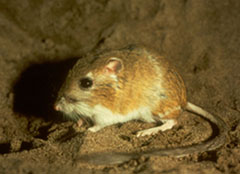
Heermann's Kangaroo Rat is a mammal in the family Heteromyidae, order Rodentia, and class Mammalia. It is endemic to California in the United States, ranging from Lake Tahoe to Point Conception in Santa Barbara County. It has long, smooth fur with olive, black, and orange dorsal coloration and five toes on each hind foot.
Written 26 November 2026 from the sources listed below. Each statement was checked against the passage it cites; statements that could not be supported were removed.
Appearance
Heermann's Kangaroo Rat has long, smooth fur with olive, black, and orange coloration on its dorsal side. Its face is relatively broad compared with those of many other kangaroo rats.[1][2]
Each hind foot has five toes, distinguishing the species from Dipodomys californicus and Dipodomys nitratoides. Its average total body length is 250–313 mm, and its average tail length ranges from 160 to 200 mm.[3][4][5]
Its average hind-foot length ranges from 38 to 46 mm, and its average ear length ranges from 10 to 17 mm. The species exhibits significant sexual dimorphism in standard external measurements.[6][7][8]
Habitat
Heermann's Kangaroo Rat commonly inhabits coastal plains and ridges with shallow soil. It has comparatively broad habitat requirements.[9][10]
Its burrowing behavior varies with soil conditions. In fine, deep soil, tunnels average 10.7 m in length and reach depths of up to 51 cm, while in shallow, rocky soil, they average 3.3 m long and reach no deeper than 19.4 cm.[11][12][13]
The species sometimes modifies tunnels originally constructed by other burrowing animals, including ground squirrels. Its burrow systems have one to four escape routes in addition to the main entrance.[14][15]
Diet
Heermann's Kangaroo Rat is primarily seed-eating. It also consumes plant material, particularly during winter and spring.[16][17]
Wild individuals have been documented capturing moths, beetles, and grasshoppers at night. The species obtains water from seeds and dew on plant material in its diet.[18][19]
Individuals drink from puddles or other direct water sources only when their water intake has remained insufficient for several weeks.[20]
Behaviour
Heermann's Kangaroo Rat does not hibernate and remains active to varying degrees throughout the year. Individuals can spend up to 23 hours per day inside their burrows and typically emerge at night.[21][22][23]
Rain, fog, and bright full moonlight usually prevent individuals from emerging from their burrows. The species generally lives solitarily.[24][25]
Individuals communicate their willingness to interact socially through characteristic foot drumming. Increased foot drumming is associated with reduced willingness to socialize.[26][27]
Individuals have been observed dust-bathing after foraging. The species usually travels bipedally, occasionally making hops of approximately 15 cm, while rapid running involves hops ranging from 61 to 76 cm.[28][29][30]
Reproduction and life cycle
Heermann's Kangaroo Rat primarily breeds between February and October. Breeding activity reaches its highest level in April and declines in July.[31][32]
Newborn individuals are bright pink, wrinkled, and hairless apart from colorless vibrissae. Their eyes are closed at birth, and hair begins developing within 22 hours after birth.[33][34][35]
Young individuals complete weaning at approximately 25 days of age. They begin hunting and scavenging independently at approximately four weeks of age.[36][37]
Conservation
Heermann's Kangaroo Rat is classified as Least Concern by the IUCN. The subspecies Dipodomys heermanni morroensis is listed as endangered by the USFWS.[38][39]
Similar species
Heermann's Kangaroo Rat can be distinguished from Dipodomys californicus and Dipodomys nitratoides by the five toes on each hind foot.[3]
Uses
The named subspecies Dipodomys heermanni arenae has been studied in relation to native shrubs and the invasive plant Veldt grass.[40]
Classification of the Heermann's Kangaroo Rat
| Kingdom | Animalia |
|---|---|
| Phylum | Chordata |
| Subphylum | Vertebrata |
| Infraphylum | Gnathostomata |
| Parvphylum | Osteichthyes |
| Megaclass | Tetrapoda |
| Class | Mammalia (Mammal) |
| Subclass | Theria |
| Infraclass | Eutheria |
| Order | Rodentia (Rodent) |
| Suborder | Castorimorpha |
| Family | Heteromyidae (Pocket Mice) |
| Subfamily | Dipodomyinae (Kangaroo Mice) |
| Genus | Dipodomys (Kangaroo Rat) |
| Species | Dipodomys heermanni Le Conte, 1853 |
Where the Heermann's Kangaroo Rat is found
Checklists and occurrence records place Dipodomys heermanni in 1 country across North America. GBIF holds 3,799 georeferenced records of it.
Countries
Regions and cities with the most records
- California, United States 2,603
- San Luis Obispo, United States 237
- Soledad, United States 230
- Greenfield, United States 194
- Lamont, United States 114
- Marina, United States 113
- Salinas, United States 110
- Seaside, United States 108
- Monterey, United States 102
- Pacific Grove, United States 102
- Prunedale, United States 98
- Arvin, United States 97
- Atascadero, United States 74
- Nipomo, United States 73
- Arroyo Grande, United States 71
- Lompoc, United States 58
- Tracy, United States 54
- Turlock, United States 53
- Atwater, United States 51
- Santa Maria, United States 40
- Livermore, United States 35
- Paso Robles, United States 29
- Bakersfield, United States 28
- Oildale, United States 25
- Vincent, United States 25
- Lancaster, United States 24
- Palmdale, United States 24
- Lafayette, United States 21
- Moraga, United States 20
- Pleasant Hill, United States 20
- Walnut Creek, United States 20
- Coalinga, United States 18
- Orcutt, United States 16
- Concord, United States 14
- Danville, United States 14
- San Ramon, United States 13
Range as the checklists state it
North America
A number beside a place is its count of GBIF occurrence records. A place without a number comes from a checklist alone. Records show where a species has been observed or collected, which can include escapes and vagrants.
Common names
English
- Heermann's Kangaroo Rat
- Heermann S Kangaroo Rat
- Morro Bay Kangaroo Rat
- Morro Bay Kangaroo-rat
Names in 6 other languages
- Czech
- tarbíkomyš Heermannova
- Finnish
- calaverasinkengurotta
- Japanese
- ハーマンカンガルーネズミ
- Polish
- Szczuroskoczek płowy
- Russian
- Кенгуровый прыгун Хирмана
- Spanish
- Rata canguro de California
Subspecies and varieties
- Dipodomys heermanni arenae subspecies
- Dipodomys heermanni berkeleyensis (Berkeley Kangaroo Rat) subspecies
- Dipodomys heermanni dixoni (Merced Kangaroo Rat) subspecies
- Dipodomys heermanni goldmani subspecies
- Dipodomys heermanni heermanni (Heermann's Kangaroo Rat) subspecies
- Dipodomys heermanni jolonensis subspecies
- Dipodomys heermanni morroensis (Morro Bay Kangaroo Rat) subspecies
- Dipodomys heermanni swarthi subspecies
- Dipodomys heermanni tularensis subspecies
Related species
-
 Merriam's Kangaroo RatDipodomys merriami
-
 Desert Kangaroo RatDipodomys deserti
-
 Ord's Kangaroo RatDipodomys ordii
-
 Giant Kangaroo RatDipodomys ingens
-
 Banner-tailed Kangaroo RatDipodomys spectabilis
-
 California Kangaroo RatDipodomys californicus
-
 Panamint Kangaroo RatDipodomys panamintinus
-
 Agile Kangaroo RatDipodomys agilis
Compare
Questions and answers
What is the scientific name of the Heermann's Kangaroo Rat?
The scientific name of the Heermann's Kangaroo Rat is Dipodomys heermanni. Written with its author, the full name is Dipodomys heermanni Le Conte, 1853.
Which family does the Heermann's Kangaroo Rat belong to?
Dipodomys heermanni belongs to the family Heteromyidae, in the order Rodentia and the class Mammalia.
Where is the Heermann's Kangaroo Rat found?
Checklists and occurrence records place Dipodomys heermanni in 1 country: United States.
What is the conservation status of the Heermann's Kangaroo Rat?
The IUCN Red List category recorded for Dipodomys heermanni is Least Concern (LC).
What other names does the Heermann's Kangaroo Rat have?
Dipodomys heermanni is also known in English as Heermann S Kangaroo Rat, Morro Bay Kangaroo Rat and Morro Bay Kangaroo-rat.
Do kangaroo rats still exist?
Heermann's Kangaroo Rat is endemic to California in the United States and is classified as Least Concern by the IUCN.[41][38]
What is the diet of a kangaroo rat?
Heermann's Kangaroo Rat primarily eats seeds and also consumes plant material, particularly during winter and spring. Wild individuals have also been documented capturing moths, beetles, and grasshoppers at night.[16][17][18]
Sources
Passages the profile rests on
- The species has long, smooth fur with olive, black, and orange coloration on its dorsal side. Source passage: “Their long smooth pelage resembles typical kangaroo rats, with their dorsal side showing a mixed range of olive, black and orange colors.” — English Wikipedia
- The species has a relatively broad face compared with many other kangaroo rats. Source passage: “It is considered "broad-faced", unlike many other species of kangaroo rats, which are considered to be "narrow-faced".” — English Wikipedia
- Each hind foot has five toes, a feature useful for distinguishing this species from Dipodomys californicus and Dipodomys nitratoides. Source passage: “It has five toes on each hind foot, and this small characteristic is important in distinguishing it from similar species such as Dipodomys californicus and Dipodomys nitratoides.” — English Wikipedia
- The species has an average total body length of 250–313 mm. Source passage: “Heermann's kangaroo rat averages a total length of 250–313 mm (9.8–12.3 in)” — English Wikipedia
- Its average tail length ranges from 160 to 200 mm. Source passage: “their tail measuring 160–200 mm (6.3–7.9 in)” — English Wikipedia
- Its average hind-foot length ranges from 38 to 46 mm. Source passage: “their hind foot measuring 38–46 mm (1.5–1.8 in)” — English Wikipedia
- Its average ear length ranges from 10 to 17 mm. Source passage: “and their ear measuring 10–17 mm (0.39–0.67 in).” — English Wikipedia
- The species exhibits significant sexual dimorphism in standard external measurements. Source passage: “when looking at all standard external measurements it has been found they demonstrate significant sexual dimorphism.” — English Wikipedia
- The species commonly inhabits coastal plains and ridges with shallow soil. Source passage: “Most common areas are on coastal plains or ridges with shallow soil.” — English Wikipedia
- The species has comparatively broad habitat requirements. Source passage: “Has comparatively broad habitat requirements (Kelt 1988).” — nrm.dfg.ca.gov
- Its burrowing behavior varies with soil conditions, with longer tunnels in fine, deep soil than in shallow, rocky soil. Source passage: “The extent of the burrowing behavior depends on the type of soil present” — English Wikipedia
- In fine, deep soil, its tunnels average 10.7 m in length and reach depths of up to 51 cm. Source passage: “in areas with fine deep soil their tunnels average 10.7 m (35 ft) long and up to 51 cm (20 in) beneath the surface” — English Wikipedia
- In shallow, rocky soil, its tunnels average 3.3 m long and reach no deeper than 19.4 cm. Source passage: “whereas in shallow rocky soils the average length is 3.3 m (11 ft) and they do not extend deeper than 19.4 cm (7.6 in).” — English Wikipedia
- The species sometimes modifies tunnels originally constructed by other burrowing animals, including ground squirrels. Source passage: “they manipulate the tunnels already made by other burrowing animals to make their own, such as tunnels made by ground squirrels (Spermophilus).” — English Wikipedia
- Its burrow systems have one to four escape routes in addition to the main entrance. Source passage: “Additionally they have one to four escape routes besides the main entrance.” — English Wikipedia
- The species is primarily seed-eating. Source passage: “Heermann's kangaroo rats are granivores” — English Wikipedia
- The species also consumes plant material, particularly during winter and spring. Source passage: “They are also herbivores, especially during seasons of winter and spring.” — English Wikipedia
- Wild individuals have been documented capturing moths, beetles, and grasshoppers at night. Source passage: “in the wild they have been documented capturing insects at night such as moths, beetles, and grasshoppers.” — English Wikipedia
- The species obtains water from seeds and dew on plant material in its diet. Source passage: “They achieve necessary water consumption from seeds and dew from the plant material in their diet” — English Wikipedia
- Individuals drink from puddles or other direct water sources only when their water intake has remained insufficient for several weeks. Source passage: “will only drink from a puddle or direct water source if water intake isn't achieved for several weeks.” — English Wikipedia
- The species does not hibernate and remains active to varying degrees throughout the year. Source passage: “The Heermann's kangaroo rat does not hibernate, instead it remains more or less active during the year depending on time of day.” — English Wikipedia
- Individuals can spend up to 23 hours per day inside their burrows. Source passage: “It lives in a burrow for the majority of the day (up to 23 hours/day)” — English Wikipedia
- The species typically emerges from its burrow at night. Source passage: “and typically only comes out at night.” — English Wikipedia
- Rain, fog, and bright full moonlight usually prevent individuals from emerging from their burrows. Source passage: “Rain, fog and a bright full moon will usually prevent them from coming out of their burrow.” — English Wikipedia
- The species generally lives solitarily. Source passage: “They live a solitary life” — English Wikipedia
- Individuals communicate their willingness to interact socially through characteristic foot drumming. Source passage: “Kangaroo rats exhibit their willingness to interact with each other with a characteristic foot drumming” — English Wikipedia
- Increased foot drumming is associated with reduced willingness to socialize. Source passage: “increased foot drumming was associated with unwillingness to socialize” — English Wikipedia
- Individuals have been observed dust-bathing after foraging. Source passage: “They have been observed dust-bathing after foraging.” — English Wikipedia
- The species usually travels bipedally, occasionally making hops of approximately 15 cm. Source passage: “Traveling is mostly done in a bipedal position with occasional hops that generally reach distances about 15 cm (6 in).” — English Wikipedia
- Rapid running involves hops ranging from 61 to 76 cm. Source passage: “When running rapidly their hops can range from 61 to 76 cm (24 to 30 in)” — English Wikipedia
- The species primarily breeds between February and October. Source passage: “Heermann's kangaroo rat has a wide window in which it primarily breeds, ranging from February to October.” — English Wikipedia
- Breeding activity reaches its highest level in April and declines in July. Source passage: “Its highest breeding activity is in April, and this decreases in July.” — English Wikipedia
- Newborn individuals are bright pink, wrinkled, and hairless apart from colorless vibrissae. Source passage: “The young are born bright pink, wrinkled, hairless (except for colorless vibrissae)” — English Wikipedia
- Newborn individuals have closed eyes. Source passage: “poikilothermic, and with their eyes closed.” — English Wikipedia
- Hair begins developing within 22 hours after birth. Source passage: “Within 22 hours of birth, hair is already developing” — English Wikipedia
- Young individuals complete weaning at approximately 25 days of age. Source passage: “Weaning is completed around day 25” — English Wikipedia
- Young individuals begin hunting and scavenging independently at approximately four weeks of age. Source passage: “young begin hunting and scavenging independently by 4 weeks.” — English Wikipedia
- The species is classified as Least Concern by the IUCN. Source passage: “the Heermann's kangaroo rat is listed as a species of least concern according to the IUCN.” — English Wikipedia
- The subspecies Dipodomys heermanni morroensis is listed as endangered by the USFWS. Source passage: “According to USFWS the sub-species D.h. morroensis is listed as endangered.” — English Wikipedia
- The named subspecies Dipodomys heermanni arenae has been studied in relation to native shrubs and the invasive plant Veldt grass. Source passage: “rodent (Heermann's kangaroo rat, Dipodomys heermanni arenae) on native shrubs and an invasive plant (Veldt grass, Ehrharta calycina).” — digitalcommons.calpoly.edu
- The species is endemic to California in the United States. Source passage: “Dipodomys heermanni is endemic to California in the United States.” — English Wikipedia
Data
- Catalogue of Life, 2026-10-16 XR cc by
- Global Biodiversity Information Facility CC BY 4.0
- Wikidata CC0
- GeoNames CC BY 4.0
- Wikimedia Commons per image; credit shown with each image
- Within the Catalogue of Life, this name comes from The Integrated Taxonomic Information System cc0
References
- Proc. Acad. Nat. Sci. Philadelphia vol.6 p.224 where the name was published
- Banks, R. C., R. W. McDiarmid, and A. L. Gardner. (1987). Checklist of Vertebrates of the United States, the U.S. Territories, and Canada. Resource Publication, No. 166.
- Wilson, Don E., and DeeAnn M. Reeder, eds. (1993). Mammal Species of the World: A Taxonomic and Geographic Reference, 2nd Ed., 3rd Printing.
- Wilson, Don E., and Sue Ruff, eds. (1999). The Smithsonian Book of North American Mammals.
- Wilson, Don E., and F. Russell Cole. (2000). Common Names of Mammals of the World.
- Wilson, Don E., and DeeAnn M. Reeder, eds. (2005). Mammal Species of the World: A Taxonomic and Geographic Reference, 3rd Ed., Vols. 1 & 2.
- Hafner, M. S. / Wilson, Don E., T. E. Lacher Jr., and R. A. Mittermeier, eds. (2016). Family Heteromyidae (Pocket Mice, Kangaroo Mice and Kangaroo Rats). Handbook of the Mammals of the World. Vol. 6: Lagomorphs and Rodents I.
- Burgin, Connor J., Don E. Wilson, Russell A. Mittermeier, Anthony B. Rylands, et al. (2020). Illustrated Checklist of the Mammals of the World. Vol. 1. Monotremata to Rodentia.
This species in other databases
Page built on 27 November 2026. See how the catalog is made and all sources and licences.
Cite this page
ScientificNames.org. (2026). Dipodomys heermanni (Heermann's Kangaroo Rat). Retrieved November 27, 2026, from https://scientificnames.org/species/dipodomys-heermanni
“Dipodomys heermanni (Heermann's Kangaroo Rat).” ScientificNames.org, 2026, scientificnames.org/species/dipodomys-heermanni. Accessed 27 Nov. 2026.
ScientificNames.org. “Dipodomys heermanni (Heermann's Kangaroo Rat).” Accessed November 27, 2026. https://scientificnames.org/species/dipodomys-heermanni.
@misc{scientificnames_dipodomys_heermanni_heermanns_kangaroo_rat,
  author = {{ScientificNames.org}},
  title = {Dipodomys heermanni (Heermann's Kangaroo Rat)},
  year = {2026},
  url = {https://scientificnames.org/species/dipodomys-heermanni},
  note = {Accessed 2026-11-27}
}