Species · Mammals
Fresno Kangaroo Rat Dipodomys nitratoides
The scientific name of the Fresno Kangaroo Rat is Dipodomys nitratoides. It is a species of mammal in the family Heteromyidae (pocket mice), order Rodentia. The name dates from 1894.
- Scientific name
- Dipodomys nitratoides Merriam, 1894
- Common name
- Fresno Kangaroo Rat
- Genus
- Dipodomys
- Family
- Heteromyidae (Pocket Mice)
- Order
- Rodentia
- Class
- Mammalia
- Red List category
- VU Vulnerable
- Recorded in
- 1 country
- Name status
- accepted in the Catalogue of Life

Overview
The species is endemic to areas within and near California's San Joaquin Valley in the United States. It is the smallest kangaroo rat in its genus and has yellowish upper fur, white underparts, long hind legs, and a long tufted tail.
Written 26 November 2026 from the sources listed below. Each statement was checked against the passage it cites; statements that could not be supported were removed.
Appearance
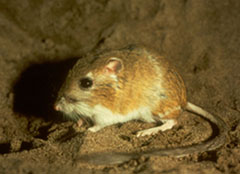
The species has tawny yellow fur on its head and back and white fur on its belly. A white stripe crosses its hips and continues along the sides of its tail, whose upper and lower surfaces are blackish.[1][2][3]
It has long hind legs, a long tail, a short neck, and a large head. Its tail is longer than the combined length of its head and body and ends in a large tuft of fur.[4][5]
The species has large eyes positioned dorsally, small rounded ears, and four toes on each hind foot.[6][7]
Habitat
The species inhabits arid environments and occurs in alkali-sink plant communities. Recent records of the Fresno subspecies have been restricted to alkali-sink communities at elevations of 200–300 feet.[8][9][10]
The historical range of the Fresno subspecies included grassland and alkali desert scrub in Merced, Kings, Fresno, and Madera counties. No populations are currently known within the historical range in Merced, Madera, and Fresno counties.[11][12]
The species shelters in underground burrows dug in relatively light, sandy soils, usually on raised ground. Its burrows generally have two to five entrances that slope gently underground.[13][14]
Diet
The species feeds primarily on seeds and supplements its diet with small amounts of green vegetation and insects when available.[15][16]
It collects seeds in external cheek pouches lined with fur.[17]
Behaviour
The species is nocturnal and reaches its highest activity levels shortly after sunset. It is approximately three times less active on moonlit nights than on moonless nights.[18][19]
It uses its hind limbs for hopping and its tail for balance. It transports seeds in its cheek pouches to its burrow for consumption or storage.[20][21]
The species frequently searches for food across a large home range by sifting through the upper layers of sand and soil. It stores seeds in small surface-soil pits distributed across its home range.[22][23]
Reproduction and life cycle
Mating in the Fresno subspecies appears to begin during winter. Most females appear to produce one litter annually, although some produce two or more.[24][25]
Breeding may occur three times annually, with litters containing up to five young. The gestation period is approximately one month, and young are born inside burrows.[26][27][28]
In captivity, gestation lasts 32 days and the average litter size is two young.[29][30]
Conservation
The Fresno subspecies was listed as endangered in 1985. The Fresno kangaroo rat was believed extinct by the early 1900s but was rediscovered in 1933.[31][32]
Agricultural development and urbanization have reduced the species' habitat. Habitat loss through cultivation, year-round grazing, and land conversion continues to reduce the extent and quality of its habitat.[33][34]
Flooding of existing habitat in Fresno County is a threat to the species. Extensive floods affecting its Fresno County habitat occurred in 1986 and 1997.[35][36]
Rodenticide use, competition with Heermann's kangaroo rats, disease, and predation are identified as potential threats.[37]
Uses
The species provides food for predators, including the endangered San Joaquin kit fox. Its burrows are used by the endangered blunt-nosed leopard lizard and other reptiles.[38][39]
Its seed-caching behaviour may contribute to plant seed dispersal and germination. Its burrowing and digging may improve soil structure and fertility.[40][41]
Classification of the Fresno Kangaroo Rat
| Kingdom | Animalia |
|---|---|
| Phylum | Chordata |
| Subphylum | Vertebrata |
| Infraphylum | Gnathostomata |
| Parvphylum | Osteichthyes |
| Megaclass | Tetrapoda |
| Class | Mammalia (Mammal) |
| Subclass | Theria |
| Infraclass | Eutheria |
| Order | Rodentia (Rodent) |
| Suborder | Castorimorpha |
| Family | Heteromyidae (Pocket Mice) |
| Subfamily | Dipodomyinae (Kangaroo Mice) |
| Genus | Dipodomys (Kangaroo Rat) |
| Species | Dipodomys nitratoides Merriam, 1894 |
Where the Fresno Kangaroo Rat is found
Checklists and occurrence records place Dipodomys nitratoides in 1 country across North America. GBIF holds 1,583 georeferenced records of it.
Countries
Regions and cities with the most records
- California, United States 1,007
- Delano, United States 84
- Tulare, United States 57
- Lamont, United States 56
- Bakersfield, United States 37
- Oildale, United States 35
- Arvin, United States 34
- Lancaster, United States 28
- Palmdale, United States 28
- Vincent, United States 28
- Coalinga, United States 19
- Shafter, United States 14
- Lemoore, United States 8
- Hanford, United States 7
- Wasco, United States 6
- Clovis, United States 5
- Fresno, United States 5
- Visalia, United States 5
- Sanger, United States 4
Range as the checklists state it
North America
A number beside a place is its count of GBIF occurrence records. A place without a number comes from a checklist alone. Records show where a species has been observed or collected, which can include escapes and vagrants.
Common names
English
- Fresno Kangaroo Rat
- San Joaquin Kangaroo Rat
- San Joaquin Valley Kangaroo Rat
Names in 5 other languages
- Finnish
- fresnonkengurotta
- Japanese
- サンホキアンカンガルーネズミ
- Polish
- Szczuroskoczek pędzloogonowy
- Russian
- Фресновский кенгуровый прыгун
- Spanish
- Rata canguro de San Joaquín
Subspecies and varieties
- Dipodomys nitratoides brevinasus (Short-nosed Kangaroo Rat) subspecies
- Dipodomys nitratoides exilis (Fresno Kangaroo Rat) subspecies
- Dipodomys nitratoides nitratoides (Tipton Kangaroo Rat) subspecies
Related species
-
 Merriam's Kangaroo RatDipodomys merriami
-
 Desert Kangaroo RatDipodomys deserti
-
 Ord's Kangaroo RatDipodomys ordii
-
 Giant Kangaroo RatDipodomys ingens
-
 Banner-tailed Kangaroo RatDipodomys spectabilis
-
 California Kangaroo RatDipodomys californicus
-
 Panamint Kangaroo RatDipodomys panamintinus
-
 Agile Kangaroo RatDipodomys agilis
Compare
Questions and answers
What is the scientific name of the Fresno Kangaroo Rat?
The scientific name of the Fresno Kangaroo Rat is Dipodomys nitratoides. Written with its author, the full name is Dipodomys nitratoides Merriam, 1894.
Which family does the Fresno Kangaroo Rat belong to?
Dipodomys nitratoides belongs to the family Heteromyidae, in the order Rodentia and the class Mammalia.
Where is the Fresno Kangaroo Rat found?
Checklists and occurrence records place Dipodomys nitratoides in 1 country: United States.
What is the conservation status of the Fresno Kangaroo Rat?
The IUCN Red List category recorded for Dipodomys nitratoides is Vulnerable (VU).
What other names does the Fresno Kangaroo Rat have?
Dipodomys nitratoides is also known in English as San Joaquin Kangaroo Rat and San Joaquin Valley Kangaroo Rat.
Do kangaroo rats still exist?
The Fresno Kangaroo Rat was rediscovered in 1933 after being believed extinct by the early 1900s. Recent records of the Fresno subspecies have been restricted to alkali-sink communities at elevations of 200–300 feet.[10][32]
What is the diet of a kangaroo rat?
The Fresno Kangaroo Rat feeds primarily on seeds and also consumes small amounts of green vegetation and insects when available.[15][16]
Sources
Passages the profile rests on
- The species has tawny yellow fur on its head and back and white fur on its belly. Source passage: “The fur is a tawny yellow on the head and back, and white on the belly.” — esrp.csustan.edu
- The species has a white stripe across its hips that continues along the sides of its tail. Source passage: “A white stripe extends across the hips and continues down the sides of the tail” — esrp.csustan.edu
- The upper and lower surfaces of the species' tail are blackish. Source passage: “which is blackish on the top and the bottom.” — esrp.csustan.edu
- The species has a tail longer than its combined head and body length, ending in a large tuft of fur. Source passage: “its tail, which is tipped with a large tuft of fur, is longer than the head and body combined.” — English Wikipedia
- The species has long hind legs, a long tail, a short neck, and a large head. Source passage: “the rat has long hind legs, a long tail, a short neck and a large head.” — fws.gov
- The species has four toes on each hind foot. Source passage: “They have four, rather than five, toes on their hind feet.” — fws.gov
- The species has large eyes positioned dorsally and small, rounded ears. Source passage: “large, dorsally placed eyes; and small rounded ears.” — esrp.csustan.edu
- The species inhabits arid environments. Source passage: “The Fresno kangaroo rat lives in arid areas” — fws.gov
- The species occurs in alkali-sink plant communities. Source passage: “Within the alkali-sink plant associations, Fresno kangaroo rats were probably the most numerous small mammal under natural conditions.” — esrp.csustan.edu
- Recent records of the Fresno subspecies have been restricted to alkali-sink communities at elevations of 200–300 feet. Source passage: “Recently they have been found only in alkali sink communities from 200 to 300 feet in elevation.” — esrp.csustan.edu
- The historical range of the Fresno subspecies included grassland and alkali desert scrub in Merced, Kings, Fresno, and Madera counties. Source passage: “The known historical geographic range of the Fresno kangaroo rat encompassed an area of grassland and alkali desert scrub communities on the San Joaquin Valley floor in Merced, Kings, Fresno, and Madera counties.” — esrp.csustan.edu
- No populations are currently known within the historical range in Merced, Madera, and Fresno counties. Source passage: “Currently there are no known populations within its historical geographic range in Merced, Madera, and Fresno counties.” — esrp.csustan.edu
- The species shelters in underground burrows dug in relatively light, sandy soils, usually on raised ground. Source passage: “Burrows are usually found in relatively light, sandy soils in raised areas.” — esrp.csustan.edu
- The species' burrows generally have two to five entrances that slope gently underground. Source passage: “There are usually two to five burrow entrances that slant gently underground” — esrp.csustan.edu
- The species feeds primarily on seeds. Source passage: “It feeds largely on seeds” — English Wikipedia
- The species supplements its seed-based diet with small amounts of green vegetation and insects when available. Source passage: “with small amounts of green vegetation and insects supplementing their diet when available.” — fws.gov
- The species collects seeds in external cheek pouches lined with fur. Source passage: “Fresno kangaroo rats collect and carry seeds in fur-lined external cheek pouches.” — esrp.csustan.edu
- The species is nocturnal and reaches its highest activity levels shortly after sunset. Source passage: “The species is nocturnal and shows maximum activity levels shortly after sunset.” — English Wikipedia
- The species is approximately three times less active on moonlit nights than on moonless nights. Source passage: “It is three times less active on nights with a moon than on moonless nights” — English Wikipedia
- The species uses its hind limbs for hopping and its tail for balance. Source passage: “use their powerful hind limbs to jump as in the manner of a kangaroo, using their tails for balance” — English Wikipedia
- The species transports seeds in its cheek pouches to its burrow for consumption or storage. Source passage: “which it stuffs into its cheek pouches for transporting back to the burrow to eat or to cache.” — English Wikipedia
- The species frequently searches for food across a large home range by sifting through upper layers of sand and soil. Source passage: “They forage for food frequently throughout a large home-range, sifting through the upper layers of sand and soil for fallen seeds.” — fws.gov
- The species stores seeds in small surface-soil pits distributed across its home range. Source passage: “Typically, caches are made in small pits on the surface of the soil, scattered over the home range of the individual.” — esrp.csustan.edu
- Mating in the Fresno subspecies appears to begin during winter. Source passage: “Mating appears to begin in the winter.” — fws.gov
- Most females appear to produce one litter annually, although some produce two or more. Source passage: “Most females seem to have one litter per year, although some have two or more.” — fws.gov
- Breeding may occur three times annually, with litters containing up to five young. Source passage: “Breeding may take place three times a year, with litters of up to five young” — English Wikipedia
- The gestation period is approximately one month. Source passage: “the gestation period is about one month.” — English Wikipedia
- Young are born inside burrows. Source passage: “Young are born in burrows.” — fws.gov
- Gestation in captivity lasts 32 days. Source passage: “In captivity, gestation is 32 days” — esrp.csustan.edu
- The average litter size in captivity is two young. Source passage: “the average litter size is 2.” — esrp.csustan.edu
- The Fresno subspecies was listed as endangered in 1985. Source passage: “This species was listed as endangered in 1985.” — fws.gov
- The Fresno kangaroo rat was believed extinct by the early 1900s but was rediscovered in 1933. Source passage: “The Fresno kangaroo rat was believed to be extinct by the early 1900's, only to be rediscovered in 1933.” — esrp.csustan.edu
- Agricultural development and urbanization have reduced the species' habitat. Source passage: “transition of land to agricultural and urban uses reduced that habitat.” — fws.gov
- Habitat loss through cultivation, year-round grazing, and land conversion continues to reduce the extent and quality of the species' habitat. Source passage: “Loss of habitat to cultivation, year-round grazing and conversion of land to other uses continue to diminish the size and quality of existing, historical habitat.” — esrp.csustan.edu
- Flooding of existing habitat in Fresno County is a threat to the species. Source passage: “Existing threats to this species' survival include flooding of existing habitat in Fresno County which is located near the San Joaquin River.” — esrp.csustan.edu
- The extensive floods affecting the species' Fresno County habitat occurred in 1986 and 1997. Source passage: “The most recent extensive floods were in 1986 and 1997.” — esrp.csustan.edu
- Rodenticide use, competition with Heermann's kangaroo rats, disease, and predation are identified as potential threats. Source passage: “Other potential threats are the indiscriminate use of rodenticides, competition with Heermann's kangaroo rats (Dipodomys heermanni), and disease and depredation” — esrp.csustan.edu
- The species provides food for predators including the endangered San Joaquin kit fox. Source passage: “they provided a major source of food for a variety of predators, including the endangered San Joaquin kit fox.” — esrp.csustan.edu
- The species' burrows are used by the endangered blunt-nosed leopard lizard and other reptiles. Source passage: “Their burrows were used extensively by the endangered blunt-nosed leopard lizard and other reptiles.” — esrp.csustan.edu
- The species' seed-caching behaviour may contribute to plant seed dispersal and germination. Source passage: “Their seed-caching behavior may have been important in the dispersal and germination of some plants” — esrp.csustan.edu
- The species' burrowing and digging may improve soil structure and fertility. Source passage: “their burrowing and digging probably beneficially affected soil structure and fertility.” — esrp.csustan.edu
Data
- Catalogue of Life, 2026-10-16 XR cc by
- Global Biodiversity Information Facility CC BY 4.0
- Wikidata CC0
- GeoNames CC BY 4.0
- Wikimedia Commons per image; credit shown with each image
- Within the Catalogue of Life, this name comes from The Integrated Taxonomic Information System cc0
References
- Proc. Biol. Soc. Wash. vol.9 p.112 where the name was published
- Banks, R. C., R. W. McDiarmid, and A. L. Gardner. (1987). Checklist of Vertebrates of the United States, the U.S. Territories, and Canada. Resource Publication, No. 166.
- Wilson, Don E., and DeeAnn M. Reeder, eds. (1993). Mammal Species of the World: A Taxonomic and Geographic Reference, 2nd Ed., 3rd Printing.
- Wilson, Don E., and Sue Ruff, eds. (1999). The Smithsonian Book of North American Mammals.
- Wilson, Don E., and F. Russell Cole. (2000). Common Names of Mammals of the World.
- Wilson, Don E., and DeeAnn M. Reeder, eds. (2005). Mammal Species of the World: A Taxonomic and Geographic Reference, 3rd Ed., Vols. 1 & 2.
- Hafner, M. S. / Wilson, Don E., T. E. Lacher Jr., and R. A. Mittermeier, eds. (2016). Family Heteromyidae (Pocket Mice, Kangaroo Mice and Kangaroo Rats). Handbook of the Mammals of the World. Vol. 6: Lagomorphs and Rodents I.
- Burgin, Connor J., Don E. Wilson, Russell A. Mittermeier, Anthony B. Rylands, et al. (2020). Illustrated Checklist of the Mammals of the World. Vol. 1. Monotremata to Rodentia.
This species in other databases
Page built on 27 November 2026. See how the catalog is made and all sources and licences.
Cite this page
ScientificNames.org. (2026). Dipodomys nitratoides (Fresno Kangaroo Rat). Retrieved November 27, 2026, from https://scientificnames.org/species/dipodomys-nitratoides
“Dipodomys nitratoides (Fresno Kangaroo Rat).” ScientificNames.org, 2026, scientificnames.org/species/dipodomys-nitratoides. Accessed 27 Nov. 2026.
ScientificNames.org. “Dipodomys nitratoides (Fresno Kangaroo Rat).” Accessed November 27, 2026. https://scientificnames.org/species/dipodomys-nitratoides.
@misc{scientificnames_dipodomys_nitratoides_fresno_kangaroo_rat,
  author = {{ScientificNames.org}},
  title = {Dipodomys nitratoides (Fresno Kangaroo Rat)},
  year = {2026},
  url = {https://scientificnames.org/species/dipodomys-nitratoides},
  note = {Accessed 2026-11-27}
}