Species · Mammals
Dulzura Kangaroo Rat Dipodomys simulans
The scientific name of the Dulzura Kangaroo Rat is Dipodomys simulans. It is a species of mammal in the family Heteromyidae (pocket mice), order Rodentia. The name dates from 1904.
- Scientific name
- Dipodomys simulans (Merriam, 1904)
- Common name
- Dulzura Kangaroo Rat
- Genus
- Dipodomys
- Family
- Heteromyidae (Pocket Mice)
- Order
- Rodentia
- Class
- Mammalia
- Red List category
- LC Least Concern
- Recorded in
- 2 countries
- Name status
- accepted in the Catalogue of Life

Overview
The Dulzura kangaroo rat, or San Diego kangaroo rat (Dipodomys simulans) is a species of rodent in the family Heteromyidae. It is found in Baja California, Mexico, and in the Colorado Desert and elsewhere in California in the United States. It is a common species and the IUCN has assessed its status as being of "least concern".
Classification of the Dulzura Kangaroo Rat
| Kingdom | Animalia |
|---|---|
| Phylum | Chordata |
| Subphylum | Vertebrata |
| Infraphylum | Gnathostomata |
| Parvphylum | Osteichthyes |
| Megaclass | Tetrapoda |
| Class | Mammalia (Mammal) |
| Subclass | Theria |
| Infraclass | Eutheria |
| Order | Rodentia (Rodent) |
| Suborder | Castorimorpha |
| Family | Heteromyidae (Pocket Mice) |
| Subfamily | Dipodomyinae (Kangaroo Mice) |
| Genus | Dipodomys (Kangaroo Rat) |
| Species | Dipodomys simulans (Merriam, 1904) |
Where the Dulzura Kangaroo Rat is found
Checklists and occurrence records place Dipodomys simulans in 2 countries across North America. GBIF holds 3,626 georeferenced records of it.
Countries
Regions and cities with the most records
- Baja California, Mexico 2,008
- California, United States 736
- Baja California Sur, Mexico 367
- Vista, United States 216
- San Marcos, United States 213
- Carlsbad, United States 150
- Oceanside, United States 146
- Tecate, Mexico 82
- Temecula, United States 73
- Poway, United States 72
- National City, United States 68
- San Diego, United States 64
- El Cajon, United States 62
- Escondido, United States 60
- La Mesa, United States 59
- Santee, United States 47
- Tijuana, Mexico 47
- Chula Vista, United States 44
- San Luis Río Colorado, Mexico 36
- Menifee, United States 34
- Lake Elsinore, United States 32
- Mexicali, Mexico 31
- Rosarito, Mexico 27
- Murrieta, United States 26
- Perris, United States 26
- Encinitas, United States 24
- Ensenada, Mexico 23
- Moreno Valley, United States 16
- San Jacinto, United States 16
- Cathedral City, United States 14
- Hemet, United States 14
- Palm Desert, United States 14
- Colton, United States 8
- Fontana, United States 8
- Riverside, United States 7
- Rialto, United States 6
Range as the checklists state it
Middle America
North America
A number beside a place is its count of GBIF occurrence records. A place without a number comes from a checklist alone. Records show where a species has been observed or collected, which can include escapes and vagrants.
Common names
English
- Dulzura Kangaroo Rat
- San Diego Kangaroo Rat
Names in 4 other languages
- Japanese
- サンディエゴカンガルーネズミ
- Norwegian Bokmål
- Dulzurakengurumus
- Polish
- Szczuroskoczek pływający
- Spanish
- Rata canguro de Baja California
Synonyms
One other scientific name has been used for this species and is now treated as a synonym of Dipodomys simulans.
- Perodipus streatori simulans Merriam, 1904
Subspecies and varieties
- Dipodomys simulans peninsularis subspecies
- Dipodomys simulans simulans subspecies
Related species
-
 Merriam's Kangaroo RatDipodomys merriami
-
 Desert Kangaroo RatDipodomys deserti
-
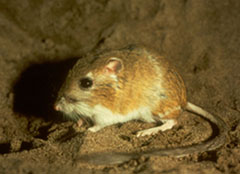 Ord's Kangaroo RatDipodomys ordii
-
 Giant Kangaroo RatDipodomys ingens
-
 Banner-tailed Kangaroo RatDipodomys spectabilis
-
 California Kangaroo RatDipodomys californicus
-
 Panamint Kangaroo RatDipodomys panamintinus
-
 Agile Kangaroo RatDipodomys agilis
Compare
Questions and answers
What is the scientific name of the Dulzura Kangaroo Rat?
The scientific name of the Dulzura Kangaroo Rat is Dipodomys simulans. Written with its author, the full name is Dipodomys simulans (Merriam, 1904).
Which family does the Dulzura Kangaroo Rat belong to?
Dipodomys simulans belongs to the family Heteromyidae, in the order Rodentia and the class Mammalia.
Where is the Dulzura Kangaroo Rat found?
Checklists and occurrence records place Dipodomys simulans in 2 countries: Mexico and United States.
What is the conservation status of the Dulzura Kangaroo Rat?
The IUCN Red List category recorded for Dipodomys simulans is Least Concern (LC).
What other names does the Dulzura Kangaroo Rat have?
Dipodomys simulans is also known in English as San Diego Kangaroo Rat.
Sources
Data
- Catalogue of Life, 2026-10-16 XR cc by
- Global Biodiversity Information Facility CC BY 4.0
- Wikidata CC0
- English Wikipedia CC BY-SA 4.0
- GeoNames CC BY 4.0
- Wikimedia Commons per image; credit shown with each image
- Within the Catalogue of Life, this name comes from The Integrated Taxonomic Information System cc0
References
- Proc. Biol. Soc. Wash. vol.17 p.144 where the name was published
- Wilson, Don E., and Sue Ruff, eds. (1999). The Smithsonian Book of North American Mammals.
- Wilson, Don E., and DeeAnn M. Reeder, eds. (2005). Mammal Species of the World: A Taxonomic and Geographic Reference, 3rd Ed., Vols. 1 & 2.
- Hafner, M. S. / Wilson, Don E., T. E. Lacher Jr., and R. A. Mittermeier, eds. (2016). Family Heteromyidae (Pocket Mice, Kangaroo Mice and Kangaroo Rats). Handbook of the Mammals of the World. Vol. 6: Lagomorphs and Rodents I.
- Burgin, Connor J., Don E. Wilson, Russell A. Mittermeier, Anthony B. Rylands, et al. (2020). Illustrated Checklist of the Mammals of the World. Vol. 1. Monotremata to Rodentia.
This species in other databases
Page built on 25 November 2026. See how the catalog is made and all sources and licences.
Cite this page
ScientificNames.org. (2026). Dipodomys simulans (Dulzura Kangaroo Rat). Retrieved November 25, 2026, from https://scientificnames.org/species/dipodomys-simulans
“Dipodomys simulans (Dulzura Kangaroo Rat).” ScientificNames.org, 2026, scientificnames.org/species/dipodomys-simulans. Accessed 25 Nov. 2026.
ScientificNames.org. “Dipodomys simulans (Dulzura Kangaroo Rat).” Accessed November 25, 2026. https://scientificnames.org/species/dipodomys-simulans.
@misc{scientificnames_dipodomys_simulans_dulzura_kangaroo_rat,
  author = {{ScientificNames.org}},
  title = {Dipodomys simulans (Dulzura Kangaroo Rat)},
  year = {2026},
  url = {https://scientificnames.org/species/dipodomys-simulans},
  note = {Accessed 2026-11-25}
}