Species · Flowering plants
Burningbush Euonymus alatus
The scientific name of the Burningbush is Euonymus alatus. It is a species of flowering plant in the family Celastraceae (staff-tree family), order Celastrales.
- Scientific name
- Euonymus alatus (Thunb.) Siebold
- Common name
- Burningbush
- Genus
- Euonymus
- Family
- Celastraceae (Staff-tree Family)
- Order
- Celastrales
- Class
- Magnoliopsida
- Recorded in
- 12 countries
- Name status
- accepted in the Catalogue of Life

Overview
The stems have four distinctive corky ridges that form wing-like structures.
Written 26 November 2026 from the sources listed below. Each statement was checked against the passage it cites; statements that could not be supported were removed.
Appearance
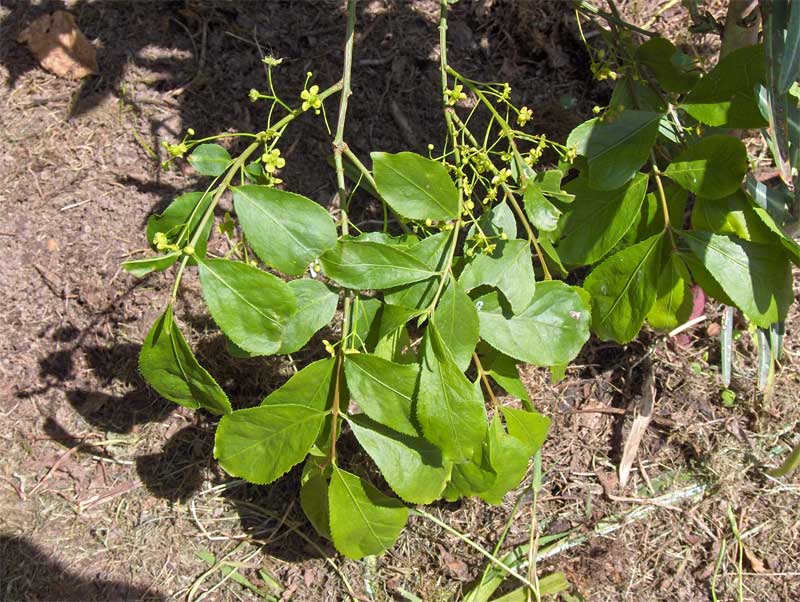
Burningbush is a deciduous shrub with a wide-spreading growth form. Its stems have four distinctive corky ridges that form wing-like structures.[1][2]
Its leaves are ovate-elliptic with pointed tips and measure 2–7 cm long and 1–4 cm wide. They are oppositely arranged and have finely toothed margins.[3][4]
Its summer foliage is dark green and turns bright red in autumn. Its flowers are greenish yellow, have four petals, and appear in spring in groups of three along the stems; they are less than half an inch across.[5][6][7][8]
Its fruits consist of red arils enclosed in capsules that can be pink, yellow, or orange. The autumn fruits are approximately half an inch in diameter and have a split purplish husk that exposes four red-orange seeds.[9][10][11]
The shrub can reach 6.1 metres in height and often grows wider than it is tall. Its typical height is approximately 8–10 feet, although specimens reaching 20 feet tall and 25 feet wide occur.[12][13]
Diet
Birds eat the orange-red fruits of burningbush.[14]
Behaviour
Birds disperse burningbush primarily by consuming and distributing its abundant fruits. The fruits can persist into winter and become more visible to birds and mammals.[15][16]
Reproduction and life cycle
Burningbush produces fruits in autumn and produces abundant seeds. It is a prolific seeder.[17][18]
Habitat
In its native range, burningbush grows in forests, woodlands, and scrublands. Its native habitat extends from sea level to elevations of approximately 2,700 metres.[19][20]
Conservation
Burningbush is regarded as invasive in woodlands of the northeastern United States and southeastern Canada. It can outcompete native vegetation and disrupt local ecosystems.[21][22]
The species is classified as invasive in 21 United States states. Importation and sale are prohibited in Maine, Massachusetts, New Hampshire, Pennsylvania, and Vermont.[23][24]
Minnesota classifies burningbush as a Restricted Noxious Weed, prohibiting its sale, propagation, and transport. Pennsylvania has also declared it a noxious weed, making intentional planting and propagation illegal in the state.[25][26]
Uses
Burningbush is cultivated ornamentally in gardens and parks for its autumn foliage and colorful fruits. It is commonly planted in foundations, hedges, and along highways and commercial strips.[27][28]
Similar species
Euonymus phellomanus is a related species that also has corky stem ridges. Euonymus americanus, Euonymus atropurpureus, and Euonymus obovatus lack the corky wings found on burningbush.[29][30]
Young sweetgum can have winged twigs but has star-shaped leaves with five lobes.[31]
Classification of the Burningbush
| Kingdom | Plantae |
|---|---|
| Subkingdom | Pteridobiotina |
| Phylum | Tracheophyta |
| Class | Magnoliopsida |
| Order | Celastrales |
| Family | Celastraceae (Staff-tree Family) |
| Subfamily | Celastroideae |
| Tribe | Euonymae |
| Genus | Euonymus (Spindle) |
| Species | Euonymus alatus (Thunb.) Siebold |
Where the Burningbush is found
Checklists and occurrence records place Euonymus alatus in 12 countries across Asia, Europe and North America. GBIF holds 53,720 georeferenced records of it.
Countries where it is native or its origin is not stated
Countries where it has been introduced
Regions and cities with the most records
- Massachusetts, United States 4,290
- New York, United States 4,018
- Pennsylvania, United States 3,450
- New Jersey, United States 2,717
- Connecticut, United States 2,311
- Ohio, United States 2,226
- Ontario, Canada 1,861
- Virginia, United States 1,465
- Maryland, United States 1,370
- Newton, United States 1,322
- Waltham, United States 1,301
- Michigan, United States 1,280
- New Rochelle, United States 1,275
- Watertown, United States 1,260
- Brighton, United States 1,257
- Chestnut Hill, United States 1,251
- Belmont, United States 1,241
- Greenburgh, United States 1,215
- Lexington, United States 1,215
- Allston, United States 1,214
- Harrison, United States 1,212
- Illinois, United States 1,208
- Mount Vernon, United States 1,206
- Brookline, United States 1,204
- Scarsdale, United States 1,204
- Mamaroneck, United States 1,203
- White Plains, United States 1,194
- Arlington, United States 1,180
- Yonkers, United States 1,171
- Mission Hill, United States 1,169
- The Bronx, United States 1,152
- Somerville, United States 1,149
- Cambridge, United States 1,144
- Indiana, United States 1,136
- North Plainfield, United States 1,135
- Back Bay, United States 1,132
16 more countries have a few records outside this range
These countries hold a few records of Euonymus alatus but lie outside the range the checklists give for it. Such records are often zoo or garden specimens, museum material or vagrants, so the species is not counted as occurring there.
Range as the checklists state it
Germany [I]; Siberia (Buryatia, Chita, Irkutsk); Russian Far East (Upper Amur, Khabarovsk, Kuril Isl., Primorye, Sakhalin); Uzbekistan [I]; China (Anhui, Gansu, Guangdong, Guizhou, Hebei, Heilongjiang, Henan, Hubei, Hunan, Jiangsu, Jiangxi, Jilin, Liaoning, Nei Mongol, Ningxia, Shaanxi, Shanxi, Shandong, Sichuan, Zhejiang); North Korea; South Korea; Japan (Hokkaido, Honshu, Shikoku, Kyushu); Taiwan [I]; Canada [I] (Ontario [I]); USA [I] (Connecticut [I], District of Columbia [I], Delaware [I], Georgia [I], Iowa [I], Illinois [I], Indiana [I], Kentucky [I], Massachusetts [I], Maryland [I], Michigan [I], Missouri [I], Montana [I], North Carolina [I], New Hampshire [I], New Jersey [I], New York [I], Ohio [I], Pennsylvania [I], Rhode Island [I], South Carolina [I], Virginia [I], Vermont [I], Wisconsin [I], West Virginia [I])
A number beside a place is its count of GBIF occurrence records. A place without a number comes from a checklist alone. Records show where a species has been observed or collected, which can include escapes and vagrants.
Common names
English
- Burningbush
- Oriental Spindle-tree
- Winged Burning-bush
- Winged Euonymus
- Winged Spindle-tree
- Winged Spindletree
Names in 6 other languages
- French
- fusain ailé
- German
- Flügel-Spindelstrauch
- Japanese
- nishikigi
- Norwegian Bokmål
- vingebeinved
- Norwegian Nynorsk
- vengjebeinved
- Swedish
- vingbenved
Synonyms
42 other scientific names have been used for this species and are now treated as synonyms of Euonymus alatus.
- Celastrus alatus Thunb.
- Euonymus alatus f. angustatus (Makino) Honda
- Euonymus alatus f. angustatus (Makino) H.Hara
- Euonymus alatus f. compactus Rehder
- Euonymus alatus f. microphyllus (Nakai) H.Hara
- Euonymus alatus f. pilosus (O.Loes. & Rehder) Ohwi
- Euonymus alatus f. variegatus Nakai
- Euonymus alatus subsp. compactus J.W.Adams
- Euonymus alatus subsp. sacrosancta (Koidz) Vorosch.
- Euonymus alatus subvar. pilosus Kitag.
- Euonymus alatus var. alatus
- Euonymus alatus var. arakianus (Koidz.) H.Hara
- Euonymus alatus var. cornucarpus Koidz.
- Euonymus alatus var. ellipticus Chen H.Wang
- Euonymus alatus var. hirtus Koidz.
- Euonymus alatus var. latifolia Nakai
- Euonymus alatus var. macrophyllus Nakai
- Euonymus alatus var. microphyllus Chen H.Wang
- Euonymus alatus var. microphyllus Nakai
- Euonymus alatus var. nakamurae (Makino) F.Maek.
- Euonymus alatus var. pilosus Loes. & Rehder
- Euonymus alatus var. pubescens Maxim.
- Euonymus alatus var. uncinatus Nakai
- Euonymus alatus var. verus Kitag.
- Euonymus arakianus Koidz.
- Euonymus ellipticus (Chen H.Wang) C.Y.Cheng
- Euonymus kawachianus Nakai
- Euonymus loeseneri Makino
- Euonymus nakamurae Makino
- Euonymus sacrosanctus Koidz.
- Euonymus striatus f. angustatus Makino
- Euonymus striatus subsp. alata (Thunb.) Koidz.
- Euonymus striatus var. alatus (Thunb.) Makino
- Euonymus striatus var. cornucarpus Koidz.
- Euonymus striatus var. hirta Koidz.
- Euonymus striatus var. microphyllus Nakai
- Euonymus striatus var. pilosus Koidz.
- Euonymus striatus var. pubescens Makino
- Euonymus thunbergianus Blume
- Euonymus verrucosus var. tchefouensis Debeaux
Showing 40 of 42.
Subspecies and varieties
Related species
-
 European Spindle-treeEuonymus europaeus
-
 Japanese SpindleEuonymus japonicus
-
 Fortune's EuonymusEuonymus fortunei
-
 American Strawberry BushEuonymus americanus
-
 WahooEuonymus atropurpureus
-
 Hamilton's SpindleEuonymus hamiltonianus
-
 Broadleaf SpindleEuonymus latifolius
-
 CorktreeEuonymus phellomanus
Compare
Questions and answers
What is the scientific name of the Burningbush?
The scientific name of the Burningbush is Euonymus alatus. Written with its author, the full name is Euonymus alatus (Thunb.) Siebold.
Which family does the Burningbush belong to?
Euonymus alatus belongs to the family Celastraceae, in the order Celastrales and the class Magnoliopsida.
Where is the Burningbush found?
Checklists and occurrence records place Euonymus alatus in 12 countries, including South Korea, Japan, China, Russia, North Korea and Philippines.
What other names does the Burningbush have?
Euonymus alatus is also known in English as Oriental Spindle-tree, Winged Burning-bush, Winged Euonymus, Winged Spindle-tree and Winged Spindletree.
Why is burning bush illegal?
Burningbush is regarded as invasive because it can outcompete native vegetation and disrupt local ecosystems. Restrictions on its importation, sale, planting, propagation, and transport apply in several states.[21][22][24][25][26]
How toxic is burning bush?
All parts of burningbush are toxic when ingested and can cause severe discomfort.[32]
What states are burning bushes illegal in?
Importation and sale of burningbush are prohibited in Maine, Massachusetts, New Hampshire, Pennsylvania, and Vermont. Minnesota prohibits its sale, propagation, and transport. Pennsylvania also prohibits intentional planting and propagation.[24][25][26]
Is burning bush fruit edible?
No. All parts of burningbush, including its fruits, are toxic when ingested and can cause severe discomfort.[9][32]
Sources
Passages the profile rests on
- Euonymus alatus is a deciduous shrub with a wide-spreading growth form. Source passage: “Usually, it's seen as a much-branched wide spreading shrub growing 8-10 feet tall” — uaex.uada.edu
- Its stems have four distinctive corky ridges that form wing-like structures. Source passage: “the stems are notable for their four corky ridges or "wings".” — English Wikipedia
- Its leaves are ovate-elliptic with pointed tips and measure 2–7 cm long and 1–4 cm wide. Source passage: “The leaves are 2–7 cm (3⁄4–2+3⁄4 in) long and 1–4 cm (1⁄2–1+1⁄2 in) broad, ovate-elliptic, with an acute apex.” — English Wikipedia
- Its leaves are oppositely arranged and have finely toothed margins. Source passage: “Football shaped, oppositely arranged, finely toothed along the leaf edge or margin, and between 1 and 2 inches long.” — extension.psu.edu
- Its summer foliage is dark green and turns bright red in autumn. Source passage: “Opposite, simple, elliptical, dark green in the summer and bright red in the fall.” — extension.umn.edu
- Its flowers are greenish and appear in spring. Source passage: “The flowers are greenish, borne over a long period in the spring.” — English Wikipedia
- Its greenish flowers occur in groups of three along the stems and are less than half an inch across. Source passage: “The greenish flowers are held in groups of three on the stems, each less than ½ inch across.” — extension.psu.edu
- Its flowers have four petals and are greenish yellow. Source passage: “Inconspicuous, greenish yellow, with four petals.” — extension.umn.edu
- Its fruits consist of red arils enclosed in capsules that can be pink, yellow, or orange. Source passage: “The fruit is a red aril enclosed by a four-lobed pink, yellow, or orange capsule.” — English Wikipedia
- Its autumn fruits are approximately half an inch in diameter and have a split purplish husk. Source passage: “Ripening in the fall, the fruits are brilliant red with a split, purplish husk, each about ½ inch in diameter.” — extension.psu.edu
- Its fruits expose four red-orange seeds when their husks split. Source passage: “The husk splits to expose four red-orange seeds.” — extension.psu.edu
- The shrub can reach 6.1 metres in height and often grows wider than it is tall. Source passage: “This deciduous shrub grows to 6.1 m (20 ft) tall, often wider than tall.” — English Wikipedia
- Its typical height is approximately 8–10 feet, although specimens reaching 20 feet tall and 25 feet wide occur. Source passage: “Usually, it's seen as a much-branched wide spreading shrub growing 8-10 feet tall, though 20-foot specimens with a spread of 25 feet aren't uncommon.” — uaex.uada.edu
- Birds eat the species' orange-red fruits. Source passage: “Small orange-red fruits are produced in the fall and are eaten by birds.” — uaex.uada.edu
- Birds disperse the species primarily by consuming and distributing its abundant fruits. Source passage: “Burning bush is primarily spread by birds dispersing their abundant and highly visible fruit.” — extension.psu.edu
- Its fruits can persist into winter and become more visible to birds and mammals. Source passage: “The fruit often persist into winter when they become even more visible to birds and mammals.” — extension.psu.edu
- The species produces abundant seeds and is a prolific seeder. Source passage: “Burning bush, though a prolific seeder, is not difficult to control individually” — extension.psu.edu
- The species produces fruits in autumn. Source passage: “Small orange-red fruits are produced in the fall” — uaex.uada.edu
- In its native range, the species grows in forests, woodlands, and scrublands. Source passage: “In its native areas, it occurs in forests, woodlands, and scrublands” — English Wikipedia
- Its native habitat extends from sea level to elevations of approximately 2,700 metres. Source passage: “from sea level to an elevation of 8,900 ft (2,700 m).” — English Wikipedia
- The species is regarded as invasive in woodlands of the northeastern United States and southeastern Canada. Source passage: “Euonymus alatus is regarded as an invasive species of woodlands in the northeastern United States and southeastern Canada” — English Wikipedia
- The species can outcompete native vegetation and disrupt local ecosystems. Source passage: “where it can outcompete native vegetation and disrupt local ecosystems.” — English Wikipedia
- The species is classified as invasive in 21 United States states. Source passage: “it is currently, since the 1970s, considered an invasive species in 21 U.S. states” — English Wikipedia
- Importation and sale of the species are prohibited in Maine, Massachusetts, New Hampshire, Pennsylvania, and Vermont. Source passage: “its importation and sale are prohibited in the U.S. states of Maine, Massachusetts, New Hampshire, Pennsylvania, and Vermont.” — English Wikipedia
- The species is classified as a Restricted Noxious Weed in Minnesota, where its sale, propagation, and transport are prohibited. Source passage: “Burning bush is a Restricted Noxious Weed; it is prohibited from sale, propagation and transport in the state of Minnesota.” — extension.umn.edu
- Pennsylvania has declared the species a noxious weed, making intentional planting and propagation illegal in the state. Source passage: “Burning bush has been declared a noxious weed by the Pennsylvania Department of Agriculture, therefore it is now illegal to purchase, intentionally plant, or propagate this species within the state.” — extension.psu.edu
- The species is cultivated ornamentally in gardens and parks for its autumn foliage and colorful fruits. Source passage: “It is a popular ornamental plant in gardens and parks due to its bright pink or orange fruit and attractive autumn color” — English Wikipedia
- The shrub is commonly planted in foundations, hedges, and along highways and commercial strips. Source passage: “the shrub commonly is used in foundation planting, hedges, and along highways and commercial strips.” — English Wikipedia
- Euonymus phellomanus is a related species that also has corky stem ridges. Source passage: “As with the related Euonymus phellomanus, the stems are notable for their four corky ridges or "wings".” — English Wikipedia
- Euonymus americanus, Euonymus atropurpureus, and Euonymus obovatus lack the corky wings found on Euonymus alatus. Source passage: “Native euonymus species (E. americanus, E. atropurpureus, E. obovatus) all lack the corky wings of the invasive shrub.” — extension.psu.edu
- Young sweetgum can have winged twigs but has star-shaped leaves with five lobes. Source passage: “Though young sweetgum (Liquidambar styraciflua) can have winged twigs, its leaves are star shaped, contain five lobes” — extension.psu.edu
- All parts of the plant are toxic when ingested and can cause severe discomfort. Source passage: “All parts of the plant are toxic by ingestion, causing severe discomfort.” — English Wikipedia
- The species can grow in deep shade, full sun, and partial sun. Source passage: “Though they can also grow in full or partial sun, they thrive in forest interiors where there is less competition from other invasive shrubs.” — extension.psu.edu
- The species grows in a wide range of soil types and light conditions. Source passage: “This shrub survives in a wide array of soil types; it grows in varying light conditions” — uaex.uada.edu
- The species is moderately drought tolerant. Source passage: “and is moderately drought tolerant.” — uaex.uada.edu
Data
- Catalogue of Life, 2026-10-16 XR cc by
- Global Biodiversity Information Facility CC BY 4.0
- Wikidata CC0
- GeoNames CC BY 4.0
- Wikimedia Commons per image; credit shown with each image
- Within the Catalogue of Life, this name comes from Synonymic Checklists of the Vascular Plants of the World cc by
References
- Siebold. (1830). Verh. Batav. Genootsch. Kunsten 12: 49 (1830). where the name was published
This species in other databases
Page built on 26 November 2026. See how the catalog is made and all sources and licences.
Cite this page
ScientificNames.org. (2026). Euonymus alatus (Burningbush). Retrieved November 26, 2026, from https://scientificnames.org/species/euonymus-alatus
“Euonymus alatus (Burningbush).” ScientificNames.org, 2026, scientificnames.org/species/euonymus-alatus. Accessed 26 Nov. 2026.
ScientificNames.org. “Euonymus alatus (Burningbush).” Accessed November 26, 2026. https://scientificnames.org/species/euonymus-alatus.
@misc{scientificnames_euonymus_alatus_burningbush,
  author = {{ScientificNames.org}},
  title = {Euonymus alatus (Burningbush)},
  year = {2026},
  url = {https://scientificnames.org/species/euonymus-alatus},
  note = {Accessed 2026-11-26}
}