Species · Flowering plants
European Spindle-tree Euonymus europaeus
The scientific name of the European Spindle-tree is Euonymus europaeus. It is a species of flowering plant in the family Celastraceae (staff-tree family), order Celastrales.
- Scientific name
- Euonymus europaeus L.
- Common name
- European Spindle-tree
- Genus
- Euonymus
- Family
- Celastraceae (Staff-tree Family)
- Order
- Celastrales
- Class
- Magnoliopsida
- Red List category
- LC Least Concern
- Recorded in
- 58 countries
- Name status
- accepted in the Catalogue of Life

Overview
Euonymus europaeus is native to much of Europe and commonly grows along forest edges, in hedgerows, open woodland and scrubland. It is distinguished by its colourful autumn foliage and red, purple or pink fruit capsules that split open to expose orange seeds.
Written 26 November 2026 from the sources listed below. Each statement was checked against the passage it cites; statements that could not be supported were removed.
Appearance
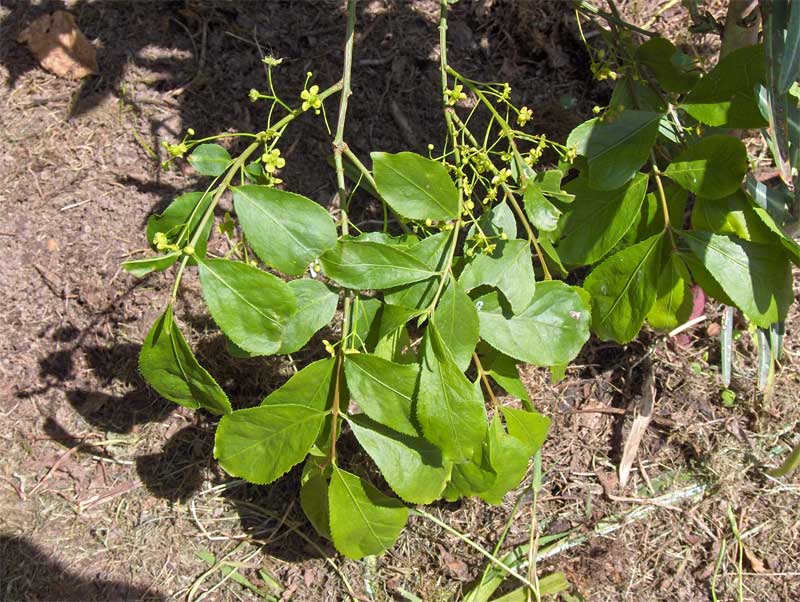
European spindle-tree is a deciduous shrub or small tree, typically reaching 3–6 metres in height and rarely reaching 10 metres. Its stem can reach 20 centimetres in diameter.[1][2][3]
Its leaves grow in opposite pairs and have lanceolate to elliptical shapes with finely serrated margins. They measure 3–8 centimetres in length and 1–3 centimetres in width, and are dark green during summer.[4][5][6]
Its autumn foliage ranges from yellow-green to reddish-purple depending on environmental conditions. Its flowers have yellowish-green petals and are relatively small and inconspicuous, arranged in clusters of three to eight.[7][8][9]
Its mature fruits are red, purple or pink capsules approximately 1–1.5 cm wide. When ripe, the capsules split into four lobes, exposing orange seeds.[10][11]
Habitat
European spindle-tree is native to much of Europe, where its distribution is generally scattered, although it can be locally abundant. The Chilterns in England contain a locality known as Spindle Valley where the species is particularly common.[12][13][14]
The species primarily occupies old hedgerows, open woodland clearings, woodland margins and scrubland. It commonly grows along forest edges, in hedgerows and on gentle slopes.[15][16]
It commonly grows on base-rich or calcareous soils and tends to thrive in nutrient-rich, chalky and salt-poor soils. It is tolerant of shaded conditions.[17][18][19]
In Ireland, it occurs on rocky limestone outcrops, rocky lake shores and limestone pavements. It is characteristic of Fraxinus excelsior–Acer campestre–Mercurialis perennis woodland classified as W8.[20][21]
The species frequently occurs alongside Cornus sanguinea in open scrub growing over limestone.[22]
Reproduction and life cycle
European spindle-tree produces hermaphroditic flowers in late spring. Its flowers are pollinated by insects.[23][24]
Its fruits ripen during autumn.[25]
Behaviour
European spindle-tree rarely colonizes open grassland habitats unless abundant hedges are present. Birds and rodents are identified as likely agents limiting its distribution through seed dispersal.[26][27]
Diet
European spindle-tree serves as the almost exclusive winter host plant of the black bean aphid.[28]
Uses
European spindle-tree is cultivated as an ornamental plant in gardens and parks because of its colourful fruits and autumn foliage. The Red Cascade cultivar has received the Royal Horticultural Society's Award of Garden Merit in UK cultivation.[29][30]
Its exceptionally hard wood was historically used to manufacture wool-spinning spindles and butchers' skewers. Charcoal made from the species is valued by artists for its strength and density.[31][32]
Parts of the plant have historically been used for medicinal purposes.[33]
Classification of the European Spindle-tree
| Kingdom | Plantae |
|---|---|
| Subkingdom | Pteridobiotina |
| Phylum | Tracheophyta |
| Class | Magnoliopsida |
| Order | Celastrales |
| Family | Celastraceae (Staff-tree Family) |
| Subfamily | Celastroideae |
| Tribe | Euonymae |
| Genus | Euonymus (Spindle) |
| Species | Euonymus europaeus L. |
Where the European Spindle-tree is found
Checklists and occurrence records place Euonymus europaeus in 58 countries across Asia, Europe and North America. GBIF holds 549,295 georeferenced records of it.
Countries where it is native or its origin is not stated
- Albania 16
- Andorra
- Armenia 64
- Austria 15,890
- Azerbaijan 14
- Belarus 486
- Belgium 10,275
- Bosnia and Herzegovina 85
- Bulgaria 173
- China 16
- Croatia 489
- Czechia 7,981
- Denmark 9,705
- Estonia 361
- Finland 54
- France 193,673
- Georgia 69
- Germany 87,439
- Greece 110
- Hong Kong 3
- Hungary 1,592
- Ireland 982
- Isle of Man 14
- Italy 9,458
- Japan 6
- Kazakhstan 8
- Kosovo 7
- Latvia 324
- Liechtenstein 69
- Lithuania 551
- Luxembourg 586
- Moldova 163
- Montenegro 38
- New Zealand 1,075
- North Macedonia 28
- Norway 178
- Poland 14,429
- Portugal 68
- Romania 414
- Russia 4,376
- San Marino 7
- Serbia 160
- Slovakia 4,000
- Slovenia 545
- South Korea 3
- Spain 5,566
- Sweden 8,167
- Switzerland 24,519
- The Netherlands 48,573
- Turkey 99
- Ukraine 3,530
Countries where it has been introduced
- Canada 1,628
- Jersey
- Tajikistan
- Turkmenistan 2
- United Kingdom 89,176
- United States 2,049
- Uzbekistan 2
Regions and cities with the most records
- England, United Kingdom 82,138
- Bavaria, Germany 54,097
- Auvergne-Rhône-Alpes, France 36,610
- Bourgogne-Franche-Comté, France 28,304
- Centre-Val de Loire, France 24,644
- Île-de-France, France 17,405
- Grand Est, France 16,761
- Hauts-de-France, France 15,380
- Occitanie, France 10,571
- Upper Austria, Austria 8,021
- Gelderland, The Netherlands 7,667
- Pays de la Loire, France 7,646
- Sassenheim, The Netherlands 6,400
- Noordwijk-Binnen, The Netherlands 6,388
- Oegstgeest, The Netherlands 5,935
- Katwijk aan Zee, The Netherlands 5,906
- North Rhine-Westphalia, Germany 5,881
- Haarlem, The Netherlands 5,875
- Velserbroek, The Netherlands 5,814
- Baden-Wurttemberg, Germany 5,792
- Ypenburg, The Netherlands 5,665
- Voorburg, The Netherlands 5,658
- Leiderdorp, The Netherlands 5,621
- Leiden, The Netherlands 5,601
- Delft, The Netherlands 5,592
- Wassenaar, The Netherlands 5,591
- IJmuiden, The Netherlands 5,587
- Voorschoten, The Netherlands 5,568
- Nootdorp, The Netherlands 5,555
- Rijswijk, The Netherlands 5,518
- The Hague, The Netherlands 5,514
- Vaud, Switzerland 5,506
- Pijnacker, The Netherlands 5,489
- Velsen-Noord, The Netherlands 5,459
- Assendelft, The Netherlands 5,447
- Lisse, The Netherlands 5,447
9 more countries have a few records outside this range
These countries hold a few records of Euonymus europaeus but lie outside the range the checklists give for it. Such records are often zoo or garden specimens, museum material or vagrants, so the species is not counted as occurring there.
Range as the checklists state it
England (England, Wales, Isle of Man, S-Scotland, Isles of Scilly [I]); Ireland (Ireland, Northern Ireland); Denmark; Norway; Sweden; Netherlands; Belgium; Luxembourg; Germany (Brandenburg, Berlin, Baden-Württemberg, Bayern, Hessen, Hamburg, Mecklenburg-Vorpommern, Niedersachsen, Nordrhein-Westfalen, Rheinland-Pfalz, Schleswig-Holstein, Saarland, Sachsen, Sachsen-Anhalt, Thüringen); Switzerland; Liechtenstein; Austria; Poland; Czech Republic; Slovakia; Hungary; Portugal; Spain; Andorra; France; Channel Isl. [I] (Alderney [I], Jersey [I]); Corsica; Sardinia; Italy; Sicily; San Marino; Slovenia; Croatia; Bosnia & Hercegovina; Montenegro; Serbia; Kosovo; North Macedonia; Albania; Romania; Bulgaria; European Turkey; Greece (mainland south to N-Peloponnisos, Evvoia); Estonia; Latvia; Lithuania; Belarus; C-European Russia; E-European Russia; W-European Russia; Ukraine; Crimea; Turkmenistan [I]; Uzbekistan [I]; Tajikistan [I]; Northern Caucasus; Georgia [Caucasus]; Armenia; Azerbaijan; Turkey (Inner Anatolia, N-Anatolia, NE-Anatolia, NW-Anatolia: Bithynia, S-Anatolia); Chatham Isl. [I]; Canada [I] (New Brunswick [I], Ontario [I], Québec [I]); USA [I] (Connecticut [I], Illinois [I], Kentucky [I], Massachusetts [I], Maine [I], Michigan [I], Mississippi [I], New Hampshire [I], New Jersey [I], New York [I], Ohio [I], Pennsylvania [I], Rhode Island [I], Tennessee [I], Virginia [I], Vermont [I], Wisconsin [I])
A number beside a place is its count of GBIF occurrence records. A place without a number comes from a checklist alone. Records show where a species has been observed or collected, which can include escapes and vagrants.
Common names
English
- European Spindle-tree
- European Euonymus
- Spindle
- Spindle-Tree
- Spindleberry
- Common Spindle
- Spindletree
Names in 37 other languages
- Arabic
- مضاض أوروبي
- Asturian
- escuernacabra
- Azerbaijani
- Avropa gərməşovu
- Basque
- Basaerramu
- Belarusian
- Брызгліна еўрапейская
- Catalan
- Boneter, barretets rojos
- Chinese
- 歐洲衛矛
- Croatian
- Evropska kurika, Obična kurika
- Czech
- brslen evropský
- Danish
- Almindelig benved, Benved
- Dutch
- Kardinaalsmuts, Wilde kardinaalsmuts
- Estonian
- harilik kikkapuu
- Finnish
- euroopansorvarinpensas
- French
- bonnet de prêtre, fusain d'Europe
- German
- Europäisches Pfaffenhütchen, Gewöhnlicher Spindelstrauch, Pfaffenhütchen, Pfaffenkapperl, Pfaffenkäppchen, Spillbaum, Spindelbaum, gewöhnliches Pfaffenhütchen
- Hungarian
- Közönséges kecskerágó, csíkos kecskerágó
- Icelandic
- Beinviður
- Irish
- Feoras
- Italian
- Berretta del prete, Fusaggine, evonimo comune
- Japanese
- セイヨウマユミ
- Latvian
- Eiropas segliņš
- Lithuanian
- Europinis ožekšnis
- Norwegian Bokmål
- (beinved), spolebusk
- Polish
- Trzmielina pospolita
- Portuguese
- Evónimo, barrete-de-padre
- Romanian
- Salbă moale
- Russian
- beresklet evropejskij, Бересклет европейский
- Serbian
- Курика
- Slovak
- bršlen európsky
- Slovenian
- navadna trdoleska
- Spanish
- bonetero
- Turkish
- Papaz Külahı, İğcik Ağacı
- Ukrainian
- Бруслина європейська
- Welsh
- Llwyn Addurnol, Pisgwydden, Piswydd, Piswydden, Piswydden piswydd, Pren Cas Gan Gythraul, Pren Clefyd Melyn
- csb
- Zwëczajny brzëmielnik
- ido
- Fuzeno
- srd
- Arangixeddu arrùbiu
Synonyms
55 other scientific names have been used for this species and are now treated as synonyms of Euonymus europaeus.
- Euonymus bulgaricus Velen.
- Euonymus czernjaevii Klokov
- Euonymus europaea subsp. moldavica (Klokov) Grosset
- Euonymus europaea subsp. pontica Savul. & Rayss
- Euonymus europaea subsp. subvelutina (Savul. & Rayss) Grosset
- Euonymus europaea var. involuta Lindem.
- Euonymus europaea var. suberoso-alata Lindem.
- Euonymus europaea var. subvelutina Savul. & Rayss
- Euonymus europaeus f. albus (Weston) Rehder
- Euonymus europaeus f. aldenhamensis (Gibbs) Rehder
- Euonymus europaeus f. angustifolius Gančev
- Euonymus europaeus f. atropurpureus (Rehder) Hegi
- Euonymus europaeus f. atrorubens C.K.Schneid.
- Euonymus europaeus f. atrorubens (C.K.Schneid.) Hegi
- Euonymus europaeus f. bulgaricus (Velen.) Gančev
- Euonymus europaeus f. microphyllus (Beck) Gančev
- Euonymus europaeus f. nanus (Lodd. ex Loudon) Besser
- Euonymus europaeus f. scaberulus (Beck) Jovan.
- Euonymus europaeus f. variegatus (Dippel) Hegi
- Euonymus europaeus subf. scaberulus Beck ex Hayek
- Euonymus europaeus subsp. moldavicus (Klokov) Grosset
- Euonymus europaeus subsp. subvelutinus (Savul. & Rayss) Grosset
- Euonymus europaeus subsp. tenuifolius Ehrh.
- Euonymus europaeus var. albus Weston
- Euonymus europaeus var. aldenhamensis (Gibbs) Bean
- Euonymus europaeus var. angustifolius C.F.Schultz
- Euonymus europaeus var. atropurpureus Mouill.
- Euonymus europaeus var. australis Kom.
- Euonymus europaeus var. fibrilliferus (Fisch. & C.A.Mey.) Medw. ex N.Busch
- Euonymus europaeus var. intermedius Gaudin
- Euonymus europaeus var. leucocarpus DC.
- Euonymus europaeus var. multiflorus (Opiz) Hegi
- Euonymus europaeus var. nanus Lodd. ex Loudon
- Euonymus europaeus var. pumilus G.Don
- Euonymus europaeus var. suberosus (Klokov) Tzvelev
- Euonymus europaeus var. tenuifolius L.
- Euonymus europaeus var. vulgaris Merrem
- Euonymus fibrilliferus Fisch. & C.A.Mey.
- Euonymus flavescens Paul
- Euonymus floribundus Steven
Showing 40 of 55.
Related species
-
 BurningbushEuonymus alatus
-
 Japanese SpindleEuonymus japonicus
-
 Fortune's EuonymusEuonymus fortunei
-
 American Strawberry BushEuonymus americanus
-
 WahooEuonymus atropurpureus
-
 Hamilton's SpindleEuonymus hamiltonianus
-
 Broadleaf SpindleEuonymus latifolius
-
 CorktreeEuonymus phellomanus
Compare
Questions and answers
What is the scientific name of the European Spindle-tree?
The scientific name of the European Spindle-tree is Euonymus europaeus. Written with its author, the full name is Euonymus europaeus L..
Which family does the European Spindle-tree belong to?
Euonymus europaeus belongs to the family Celastraceae, in the order Celastrales and the class Magnoliopsida.
Where is the European Spindle-tree found?
Checklists and occurrence records place Euonymus europaeus in 58 countries, including France, Germany, The Netherlands, Switzerland, Austria and Poland.
What is the conservation status of the European Spindle-tree?
The IUCN Red List category recorded for Euonymus europaeus is Least Concern (LC).
What other names does the European Spindle-tree have?
Euonymus europaeus is also known in English as European Euonymus, Spindle, Spindle-Tree, Spindleberry, Common Spindle and Spindletree.
Are spindle tree fruits edible?
No. The fruits are poisonous and contain toxic compounds including theobromine, caffeine and cardiac glycosides. Ingestion can cause liver and kidney damage or death.[34][35]
Sources
Passages the profile rests on
- Euonymus europaeus is a deciduous shrub or small tree. Source passage: “It is a deciduous shrub or small tree.” — English Wikipedia
- The plant typically reaches a height of 3–6 metres, although it rarely reaches 10 metres. Source passage: “Euonymus europaeus grows to 3–6 m (10–20 ft) tall, rarely 10 m (33 ft)” — English Wikipedia
- Its stem can reach 20 centimetres in diameter. Source passage: “with a stem up to 20 cm (8 in) in diameter.” — English Wikipedia
- Its leaves grow in opposite pairs and have lanceolate to elliptical shapes with finely serrated margins. Source passage: “The leaves are opposite, lanceolate to elliptical, 3–8 cm long and 1–3 cm broad, with a finely serrated edge.” — English Wikipedia
- Its leaves are dark green during summer. Source passage: “Leaves are dark green in summer.” — English Wikipedia
- Its leaves measure 3–8 centimetres in length and 1–3 centimetres in width. Source passage: “3–8 cm long and 1–3 cm broad” — English Wikipedia
- Its autumn foliage ranges from yellow-green to reddish-purple depending on environmental conditions. Source passage: “Autumn colour ranges from yellow-green to reddish-purple, depending on environmental conditions.” — English Wikipedia
- Its flowers have yellowish-green petals and are relatively small and inconspicuous. Source passage: “They are rather inconspicuous and small with yellowish-green petals” — English Wikipedia
- Its flowers are arranged in clusters of three to eight. Source passage: “grow in cymes of 3–8 together.” — English Wikipedia
- Its mature fruits are red, purple or pink capsules approximately 1–1.5 cm wide. Source passage: “The capsular fruit ripens in autumn, and is red to purple or pink in colour and approximately 1–1.5 cm wide.” — English Wikipedia
- Its ripe fruit capsules split into four lobes, exposing orange seeds. Source passage: “When ripe, the four lobes split open to reveal the orange seeds.” — English Wikipedia
- Euonymus europaeus is native to much of Europe. Source passage: “native to much of Europe” — English Wikipedia
- Its distribution is generally scattered, although it can be locally abundant. Source passage: “Its distribution is usually scattered, but it may occasionally occur remarkably commonly on a local scale.” — English Wikipedia
- The Chilterns in England contain a locality known as Spindle Valley where the species is particularly common. Source passage: “An example of this is in the so-called "Spindle Valley" in the Chilterns.” — English Wikipedia
- The species commonly grows along forest edges, in hedgerows and on gentle slopes. Source passage: “where it inhabits the edges of forest, hedges and gentle slopes” — English Wikipedia
- It primarily occupies old hedgerows, open woodland clearings, woodland margins and scrubland. Source passage: “primarily in old hedgerows, open woodland clearings and margins, and scrubland” — English Wikipedia
- It commonly grows on base-rich or calcareous soils. Source passage: “scrubland on base-rich or calcareous soils.” — English Wikipedia
- It tends to thrive in nutrient-rich, chalky and salt-poor soils. Source passage: “tending to thrive on nutrient-rich, chalky and salt-poor soils.” — English Wikipedia
- The species is tolerant of shaded conditions. Source passage: “However, it is also shade-tolerant.” — English Wikipedia
- In Ireland, it occurs on rocky limestone outcrops, rocky lake shores and limestone pavements. Source passage: “In Ireland, it can also be found growing on rocky limestone outcrops, rocky lake shores and limestone pavements.” — English Wikipedia
- It is characteristic of Fraxinus excelsior–Acer campestre–Mercurialis perennis woodland classified as W8. Source passage: “It is typical in Fraxinus excelsior – Acer campestre – Mercurialis perennis woodland (W8)” — English Wikipedia
- It frequently occurs alongside Cornus sanguinea in open scrub growing over limestone. Source passage: “it is a frequent companion of Cornus sanguinea in open-stand scrub over limestone” — English Wikipedia
- The species produces hermaphroditic flowers in late spring. Source passage: “The hermaphrodite flowers are produced in late spring” — English Wikipedia
- Its flowers are pollinated by insects. Source passage: “and are insect-pollinated.” — English Wikipedia
- Its fruits ripen during autumn. Source passage: “The capsular fruit ripens in autumn” — English Wikipedia
- The species rarely colonizes open grassland habitats unless abundant hedges are present. Source passage: “It rarely invades open habitats such as grasslands unless abundant hedges are present” — English Wikipedia
- Birds and rodents are identified as likely agents limiting the species' distribution through seed dispersal. Source passage: “The scattered distribution is likely limited by dispersal of seeds via birds and rodents.” — English Wikipedia
- Euonymus europaeus serves as the almost exclusive winter host plant of the black bean aphid. Source passage: “E. europaeus is the almost exclusive winter host of the black bean aphid.” — English Wikipedia
- The species is cultivated as an ornamental plant in gardens and parks because of its colourful fruits and autumn foliage. Source passage: “It is a popular ornamental plant in gardens and parks due to its bright pink or purple fruits and attractive autumn colouring.” — English Wikipedia
- The Red Cascade cultivar has received the Royal Horticultural Society's Award of Garden Merit in UK cultivation. Source passage: “In cultivation in the UK, the cultivar 'Red Cascade' has gained the Royal Horticultural Society's Award of Garden Merit.” — English Wikipedia
- Its exceptionally hard wood was historically used to manufacture wool-spinning spindles and butchers' skewers. Source passage: “In the past it was used to make spindles for spinning wool and for butchers' skewers.” — English Wikipedia
- Charcoal made from the species is valued by artists for its strength and density. Source passage: “Charcoal produced from this plant is held in high esteem among artists for its exceptional strength and density.” — English Wikipedia
- Parts of the plant have historically been used for medicinal purposes. Source passage: “Parts of the plant have been used for medicinal purposes.” — English Wikipedia
- The fruit is poisonous and contains toxic compounds including theobromine, caffeine and cardiac glycosides. Source passage: “the fruit is poisonous and contains several toxic substances, including the alkaloids theobromine and caffeine, as well as a large number of much more toxic substances, including cardiac glycosides” — English Wikipedia
- Ingestion of the fruit can cause liver and kidney damage or death. Source passage: “Ingesting them can result in liver and kidney damage, or even death.” — English Wikipedia
- Fruit poisoning occurs more commonly in young children who are attracted to its brightly coloured fruits. Source passage: “Poisoning is more common in young children, who are attracted to the brightly coloured fruits.” — English Wikipedia
Data
- Catalogue of Life, 2026-10-16 XR cc by
- Global Biodiversity Information Facility CC BY 4.0
- Wikidata CC0
- GeoNames CC BY 4.0
- Wikimedia Commons per image; credit shown with each image
- Within the Catalogue of Life, this name comes from Synonymic Checklists of the Vascular Plants of the World cc by
References
- L. (1753). Sp. Pl. [Linnaeus] 1: 197 (1753). where the name was published
This species in other databases
Page built on 28 November 2026. See how the catalog is made and all sources and licences.
Cite this page
ScientificNames.org. (2026). Euonymus europaeus (European Spindle-tree). Retrieved November 28, 2026, from https://scientificnames.org/species/euonymus-europaeus
“Euonymus europaeus (European Spindle-tree).” ScientificNames.org, 2026, scientificnames.org/species/euonymus-europaeus. Accessed 28 Nov. 2026.
ScientificNames.org. “Euonymus europaeus (European Spindle-tree).” Accessed November 28, 2026. https://scientificnames.org/species/euonymus-europaeus.
@misc{scientificnames_euonymus_europaeus_european_spindle_tree,
  author = {{ScientificNames.org}},
  title = {Euonymus europaeus (European Spindle-tree)},
  year = {2026},
  url = {https://scientificnames.org/species/euonymus-europaeus},
  note = {Accessed 2026-11-28}
}