Species · Flowering plants
American Strawberry Bush Euonymus americanus
The scientific name of the American Strawberry Bush is Euonymus americanus. It is a species of flowering plant in the family Celastraceae (staff-tree family), order Celastrales.
- Scientific name
- Euonymus americanus L.
- Common name
- American Strawberry Bush
- Genus
- Euonymus
- Family
- Celastraceae (Staff-tree Family)
- Order
- Celastrales
- Class
- Magnoliopsida
- Recorded in
- 3 countries
- Name status
- accepted in the Catalogue of Life

Overview
American strawberry bush (Euonymus americanus L.) is a deciduous shrub in the family Celastraceae, order Celastrales, and class Magnoliopsida. The species is native to the eastern United States, its range extends westward to Texas, and it has also been recorded in Ontario. It produces conspicuous crimson-red, warty fruit capsules that split open to expose seeds covered by bright red arils.
Written 26 November 2026 from the sources listed below. Each statement was checked against the passage it cites; statements that could not be supported were removed.
Appearance
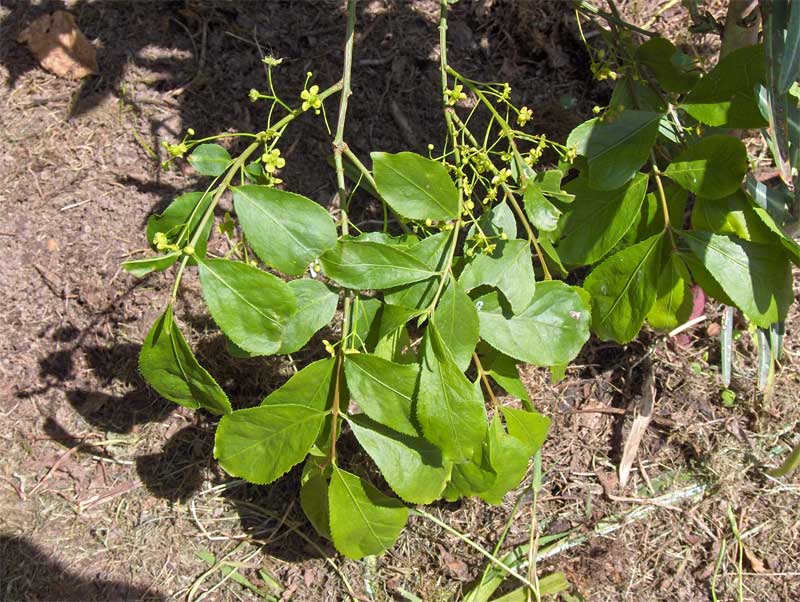
American strawberry bush is a deciduous shrub that can reach 2 metres in height. It has multiple stems, slender square stems that remain green throughout the year, and spreads through suckering growth.[1][2][3][4]
Its simple leaves are arranged oppositely, have leathery or papery textures and toothed margins, and can grow up to 10 centimetres long. The leaves turn red in autumn.[5][6][7][8]
The species produces small, inconspicuous flowers on new growth between May and June. Its flowers have five yellowish-green petals and purple stamens.[9][10]
Its fruit capsules are crimson-red and warty, and expose reddish-orange seeds when they split. The shrub produces orange and red fruits.[11][12]
Reproduction and life cycle
The flowers grow in leaf axils on peduncles that can reach 2.2 centimetres in length. The sepals are yellow-green and measure 1 or 2 centimetres in length, while the greenish or reddish petals are smaller than the sepals.[13][14][15]
The species produces conspicuous crimson-red fruit capsules in autumn. The capsules split into five sections to expose seeds covered by bright red arils.[16][17]
Animals disperse the seeds of the species.[18]
Habitat
American strawberry bush occurs along swamp margins, shaded stream banks, and sloped wetlands. It also grows in moist, wooded areas near creeks and rivers.[19][20]
The species grows in moderately saturated soils rather than flood conditions. It grows best in organically rich soil but tolerates sandy and clay soils.[21][22]
The shrub can grow under shaded conditions and grows best in partial shade or morning sunlight. It requires protection from hot afternoon sunlight.[23][24]
Diet
The fruits are toxic to humans and pets and can cause serious stomach problems.[25]
Behaviour
Young plants tend to spread outward, while mature plants develop a more upright form. Established plants have moderate drought tolerance.[26][27]
Conservation
American strawberry bush is common across most of its geographic range but is listed as endangered in New York.[28]
Uses
Native Americans used the roots to prepare tea for several ailments, including stomach aches and malaria. The shrub's bark was powdered and used to help control dandruff.[29][30]
The seeds have a strong laxative effect.[31]
Classification of the American Strawberry Bush
| Kingdom | Plantae |
|---|---|
| Subkingdom | Pteridobiotina |
| Phylum | Tracheophyta |
| Class | Magnoliopsida |
| Order | Celastrales |
| Family | Celastraceae (Staff-tree Family) |
| Subfamily | Celastroideae |
| Tribe | Euonymae |
| Genus | Euonymus (Spindle) |
| Species | Euonymus americanus L. |
Where the American Strawberry Bush is found
Checklists and occurrence records place Euonymus americanus in 3 countries across North America. GBIF holds 23,108 georeferenced records of it.
Countries
Regions and cities with the most records
- North Carolina, United States 3,970
- Virginia, United States 2,636
- Tennessee, United States 2,521
- Georgia, United States 1,812
- Alabama, United States 1,303
- Maryland, United States 1,006
- West Falls Church, United States 997
- Merrifield, United States 994
- Annandale, United States 985
- Idylwood, United States 978
- Baileys Crossroads, United States 963
- Lincolnia, United States 946
- Arlington, United States 938
- South Carolina, United States 927
- Foggy Bottom, United States 903
- Southwest Waterfront, United States 897
- Adams Morgan, United States 893
- Downtown DC, United States 892
- Golden Triangle, United States 889
- Rose Hill, United States 877
- Washington, United States 873
- Capitol Riverfront, United States 871
- Shaw, United States 869
- Mount Vernon Triangle, United States 868
- West Springfield, United States 866
- H Street NE, United States 864
- Northwest One, United States 859
- NoMa, United States 858
- Springfield, United States 849
- Burke, United States 846
- Franconia, United States 816
- Glassmanor, United States 782
- Alexandria, United States 773
- Hybla Valley, United States 773
- Suitland-Silver Hill, United States 764
- Suitland, United States 763
2 more countries have a few records outside this range
These countries hold a few records of Euonymus americanus but lie outside the range the checklists give for it. Such records are often zoo or garden specimens, museum material or vagrants, so the species is not counted as occurring there.
Range as the checklists state it
USA (Alabama, Arkansas, District of Columbia, Delaware, Florida, Georgia, Illinois, Indiana, Kentucky, Louisiana, Maryland, Missouri, Mississippi, North Carolina, New Jersey, New York, Ohio, Oklahoma, Pennsylvania, South Carolina, Tennessee, Texas, Virginia, West Virginia)
A number beside a place is its count of GBIF occurrence records. A place without a number comes from a checklist alone. Records show where a species has been observed or collected, which can include escapes and vagrants.
Common names
English
- American Strawberry Bush
- Hearts-a-bustin'
- Hearts-a-bustin' With Love
- Hearts-bustin'-with-love
- Strawberry Bush
- Strawberry-bush
Names in 9 other languages
- Chinese
- 美洲衛矛
- Czech
- brslen americký
- Dutch
- Amerikaanse kardinaalsmuts
- Estonian
- ameerika kikkapuu
- Finnish
- hurmesorvarinpensas
- German
- amerikanischer Spindelstrauch
- Polish
- trzmielina amerykańska
- Russian
- Бересклет американский
- Slovak
- bršlen americký
Synonyms
10 other scientific names have been used for this species and are now treated as synonyms of Euonymus americanus.
- Euonymus alternifolius Moench
- Euonymus americanus var. angustifolius (Pursh) Alph.Wood
- Euonymus americanus var. angustifolius (Pursh) Dippel
- Euonymus americanus var. sarmentosus Nutt.
- Euonymus heterophylus Raf.
- Euonymus muricatus Raf.
- Euonymus sarmentosus G.Don
- Euonymus angustifolius Pursh ambiguous synonym
- Euonymus scandens G.Don ambiguous synonym
- Euonymus sempervirens Marshall ambiguous synonym
Related species
-
 BurningbushEuonymus alatus
-
 European Spindle-treeEuonymus europaeus
-
 Japanese SpindleEuonymus japonicus
-
 Fortune's EuonymusEuonymus fortunei
-
 WahooEuonymus atropurpureus
-
 Hamilton's SpindleEuonymus hamiltonianus
-
 Broadleaf SpindleEuonymus latifolius
-
 CorktreeEuonymus phellomanus
Compare
Questions and answers
What is the scientific name of the American Strawberry Bush?
The scientific name of the American Strawberry Bush is Euonymus americanus. Written with its author, the full name is Euonymus americanus L..
Which family does the American Strawberry Bush belong to?
Euonymus americanus belongs to the family Celastraceae, in the order Celastrales and the class Magnoliopsida.
Where is the American Strawberry Bush found?
Checklists and occurrence records place Euonymus americanus in 3 countries: United States, Canada and Panama.
What other names does the American Strawberry Bush have?
Euonymus americanus is also known in English as Hearts-a-bustin', Hearts-a-bustin' With Love, Hearts-bustin'-with-love, Strawberry Bush and Strawberry-bush.
Is Euonymus americanus toxic to dogs?
The fruits are toxic to pets and can cause serious stomach problems.[25]
What does a strawberry shrub look like?
American strawberry bush is a deciduous shrub with multiple stems and slender, square stems that remain green throughout the year. Its opposite leaves have toothed margins and turn red in autumn. It produces small flowers and crimson-red, warty fruit capsules that expose reddish-orange seeds when they split.[1][3][4][8][9][12]
Is Euonymus americanus edible?
The fruits are toxic to humans and can cause serious stomach problems. The seeds have a strong laxative effect.[31][25]
Can you eat the American strawberry bush?
The fruits are toxic to humans and can cause serious stomach problems.[25]
Sources
Passages the profile rests on
- The species is a deciduous shrub. Source passage: “This is a deciduous shrub growing up to 2 metres (6 ft 7 in) tall.” — English Wikipedia
- The shrub can reach a height of 2 metres. Source passage: “This is a deciduous shrub growing up to 2 metres (6 ft 7 in) tall.” — English Wikipedia
- The shrub has multiple stems and spreads through suckering growth. Source passage: “with a multi-stemmed suckering growth habit.” — hgic.clemson.edu
- Its slender, square stems remain green throughout the year. Source passage: “The slender, square stems remain green throughout the year.” — hgic.clemson.edu
- Its leaves are arranged oppositely and have leathery or papery textures. Source passage: “The oppositely arranged leaves are leathery or papery in texture” — English Wikipedia
- Its leaves can grow up to 10 centimetres long. Source passage: “measure up to 10 cm (3.9 in) long.” — English Wikipedia
- Its leaves are approximately one inch long, simple, and arranged oppositely. Source passage: “The 1-inch leaves are small and simple arranged oppositely on the branches.” — hgic.clemson.edu
- Its leaves have toothed margins and turn red in autumn. Source passage: “They have a toothed margin and will turn red in the fall.” — hgic.clemson.edu
- The species produces small, inconspicuous flowers on new growth between May and June. Source passage: “Small, inconspicuous flowers will bloom on new wood from May to June.” — hgic.clemson.edu
- Its flowers have five yellowish-green petals and purple stamens. Source passage: “They will have 5 yellowish-green petals featuring purple stamens.” — hgic.clemson.edu
- The shrub produces white and green flowers and orange and red fruits. Source passage: “Euonymus americanus grows white and green flowers that produce orange and red colored fruits.” — English Wikipedia
- Its seed capsules are crimson-red and warty and expose reddish-orange seeds when they split. Source passage: “the crimson-red, warty seed capsules, called arils, split open to expose the reddish-orange seeds” — hgic.clemson.edu
- Its flowers grow in the leaf axils on peduncles that can reach 2.2 centimetres in length. Source passage: “Flowers are borne in the leaf axils on peduncles up to 2.2 cm (0.87 in) long.” — English Wikipedia
- Its sepals are yellow-green and measure 1 or 2 centimetres in length. Source passage: “The yellow-green sepals are 1 or 2 cm (0.39 or 0.79 in) long” — English Wikipedia
- Its petals are greenish or reddish and smaller than its sepals. Source passage: “the greenish or reddish petals above are smaller.” — English Wikipedia
- Its fruit capsule splits into five sections to expose seeds covered by bright red arils. Source passage: “The capsule splits into five sections, revealing seeds covered in bright red arils.” — English Wikipedia
- The species produces conspicuous crimson-red fruit capsules in autumn. Source passage: “Fruit: Fall; showy crimson-red warty capsules (known as arils) with reddish-orange seeds” — hgic.clemson.edu
- Animals disperse the seeds of this species. Source passage: “The seeds are dispersed by animals.” — English Wikipedia
- The species occurs along swamp margins, shaded stream banks, and sloped wetlands. Source passage: “The American strawberry bush is found in wetland areas such as margins of swamps, shaded stream banks, and sloped wetlands.” — English Wikipedia
- The species grows in moist, wooded areas near creeks and rivers. Source passage: “It is native to the Southeast and can be found growing in moist, wooded areas near creeks or rivers.” — hgic.clemson.edu
- The species grows in moderately saturated soils rather than flood conditions. Source passage: “it is not a flood tolerant species; therefore, only being able to grow in moderately saturated soils.” — English Wikipedia
- The species grows best in organically rich soil but tolerates sandy and clay soils. Source passage: “Strawberry-bush grows best in organically rich soils but will tolerate sandy or clay soils.” — hgic.clemson.edu
- The species can grow under shaded conditions. Source passage: “The shrub can grow in shaded conditions.” — English Wikipedia
- The shrub grows best in partial shade or morning sunlight and requires protection from hot afternoon sunlight. Source passage: “It grows best in partial shade or morning sun; the strawberry-bush requires protection from the hot afternoon sun.” — hgic.clemson.edu
- The fruits are toxic to humans and pets and can cause serious stomach problems. Source passage: “they are toxic to humans and pets and will cause major stomach issues.” — hgic.clemson.edu
- Young plants tend to spread outward, while mature plants develop a more upright form. Source passage: “When young, the plant tends to have a sprawling growth habit, but it will be more upright as it matures.” — hgic.clemson.edu
- Established plants have moderate drought tolerance. Source passage: “Once established, it is moderately drought-tolerant.” — hgic.clemson.edu
- The species is common across most of its geographic range but is listed as endangered in New York. Source passage: “The American strawberry bush is common in most of its range. However, it is listed as endangered in the state of New York.” — English Wikipedia
- Native Americans used the roots to prepare tea for several ailments, including stomach aches and malaria. Source passage: “Native Americans used the roots of the Euonymus americanus to make a tea that would aid in uterine prolapse, vomiting of blood, stomach aches, malaria, liver congestion, constipation, and urinary tract infections.” — English Wikipedia
- The shrub's bark was powdered and used to help control dandruff. Source passage: “The bark of the shrub was also used in aiding dandruff control when the bark was turned into a powder-like substance.” — English Wikipedia
- The seeds have a strong laxative effect. Source passage: “Additionally, the seed of the American strawberry bush can be used as a strong laxative.” — English Wikipedia
Data
- Catalogue of Life, 2026-10-16 XR cc by
- Global Biodiversity Information Facility CC BY 4.0
- Wikidata CC0
- GeoNames CC BY 4.0
- Wikimedia Commons per image; credit shown with each image
- Within the Catalogue of Life, this name comes from Synonymic Checklists of the Vascular Plants of the World cc by
References
- L. (1753). Sp. Pl. [Linnaeus] 1: 197 (1753). where the name was published
This species in other databases
- Catalogue of Life 3CGSM
- Wikidata Q4117758
- iNaturalist 83150
- World Flora Online wfo-0000681592
- GRIN 16250
Page built on 26 November 2026. See how the catalog is made and all sources and licences.
Cite this page
ScientificNames.org. (2026). Euonymus americanus (American Strawberry Bush). Retrieved November 26, 2026, from https://scientificnames.org/species/euonymus-americanus
“Euonymus americanus (American Strawberry Bush).” ScientificNames.org, 2026, scientificnames.org/species/euonymus-americanus. Accessed 26 Nov. 2026.
ScientificNames.org. “Euonymus americanus (American Strawberry Bush).” Accessed November 26, 2026. https://scientificnames.org/species/euonymus-americanus.
@misc{scientificnames_euonymus_americanus_american_strawberry_bush,
  author = {{ScientificNames.org}},
  title = {Euonymus americanus (American Strawberry Bush)},
  year = {2026},
  url = {https://scientificnames.org/species/euonymus-americanus},
  note = {Accessed 2026-11-26}
}