Species · Flowering plants
Hamilton's Spindle Euonymus hamiltonianus
The scientific name of the Hamilton's Spindle is Euonymus hamiltonianus. It is a species of flowering plant in the family Celastraceae (staff-tree family), order Celastrales.
- Scientific name
- Euonymus hamiltonianus Wall.
- Common name
- Hamilton's Spindle
- Genus
- Euonymus
- Family
- Celastraceae (Staff-tree Family)
- Order
- Celastrales
- Class
- Magnoliopsida
- Red List category
- LC Least Concern
- Recorded in
- 12 countries
- Name status
- accepted in the Catalogue of Life

Overview
The species is native to Asia and occurs in Afghanistan, Russia, China, Japan, Korea, India, Nepal, Pakistan, Bhutan, Thailand, and Myanmar. It is distinguished by clusters of white flowers, colorful four-section fruit capsules, and autumn foliage that can display red, pink, and yellow shades.
Written 26 November 2026 from the sources listed below. Each statement was checked against the passage it cites; statements that could not be supported were removed.
Appearance
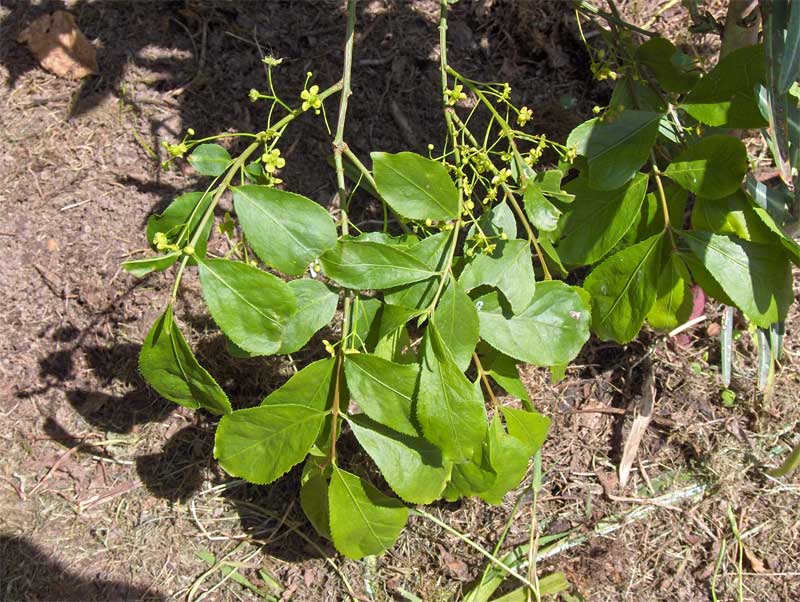
The leaves are somewhat oval with pointed tips and slightly wavy edges. Their surfaces are rough, and their textures range from leathery to papery.[1][2]
The plant produces clusters of several white flowers that are nearly one centimeter wide. Its autumn foliage can display bright shades of red, pink, and yellow.[3][4][5]
The fruit capsules can be brown, yellowish, or reddish and split into four sections. They contain brown seeds with orange arils.[6][7]
The cultivar 'Coral Charm' has light pink fruit capsules and seeds with red arils. The cultivar 'Red Elf' is a shrubbier form with dark pink fruits and seeds with orange-red arils.[8][9]
Habitat
Hamilton's spindle is native to Asia. It occurs in Afghanistan, Russia, China, Japan, Korea, India, Nepal, Pakistan, Bhutan, Thailand, and Myanmar.[10][11]
Uses
Hamilton's spindle is cultivated in gardens and landscapes outside its native range. It is grown as an ornamental plant for its autumn foliage, and its fruits and large seeds are considered attractive ornamental features.[12][13][14]
Similar species
Some authorities treat E. yedoensis, included among the varieties of this species, as a separate species.[15]
Classification of the Hamilton's Spindle
| Kingdom | Plantae |
|---|---|
| Subkingdom | Pteridobiotina |
| Phylum | Tracheophyta |
| Class | Magnoliopsida |
| Order | Celastrales |
| Family | Celastraceae (Staff-tree Family) |
| Subfamily | Celastroideae |
| Tribe | Euonymae |
| Genus | Euonymus (Spindle) |
| Species | Euonymus hamiltonianus Wall. |
Where the Hamilton's Spindle is found
Checklists and occurrence records place Euonymus hamiltonianus in 12 countries across Asia and North America. GBIF holds 8,019 georeferenced records of it.
Countries where it is native or its origin is not stated
- Afghanistan 4
- Bhutan 1
- China 2,299
- India 81
- Japan 4,510
- Myanmar 2
- Nepal 27
- North Korea 32
- Pakistan 47
- South Korea 836
- Thailand
Countries where it has been introduced
Regions and cities with the most records
- Nagano, Japan 717
- Chongqing, China 452
- Kanagawa, Japan 344
- Suzaka, Japan 320
- Hubei, China 314
- Sakaki, Japan 261
- Sichuan, China 257
- Ueda, Japan 251
- Tōmi, Japan 243
- Shaanxi, China 214
- Minawa, Japan 189
- Azamino, Japan 182
- Yamato, Japan 182
- Minamirinkan, Japan 180
- Zama, Japan 178
- Minamiashigara, Japan 176
- Kanaishima, Japan 175
- Chiba, Japan 168
- Atsugi, Japan 166
- Gunma, Japan 166
- Hokkaido, Japan 166
- Guizhou, China 165
- Inagi, Japan 160
- Ayase, Japan 159
- Machida, Japan 158
- Nagano, Japan 156
- Noborito, Japan 147
- Toyama, Japan 146
- Ebina, Japan 145
- Odawara, Japan 145
- Aihara, Japan 144
- Hadano, Japan 143
- Yunnan, China 143
- Komae, Japan 142
- Nihammatsu, Japan 141
- Sagamihara, Japan 141
10 more countries have a few records outside this range
These countries hold a few records of Euonymus hamiltonianus but lie outside the range the checklists give for it. Such records are often zoo or garden specimens, museum material or vagrants, so the species is not counted as occurring there.
Range as the checklists state it
Russian Far East (Kuril Isl., Sakhalin); Afghanistan (Kunar / Nuristan); China (Anhui, Fujian, Gansu, Guangdong, Guangxi, Guizhou, Henan, Hubei, Hunan, Jiangsu, Jiangxi, Shaanxi, Shanxi, Sichuan, Yunnan, Zhejiang); Tibet; North Korea; South Korea; Japan (Hokkaido, Honshu, Shikoku, Kyushu); Pakistan (Kurram, Chitral, Swat, Hazara, Murree); Nepal; Bhutan; India (Arunachal Pradesh, Assam, Himachal Pradesh, Jaliltnu & Kashmir, Manipur, Meghalaya, Nagaland, Uttar Pradesh); N-Myanmar (Kachin); Thailand; USA [I] (Pennsylvania [I])
A number beside a place is its count of GBIF occurrence records. A place without a number comes from a checklist alone. Records show where a species has been observed or collected, which can include escapes and vagrants.
Common names
English
- Hamilton's Spindle
- Himalayan Spindle
Names in 2 other languages
- German
- Hamiltons Spindelstrauch
- Swedish
- tokyobenved
Synonyms
38 other scientific names have been used for this species and are now treated as synonyms of Euonymus hamiltonianus.
- Euonymus dolichophyllus Koidz.
- Euonymus dorsicostatus Nakai
- Euonymus europaeus var. hamiltonianus (Wall.) Maxim.
- Euonymus hamiltonianus Dippel ex Koehne
- Euonymus hamiltonianus f. hamiltonianus
- Euonymus hamiltonianus f. koehneanus (Loes.) Blakelock
- Euonymus hamiltonianus f. lanceifolius (Loes.) C.Y.Cheng ex Q.H.Chen
- Euonymus hamiltonianus subsp. sieboldiana (Blume) H.Hara
- Euonymus hamiltonianus var. australis Kom.
- Euonymus hamiltonianus var. hians (Koehne) Blakelock
- Euonymus hamiltonianus var. lanceifolius (Loes.) Blakelock
- Euonymus hamiltonianus var. nikoensis (Nakai) Blakelock
- Euonymus hamiltonianus var. pubinervius S.Z.Qu & Y.H.He
- Euonymus hamiltonianus var. semiexsertus (Koehne) Blakelock
- Euonymus hamiltonianus var. sieboldianus (Blume) Kom.
- Euonymus hamiltonianus var. yedoensis (H.Hara) Blakelock
- Euonymus hians Koehne
- Euonymus juzepczukii Leonova
- Euonymus lanceifolius Loes.
- Euonymus majumi Siebold
- Euonymus nikoensis Nakai
- Euonymus semiexsertus Koehne
- Euonymus sieboldianus Blume
- Euonymus sieboldianus f. albicarpus Y.N.Lee
- Euonymus sieboldianus f. dorsicostatus (Nakai) H.Hara
- Euonymus sieboldianus f. stenophyllus (Koidz.) H.Hara
- Euonymus sieboldianus var. megaphyllus H.Hara
- Euonymus sieboldianus var. nikoensis (Nakai) Ohwi
- Euonymus sieboldianus var. sanguineus Nakai
- Euonymus sieboldianus var. sphaerocarpus Nakai
- Euonymus sieboldianus var. yedoensis H.Hara
- Euonymus vidalii Franch. & Sav.
- Euonymus vidalii var. stenophyllus Koidz.
- Euonymus yedoensis Koehne
- Euonymus yedoensis f. calocarpus Koehne
- Euonymus yedoensis var. koehneanus Loes.
- Euonymus atropurpureus Roxb. ambiguous synonym
- Euonymus darrisii H.Lév. ambiguous synonym
Related species
-
 BurningbushEuonymus alatus
-
 European Spindle-treeEuonymus europaeus
-
 Japanese SpindleEuonymus japonicus
-
 Fortune's EuonymusEuonymus fortunei
-
 American Strawberry BushEuonymus americanus
-
 WahooEuonymus atropurpureus
-
 Broadleaf SpindleEuonymus latifolius
-
 CorktreeEuonymus phellomanus
Compare
Questions and answers
What is the scientific name of the Hamilton's Spindle?
The scientific name of the Hamilton's Spindle is Euonymus hamiltonianus. Written with its author, the full name is Euonymus hamiltonianus Wall..
Which family does the Hamilton's Spindle belong to?
Euonymus hamiltonianus belongs to the family Celastraceae, in the order Celastrales and the class Magnoliopsida.
Where is the Hamilton's Spindle found?
Checklists and occurrence records place Euonymus hamiltonianus in 12 countries, including Japan, China, South Korea, India, Pakistan and North Korea.
What is the conservation status of the Hamilton's Spindle?
The IUCN Red List category recorded for Euonymus hamiltonianus is Least Concern (LC).
What other names does the Hamilton's Spindle have?
Euonymus hamiltonianus is also known in English as Himalayan Spindle.
What is Euonymus hamiltonianus?
Hamilton's spindle is a flowering plant in the family Celastraceae. It is described as one of the most common species in the genus Euonymus.[16]
Sources
Passages the profile rests on
- The leaves are somewhat oval, have pointed tips, and feature slightly wavy edges. Source passage: “The leaf blades are somewhat oval with pointed tips and measure up to 15 centimeters long.” — English Wikipedia
- The leaves have leathery to papery textures and rough surfaces. Source passage: “They are leathery to papery in texture with rough surfaces and slightly wavy edges.” — English Wikipedia
- The plant produces clusters of several white flowers. Source passage: “The inflorescence is a cymose cluster of several white flowers, each nearly a centimeter wide.” — English Wikipedia
- The flowers are nearly one centimeter wide. Source passage: “The inflorescence is a cymose cluster of several white flowers, each nearly a centimeter wide.” — English Wikipedia
- Its autumn foliage can display bright shades of red, pink, and yellow. Source passage: “which can be many bright shades of red, pink, and yellow.” — English Wikipedia
- The fruit capsules can be brown, yellowish, or reddish and split into four sections. Source passage: “The brown, yellowish, or reddish fruit capsule splits into four sections holding brown seeds with orange arils.” — English Wikipedia
- The fruit capsules contain brown seeds with orange arils. Source passage: “The brown, yellowish, or reddish fruit capsule splits into four sections holding brown seeds with orange arils.” — English Wikipedia
- The cultivar 'Coral Charm' has light pink fruit capsules and seeds with red arils. Source passage: “Cultivars include 'Coral Charm', which has light pink fruit capsules containing seeds with red arils” — English Wikipedia
- The cultivar 'Red Elf' is a shrubbier form with dark pink fruits and seeds with orange-red arils. Source passage: “and 'Red Elf', a shrubbier breed with dark pink fruits and seeds with orange-red arils.” — English Wikipedia
- The species is native to Asia. Source passage: “It is native to Asia” — English Wikipedia
- The species occurs in Afghanistan, Russia, China, Japan, Korea, India, Nepal, Pakistan, Bhutan, Thailand, and Myanmar. Source passage: “where it is distributed in Afghanistan, Russia, China, Japan, Korea, India, Nepal, Pakistan, Bhutan, Thailand, and Myanmar.” — English Wikipedia
- The species is cultivated in gardens and landscapes outside its native range. Source passage: “It is cultivated in gardens and landscapes in other parts of the world.” — English Wikipedia
- The species is cultivated as an ornamental plant for its autumn foliage. Source passage: “Like some other spindles, this plant is cultivated as an ornamental for its fall foliage” — English Wikipedia
- The fruits and large seeds are considered attractive ornamental features. Source passage: “The fruits and large seeds are also considered attractive.” — English Wikipedia
- Some authorities treat E. yedoensis, included among the varieties of this species, as a separate species. Source passage: “This species includes several varieties which some authorities maintain as separate species, E. yedoensis.” — English Wikipedia
- Euonymus hamiltonianus is described as one of the most common species in the genus Euonymus. Source passage: “This is one of the most common Euonymus species.” — English Wikipedia
Data
- Catalogue of Life, 2026-10-16 XR cc by
- Global Biodiversity Information Facility CC BY 4.0
- Wikidata CC0
- GeoNames CC BY 4.0
- Wikimedia Commons per image; credit shown with each image
- Within the Catalogue of Life, this name comes from Synonymic Checklists of the Vascular Plants of the World cc by
References
- Wall. Fl. Ind. [Roxburgh] 2: 403. where the name was published
This species in other databases
Page built on 27 November 2026. See how the catalog is made and all sources and licences.
Cite this page
ScientificNames.org. (2026). Euonymus hamiltonianus (Hamilton's Spindle). Retrieved November 27, 2026, from https://scientificnames.org/species/euonymus-hamiltonianus
“Euonymus hamiltonianus (Hamilton's Spindle).” ScientificNames.org, 2026, scientificnames.org/species/euonymus-hamiltonianus. Accessed 27 Nov. 2026.
ScientificNames.org. “Euonymus hamiltonianus (Hamilton's Spindle).” Accessed November 27, 2026. https://scientificnames.org/species/euonymus-hamiltonianus.
@misc{scientificnames_euonymus_hamiltonianus_hamiltons_spindle,
  author = {{ScientificNames.org}},
  title = {Euonymus hamiltonianus (Hamilton's Spindle)},
  year = {2026},
  url = {https://scientificnames.org/species/euonymus-hamiltonianus},
  note = {Accessed 2026-11-27}
}