Species · Flowering plants
Wahoo Euonymus atropurpureus
The scientific name of the Wahoo is Euonymus atropurpureus. It is a species of flowering plant in the family Celastraceae (staff-tree family), order Celastrales.
- Scientific name
- Euonymus atropurpureus Jacq.
- Common name
- Wahoo
- Genus
- Euonymus
- Family
- Celastraceae (Staff-tree Family)
- Order
- Celastrales
- Class
- Magnoliopsida
- Red List category
- LC Least Concern
- Recorded in
- 3 countries
- Name status
- accepted in the Catalogue of Life

Overview
Wahoo is a deciduous shrub. It is native to eastern North America and occurs primarily in the Midwestern United States, with a distribution extending from southern Ontario southward to northern Florida and Texas. Its leaves turn bright red in autumn.
Written 26 November 2026 from the sources listed below. Each statement was checked against the passage it cites; statements that could not be supported were removed.
Appearance
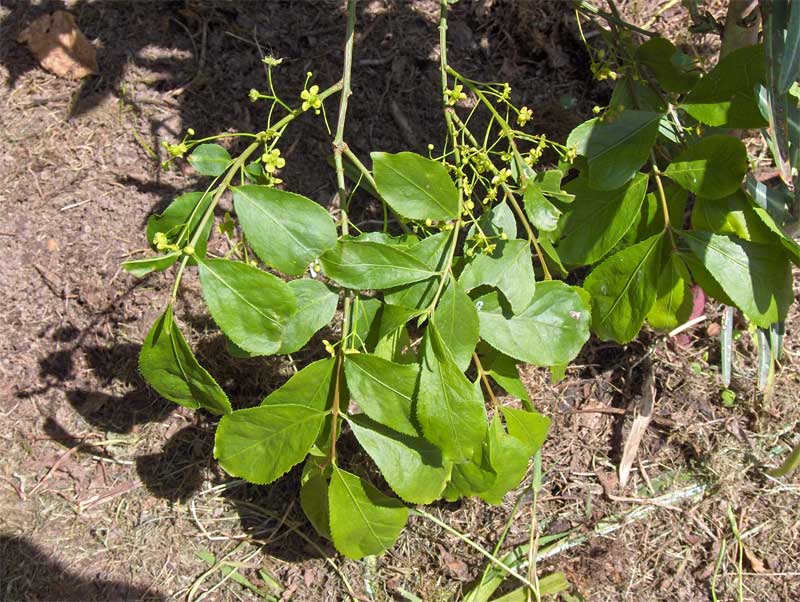
Wahoo is a shrub or small tree that can reach 8 m in height, with stems up to 10 cm in diameter. Its bark is gray, smooth, and lightly fissured, while its slender twigs are dark purplish-brown and may be four-angled or slightly winged.[1][2][3][4][5]
Its leaves are arranged oppositely and have elliptical blades measuring 8.5–11.3 cm long and 3.2–5.5 cm wide. They have abruptly elongated pointed tips, finely serrated margins, green upper surfaces, and paler undersides that often bear fine hairs.[6][7][8][9]
Its bisexual flowers measure 10–12 mm in diameter and grow in small axillary cymes. Each flower has four greenish sepals, four brown-purple petals, and four stamens.[10][11][12]
Its fruit is a smooth, reddish-to-pink capsule with four lobes, although some lobes may fail to develop. The capsules can reach 17 mm in diameter, and the orange seeds are surrounded by fleshy red arils.[13][14][15]
Habitat
Wahoo grows in low meadows, open slopes, open woodland, stream banks, and prairies. It favors moist soils, particularly in thickets, valleys, and forest edges.[16][17]
Diet
Several bird species eat the fruit of wahoo.[18]
Reproduction and life cycle
Each fruit lobe contains one seed. Birds disperse the seeds through their droppings after eating the fruit.[19][20]
Uses
Wahoo has been used medicinally in the United States and southeastern Canada. Native Americans and pioneers used its powdered bark as a purgative.[21][22]
Its fruit is poisonous to humans. The species is listed as providing attributes for butterflies and caterpillars.[23][24]
Classification of the Wahoo
| Kingdom | Plantae |
|---|---|
| Subkingdom | Pteridobiotina |
| Phylum | Tracheophyta |
| Class | Magnoliopsida |
| Order | Celastrales |
| Family | Celastraceae (Staff-tree Family) |
| Subfamily | Celastroideae |
| Tribe | Euonymae |
| Genus | Euonymus (Spindle) |
| Species | Euonymus atropurpureus Jacq. |
Where the Wahoo is found
Checklists and occurrence records place Euonymus atropurpureus in 3 countries across Asia and North America. GBIF holds 6,649 georeferenced records of it.
Countries where it is native or its origin is not stated
Countries where it has been introduced
Regions and cities with the most records
- Texas, United States 537
- Ohio, United States 471
- Pennsylvania, United States 414
- Illinois, United States 346
- Indiana, United States 337
- Missouri, United States 330
- Kansas, United States 250
- Kentucky, United States 230
- Addison, United States 226
- Richardson, United States 219
- Plano, United States 180
- Minnesota, United States 169
- Murphy, United States 166
- Allen, United States 161
- Fort Worth, United States 159
- Garland, United States 157
- Wylie, United States 148
- Sachse, United States 145
- Rowlett, United States 136
- Euless, United States 125
- Norwood, United States 121
- White Settlement, United States 120
- Wisconsin, United States 120
- Benbrook, United States 119
- Lansdale, United States 117
- Limerick, United States 112
- Cincinnati, United States 109
- White Oak, United States 109
- Irving, United States 108
- Farmers Branch, United States 106
- Haltom City, United States 106
- Forest Park, United States 104
- North Richland Hills, United States 103
- Watauga, United States 103
- Ontario, Canada 102
- Carrollton, United States 101
2 more countries have a few records outside this range
These countries hold a few records of Euonymus atropurpureus but lie outside the range the checklists give for it. Such records are often zoo or garden specimens, museum material or vagrants, so the species is not counted as occurring there.
Range as the checklists state it
Tajikistan [I]; Canada (Ontario, Québec); USA (Alabama, Arkansas, Connecticut, District of Columbia, Delaware, Florida, Georgia, Iowa, Illinois, Indiana, Kansas, Kentucky, Louisiana, Massachusetts, Maryland, Maine, Michigan, Minnesota, Missouri, Mississippi, Montana, North Carolina, North Dakota, Nebraska, New Hampshire, New Jersey, New York, Ohio, Oklahoma, Pennsylvania, Rhode Island, South Carolina, South Dakota, Tennessee, Texas, Virginia, Wisconsin, West Virginia)
A number beside a place is its count of GBIF occurrence records. A place without a number comes from a checklist alone. Records show where a species has been observed or collected, which can include escapes and vagrants.
Common names
English
- Wahoo
- Bitter-ash
- Burning-bush Euonymus
- Burningbush
- Eastern Burning-bush
Names in 2 other languages
- French
- fusain de l'Est, fusain pourpre
- German
- Purpur-Spindelstrauch
Synonyms
7 other scientific names have been used for this species and are now treated as synonyms of Euonymus atropurpureus.
- Euonymus atropurpureus var. atropurpureus
- Euonymus atropurpureus var. grandifolius Raf.
- Euonymus atropurpureus var. latifolius Raf.
- Euonymus atropurpureus var. oblongifolius Raf.
- Euonymus caroliniensis Marshall
- Euonymus tristis Salisb.
- Euonymus latifolius Marshall ambiguous synonym
Subspecies and varieties
Related species
-
 BurningbushEuonymus alatus
-
 European Spindle-treeEuonymus europaeus
-
 Japanese SpindleEuonymus japonicus
-
 Fortune's EuonymusEuonymus fortunei
-
 American Strawberry BushEuonymus americanus
-
 Hamilton's SpindleEuonymus hamiltonianus
-
 Broadleaf SpindleEuonymus latifolius
-
 CorktreeEuonymus phellomanus
Compare
Questions and answers
What is the scientific name of the Wahoo?
The scientific name of the Wahoo is Euonymus atropurpureus. Written with its author, the full name is Euonymus atropurpureus Jacq..
Which family does the Wahoo belong to?
Euonymus atropurpureus belongs to the family Celastraceae, in the order Celastrales and the class Magnoliopsida.
Where is the Wahoo found?
Checklists and occurrence records place Euonymus atropurpureus in 3 countries, including United States and Canada.
What is the conservation status of the Wahoo?
The IUCN Red List category recorded for Euonymus atropurpureus is Least Concern (LC).
What other names does the Wahoo have?
Euonymus atropurpureus is also known in English as Bitter-ash, Burning-bush Euonymus, Burningbush and Eastern Burning-bush.
Are wahoo berries edible?
No. Wahoo fruit is poisonous to humans.[23]
How big does a wahoo tree get?
Wahoo can reach 8 m in height, and its stems can reach 10 cm in diameter.[1][2]
Is Euonymus fruit edible?
The fruit of Euonymus atropurpureus is poisonous to humans.[23]
Sources
Passages the profile rests on
- The shrub can reach a height of 8 m. Source passage: “growing to 8 m (26 ft) tall” — English Wikipedia
- Its stems can reach 10 cm in diameter. Source passage: “stems up to 10 cm (3.9 in) diameter.” — English Wikipedia
- Its bark is gray, smooth, and lightly fissured. Source passage: “The bark is gray, smooth, and lightly fissured.” — English Wikipedia
- Its slender twigs are dark purplish-brown and may be four-angled or slightly winged. Source passage: “The twigs are dark purplish-brown, slender, sometimes four-angled or slightly winged.” — English Wikipedia
- The species is described as a native shrub or small tree. Source passage: “Eastern wahoo is a native shrub or small tree” — mdc.mo.gov
- Its leaves are arranged oppositely and have elliptical blades. Source passage: “The leaves are opposite, elliptical,” — English Wikipedia
- Its leaves measure 8.5–11.3 cm long and 3.2–5.5 cm wide. Source passage: “8.5–11.3 cm (3.3–4.4 in) long and 3.2–5.5 cm (1.3–2.2 in) broad,” — English Wikipedia
- Its leaves have abruptly elongated pointed tips and finely serrated margins. Source passage: “abruptly long pointed at the tip, and with a finely serrated margin;” — English Wikipedia
- Its leaves are green above and paler underneath, where fine hairs are often present. Source passage: “they are green above, paler and often with fine hairs beneath,” — English Wikipedia
- Its flowers are bisexual and measure 10–12 mm in diameter. Source passage: “The flowers are bisexual, 10–12 mm (0.39–0.47 in) diameter,” — English Wikipedia
- Its flowers have four greenish sepals, four brown-purple petals, and four stamens. Source passage: “with four greenish sepals, four brown-purple petals and four stamens;” — English Wikipedia
- Its flowers grow in small axillary cymes. Source passage: “they are produced in small axillary cymes.” — English Wikipedia
- Its fruit is a smooth, reddish-to-pink capsule with four lobes, although some lobes may fail to develop. Source passage: “The fruit is a smooth reddish to pink four-lobed (sometimes one or more of the lobes abort) capsule,” — English Wikipedia
- Its fruit capsules can reach 17 mm in diameter. Source passage: “up to 17 mm (0.67 in) diameter,” — English Wikipedia
- Its seeds are orange and surrounded by a fleshy red aril. Source passage: “orange with a fleshy red aril.” — English Wikipedia
- The species grows in low meadows, open slopes, open woodland, stream banks, and prairies. Source passage: “It grows in low meadows, open slopes, open woodland, stream banks and prairies,” — English Wikipedia
- The species favors moist soils, particularly in thickets, valleys, and forest edges. Source passage: “in moist soils, especially thickets, valleys, and forest edges.” — English Wikipedia
- Several bird species eat its fruit. Source passage: “but is eaten by several species of birds,” — English Wikipedia
- Each fruit lobe contains one seed. Source passage: “each lobe containing a single seed,” — English Wikipedia
- Birds disperse the species' seeds through their droppings after eating its fruit. Source passage: “which disperse the seeds in their droppings.” — English Wikipedia
- The species has been used medicinally in the United States and southeastern Canada. Source passage: “It is used medicinally in both the United States and southeastern Canada.” — English Wikipedia
- Native Americans and pioneers used the powdered bark as a purgative. Source passage: “The powdered bark was used by Native Americans and pioneers as a purgative.” — English Wikipedia
- The species' fruit is poisonous to humans. Source passage: “The fruit is poisonous to humans,” — English Wikipedia
- The species is listed as providing attributes for butterflies and caterpillars. Source passage: “Attributes. Butterflies, Caterpillars,” — audubon.org
Data
- Catalogue of Life, 2026-10-16 XR cc by
- Global Biodiversity Information Facility CC BY 4.0
- Wikidata CC0
- GeoNames CC BY 4.0
- Wikimedia Commons per image; credit shown with each image
- Within the Catalogue of Life, this name comes from Synonymic Checklists of the Vascular Plants of the World cc by
References
- Jacq. (1772). Hort. Bot. Vindob. 2: 55 (1772-73). where the name was published
This species in other databases
Page built on 29 November 2026. See how the catalog is made and all sources and licences.
Cite this page
ScientificNames.org. (2026). Euonymus atropurpureus (Wahoo). Retrieved November 29, 2026, from https://scientificnames.org/species/euonymus-atropurpureus
“Euonymus atropurpureus (Wahoo).” ScientificNames.org, 2026, scientificnames.org/species/euonymus-atropurpureus. Accessed 29 Nov. 2026.
ScientificNames.org. “Euonymus atropurpureus (Wahoo).” Accessed November 29, 2026. https://scientificnames.org/species/euonymus-atropurpureus.
@misc{scientificnames_euonymus_atropurpureus_wahoo,
  author = {{ScientificNames.org}},
  title = {Euonymus atropurpureus (Wahoo)},
  year = {2026},
  url = {https://scientificnames.org/species/euonymus-atropurpureus},
  note = {Accessed 2026-11-29}
}