Species · Flowering plants
Caley Pea Lathyrus hirsutus
The scientific name of the Caley Pea is Lathyrus hirsutus. It is a species of flowering plant in the family Fabaceae (bean), order Fabales.
- Scientific name
- Lathyrus hirsutus L.
- Common name
- Caley Pea
- Genus
- Lathyrus
- Family
- Fabaceae (Bean)
- Order
- Fabales
- Class
- Magnoliopsida
- Red List category
- LC Least Concern
- Recorded in
- 59 countries
- Name status
- accepted in the Catalogue of Life

Overview
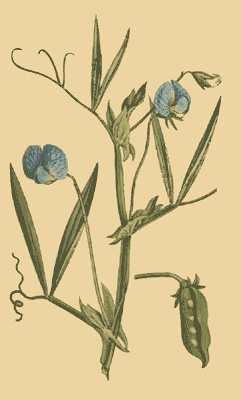
Caley Pea is an annual legume. The species is native to Europe, North Africa, and much of Asia, and occurs as an introduced plant on other continents, including North America. The plant has winged stems, leaves with coiled tendrils, and hairy fruit pods.
Written 26 November 2026 from the sources listed below. Each statement was checked against the passage it cites; statements that could not be supported were removed.
Appearance
Caley Pea is classified as a forb and vine in growth form. Its winged stems grow between 10 and 40 inches long.[1][2]
Each leaf consists of two leaflike leaflets and a branching, coiled tendril. The leaves are linear, elliptic, or lanceolate.[3][4]
The plant produces one or two flowers per inflorescence, which may be pink, blue, or bicolored. The flowers measure between 1 and 1.5 centimeters in width.[5][6]
The fruit is a dehiscent legume pod covered with hairs. Each hair grows from a minute bulbous base, while the other parts of the plant are generally hairless.[7][8][9]
Habitat
Caley Pea is a cool-season plant. It is native to Europe, North Africa, and much of Asia, and occurs as an introduced plant on other continents, including North America.[10][11][12]
Reproduction and life cycle
Caley Pea is an annual legume. It produces a heavy seed crop under usual conditions.[13][14]
Uses
The seed crop may be suitable as food for game birds.[14][15]
Conservation
Caley Pea is potentially toxic to horses.[16]
Classification of the Caley Pea
| Kingdom | Plantae |
|---|---|
| Subkingdom | Pteridobiotina |
| Phylum | Tracheophyta |
| Class | Magnoliopsida |
| Order | Fabales |
| Family | Fabaceae (Bean) |
| Genus | Lathyrus (Pea) |
| Species | Lathyrus hirsutus L. |
Where the Caley Pea is found
Checklists and occurrence records place Lathyrus hirsutus in 59 countries across Africa, Asia, Europe, North America and South America. GBIF holds 28,301 georeferenced records of it.
Countries where it is native or its origin is not stated
- Afghanistan 18
- Albania 7
- Algeria 5
- Armenia 89
- Austria 170
- Azerbaijan 122
- Belarus 3
- Belgium 493
- Bosnia and Herzegovina 6
- Bulgaria 34
- Croatia 50
- Czechia 149
- Denmark 14
- Egypt 66
- Estonia 12
- Finland 26
- France 14,265
- Georgia 75
- Germany 1,291
- Greece 83
- Hungary 73
- India
- Iran 14
- Iraq
- Israel 53
- Italy 461
- Kyrgyzstan
- Luxembourg 35
- Moldova 5
- Montenegro 5
- Morocco 18
- North Macedonia 3
- Norway 12
- Pakistan
- Poland 13
- Portugal 640
- Romania 46
- Russia 273
- Serbia 19
- Slovakia 152
- Slovenia 5
- Spain 1,338
- Sweden 238
- Switzerland 426
- Syria 3
- Tajikistan 8
- The Netherlands 1,425
- Tunisia 9
- Turkey 42
- Turkmenistan 32
- Ukraine 104
- Uzbekistan 8
Countries where it has been introduced
Regions and cities with the most records
- Centre-Val de Loire, France 3,070
- Texas, United States 2,750
- Auvergne-Rhône-Alpes, France 2,240
- Bourgogne-Franche-Comté, France 1,240
- Occitanie, France 1,234
- Grand Est, France 1,064
- Île-de-France, France 812
- Provence-Alpes-Côte d'Azur, France 729
- Bavaria, Germany 711
- Pays de la Loire, France 668
- Rotterdam, The Netherlands 632
- Krimpen aan den IJssel, The Netherlands 625
- Capelle aan den IJssel, The Netherlands 614
- Addison, United States 605
- Plano, United States 522
- Berkel en Rodenrijs, The Netherlands 521
- Bergschenhoek, The Netherlands 520
- Pijnacker, The Netherlands 499
- Schiedam, The Netherlands 491
- Delft, The Netherlands 490
- Nootdorp, The Netherlands 481
- Ypenburg, The Netherlands 478
- Zoetermeer, The Netherlands 473
- Richardson, United States 470
- Hauts-de-France, France 468
- Voorburg, The Netherlands 460
- Allen, United States 459
- Frisco, United States 458
- Gouda, The Netherlands 452
- Benthuizen, The Netherlands 451
- Waddinxveen, The Netherlands 450
- The Colony, United States 440
- Voorschoten, The Netherlands 440
- Highland Village, United States 439
- Lewisville, United States 439
- Leiderdorp, The Netherlands 438
3 more countries have a few records outside this range
These countries hold a few records of Lathyrus hirsutus but lie outside the range the checklists give for it. Such records are often zoo or garden specimens, museum material or vagrants, so the species is not counted as occurring there.
A number beside a place is its count of GBIF occurrence records. A place without a number comes from a checklist alone. Records show where a species has been observed or collected, which can include escapes and vagrants.
Common names
English
- Caley Pea
- Austrian Winterpea
- Caley-pea
- Hairy Pea
- Hairy Vetchling
- Hairy Singletary Pea
- Rough Pea
- Singletary Pea
- Winterpea
- Rough-pea
- Singletary-pea
Names in 24 other languages
- Arabic
- بازلاء مشعرة, جلبان مشعر
- Catalan
- guixó hirsut
- Czech
- hrachor chlupatý
- Dutch
- Ruige lathyrus
- Estonian
- karvane seahernes
- Finnish
- karvanätkelmä
- French
- Gesse Hérissée, Gesse Velue, Gesse hirsute, Gesse à gousses velues
- German
- Behaarte Platterbse, Behaartfrüchtige Platterbse, Haarfrüchtige Platterbse, Rauhaarige Platterbse, rauhhaarige Platterbse
- Hebrew
- טופח שעיר
- Hungarian
- borzas lednek
- Italian
- Cicerchia Irsuta, Cicerchia Pelosa
- Lithuanian
- Plaukuotasis pelėžirnis
- Norwegian Bokmål
- lodneflatbelg
- Norwegian Nynorsk
- lodneskolm
- Polish
- groszek kosmatostrąkowy
- Portuguese
- Cizirão-eriçado
- Russian
- Чина жестковолосистая, Чина шершавая
- Slovak
- hrachor chlpatý
- Slovenian
- dlakavi grahor
- Spanish
- Guija Velluda, Guisante de Invierno Austríaco
- Swedish
- luddvial
- Turkish
- Kabamürdümük, Tüylü mürdümük
- Ukrainian
- Чина шорстка
- Welsh
- Ytbys Blewog, Ytbysen Flewgodog, Ytbysen Flewog
Synonyms
15 other scientific names have been used for this species and are now treated as synonyms of Lathyrus hirsutus.
- Lastila hirsuta (L.) Alef.
- Lastila hirsuta var. annua Alef.
- Lastila hirsuta var. biennis Alef.
- Lathyrus cicer Hablitz
- Lathyrus coerulescens Boiss. & Reut.
- Lathyrus hirsutus f. brevipedunculatus Cout.
- Lathyrus hirsutus var. brevipedunculatus Cout.
- Lathyrus hirsutus var. ecirrhosus Schur
- Lathyrus hirtus Lam.
- Orobus glabratus Nyman
- Orobus hirsutus var. glabriusculus Ser.
- Pisum hirsutum (L.) E.H.L.Krause
- Lathyrus leptophyllus K.Koch ex Boiss. ambiguous synonym
- Lathyrus variegatus Host ambiguous synonym
- Orobus lathyroides Hablitz misapplied
Related species
-
 Sweet PeaLathyrus odoratus
-
 Indian PeaLathyrus sativus
-
 Perennial PeaLathyrus latifolius
-
 Tuberous PeaLathyrus tuberosus
-
 Beach PeaLathyrus japonicus
-
 Yellow VetchlingLathyrus aphaca
-
 Bitter VetchLathyrus linifolius
-
 Spanish VetchlingLathyrus clymenum
Compare
Questions and answers
What is the scientific name of the Caley Pea?
The scientific name of the Caley Pea is Lathyrus hirsutus. Written with its author, the full name is Lathyrus hirsutus L..
Which family does the Caley Pea belong to?
Lathyrus hirsutus belongs to the family Fabaceae, in the order Fabales and the class Magnoliopsida.
Where is the Caley Pea found?
Checklists and occurrence records place Lathyrus hirsutus in 59 countries, including France, The Netherlands, Spain, Germany, Portugal and Belgium.
What is the conservation status of the Caley Pea?
The IUCN Red List category recorded for Lathyrus hirsutus is Least Concern (LC).
What other names does the Caley Pea have?
Lathyrus hirsutus is also known in English as Austrian Winterpea, Caley-pea, Hairy Pea, Hairy Vetchling, Hairy Singletary Pea and Rough Pea.
Sources
Passages the profile rests on
- The species is classified as a forb and vine in growth form. Source passage: “Growth Form forb, vine” — warcapps.usgs.gov
- The winged stems grow between 10 and 40 inches long. Source passage: “winged stems that grow from 10 to 40 inches” — rangeplants.tamu.edu
- Each leaf consists of two leaflike leaflets and a branching, coiled tendril. Source passage: “leaves each made up of two leaflike leaflets with a branching, coiled tendril.” — English Wikipedia
- The species has linear, elliptic, or lanceolate leaves. Source passage: “Leaf Shape linear, elliptic, lanceolate” — warcapps.usgs.gov
- The plant produces one or two flowers per inflorescence, which may be pink, blue, or bicolored. Source passage: “The inflorescence holds one or two pink, blue, or bicolored pea flowers” — English Wikipedia
- The flowers measure between 1 and 1.5 centimeters in width. Source passage: “each 1 to 1.5 centimeters wide.” — English Wikipedia
- The fruit is a dehiscent legume pod covered with hairs. Source passage: “The fruit is a dehiscent legume pod covered in hairs” — English Wikipedia
- Each hair on the fruit grows from a minute bulbous base. Source passage: “with each hair growing from a minute bulbous base.” — English Wikipedia
- The parts of the plant other than its hairy fruit are generally hairless. Source passage: “The rest of the plant is generally hairless.” — English Wikipedia
- The species is described as a cool-season plant. Source passage: “introduced, cool season, annual legume” — rangeplants.tamu.edu
- The species is native to Europe, North Africa, and much of Asia. Source passage: “It is native to Europe, North Africa, and much of Asia” — English Wikipedia
- The species occurs as an introduced plant on other continents, including North America. Source passage: “it is known from other continents, including North America, as an introduced species.” — English Wikipedia
- The species is an annual legume. Source passage: “Singletary Pea is an introduced, cool season, annual legume” — rangeplants.tamu.edu
- The species produces a heavy seed crop under usual conditions. Source passage: “Caley peas (Lathyrus hirsutus) usually produce a heavy seed crop” — aurora.auburn.edu
- The seed crop may be suitable as food for game birds. Source passage: “which may be suitable for game birds” — aurora.auburn.edu
- The species is potentially toxic to horses. Source passage: “Caley Pea (Lathyrus hirsutus) is potentially toxic to horses” — pubmed.ncbi.nlm.nih.gov
Data
- Catalogue of Life, 2026-10-16 XR cc by
- Global Biodiversity Information Facility CC BY 4.0
- Wikidata CC0
- GeoNames CC BY 4.0
- Wikimedia Commons per image; credit shown with each image
- Within the Catalogue of Life, this name comes from The World Checklist of Vascular Plants (WCVP): Fabaceae cc by
References
- Sp. Pl.: 732 (1753) where the name was published
This species in other databases
Page built on 27 November 2026. See how the catalog is made and all sources and licences.
Cite this page
ScientificNames.org. (2026). Lathyrus hirsutus (Caley Pea). Retrieved November 27, 2026, from https://scientificnames.org/species/lathyrus-hirsutus
“Lathyrus hirsutus (Caley Pea).” ScientificNames.org, 2026, scientificnames.org/species/lathyrus-hirsutus. Accessed 27 Nov. 2026.
ScientificNames.org. “Lathyrus hirsutus (Caley Pea).” Accessed November 27, 2026. https://scientificnames.org/species/lathyrus-hirsutus.
@misc{scientificnames_lathyrus_hirsutus_caley_pea,
  author = {{ScientificNames.org}},
  title = {Lathyrus hirsutus (Caley Pea)},
  year = {2026},
  url = {https://scientificnames.org/species/lathyrus-hirsutus},
  note = {Accessed 2026-11-27}
}