Species · Flowering plants
Grass Vetchling Lathyrus nissolia
The scientific name of the Grass Vetchling is Lathyrus nissolia. It is a species of flowering plant in the family Fabaceae (bean), order Fabales.
- Scientific name
- Lathyrus nissolia L.
- Common name
- Grass Vetchling
- Genus
- Lathyrus
- Family
- Fabaceae (Bean)
- Order
- Fabales
- Class
- Magnoliopsida
- Red List category
- LC Least Concern
- Recorded in
- 49 countries
- Name status
- accepted in the Catalogue of Life

Overview
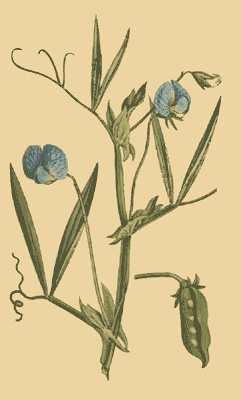
Grass Vetchling is an annual species. It occurs in grassland, on banks, along field margins and in disturbed ground. It lacks true leaves, leaflets and tendrils, and has a flattened, grass-like leaf stalk and crimson flowers.
Written 26 November 2026 from the sources listed below. Each statement was checked against the passage it cites; statements that could not be supported were removed.
Appearance
The plant has an erect stem that branches from its base. It lacks true leaves, leaflets and tendrils, and its flattened leaf stalk resembles a grass blade and ends in a fine point.[1][2][3]
The plant produces small crimson flowers measuring 8–18 mm in length. They grow singly or in pairs on long flower stalks.[4][5][6]
The plant develops long, slender and straight seed pods that change from flat to cylindrical as the peas mature.[7]
The plant typically grows between 20 and 90 cm tall. Its grass-like leaf stalk can reach 15 cm in length.[8][9]
Habitat
The plant occurs in grassland, on banks and along field margins. It also grows in disturbed ground, crops, hedgerows, bushes and forest edges.[10][11][12]
The species occurs in meso-xerophilic meadows on clay to siliceous substrates. It grows sparsely among ungrazed grass and on roadside banks.[13][14]
The species has been recorded at elevations between 100 and 1,300 metres. It was not recorded in stocked pastures adjacent to locations where it grew.[15][16]
Behaviour
Grass Vetchling is an annual species. It can be difficult to detect when it is not flowering or fruiting because it resembles grass.[17][18]
Reproduction and life cycle
The flowers appear during June and July. They are capable of self-pollination.[19][20]
The flowers develop into long, slender and straight pods.[21]
Classification of the Grass Vetchling
| Kingdom | Plantae |
|---|---|
| Subkingdom | Pteridobiotina |
| Phylum | Tracheophyta |
| Class | Magnoliopsida |
| Order | Fabales |
| Family | Fabaceae (Bean) |
| Genus | Lathyrus (Pea) |
| Species | Lathyrus nissolia L. |
Where the Grass Vetchling is found
Checklists and occurrence records place Lathyrus nissolia in 49 countries across Africa, Asia, Europe, North America and Oceania. GBIF holds 41,543 georeferenced records of it.
Countries where it is native or its origin is not stated
- Afghanistan 16
- Albania 7
- Algeria 2
- Andorra 7
- Armenia 39
- Austria 92
- Azerbaijan 30
- Belgium 3,006
- Bosnia and Herzegovina 4
- Bulgaria 52
- Croatia 31
- Czechia 87
- Denmark 9
- France 12,812
- Georgia 50
- Germany 1,351
- Greece 99
- Hungary 104
- Iran 5
- Iraq 1
- Ireland 3
- Israel 49
- Italy 150
- Luxembourg 67
- Moldova 9
- Montenegro 7
- Morocco 22
- North Macedonia 4
- Norway 4
- Poland 28
- Portugal 82
- Romania 70
- Russia 104
- Serbia 17
- Slovakia 355
- Slovenia 3
- Spain 723
- Sweden 73
- Switzerland 289
- Syria 8
- Tajikistan 6
- The Netherlands 3,730
- Tunisia 1
- Turkey 77
- Ukraine 189
- United Kingdom 17,566
Countries where it has been introduced
Regions and cities with the most records
- England, United Kingdom 15,780
- Auvergne-Rhône-Alpes, France 1,700
- Centre-Val de Loire, France 1,631
- Occitanie, France 1,499
- Worcester, United Kingdom 1,468
- Great Malvern, United Kingdom 1,389
- Oudenaarde, Belgium 1,256
- Bevere, Belgium 1,255
- Waregem, Belgium 1,245
- Deinze, Belgium 1,234
- Zottegem, Belgium 1,219
- Zeeland, The Netherlands 1,194
- Herzele, Belgium 1,160
- Merelbeke, Belgium 1,154
- Wetteren, Belgium 1,121
- Droitwich, United Kingdom 1,118
- Tewkesbury, United Kingdom 1,118
- Borssele, The Netherlands 1,113
- Gent, Belgium 1,108
- Gentbrugge, Belgium 1,107
- Sint-Amandsberg, Belgium 1,104
- Destelbergen, Belgium 1,087
- Mariakerke, Belgium 1,062
- Vlissingen, The Netherlands 1,038
- Bourgogne-Franche-Comté, France 1,034
- Hauts-de-France, France 986
- Ronse, Belgium 957
- Goes, The Netherlands 949
- Middelburg, The Netherlands 864
- Evesham, United Kingdom 862
- Mangotsfield, United Kingdom 810
- Golders Green, United Kingdom 807
- Grand Est, France 807
- Harlesden, United Kingdom 801
- Wembley, United Kingdom 801
- Harrow, United Kingdom 795
A number beside a place is its count of GBIF occurrence records. A place without a number comes from a checklist alone. Records show where a species has been observed or collected, which can include escapes and vagrants.
Common names
English
- Grass Vetchling
- Crimson-shoe
- Grass Pea
- Shoes-and-stockings
Names in 17 other languages
- Arabic
- جلبان عشبي, جلبان نيسولي, حذاء قرمزي
- Danish
- Græs-fladbælg
- Dutch
- Graslathyrus
- Estonian
- oras-seahernes
- Finnish
- heinänätkelmä
- French
- Gesse Nissole, Gesse de Nissole, Gesse graminée, Gesse sans Vrilles, Gesse sans vrille
- German
- Gras Platterbse, Gras-Platterbse
- Hebrew
- טופח עדין
- Hungarian
- kacstalan lednek
- Italian
- Cicerchia Semplice
- Polish
- groszek liściakowy
- Russian
- Чина Ниссоля
- Slovak
- hrachor trávolistý
- Slovenian
- Nissolejev grahor
- Swedish
- gräsvial
- Turkish
- Çimen Burçağı
- Welsh
- Ytbysen Feinddail, Ytbysen Goch
Synonyms
4 other scientific names have been used for this species and are now treated as synonyms of Lathyrus nissolia.
- Anurus nissolia (L.) Fourr.
- Orobus nissolia (L.) Döll
- Orobus nissolia Doeil
- Pisum nissolia (L.) E.H.L.Krause
Subspecies and varieties
- Lathyrus nissolia subsp. amanus subspecies
- Lathyrus nissolia subsp. nissolia subspecies
Related species
-
 Sweet PeaLathyrus odoratus
-
 Indian PeaLathyrus sativus
-
 Perennial PeaLathyrus latifolius
-
 Tuberous PeaLathyrus tuberosus
-
 Beach PeaLathyrus japonicus
-
 Yellow VetchlingLathyrus aphaca
-
 Bitter VetchLathyrus linifolius
-
 Spanish VetchlingLathyrus clymenum
Compare
Questions and answers
What is the scientific name of the Grass Vetchling?
The scientific name of the Grass Vetchling is Lathyrus nissolia. Written with its author, the full name is Lathyrus nissolia L..
Which family does the Grass Vetchling belong to?
Lathyrus nissolia belongs to the family Fabaceae, in the order Fabales and the class Magnoliopsida.
Where is the Grass Vetchling found?
Checklists and occurrence records place Lathyrus nissolia in 49 countries, including United Kingdom, France, The Netherlands, Belgium, Germany and Spain.
What is the conservation status of the Grass Vetchling?
The IUCN Red List category recorded for Lathyrus nissolia is Least Concern (LC).
What other names does the Grass Vetchling have?
Lathyrus nissolia is also known in English as Crimson-shoe, Grass Pea and Shoes-and-stockings.
Why is it called Grass Vetchling?
The common name Grass Vetchling refers to the species' grass-like foliage.[22]
When does Grass Vetchling flower?
The flowers appear during June and July.[20]
How tall does Grass Vetchling grow?
The plant typically grows between 20 and 90 cm tall.[9]
Can Grass Vetchling self-pollinate?
Yes. Its flowers are capable of self-pollination.[19]
Sources
Passages the profile rests on
- The plant has an erect stem that branches from its base. Source passage: “with an erect stem branching from the base” — English Wikipedia
- The plant lacks true leaves, leaflets and tendrils. Source passage: “It is entirely without true leaves, leaflets or tendrils.” — English Wikipedia
- Its flattened leaf stalk resembles a grass blade and ends in a fine point. Source passage: “The leaf stalk, however, is flattened out until it closely resembles a blade of grass up to 15 cm long and ending in a fine point” — English Wikipedia
- The plant produces crimson flowers. Source passage: “The crimson flowers come out in June and July” — English Wikipedia
- Its flowers are small, measuring 8–18 mm in length. Source passage: “are rather small (8–18 mm long)” — English Wikipedia
- The flowers grow singly or in pairs on long flower stalks. Source passage: “solitary or in pairs, on a very long peduncle.” — English Wikipedia
- The plant develops long, slender and straight seed pods that change from flat to cylindrical as the peas mature. Source passage: “long, slender, straight pods, which are at first very flat, but become cylindrical” — English Wikipedia
- Its grass-like leaf stalk can reach 15 cm in length. Source passage: “a blade of grass up to 15 cm long” — English Wikipedia
- The plant typically grows between 20 and 90 cm tall. Source passage: “L. nissolia is an annual plant 20–90 cm” — soilhealth.ccmaknowledgebase.vic.gov.au
- The plant occurs in grassland, on banks and along field margins. Source passage: “Grassland, banks and field margins on neutral to acid soil.” — English Wikipedia
- The plant grows in disturbed ground and along field borders. Source passage: “Grass Vetchling is an annual plant of disturbed ground and field borders” — soilhealth.ccmaknowledgebase.vic.gov.au
- The species occurs in crops, hedgerows, bushes and forest edges. Source passage: “L. nissolia occurs in crops, hedgerows and bushes, forest edges” — soilhealth.ccmaknowledgebase.vic.gov.au
- The species occurs in meso-xerophilic meadows on clay to siliceous substrates. Source passage: “meso-xerophilic meadows, mainly on clay to siliceous substrate” — soilhealth.ccmaknowledgebase.vic.gov.au
- The species grows sparsely among ungrazed grass and on roadside banks. Source passage: “Grows sparingly through ungrazed grass and as weeds on roadside banks” — soilhealth.ccmaknowledgebase.vic.gov.au
- The plant was not recorded in stocked pastures adjacent to locations where it grew. Source passage: “was absent from adjacent stocked pastures” — soilhealth.ccmaknowledgebase.vic.gov.au
- The species has been recorded at elevations between 100 and 1,300 metres. Source passage: “Occurs between 100-1300 m” — soilhealth.ccmaknowledgebase.vic.gov.au
- The plant is an annual species. Source passage: “Grass vetchling is an annual plant” — English Wikipedia
- The species can be difficult to detect when it is not flowering or fruiting because it resembles grass. Source passage: “very difficult to discover when not in flower or fruit because of its close resemblance to grass” — soilhealth.ccmaknowledgebase.vic.gov.au
- The flowers are capable of self-pollination. Source passage: “They have the ability to self-pollinate.” — English Wikipedia
- The flowers appear during June and July. Source passage: “The crimson flowers come out in June and July” — English Wikipedia
- The flowers develop into long, slender and straight pods. Source passage: “The flowers are succeeded by long, slender, straight pods” — English Wikipedia
- The common name Grass Vetchling refers to the species' grass-like foliage. Source passage: “Its common name refers to the grass-like foliage” — English Wikipedia
- The species contains the toxin 3-aminopropionitrile. Source passage: “L. nissolia (grass vetchling) contains the toxin 3-aminopropionitrile” — soilhealth.ccmaknowledgebase.vic.gov.au
- The species has been reported as poisonous to mammals. Source passage: “Lathyrus nissolia listed as being poisonous to mammals” — soilhealth.ccmaknowledgebase.vic.gov.au
- The toxin associated with the species has been linked to neurological disease, excitability, convulsions and death without skeletal lesions. Source passage: “causes neurological disease, including excitability, convulsions and death without skeletal lesions” — soilhealth.ccmaknowledgebase.vic.gov.au
Data
- Catalogue of Life, 2026-10-16 XR cc by
- Global Biodiversity Information Facility CC BY 4.0
- Wikidata CC0
- GeoNames CC BY 4.0
- Wikimedia Commons per image; credit shown with each image
- Within the Catalogue of Life, this name comes from The World Checklist of Vascular Plants (WCVP): Fabaceae cc by
References
- Sp. Pl.: 729 (1753) where the name was published
This species in other databases
Page built on 27 November 2026. See how the catalog is made and all sources and licences.
Cite this page
ScientificNames.org. (2026). Lathyrus nissolia (Grass Vetchling). Retrieved November 27, 2026, from https://scientificnames.org/species/lathyrus-nissolia
“Lathyrus nissolia (Grass Vetchling).” ScientificNames.org, 2026, scientificnames.org/species/lathyrus-nissolia. Accessed 27 Nov. 2026.
ScientificNames.org. “Lathyrus nissolia (Grass Vetchling).” Accessed November 27, 2026. https://scientificnames.org/species/lathyrus-nissolia.
@misc{scientificnames_lathyrus_nissolia_grass_vetchling,
  author = {{ScientificNames.org}},
  title = {Lathyrus nissolia (Grass Vetchling)},
  year = {2026},
  url = {https://scientificnames.org/species/lathyrus-nissolia},
  note = {Accessed 2026-11-27}
}