Species · Flowering plants
Persian Everlasting Pea Lathyrus rotundifolius
The scientific name of the Persian Everlasting Pea is Lathyrus rotundifolius. It is a species of flowering plant in the family Fabaceae (bean), order Fabales.
- Scientific name
- Lathyrus rotundifolius Willd.
- Common name
- Persian Everlasting Pea
- Genus
- Lathyrus
- Family
- Fabaceae (Bean)
- Order
- Fabales
- Class
- Magnoliopsida
- Red List category
- NT Near Threatened
- Recorded in
- 3 countries
- Name status
- accepted in the Catalogue of Life

Overview
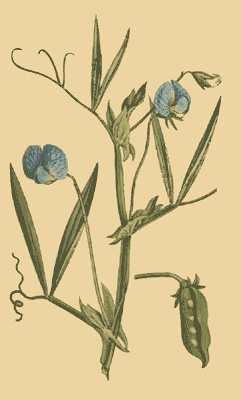
Persian Everlasting Pea is a herbaceous perennial climbing plant with twining, clinging tendrils. It requires a growing position in full sun. It produces unscented, brick-red flowers during summer.
Written 27 November 2026 from the sources listed below. Each statement was checked against the passage it cites; statements that could not be supported were removed.
Appearance
Persian Everlasting Pea is a herbaceous perennial climbing plant with twining, clinging tendrils. It can grow to a height of 1.5 metres.[1][2]
The plant produces brick-red flowers during summer. The flowers are unscented.[3][4]
Habitat
Persian Everlasting Pea requires a growing position in full sun.[5]
Conservation
Persian Everlasting Pea holds the Royal Horticultural Society's Award of Garden Merit.[6]
Uses
Persian Everlasting Pea is suitable for growing over fences. It can also be grown scrambling through another shrub or tree.[7][8]
Similar species
Persian Everlasting Pea has a close relationship to the sweet pea (Lathyrus odoratus).[9]
Classification of the Persian Everlasting Pea
| Kingdom | Plantae |
|---|---|
| Subkingdom | Pteridobiotina |
| Phylum | Tracheophyta |
| Class | Magnoliopsida |
| Order | Fabales |
| Family | Fabaceae (Bean) |
| Genus | Lathyrus (Pea) |
| Species | Lathyrus rotundifolius Willd. |
Where the Persian Everlasting Pea is found
Checklists and occurrence records place Lathyrus rotundifolius in 3 countries across Europe. GBIF holds 655 georeferenced records of it.
Countries where it is native or its origin is not stated
Countries where it has been introduced
Regions and cities with the most records
- Crimea, Ukraine 267
- Bashkortostan Republic, Russia 176
- Balaklava, Ukraine 91
- Alushta, Ukraine 89
- Sudak, Ukraine 63
- Yalta, Ukraine 51
- Sevastopol, Ukraine 50
- Bakhchysaray, Ukraine 41
- Chelyabinsk, Russia 31
- Ishimbay, Russia 31
- Salavat, Russia 29
- Kalmar, Sweden 19
- Bilohirsk, Ukraine 18
- Ufa, Russia 16
- Feodosiya, Ukraine 10
- Ust’-Katav, Russia 9
- Sterlitamak, Russia 7
- Dagestan, Russia 6
- Sim, Russia 6
- Simferopol, Ukraine 6
- Asha, Russia 4
- Samara Oblast, Russia 4
- Krasnodar Krai, Russia 3
- Kumertau, Russia 3
- Kusa, Russia 3
- Orenburg Oblast, Russia 3
6 more countries have a few records outside this range
These countries hold a few records of Lathyrus rotundifolius but lie outside the range the checklists give for it. Such records are often zoo or garden specimens, museum material or vagrants, so the species is not counted as occurring there.
A number beside a place is its count of GBIF occurrence records. A place without a number comes from a checklist alone. Records show where a species has been observed or collected, which can include escapes and vagrants.
Common names
English
- Persian Everlasting Pea
- Round-Leaf Vetchling
- Round-leaved Vetchling
Names in 2 other languages
- Russian
- China Kruglolistnaya, China Litvinova
- Swedish
- praktvial, rundvial
Synonyms
9 other scientific names have been used for this species and are now treated as synonyms of Lathyrus rotundifolius.
- Lathyrus drummondii Anon.
- Lathyrus drummondii T.Moore & Mast.
- Lathyrus drummondii hort.
- Lathyrus latifolius var. rotundifolius (Willd.) Rchb.
- Lathyrus latifolius var. rotundifolius L.
- Lathyrus litvinovii Iljin
- Lathyrus peduncularis Poir.
- Lathyrus rotundifolius subsp. litvinovii (Iljin) Jäger
- Lathyrus rotundifolius var. ellipticus Ser.
Subspecies and varieties
- Lathyrus rotundifolius subsp. rotundifolius subspecies
Related species
-
 Sweet PeaLathyrus odoratus
-
 Indian PeaLathyrus sativus
-
 Perennial PeaLathyrus latifolius
-
 Tuberous PeaLathyrus tuberosus
-
 Beach PeaLathyrus japonicus
-
 Yellow VetchlingLathyrus aphaca
-
 Bitter VetchLathyrus linifolius
-
 Spanish VetchlingLathyrus clymenum
Compare
Questions and answers
What is the scientific name of the Persian Everlasting Pea?
The scientific name of the Persian Everlasting Pea is Lathyrus rotundifolius. Written with its author, the full name is Lathyrus rotundifolius Willd..
Which family does the Persian Everlasting Pea belong to?
Lathyrus rotundifolius belongs to the family Fabaceae, in the order Fabales and the class Magnoliopsida.
Where is the Persian Everlasting Pea found?
Checklists and occurrence records place Lathyrus rotundifolius in 3 countries, including Ukraine and Russia.
What is the conservation status of the Persian Everlasting Pea?
The IUCN Red List category recorded for Lathyrus rotundifolius is Near Threatened (NT).
What other names does the Persian Everlasting Pea have?
Lathyrus rotundifolius is also known in English as Round-Leaf Vetchling and Round-leaved Vetchling.
Sources
Passages the profile rests on
- Lathyrus rotundifolius is a herbaceous perennial climbing plant with twining, clinging tendrils. Source passage: “this herbaceous perennial climber has twining, clinging tendrils” — English Wikipedia
- The plant can grow to a height of 1.5 metres. Source passage: “Growing to 1.5 m (4.9 ft) tall” — English Wikipedia
- The species produces brick-red flowers during summer. Source passage: “brick red flowers in summer” — English Wikipedia
- The flowers of Lathyrus rotundifolius are unscented. Source passage: “the flowers are unscented” — English Wikipedia
- The species requires a growing position in full sun. Source passage: “requires a position in full sun” — English Wikipedia
- Lathyrus rotundifolius holds the Royal Horticultural Society's Award of Garden Merit. Source passage: “It holds the Royal Horticultural Society's Award of Garden Merit.” — English Wikipedia
- The species is suitable for growing over fences. Source passage: “It is a suitable subject for scrambling over a fence” — English Wikipedia
- The species can be grown scrambling through another shrub or tree. Source passage: “through another shrub or tree.” — English Wikipedia
- Lathyrus rotundifolius has a close relationship to the sweet pea (Lathyrus odoratus). Source passage: “Unlike its relative, the sweet pea (Lathyrus odoratus)” — English Wikipedia
Data
- Catalogue of Life, 2026-10-16 XR cc by
- Global Biodiversity Information Facility CC BY 4.0
- Wikidata CC0
- GeoNames CC BY 4.0
- Wikimedia Commons per image; credit shown with each image
- Within the Catalogue of Life, this name comes from The World Checklist of Vascular Plants (WCVP): Fabaceae cc by
References
- Sp. Pl., ed. 4. 3: 1088 (1802) where the name was published
This species in other databases
Page built on 28 November 2026. See how the catalog is made and all sources and licences.
Cite this page
ScientificNames.org. (2026). Lathyrus rotundifolius (Persian Everlasting Pea). Retrieved November 28, 2026, from https://scientificnames.org/species/lathyrus-rotundifolius
“Lathyrus rotundifolius (Persian Everlasting Pea).” ScientificNames.org, 2026, scientificnames.org/species/lathyrus-rotundifolius. Accessed 28 Nov. 2026.
ScientificNames.org. “Lathyrus rotundifolius (Persian Everlasting Pea).” Accessed November 28, 2026. https://scientificnames.org/species/lathyrus-rotundifolius.
@misc{scientificnames_lathyrus_rotundifolius_persian_everlasting_pea,
  author = {{ScientificNames.org}},
  title = {Lathyrus rotundifolius (Persian Everlasting Pea)},
  year = {2026},
  url = {https://scientificnames.org/species/lathyrus-rotundifolius},
  note = {Accessed 2026-11-28}
}