Species · Flowering plants
Tangier Pea Lathyrus tingitanus
The scientific name of the Tangier Pea is Lathyrus tingitanus. It is a species of flowering plant in the family Fabaceae (bean), order Fabales.
- Scientific name
- Lathyrus tingitanus L.
- Common name
- Tangier Pea
- Genus
- Lathyrus
- Family
- Fabaceae (Bean)
- Order
- Fabales
- Class
- Magnoliopsida
- Red List category
- LC Least Concern
- Recorded in
- 22 countries
- Name status
- accepted in the Catalogue of Life

Overview
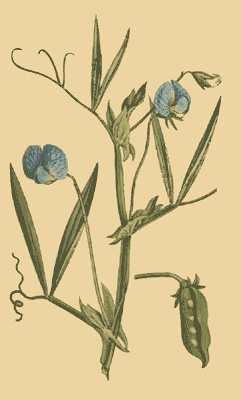
Tangier Pea (Lathyrus tingitanus L.) is an annual flowering herb in the family Fabaceae, order Fabales and class Magnoliopsida. The species is native to southwestern Europe and Northwest Africa and has been introduced to other parts of the world, including the Pacific Northwest of the United States. It has a winged climbing stem with coiled tendrils, leaves with two linear leaflets, and clusters of red flowers.
Written 26 November 2026 from the sources listed below. Each statement was checked against the passage it cites; statements that could not be supported were removed.
Appearance
Tangier Pea produces a winged stem that climbs using coiled tendrils. Each leaf consists of two linear, leaflike leaflets that are a few centimeters long.[1][2][3]
The flowers occur in clusters of two or three and vary in shades of red. Each flower can reach 3 centimetres in width.[4][5]
The fruit is a hairless legume pod that opens when mature.[6]
Habitat
Tangier Pea is native to southwestern Europe and Northwest Africa. It has been introduced to other parts of the world, including the Pacific Northwest of the United States.[7][8]
Classification of the Tangier Pea
| Kingdom | Plantae |
|---|---|
| Subkingdom | Pteridobiotina |
| Phylum | Tracheophyta |
| Class | Magnoliopsida |
| Order | Fabales |
| Family | Fabaceae (Bean) |
| Genus | Lathyrus (Pea) |
| Species | Lathyrus tingitanus L. |
Where the Tangier Pea is found
Checklists and occurrence records place Lathyrus tingitanus in 22 countries across Africa, Europe, North America and Oceania. GBIF holds 6,708 georeferenced records of it.
Countries where it is native or its origin is not stated
- Algeria 56
- Czechia 7
- Denmark 4
- Estonia 3
- France 87
- Gibraltar 3
- Italy 9
- Mauritania 3
- Morocco 80
- Poland 21
- Portugal 1,627
- Spain 2,104
- Sweden 9
- Ukraine 3
- United Kingdom 6
Countries where it has been introduced
Regions and cities with the most records
- California, United States 1,053
- Canary Islands, Spain 641
- Azores, Portugal 536
- Catalonia, Spain 469
- South Australia, Australia 425
- Adelaide Hills, Australia 338
- Adelaide, Australia 332
- Cardedeu, Spain 223
- Arenys de Mar, Spain 217
- Mataró, Spain 211
- Granollers, Spain 206
- Canovelles, Spain 205
- Montornès del Vallès, Spain 194
- Sant Celoni, Spain 189
- Mollet del Vallès, Spain 185
- Parets del Vallès, Spain 183
- Faro, Portugal 177
- Vilassar de Mar, Spain 177
- Santa Perpètua de Mogoda, Spain 174
- Calella, Spain 170
- Los Llanos de Aridane, Spain 167
- El Masnou, Spain 162
- Wellington Region, New Zealand 161
- Cacém, Portugal 159
- Lisbon, Portugal 159
- Rio de Mouro, Portugal 159
- Algés, Portugal 158
- Belas, Portugal 158
- Olival, Portugal 158
- Amadora, Portugal 157
- Carcavelos, Portugal 157
- Carnaxide, Portugal 157
- Falagueira, Portugal 157
- Linda-a-Velha, Portugal 157
- Massamá, Portugal 157
- Paço de Arcos, Portugal 157
8 more countries have a few records outside this range
These countries hold a few records of Lathyrus tingitanus but lie outside the range the checklists give for it. Such records are often zoo or garden specimens, museum material or vagrants, so the species is not counted as occurring there.
A number beside a place is its count of GBIF occurrence records. A place without a number comes from a checklist alone. Records show where a species has been observed or collected, which can include escapes and vagrants.
Common names
English
- Tangier Pea
- Tangier Scarlet Pea
- Tangier-pea
Names in 13 other languages
- Catalan
- Veçot
- Chinese
- 地中海香豌豆
- Czech
- hrachor tangerský
- Danish
- Afrikansk Fladbælg
- Estonian
- andaluusia lillhernes
- Finnish
- etelännätkelmä
- French
- Gesse de Tanger
- German
- Afrikanische Wicke, Tanger-Platterbse
- Japanese
- ハットクマメ
- Portuguese
- Chicharão, Chícharo-de-Tanger, Ervilha-Tangier
- Russian
- Чина танжерийская
- Spanish
- Almorta Tangerina, Chícharo de flor
- Swedish
- Spanksvial, spanskvial
Synonyms
9 other scientific names have been used for this species and are now treated as synonyms of Lathyrus tingitanus.
- Clymenum tingitanum (L.) Medik.
- Lathyrus aegyptiacus Hasselq.
- Lathyrus coruscans Emb. & Maire
- Lathyrus mexicanus Wender.
- Lathyrus napoleonis Voss
- Lathyrus tingitanus f. granatensis Lacaita
- Lathyrus tingitanus var. coruscans (Emb. & Maire) Maire
- Navidura tingitana Alef.
- Lathyrus pulcher Salisb. ambiguous synonym
Related species
-
 Sweet PeaLathyrus odoratus
-
 Indian PeaLathyrus sativus
-
 Perennial PeaLathyrus latifolius
-
 Tuberous PeaLathyrus tuberosus
-
 Beach PeaLathyrus japonicus
-
 Yellow VetchlingLathyrus aphaca
-
 Bitter VetchLathyrus linifolius
-
 Spanish VetchlingLathyrus clymenum
Compare
Questions and answers
What is the scientific name of the Tangier Pea?
The scientific name of the Tangier Pea is Lathyrus tingitanus. Written with its author, the full name is Lathyrus tingitanus L..
Which family does the Tangier Pea belong to?
Lathyrus tingitanus belongs to the family Fabaceae, in the order Fabales and the class Magnoliopsida.
Where is the Tangier Pea found?
Checklists and occurrence records place Lathyrus tingitanus in 22 countries, including Spain, Portugal, France, Morocco, Algeria and Poland.
What is the conservation status of the Tangier Pea?
The IUCN Red List category recorded for Lathyrus tingitanus is Least Concern (LC).
What other names does the Tangier Pea have?
Lathyrus tingitanus is also known in English as Tangier Scarlet Pea and Tangier-pea.
Sources
Passages the profile rests on
- Lathyrus tingitanus produces a winged stem that climbs using coiled tendrils. Source passage: “This is an annual herb producing a winged stem which climbs by means of coiled tendrils.” — English Wikipedia
- Each leaf consists of two linear, leaflike leaflets. Source passage: “The leaves are each made up of two leaflike linear leaflets a few centimeters long.” — English Wikipedia
- The leaflets are a few centimeters long. Source passage: “two leaflike linear leaflets a few centimeters long.” — English Wikipedia
- The flowers occur in clusters of two or three and vary in shades of red. Source passage: “The inflorescence has two or three pea flowers in varying shades of red” — English Wikipedia
- Each flower can reach 3 centimetres in width. Source passage: “each up to 3 centimetres (1.2 in) wide.” — English Wikipedia
- The fruit is a hairless legume pod that opens when mature. Source passage: “The fruit is a hairless dehiscent legume pod.” — English Wikipedia
- The species is native to southwestern Europe and Northwest Africa. Source passage: “It is native to southwestern Europe and Northwest Africa” — English Wikipedia
- The species has been introduced to other parts of the world, including the Pacific Northwest of the United States. Source passage: “it is present in other regions of the world as an introduced species, including the Pacific Northwest of the United States.” — English Wikipedia
Data
- Catalogue of Life, 2026-10-16 XR cc by
- Global Biodiversity Information Facility CC BY 4.0
- Wikidata CC0
- GeoNames CC BY 4.0
- Wikimedia Commons per image; credit shown with each image
- Within the Catalogue of Life, this name comes from The World Checklist of Vascular Plants (WCVP): Fabaceae cc by
References
- Sp. Pl.: 732 (1753) where the name was published
This species in other databases
- Catalogue of Life 3SL2W
- Wikidata Q1852823
- iNaturalist 61821
- World Flora Online wfo-0000212708
- GRIN 21620
Page built on 27 November 2026. See how the catalog is made and all sources and licences.
Cite this page
ScientificNames.org. (2026). Lathyrus tingitanus (Tangier Pea). Retrieved November 27, 2026, from https://scientificnames.org/species/lathyrus-tingitanus
“Lathyrus tingitanus (Tangier Pea).” ScientificNames.org, 2026, scientificnames.org/species/lathyrus-tingitanus. Accessed 27 Nov. 2026.
ScientificNames.org. “Lathyrus tingitanus (Tangier Pea).” Accessed November 27, 2026. https://scientificnames.org/species/lathyrus-tingitanus.
@misc{scientificnames_lathyrus_tingitanus_tangier_pea,
  author = {{ScientificNames.org}},
  title = {Lathyrus tingitanus (Tangier Pea)},
  year = {2026},
  url = {https://scientificnames.org/species/lathyrus-tingitanus},
  note = {Accessed 2026-11-27}
}