Species · Birds
Copper-throated Sunbird Leptocoma calcostetha
The scientific name of the Copper-throated Sunbird is Leptocoma calcostetha. It is a species of bird in the family Nectariniidae (sunbird), order Passeriformes. The name dates from 1843.
- Scientific name
- Leptocoma calcostetha (Jardine, 1843)
- Common name
- Copper-throated Sunbird
- Genus
- Leptocoma
- Family
- Nectariniidae (Sunbird)
- Order
- Passeriformes
- Class
- Aves
- Red List category
- LC Least Concern
- Recorded in
- 9 countries
- Name status
- accepted in the Catalogue of Life

Overview
Leptocoma calcostetha inhabits coastal areas and occurs across southeastern Asia.
Written 26 November 2026 from the sources listed below. Each statement was checked against the passage it cites; statements that could not be supported were removed.
Appearance
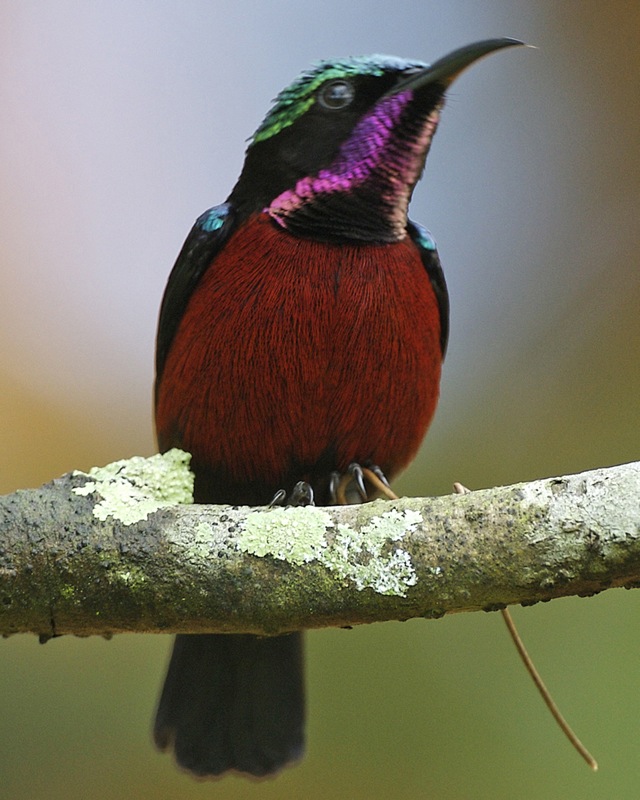
Adult males have predominantly black plumage, with shimmering green feathers on the head, shoulders, upper back, and rump. Their throat is copper-colored and surrounded by a shimmering purplish-blue ring extending down to the chest.[1][2]
Individuals measure between 12.2 and 13 cm in length. The average wingspan of a mature individual is 57.5 mm, and the average tail length is 45.5 mm.[3][4][5]
Habitat
The Copper-throated Sunbird inhabits coastal areas throughout the year rather than predominantly inland regions. Its forest habitats include tropical lowlands, tropical mangroves, heath forests, and alluvial forests.[6][7]
Its artificial habitats include plantations, coconut groves, and rural gardens. Individuals are commonly found in flowering shrubs and trees in the upper-middle canopy layers.[8][9]
Diet
The Copper-throated Sunbird consumes nectar and small invertebrates. It obtains nectar from Bruguiera plants.[10][11]
Individuals collect arthropods by gleaning them from twigs and foliage.[12]
Behaviour
Individuals actively move between trees while searching for nectar and small arthropods. They can hover briefly while feeding on nectar but cannot sustain continuous hovering.[13][14]
The species contributes to pollination by transferring pollen between flowers while collecting nectar.[15]
Individuals produce melodious trills consisting of fluctuating notes and brief pauses. Their calls have a squeaky sound that gradually decreases in pitch.[16][17]
Reproduction and life cycle
Egg laying occurs between January and July. The typical clutch contains two eggs, which are grayish-brown with dark spots.[18][19][20]
Nestlings begin appearing around July. Both sexes cooperate in building the nest.[21][22]
The nest is a loosely woven pear-shaped structure made from fine grass, fibers, and hairs. It has a solid base and an oval entrance with an overhang.[23][24]
Parents occasionally construct decoy nests, possibly to confuse predators and brood parasites.[25]
Conservation
The Copper-throated Sunbird was classified as Least Concern by the IUCN in October 2016. Its most recent assessment for the IUCN Red List was in 2025.[26][27]
The species is described as not uncommon, although its population has not been quantified.[28]
Similar species
The female has a yellow belly, pale throat, and thin dark line through the eye, distinguishing it from the more colorful male.[29]
Classification of the Copper-throated Sunbird
| Kingdom | Animalia |
|---|---|
| Phylum | Chordata |
| Subphylum | Vertebrata |
| Infraphylum | Gnathostomata |
| Parvphylum | Osteichthyes |
| Megaclass | Tetrapoda |
| Class | Aves (Bird) |
| Order | Passeriformes (Passerine) |
| Family | Nectariniidae (Sunbird) |
| Genus | Leptocoma (Green-capped Sunbirds) |
| Species | Leptocoma calcostetha (Jardine, 1843) |
Where the Copper-throated Sunbird is found
Checklists and occurrence records place Leptocoma calcostetha in 9 countries across Asia. GBIF holds 7,309 georeferenced records of it.
Countries
- Brunei 41
- Cambodia 65
- Indonesia 534
- Malaysia 1,840
- Myanmar 5
- Philippines 780
- Singapore 3,509
- Thailand 457
- Vietnam 78
Regions and cities with the most records
- Ang Mo Kio New Town, Singapore 3,509
- Sungai Simpang, Singapore 3,509
- Yishun New Town, Singapore 3,509
- Yio Chu Kang, Singapore 3,505
- Sembawang Estate, Singapore 3,503
- Novena, Singapore 3,471
- Sengkang New Town, Singapore 3,457
- Kampung Pasir Gudang Baru, Malaysia 3,450
- Masai, Malaysia 3,449
- Bandar Seri Alam, Malaysia 3,448
- Pasir Gudang, Malaysia 3,277
- Matilda Estate, Singapore 3,127
- Woodlands, Singapore 3,024
- Bukit Timah, Singapore 2,996
- Jurong West, Singapore 2,974
- Keat Hong Village, Singapore 2,974
- Taman Permas Jaya, Malaysia 2,974
- Choa Chu Kang New Town, Singapore 2,972
- Jurong Town, Singapore 2,972
- Teck Whye, Singapore 2,972
- Bukit Panjang New Town, Singapore 2,971
- Anak Bukit, Singapore 2,970
- Jurong East, Singapore 2,970
- Boon Lay, Singapore 2,967
- Marsiling, Singapore 2,966
- Yew Tee, Singapore 2,965
- Pelentong, Malaysia 2,960
- Johor Bahru, Malaysia 2,956
- Iskandar Puteri, Malaysia 2,950
- Perling, Malaysia 2,944
- Kampung Larkin Lama, Malaysia 2,942
- Queenstown Estate, Singapore 2,942
- Horizon Hills, Malaysia 2,938
- Bukit Indah, Malaysia 2,937
- Gelang Patah, Malaysia 2,935
- Mukim Pulai, Malaysia 2,935
Range as the checklists state it
Southern Asia
A number beside a place is its count of GBIF occurrence records. A place without a number comes from a checklist alone. Records show where a species has been observed or collected, which can include escapes and vagrants.
Common names
English
- Copper-throated Sunbird
Names in 25 other languages
- Chinese
- 銅喉花蜜鳥, 铜喉花蜜鸟
- Croatian
- mangrovski medosas
- Czech
- strdimil temný
- Danish
- Kobberstrubet Solfugl
- Dutch
- Koperkeelhoningzuiger
- Esperanto
- kuprogorĝa nektarinio
- Finnish
- aasianmangrovemedestäjä
- French
- Souimanga de Macklot
- German
- Kupferkehl-Nektarvogel, Kupferkehlnektarvogel
- Hungarian
- réztorkú nektármadár
- Indonesian
- Burung-madu bakau
- Italian
- Nettarinia golarame
- Japanese
- ノドアカタイヨウチョウ
- Lithuanian
- variagurklė leptokoma
- Norwegian
- kobberstrupesolfugl
- Polish
- cudonektarnik zielony, nektarnik namorzynowy
- Portuguese
- beija-flor-de-peito-bronze, nectarínia-de-papo-acobreado
- Russian
- Карминногорлая нектарница, Медногрудая нектарница
- Serbian
- Sunčica bakrenog grla
- Slovak
- nektárovka medenohrdlá
- Spanish
- Suimanga de Garganta Cobriza, Suimanga de Macklot
- Swedish
- kopparstrupig solfågel
- Thai
- นกกินปลีคอสีทองแดง
- Turkish
- Macklot Nektarkuşu
- Ukrainian
- нектаринка карміновогорла
Synonyms
20 other scientific names have been used for this species and are now treated as synonyms of Leptocoma calcostetha.
- Arachnechthra chalcostetha Jardine, W, 1843
- Arachnothera insignis Jardine, W, 1843
- Chalcostetha calcostetha Jardine, W, 1843
- Chalcostetha calcostetha halitypa Oberholser, HC, 1932
- Chalcostetha calcostetha heliomarpta Oberholser, HC, 1923
- Chalcostetha calcostetha pagicola Oberholser, HC, 1912
- Chalcostetha calcostetha proxima Riley, JH, 1927
- Chalcostetha calcostetha siberu Chasen, FN; Kloss, CB, 1926
- Chalcostetha insignis Jardine, W, 1843
- Chalcostetha insperata Hume, AO, 1875
- Chalcostetha macklotii Bonaparte, CLJL, 1850
- Chalcostetha pectoralis Temminck, CJ, 1822
- Cinnyris macklotii Bonaparte, CLJL, 1850
- Cinnyris pectoralis Temminck, CJ, 1822
- Nectarinia calcostetha Jardine, 1843
- Nectarinia insignis Jardine, W, 1843
- Nectarinia macklotii Bonaparte, CLJL, 1850
- Nectarinia pectoralis Temminck, CJ, 1822
- Nectarinia porphyrolaema Brüggemann, F, 1876
- Promerops pectoralis Temminck, CJ, 1822
Related species
-
 Purple-rumped SunbirdLeptocoma zeylonica
-
 Crimson-backed SunbirdLeptocoma minima
-
 Black SunbirdLeptocoma sericea
-
 Purple-throated SunbirdLeptocoma sperata
-
 Van Hasselt's SunbirdLeptocoma brasiliana
-
 Palestine SunbirdCinnyris osea
-
 Purple SunbirdCinnyris asiaticus
-
 Garden SunbirdCinnyris jugularis
Compare
Questions and answers
What is the scientific name of the Copper-throated Sunbird?
The scientific name of the Copper-throated Sunbird is Leptocoma calcostetha. Written with its author, the full name is Leptocoma calcostetha (Jardine, 1843).
Which family does the Copper-throated Sunbird belong to?
Leptocoma calcostetha belongs to the family Nectariniidae, in the order Passeriformes and the class Aves.
Where is the Copper-throated Sunbird found?
Checklists and occurrence records place Leptocoma calcostetha in 9 countries, including Singapore, Malaysia, Philippines, Indonesia, Thailand and Vietnam.
What is the conservation status of the Copper-throated Sunbird?
The IUCN Red List category recorded for Leptocoma calcostetha is Least Concern (LC).
Sources
Passages the profile rests on
- Adult males have predominantly black plumage with shimmering green feathers on the head, shoulders, upper back, and rump. Source passage: “Adult males are predominantly black birds with contrasting shimmering green on their heads, shoulders, upper back and rump” — English Wikipedia
- Adult males have a copper-colored throat surrounded by a shimmering purplish-blue ring extending down to the chest. Source passage: “a copper colored throat with an outer ring of shimmering purplish-blue that extends down to the chest.” — English Wikipedia
- Individuals measure between 12.2 and 13 cm in length. Source passage: “Copper-throated sunbirds are small sized birds ranging from 12.2–13 cm.” — English Wikipedia
- The average wingspan of a mature individual is 57.5 mm. Source passage: “A mature individual's wingspan averages 57.5mm” — English Wikipedia
- The average tail length is 45.5 mm. Source passage: “their tails average 45.5mm.” — English Wikipedia
- The species inhabits coastal areas throughout the year rather than predominantly inland regions. Source passage: “They predominantly reside in coastal areas year-round rather than far into the mainland.” — English Wikipedia
- Its forest habitats include tropical lowlands, tropical mangroves, heath forests, and alluvial forests. Source passage: “forest habitats consist of tropical lowlands, tropical mangroves, heath forests and alluvial forests.” — English Wikipedia
- Its artificial habitats include plantations, coconut groves, and rural gardens. Source passage: “their artificial habitats consist of plantations, coconut groves and rural gardens.” — English Wikipedia
- Individuals are commonly found in flowering shrubs and trees in the upper-middle canopy layers. Source passage: “They are often found in flowering shrubs or trees, usually keeping themselves in the upper-middle stories of the canopy.” — English Wikipedia
- The species consumes nectar and small invertebrates. Source passage: “They sustain themselves by consuming nectar as well as small invertebrates.” — English Wikipedia
- The species obtains nectar from Bruguiera plants. Source passage: “The only dietary preference documented for the copper-throated sunbirds is nectar from Bruguiera” — English Wikipedia
- Individuals collect arthropods by gleaning them from twigs and foliage. Source passage: “As for arthropods, they are collected through means of gleaning through twigs and foliage.” — English Wikipedia
- Individuals actively move between trees while searching for nectar and small arthropods. Source passage: “They are highly active birds that dart from tree to tree looking for small arthropods and nectar.” — English Wikipedia
- The species can hover briefly while feeding on nectar but cannot sustain continuous hovering. Source passage: “sunbirds have the ability to hover imperfectly long enough to consume nectar. However, they cannot do it continuously.” — English Wikipedia
- The species contributes to pollination by transferring pollen between flowers while collecting nectar. Source passage: “By traveling between multiple different flowers, they bring pollen straight to other female sexual organs which causes the plant to become fertilized.” — English Wikipedia
- Individuals produce melodious trills consisting of fluctuating notes and brief pauses. Source passage: “Their songs are a melodious trill of fluctuating notes, sounding almost squeaky, broken up by brief pauses” — English Wikipedia
- Their calls have a squeaky sound that gradually decreases in pitch. Source passage: “Their calls are squee- sound, that subtly decreases in pitch.” — English Wikipedia
- Egg laying occurs between January and July. Source passage: “Egg laying begins as early as January and finishes as late as July.” — English Wikipedia
- The typical clutch contains two eggs. Source passage: “Typical clutch size is 2.” — English Wikipedia
- The eggs are grayish-brown with dark spots. Source passage: “The eggs are grayish-brown with dark spots.” — English Wikipedia
- Nestlings begin appearing around July. Source passage: “Nestlings start to appear around the month of July.” — English Wikipedia
- Both sexes cooperate in building the nest. Source passage: “Nest building is a cooperative effect between the male and the female.” — English Wikipedia
- The nest is a loosely woven pear-shaped structure made from fine grass, fibers, and hairs. Source passage: “The nest is loosely woven into a pear-shaped structure using fine grass, fibers and hairs” — English Wikipedia
- The nest has a solid base and an oval entrance with an overhang. Source passage: “It has a solid base and an oval entrance with an overhang.” — English Wikipedia
- Parents occasionally construct decoy nests, possibly to confuse predators and brood parasites. Source passage: “Occasionally, the parents build decoy nests, most likely to confuse predators and brood parasites such as cuckoos.” — English Wikipedia
- The species was classified as Least Concern by the IUCN in October 2016. Source passage: “The copper-throated sunbird was classified as a species of least concern by the International Union for Conservation of Nature in October 2016.” — English Wikipedia
- The species was most recently assessed for the IUCN Red List in 2025. Source passage: “Copper-throated Sunbird Leptocoma calcostetha has most recently been assessed for The IUCN Red List of Threatened Species in 2025.” — iucnredlist.org
- The species is described as not uncommon despite its population not having been quantified. Source passage: “Although their populations are yet to be quantified, they have been deemed not uncommon.” — English Wikipedia
- The female has a yellow belly, pale throat, and thin dark line through the eye, distinguishing it from the more colorful male. Source passage: “Female is far plainer, with a yellow belly, a pale throat, and a thin dark line through the eye.” — ebird.org
Data
- Catalogue of Life, 2026-10-16 XR cc by
- Global Biodiversity Information Facility CC BY 4.0
- Wikidata CC0
- GeoNames CC BY 4.0
- Wikimedia Commons per image; credit shown with each image
- Within the Catalogue of Life, this name comes from The Integrated Taxonomic Information System cc0
References
- del Hoyo, Josep, Andrew Elliot, and David Christie, eds. (2008). Handbook of the Birds of the World. Vol. 13. Penduline-Tits to Shrikes.
This species in other databases
Page built on 29 November 2026. See how the catalog is made and all sources and licences.
Cite this page
ScientificNames.org. (2026). Leptocoma calcostetha (Copper-throated Sunbird). Retrieved November 29, 2026, from https://scientificnames.org/species/leptocoma-calcostetha
“Leptocoma calcostetha (Copper-throated Sunbird).” ScientificNames.org, 2026, scientificnames.org/species/leptocoma-calcostetha. Accessed 29 Nov. 2026.
ScientificNames.org. “Leptocoma calcostetha (Copper-throated Sunbird).” Accessed November 29, 2026. https://scientificnames.org/species/leptocoma-calcostetha.
@misc{scientificnames_leptocoma_calcostetha_copper_throated_sunbird,
  author = {{ScientificNames.org}},
  title = {Leptocoma calcostetha (Copper-throated Sunbird)},
  year = {2026},
  url = {https://scientificnames.org/species/leptocoma-calcostetha},
  note = {Accessed 2026-11-29}
}