Species · Birds
Purple-throated Sunbird Leptocoma sperata
The scientific name of the Purple-throated Sunbird is Leptocoma sperata. It is a species of bird in the family Nectariniidae (sunbird), order Passeriformes. The name dates from 1766.
- Scientific name
- Leptocoma sperata (Linnaeus, 1766)
- Common name
- Purple-throated Sunbird
- Genus
- Leptocoma
- Family
- Nectariniidae (Sunbird)
- Order
- Passeriformes
- Class
- Aves
- Red List category
- LC Least Concern
- Recorded in
- 10 countries
- Name status
- accepted in the Catalogue of Life

Overview
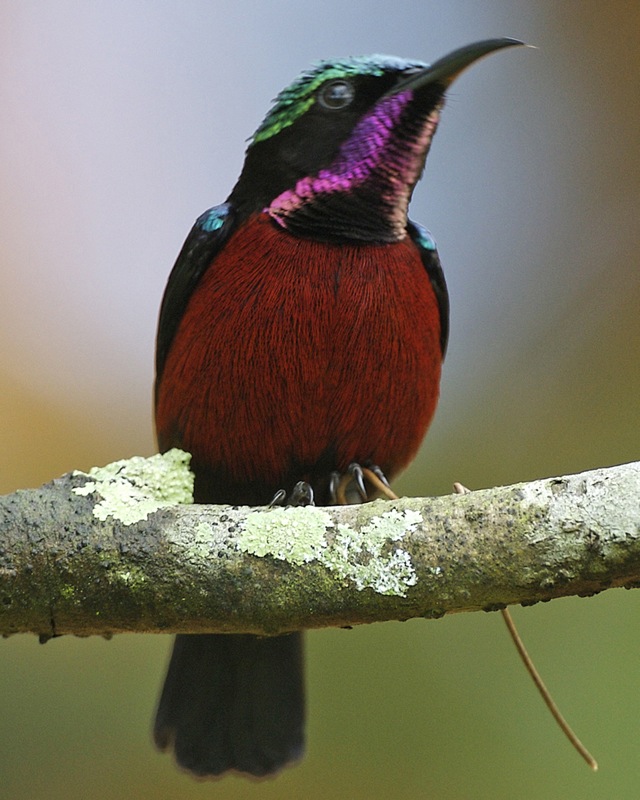
The Purple-throated Sunbird (Leptocoma sperata) is a very small bird in the family Nectariniidae, order Passeriformes and class Aves. It inhabits lowland tropical forests, tropical mangrove forests, primary and secondary forests, gardens and plantations in Maratua and the Philippines. Males have a deep purple throat and upper chest, with red or yellow lower chest colouring, while females have a yellow brow and chest.
Written 26 November 2026 from the sources listed below. Each statement was checked against the passage it cites; statements that could not be supported were removed.
Similar species
Van Hasselt's sunbird was previously considered conspecific with the Purple-throated Sunbird. The subspecies Leptocoma sperata juliae is treated as the Orange-lined sunbird in the Handbook of the Birds of the World.[1][2]
Appearance
Males have dark upperparts with a greenish crown and rump, a deep purple throat and upper chest, and a bright red lower chest and upper belly.[3]
Males from Sulu and western Mindanao have yellow rather than red chest colouring, with an orange wash.[4]
Females have a yellow brow and chest and brown wings.[5]
Habitat
The Purple-throated Sunbird inhabits lowland tropical forests and tropical mangrove forests in Maratua and the Philippines. It also occurs in tropical moist lowland primary forests and secondary forests.[6][7]
The species also inhabits gardens and plantations, mostly in lowland areas.[8]
Diet
The Purple-throated Sunbird feeds mainly on nectar. It also consumes insects, particularly when feeding its young.[9][10]
Behaviour
The species flies quickly and directly using its short wings. It can obtain nectar by hovering but usually perches while feeding.[11][12]
Reproduction and life cycle
The Purple-throated Sunbird breeds from December through May.[13]
A described nest was attached to the tip of a fern and had a teardrop shape. It was constructed from tangled dried leaves and stems.[14][15]
The described nest had a side entrance and contained two eggs.[16]
Conservation
The Purple-throated Sunbird was assessed as Least Concern by the IUCN Red List, most recently in 2018. It is common throughout its range.[17][18][19]
The species appears to tolerate disturbed habitats.[20]
Classification of the Purple-throated Sunbird
| Kingdom | Animalia |
|---|---|
| Phylum | Chordata |
| Subphylum | Vertebrata |
| Infraphylum | Gnathostomata |
| Parvphylum | Osteichthyes |
| Megaclass | Tetrapoda |
| Class | Aves (Bird) |
| Order | Passeriformes (Passerine) |
| Family | Nectariniidae (Sunbird) |
| Genus | Leptocoma (Green-capped Sunbirds) |
| Species | Leptocoma sperata (Linnaeus, 1766) |
Where the Purple-throated Sunbird is found
Checklists and occurrence records place Leptocoma sperata in 10 countries. GBIF holds 7,259 georeferenced records of it.
Countries
- Bangladesh 11
- Cambodia 3
- India 7
- Indonesia 156
- Malaysia 52
- Myanmar 7
- Philippines 6,957
- Singapore 6
- Thailand 57
- Vietnam 3
Regions and cities with the most records
- Puerto Princesa, Philippines 539
- Loboc, Philippines 432
- Bislig, Philippines 378
- San Pablo, Philippines 356
- Del Remedio, Philippines 355
- Calauan, Philippines 353
- Alaminos, Philippines 352
- Los Baños, Philippines 345
- Bay, Philippines 344
- Victoria, Philippines 344
- Tanauan, Philippines 343
- Malvar, Philippines 342
- Calamba, Philippines 341
- Mamatid, Philippines 338
- Santo Tomas, Philippines 338
- Cabuyao, Philippines 337
- Nagcarlan, Philippines 336
- Pila, Philippines 314
- Agoo, Philippines 216
- Binmaley, Philippines 215
- Domalanoan, Philippines 215
- Lingayen, Philippines 215
- Calasiao, Philippines 208
- Dagupan, Philippines 208
- Tagbina, Philippines 195
- Dumaguete, Philippines 170
- Sibulan, Philippines 170
- Hinatuan, Philippines 165
- Zamboanga, Philippines 144
- Recodo, Philippines 143
- Kidapawan, Philippines 111
- Bansalan, Philippines 108
- Lilio, Philippines 98
- Tagbilaran City, Philippines 93
- Majayjay, Philippines 91
- Lucban, Philippines 86
A number beside a place is its count of GBIF occurrence records. A place without a number comes from a checklist alone. Records show where a species has been observed or collected, which can include escapes and vagrants.
Common names
English
- Purple-throated Sunbird
Names in 24 other languages
- Catalan
- suimanga multicolor
- Chinese
- 紫喉花蜜鳥, 紫喉花蜜鸟
- Croatian
- šareni medosas
- Czech
- strdimil různobarvý
- Danish
- Grønkronet Solfugl
- Dutch
- Purperkeelhoningzuiger
- Esperanto
- purpurgorĝa nektarinio
- Finnish
- filippiinienrämeikkömedestäjä, rämeikkömedestäjä
- French
- Souimanga de Hasselt, Souimanga à gorge améthyste
- German
- Purpurkehl-Nektarvogel, Purpurkehlnektarvogel
- Hungarian
- manilai nektármadár
- Indonesian
- Burung-Madu Pengantin
- Italian
- Nettarinia golaviola
- Japanese
- ムネアカタイヨウチョウ
- Lithuanian
- purpuragurklė leptokoma
- Norwegian
- purpurstrupesolfugl
- Polish
- cudonektarnik zmienny, nektarnik zmienny
- Portuguese
- beija-flor-de-garganta-púrpura, nectarínia-de-papo-roxo
- Russian
- Манильская нектарница, Пурпурногорлая нектарница
- Slovak
- nektárovka hájová
- Spanish
- Suimanga gorjipúrpura
- Swedish
- purpurstrupig solfågel
- Turkish
- Mor Gerdanlı Nektarkuşu
- Ukrainian
- нектаринка барвиста
Synonyms
2 other scientific names have been used for this species and are now treated as synonyms of Leptocoma sperata.
- Certhia sperata Linnaeus, C, 1766
- Nectarinia sperata (Linnaeus, 1766)
Subspecies and varieties
- Leptocoma sperata henkei subspecies
- Leptocoma sperata juliae (Orange-lined Sunbird) subspecies
- Leptocoma sperata sperata subspecies
- Leptocoma sperata trochilus subspecies
Related species
-
 Purple-rumped SunbirdLeptocoma zeylonica
-
 Crimson-backed SunbirdLeptocoma minima
-
 Black SunbirdLeptocoma sericea
-
 Van Hasselt's SunbirdLeptocoma brasiliana
-
 Copper-throated SunbirdLeptocoma calcostetha
-
 Palestine SunbirdCinnyris osea
-
 Purple SunbirdCinnyris asiaticus
-
 Garden SunbirdCinnyris jugularis
Compare
Questions and answers
What is the scientific name of the Purple-throated Sunbird?
The scientific name of the Purple-throated Sunbird is Leptocoma sperata. Written with its author, the full name is Leptocoma sperata (Linnaeus, 1766).
Which family does the Purple-throated Sunbird belong to?
Leptocoma sperata belongs to the family Nectariniidae, in the order Passeriformes and the class Aves.
Where is the Purple-throated Sunbird found?
Checklists and occurrence records place Leptocoma sperata in 10 countries, including Philippines, Indonesia, Thailand, Malaysia, Bangladesh and India.
What is the conservation status of the Purple-throated Sunbird?
The IUCN Red List category recorded for Leptocoma sperata is Least Concern (LC).
How rare is purple sunbird?
The Purple-throated Sunbird is common throughout its range and is assessed as Least Concern by the IUCN Red List.[17][18]
What to feed a purple sunbird?
The Purple-throated Sunbird feeds mainly on nectar and also consumes insects, particularly when feeding its young.[9][10]
Sources
Passages the profile rests on
- Van Hasselt's sunbird was previously considered conspecific with the purple-throated sunbird. Source passage: “The Van Hasselt's sunbird was previously considered conspecific.” — English Wikipedia
- The subspecies juliae is treated as the Orange-lined sunbird in the Handbook of the Birds of the World. Source passage: “The subspecies juliae is split under Handbook of the Birds of the World as Orange-lined sunbird.” — English Wikipedia
- Males have dark upperparts with a greenish crown and rump, a deep purple throat and upper chest, and a bright red lower chest and upper belly. Source passage: “Male has dark upperparts with a greenish crown and rump, a deep purple throat and upper chest, and a bright red lower chest and upper belly.” — English Wikipedia
- Males from Sulu and western Mindanao have yellow rather than red chest colouring, with an orange wash. Source passage: “In Sulu and west Mindanao birds, the red on the chest is replaced by yellow with an orange wash.” — English Wikipedia
- Females have a yellow brow and chest and brown wings. Source passage: “Female resembles several other drab female sunbirds, but has a yellow brow and chest and a brown wing.” — English Wikipedia
- The species inhabits lowland tropical forests and tropical mangrove forests in Maratua and the Philippines. Source passage: “Its natural habitats are lowland tropical forests and tropical mangrove forests of Maratua and the Philippines.” — English Wikipedia
- The species occurs in tropical moist lowland primary forests and secondary forests. Source passage: “Its natural habitats at tropical moist lowland primary forest and secondary forest, gardens and plantations mostly in the lowlands.” — English Wikipedia
- The species also inhabits gardens and plantations, mostly in lowland areas. Source passage: “gardens and plantations mostly in the lowlands.” — English Wikipedia
- The species feeds mainly on nectar. Source passage: “Feeds largely on nectar, although they will also take insects, especially when feeding young.” — English Wikipedia
- The species also consumes insects, particularly when feeding its young. Source passage: “they will also take insects, especially when feeding young.” — English Wikipedia
- The species flies quickly and directly using its short wings. Source passage: “Flight is fast and direct on their short wings.” — English Wikipedia
- The species can obtain nectar by hovering but usually perches while feeding. Source passage: “Most species can take nectar by hovering like a hummingbird, but usually perch to feed most of the time.” — English Wikipedia
- The species breeds from December through May. Source passage: “Breeds from December to May.” — English Wikipedia
- A described nest was attached to the tip of a fern and had a teardrop shape. Source passage: “This nest was attached to the tip of a fern and tear-drop shaped” — English Wikipedia
- The described nest was constructed from tangled dried leaves and stems. Source passage: “It was made of a tangle of dried leaves and stems” — English Wikipedia
- The described nest had a side entrance and contained two eggs. Source passage: “had a side entrance and contained 2 eggs.” — English Wikipedia
- The species was assessed as Least Concern by the IUCN Red List. Source passage: “The IUCN Red List has assessed this bird as least-concern species although it is poorly known.” — English Wikipedia
- The species is common throughout its range. Source passage: “It is common across its range” — English Wikipedia
- The species was most recently assessed for the IUCN Red List in 2018. Source passage: “Purple-throated Sunbird Leptocoma sperata has most recently been assessed for The IUCN Red List of Threatened Species in 2018.” — iucnredlist.org
- The species appears to tolerate disturbed habitats. Source passage: “seems to tolerate more disturbed habitats.” — English Wikipedia
Data
- Catalogue of Life, 2026-10-16 XR cc by
- Global Biodiversity Information Facility CC BY 4.0
- Wikidata CC0
- GeoNames CC BY 4.0
- Wikimedia Commons per image; credit shown with each image
- Within the Catalogue of Life, this name comes from The Integrated Taxonomic Information System cc0
This species in other databases
Page built on 28 November 2026. See how the catalog is made and all sources and licences.
Cite this page
ScientificNames.org. (2026). Leptocoma sperata (Purple-throated Sunbird). Retrieved November 28, 2026, from https://scientificnames.org/species/leptocoma-sperata
“Leptocoma sperata (Purple-throated Sunbird).” ScientificNames.org, 2026, scientificnames.org/species/leptocoma-sperata. Accessed 28 Nov. 2026.
ScientificNames.org. “Leptocoma sperata (Purple-throated Sunbird).” Accessed November 28, 2026. https://scientificnames.org/species/leptocoma-sperata.
@misc{scientificnames_leptocoma_sperata_purple_throated_sunbird,
  author = {{ScientificNames.org}},
  title = {Leptocoma sperata (Purple-throated Sunbird)},
  year = {2026},
  url = {https://scientificnames.org/species/leptocoma-sperata},
  note = {Accessed 2026-11-28}
}