Species · Birds
Crimson-backed Sunbird Leptocoma minima
The scientific name of the Crimson-backed Sunbird is Leptocoma minima. It is a species of bird in the family Nectariniidae (sunbird), order Passeriformes. The name dates from 1832.
- Scientific name
- Leptocoma minima (Sykes, 1832)
- Common name
- Crimson-backed Sunbird
- Genus
- Leptocoma
- Family
- Nectariniidae (Sunbird)
- Order
- Passeriformes
- Class
- Aves
- Red List category
- LC Least Concern
- Recorded in
- 1 country
- Name status
- accepted in the Catalogue of Life

Overview
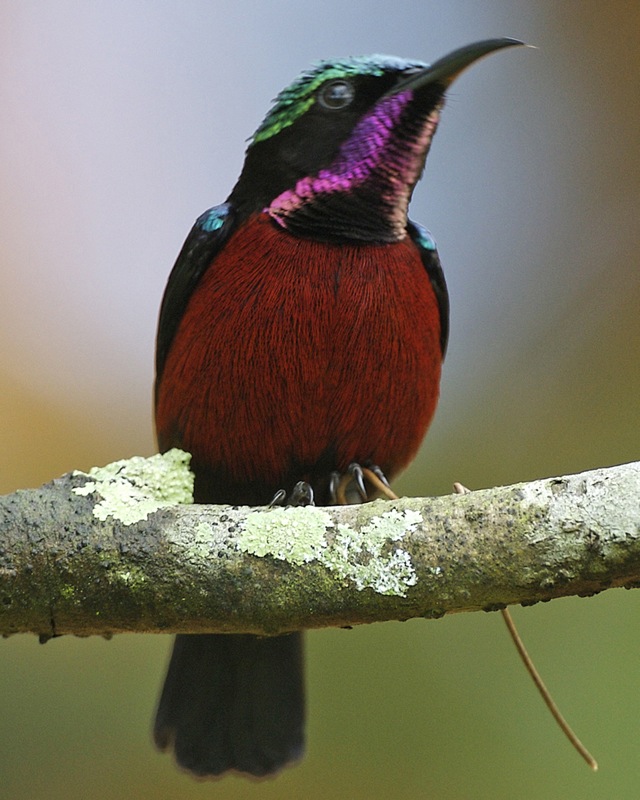
Leptocoma minima is endemic to the Western Ghats of India. Adult males have velvety red mantle and wing coverts, a broad red breast band and a shiny green crown.
Written 26 November 2026 from the sources listed below. Each statement was checked against the passage it cites; statements that could not be supported were removed.
Appearance
The Crimson-backed Sunbird is a stumpy, short-tailed sunbird with a medium-length, thin, downward-curving bill and brush-tipped tubular tongues adapted for nectar feeding.[1][2][3]
Adult males have velvety red mantle and wing coverts, a broad red breast band and a shiny green crown. They also have pink-violet patches on the throat and rump.[4][5][6]
The underside below the breast is yellowish, separated from the male's bib by a black edge. In non-breeding plumage, males have more olive coloration on the head, with velvet red restricted to the lower mantle and wing coverts.[7][8][9]
Females are olive-brown with a distinctly red rump. Males are also described as having a glossy dark green cap, a red back and chest, and a dark purplish throat.[10][11]
The species has short chik calls and longer chee-chee-which-chee calls.[12]
Habitat
The Crimson-backed Sunbird occurs in forests, including foothill forests of the Western Ghats.[13][14]
It is particularly attracted to gardens at forest edges where suitable flowering plants are grown. It also visits flower-rich gardens along forest edges and plantations.[15][16]
Diet
The Crimson-backed Sunbird feeds mainly on nectar. It also consumes insects, particularly when feeding its young.[17][18]
Behaviour
The species usually perches while feeding on nectar. Males establish and defend feeding territories around flowering shrubs and trees, defending nectar-rich plants such as Helixanthera intermedia more vigorously.[19][20][21]
The species may move to lower elevations during monsoons and return to higher elevations after the rains. It may also make movements between elevations in response to rainfall.[22][23]
Reproduction and life cycle
The Crimson-backed Sunbird is a resident breeder in the Western Ghats of India. Its peak nesting season extends from December to March, although in the southern Western Ghats it has been recorded nesting in nearly every month of the year.[24][25][26]
Females typically lay two eggs per clutch. The species builds suspended nests on thin drooping branches of low trees, fern fronds or shrubs.[27][28]
Both sexes participate in nest construction, with the female mainly building the interior. Females perform most of the incubation, which lasts approximately 18–19 days.[29][30][31]
Males may participate in feeding the young.[32]
Uses
The Crimson-backed Sunbird contributes to pollination of certain plant species.[33]
Similar species
The species was previously classified in the genus Nectarinia.[34]
Classification of the Crimson-backed Sunbird
| Kingdom | Animalia |
|---|---|
| Phylum | Chordata |
| Subphylum | Vertebrata |
| Infraphylum | Gnathostomata |
| Parvphylum | Osteichthyes |
| Megaclass | Tetrapoda |
| Class | Aves (Bird) |
| Order | Passeriformes (Passerine) |
| Family | Nectariniidae (Sunbird) |
| Genus | Leptocoma (Green-capped Sunbirds) |
| Species | Leptocoma minima (Sykes, 1832) |
Where the Crimson-backed Sunbird is found
Checklists and occurrence records place Leptocoma minima in 1 country. GBIF holds 52,025 georeferenced records of it.
Countries
Regions and cities with the most records
- Kerala, India 18,176
- Karnataka, India 12,196
- Tamil Nadu, India 8,263
- Goa, India 7,298
- Maharashtra, India 5,978
- Valparai, India 4,181
- Kalpatta, India 3,042
- Curti, India 3,036
- Kuttampuzha, India 2,969
- Ponda, India 2,962
- Curchorem, India 2,747
- Kotamangalam, India 2,671
- Wellington, India 1,945
- Kērkandi, India 1,939
- Coonoor, India 1,936
- Kotagiri, India 1,851
- Munnar, India 1,722
- Ooty, India 1,707
- Dandeli, India 1,702
- Bicholim, India 1,653
- Virajpet, India 1,390
- Iramallūr, India 1,363
- Mettupalayam, India 1,347
- Sakleshpur, India 1,174
- Marayur, India 1,129
- Chimbel, India 1,102
- Panvel, India 1,070
- Taleigao, India 972
- Kottur, India 962
- Penha de França, India 943
- Panjim, India 916
- Sāvantvādi, India 837
- Mapusa, India 817
- Davorlim, India 807
- Someshwar, India 794
- Madikeri, India 780
A number beside a place is its count of GBIF occurrence records. A place without a number comes from a checklist alone. Records show where a species has been observed or collected, which can include escapes and vagrants.
Common names
English
- Crimson-backed Sunbird
- Small Sunbird
Names in 25 other languages
- Catalan
- suimanga menut
- Chinese
- 小花蜜鳥, 小花蜜鸟
- Croatian
- zapadnogatski medosas
- Czech
- strdimil trpasličí
- Danish
- Dværgsolfugl
- Dutch
- Dwerghoningzuiger
- Esperanto
- karmezindorsa nektarinio
- Finnish
- malabarinmedestäjä
- French
- Souimanga menu
- German
- Däumlingsnektarvogel
- Hungarian
- apró nektármadár
- Italian
- Nettarinia dorsocremisi
- Japanese
- クリセタイヨウチョウ, マメタイヨウチョウ
- Lithuanian
- mažoji leptokoma
- Malayalam
- ചെറുതേൻകിളി
- Norwegian
- malabarsolfugl
- Polish
- cudonektarnik mały, nektarnik mały
- Portuguese
- beija-flor-pequeno, nectarínia-de-dorso-vermelho
- Russian
- Карликовая нектарница
- Slovak
- nektárovka malá
- Spanish
- Suimanga mínimo
- Swedish
- ghatssolfågel
- Turkish
- Al Sırtlı Nektarkuşu
- Ukrainian
- нектаринка мала
- pnb
- نکا رس پنچھی
Synonyms
2 other scientific names have been used for this species and are now treated as synonyms of Leptocoma minima.
- Cinnyris minima Sykes, WH, 1832
- Nectarinia minima (Sykes, 1832)
Related species
-
 Purple-rumped SunbirdLeptocoma zeylonica
-
 Black SunbirdLeptocoma sericea
-
 Purple-throated SunbirdLeptocoma sperata
-
 Van Hasselt's SunbirdLeptocoma brasiliana
-
 Copper-throated SunbirdLeptocoma calcostetha
-
 Palestine SunbirdCinnyris osea
-
 Purple SunbirdCinnyris asiaticus
-
 Garden SunbirdCinnyris jugularis
Compare
Questions and answers
What is the scientific name of the Crimson-backed Sunbird?
The scientific name of the Crimson-backed Sunbird is Leptocoma minima. Written with its author, the full name is Leptocoma minima (Sykes, 1832).
Which family does the Crimson-backed Sunbird belong to?
Leptocoma minima belongs to the family Nectariniidae, in the order Passeriformes and the class Aves.
Where is the Crimson-backed Sunbird found?
Checklists and occurrence records place Leptocoma minima in 1 country: India.
What is the conservation status of the Crimson-backed Sunbird?
The IUCN Red List category recorded for Leptocoma minima is Least Concern (LC).
What other names does the Crimson-backed Sunbird have?
Leptocoma minima is also known in English as Small Sunbird.
Where do crimson sunbirds live?
The Crimson-backed Sunbird is endemic to the Western Ghats of India, where it occurs in forests, including foothill forests.[35][13][14]
What do sunbirds eat?
The Crimson-backed Sunbird feeds mainly on nectar and also consumes insects, particularly when feeding its young.[17][18]
Sources
Passages the profile rests on
- The species has a medium-length, thin, downward-curving bill. Source passage: “They have medium-length thin down-curved bills” — English Wikipedia
- The species has brush-tipped tubular tongues adapted for nectar feeding. Source passage: “brush-tipped tubular tongues, both adaptations for nectar feeding.” — English Wikipedia
- The species is described as a stumpy, short-tailed sunbird. Source passage: “Stumpy, short-tailed sunbird of the Western Ghats' foothill forests.” — ebird.org
- Adult males have velvety red mantle and wing coverts and a broad red breast band. Source passage: “The adult male is velvety red on the mantle and wing coverts and there is a broad red breast band.” — English Wikipedia
- Adult males have a shiny green crown. Source passage: “The crown is shiny green” — English Wikipedia
- Adult males have pink-violet patches on their throat and rump. Source passage: “there are pink-violet patches on the throat and rump.” — English Wikipedia
- The underside below the breast is yellowish. Source passage: “The underside from the breast below is yellowish.” — English Wikipedia
- A black edge on the male's bib separates the yellow underside. Source passage: “There is a black edge to the bib that separates the yellow of the underside.” — English Wikipedia
- The non-breeding plumage of males has more olive coloration on the head, with velvet red restricted to the lower mantle and wing coverts. Source passage: “The eclipse plumage (non-breeding) of the male has more olive on the head and velvet red is restricted to the lower mantle and wing coverts.” — English Wikipedia
- Females are olive-brown with a distinctly red rump. Source passage: “The female is olive-brown but the rump is distinctly red.” — English Wikipedia
- Males have a glossy dark green cap, a red back and chest, and a dark purplish throat. Source passage: “Male has a glossy dark green cap, a red back and chest, a dark purplish throat,” — ebird.org
- The species has short chik calls and longer chee-chee-which-chee calls. Source passage: “The calls include short chik calls and longer chee-chee-which-chee.” — English Wikipedia
- The species occurs in forests. Source passage: “They are tiny birds that are resident and are found in forests” — English Wikipedia
- The species occurs in the foothill forests of the Western Ghats. Source passage: “Stumpy, short-tailed sunbird of the Western Ghats' foothill forests.” — ebird.org
- The species is particularly attracted to gardens at forest edges where suitable flowering plants are grown. Source passage: “particularly attracted to gardens at the edge of the forest where people grow suitable flower-bearing plants.” — English Wikipedia
- The species is attracted to flower-rich gardens along forest edges and plantations. Source passage: “They are attracted to flower-rich gardens at the edges of forests or plantations.” — English Wikipedia
- The species feeds mainly on nectar. Source passage: “Like other sunbirds, they feed mainly on nectar although they take insects” — English Wikipedia
- The species also consumes insects, particularly when feeding its young. Source passage: “although they take insects, especially to feed their young.” — English Wikipedia
- The species usually perches while feeding on nectar. Source passage: “They usually perch while taking nectar.” — English Wikipedia
- Males establish and defend feeding territories around flowering shrubs and trees. Source passage: “Males establish and defend feeding territories on flower bearing shrubs and trees.” — English Wikipedia
- Males defend nectar-rich plants such as Helixanthera intermedia more vigorously. Source passage: “Plants such as Helixanthera intermedia which had a lot of nectar were defended more vigorously.” — English Wikipedia
- The species may move to lower elevations during monsoons and return to higher elevations after the rains. Source passage: “In some areas they move to the foothills during the monsoons and move to the higher regions after the rains.” — English Wikipedia
- The species may make movements between elevations in response to rainfall. Source passage: “Although resident in many areas, they may make altitudinal movements in response to rains.” — English Wikipedia
- The species is a resident breeder in the Western Ghats of India. Source passage: “The crimson-backed sunbird is an endemic resident breeder in the Western Ghats of India.” — English Wikipedia
- The peak nesting season extends from December to March. Source passage: “The peak nesting season is December to March” — English Wikipedia
- In the southern Western Ghats, the species has been recorded nesting in nearly every month of the year. Source passage: “has been known to nest in nearly all months of the year in the southern Western Ghats.” — English Wikipedia
- Females typically lay two eggs per clutch. Source passage: “Two eggs are laid in a suspended nest” — English Wikipedia
- The species builds suspended nests on thin drooping branches of low trees, fern fronds or shrubs. Source passage: “in a suspended nest on a thin drooping branch of low tree, fern frond or shrub.” — English Wikipedia
- Both sexes participate in nest construction, with the female mainly building the interior. Source passage: “Both the male and female take part in nest building with the interior mainly built by the female.” — English Wikipedia
- Females perform most of the incubation. Source passage: “The eggs are mainly incubated by the female” — English Wikipedia
- The incubation period lasts approximately 18–19 days. Source passage: “The incubation period is about 18–19 days.” — English Wikipedia
- Males may participate in feeding the young. Source passage: “but males may involve themselves in feeding the young.” — English Wikipedia
- The species contributes to pollination of certain plant species. Source passage: “These birds are important pollinators of some plant species.” — English Wikipedia
- The species was previously classified in the genus Nectarinia. Source passage: “was previously placed in the genus Nectarinia” — datazone.birdlife.org
- The Crimson-backed Sunbird is endemic to the Western Ghats of India. Source passage: “The crimson-backed sunbird or small sunbird (Leptocoma minima) is a sunbird endemic to the Western Ghats of India.” — English Wikipedia
Data
- Catalogue of Life, 2026-10-16 XR cc by
- Global Biodiversity Information Facility CC BY 4.0
- Wikidata CC0
- GeoNames CC BY 4.0
- Wikimedia Commons per image; credit shown with each image
- Within the Catalogue of Life, this name comes from The Integrated Taxonomic Information System cc0
This species in other databases
Page built on 28 November 2026. See how the catalog is made and all sources and licences.
Cite this page
ScientificNames.org. (2026). Leptocoma minima (Crimson-backed Sunbird). Retrieved November 28, 2026, from https://scientificnames.org/species/leptocoma-minima
“Leptocoma minima (Crimson-backed Sunbird).” ScientificNames.org, 2026, scientificnames.org/species/leptocoma-minima. Accessed 28 Nov. 2026.
ScientificNames.org. “Leptocoma minima (Crimson-backed Sunbird).” Accessed November 28, 2026. https://scientificnames.org/species/leptocoma-minima.
@misc{scientificnames_leptocoma_minima_crimson_backed_sunbird,
  author = {{ScientificNames.org}},
  title = {Leptocoma minima (Crimson-backed Sunbird)},
  year = {2026},
  url = {https://scientificnames.org/species/leptocoma-minima},
  note = {Accessed 2026-11-28}
}