Species · Birds
Western Oriole Oriolus brachyrynchus
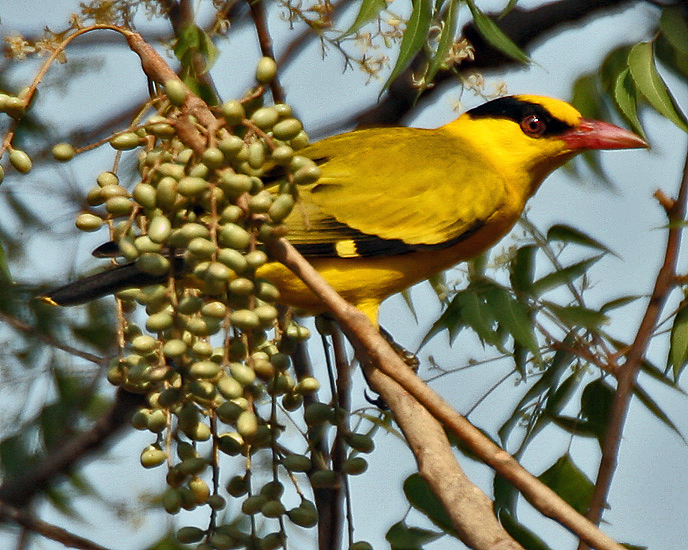
The scientific name of the Western Oriole is Oriolus brachyrynchus. It is a species of bird in the family Oriolidae (old world oriole), order Passeriformes. The name dates from 1837.
- Scientific name
- Oriolus brachyrynchus Swainson, 1837
- Common name
- Western Oriole
- Genus
- Oriolus
- Family
- Oriolidae (Old World Oriole)
- Order
- Passeriformes
- Class
- Aves
- Red List category
- LC Least Concern
- Recorded in
- 17 countries
- Name status
- accepted in the Catalogue of Life

Overview
Oriolus brachyrynchus inhabits the canopies of lowland primary forests and forest clearings containing shrubs.
Written 26 November 2026 from the sources listed below. Each statement was checked against the passage it cites; statements that could not be supported were removed.
Appearance
Juveniles have olive upperparts and an olive head. Their beaks are dusky, and their breasts are black-streaked.[1][2]
Habitat
The Western Oriole inhabits the canopies of lowland primary forests. It also occurs in forest clearings containing shrubs.[3][4]
Behaviour
The Western Oriole lives individually or in pairs. It produces several fluty vocalizations, including uoo-uoo, uoo-dleeo and tioolioo.[5][6]
Its fluty vocalizations are generally lower-pitched than those of the black-winged oriole. It also produces a harsh whit-cheeew-cheeew vocalization.[7][8]
Conservation
The Western Oriole has been classified as a species of least concern on the IUCN Red List since 1988. Its large geographic range is one reason for this classification.[9][10]
Its population is thought not to have declined by 30% over ten years or three generations. Its population size has not been measured.[11][12]
Habitat loss is identified as a cause of population decline in the Western Oriole.[13]
Similar species
The Western Oriole and the green-headed oriole are identified as sister species based on genetic data.[14]
Classification of the Western Oriole
| Kingdom | Animalia |
|---|---|
| Phylum | Chordata |
| Subphylum | Vertebrata |
| Infraphylum | Gnathostomata |
| Parvphylum | Osteichthyes |
| Megaclass | Tetrapoda |
| Class | Aves (Bird) |
| Order | Passeriformes (Passerine) |
| Family | Oriolidae (Old World Oriole) |
| Genus | Oriolus (Oriole) |
| Species | Oriolus brachyrynchus Swainson, 1837 |
Where the Western Oriole is found
Checklists and occurrence records place Oriolus brachyrynchus in 17 countries. GBIF holds 9,797 georeferenced records of it.
Countries
- Angola 37
- Cameroon 339
- Central African Republic 126
- Democratic Republic of the Congo 690
- Equatorial Guinea 309
- Gabon 205
- Ghana 1,845
- Guinea 77
- Ivory Coast 605
- Kenya 783
- Liberia 358
- Nigeria 237
- Republic of the Congo 125
- Sierra Leone 199
- Tanzania 17
- Togo 11
- Uganda 3,834
Regions and cities with the most records
- Masindi, Uganda 1,243
- Western, Ghana 711
- Kakamega County, Kenya 699
- Kakamega, Kenya 673
- Rwiimi, Uganda 645
- Central, Ghana 518
- Elubo, Ghana 517
- Lugazi, Uganda 342
- Buikwe, Uganda 332
- Bundibugyo, Uganda 328
- Eastern, Ghana 303
- Njeru, Uganda 296
- Montagnes, Ivory Coast 291
- Anyinam, Ghana 280
- Nyahuka, Uganda 278
- Wele-Nzas, Equatorial Guinea 267
- Ashanti, Ghana 246
- Ciudad de la Paz, Equatorial Guinea 234
- Ituri, Democratic Republic of the Congo 193
- Mai-Ndombe, Democratic Republic of the Congo 190
- Nimba, Liberia 171
- New Yekepa, Liberia 169
- Lagunes District, Ivory Coast 150
- Effiduase, Ghana 140
- Konongo, Ghana 138
- Fort Portal, Uganda 136
- Eastern Province, Sierra Leone 129
- South-West, Cameroon 126
- Buhesi, Uganda 124
- Sangha-Mbaéré, Central African Republic 111
- Kanungu, Uganda 109
- Cross River State, Nigeria 105
- Ogooué-Ivindo, Gabon 101
- Bas-Sassandra District, Ivory Coast 91
- Nzérékoré Region, Guinea 78
- Ntungamo, Uganda 77
A number beside a place is its count of GBIF occurrence records. A place without a number comes from a checklist alone. Records show where a species has been observed or collected, which can include escapes and vagrants.
Common names
English
- Western Oriole
- WBHO
- Western Black-headed Oriole
Names in 31 other languages
- Breton
- Glazaour penn du ar C'hornôg
- Catalan
- oriolcapnegre occidental
- Chinese
- 西非黑头黄鹂, 西非黑頭黃鸝
- Croatian
- crnoglava vuga
- Czech
- žluva lesní
- Danish
- Olivenrygget Hættepirol
- Dutch
- Blauwvleugelwielewaal
- Esperanto
- okcidenta oriolo
- Estonian
- metspeoleo
- Finnish
- huilukuhankeittäjä
- French
- Loriot à tête noire, Loriot à tête noire occidental
- German
- Blauflügelpirol, Dschungelpirol
- Italian
- Oriolo occidentale
- Japanese
- キエリコウライウグイス
- Lithuanian
- vakarinė juodagalvė volungė
- Norwegian
- jungelpirol
- Persian
- پریشاهرخ غربی
- Polish
- wilga kapturowa
- Portuguese
- papa-figos-de-cabeça-preta, papa-figos-de-cabeça-preta-ocidental
- Russian
- Гвинейская иволга, Синекрылая иволга
- Serbian
- Zapadna crnoglava vuga
- Slovak
- vlha lesná
- Spanish
- Oropéndola cabecinegra
- Swedish
- djungelgylling
- Thai
- นกขมิ้นหัวดำเวสเทิร์น
- Turkish
- Batı Afrika Kara Başlı Sarıasma
- Ukrainian
- вивільга світлокрила
- Welsh
- Euryn penddu'r Gorllewin
- arz
- الاوريول الغربى
- mrj
- Симсӹ шылдыран царамак
- pnb
- لیندا بسنتی پنچھی
Synonyms
One other scientific name has been used for this species and is now treated as a synonym of Oriolus brachyrynchus.
- Oriolus brachyrhynchus Swainson, 1837
Subspecies and varieties
- Oriolus brachyrynchus brachyrynchus subspecies
- Oriolus brachyrynchus laetior subspecies
Related species
-
 Eurasian Golden OrioleOriolus oriolus
-
 Black-naped OrioleOriolus chinensis
-
 Black-hooded OrioleOriolus xanthornus
-
 Indian Golden OrioleOriolus kundoo
-
 Black-headed OrioleOriolus larvatus
-
 Maroon OrioleOriolus traillii
-
 Green OrioleOriolus flavocinctus
-
 African Golden OrioleOriolus auratus
Compare
Questions and answers
What is the scientific name of the Western Oriole?
The scientific name of the Western Oriole is Oriolus brachyrynchus. Written with its author, the full name is Oriolus brachyrynchus Swainson, 1837.
Which family does the Western Oriole belong to?
Oriolus brachyrynchus belongs to the family Oriolidae, in the order Passeriformes and the class Aves.
Where is the Western Oriole found?
Checklists and occurrence records place Oriolus brachyrynchus in 17 countries, including Uganda, Ghana, Kenya, Democratic Republic of the Congo, Ivory Coast and Liberia.
What is the conservation status of the Western Oriole?
The IUCN Red List category recorded for Oriolus brachyrynchus is Least Concern (LC).
What other names does the Western Oriole have?
Oriolus brachyrynchus is also known in English as WBHO and Western Black-headed Oriole.
Sources
Passages the profile rests on
- Juveniles have olive upperparts and an olive head. Source passage: “The juvenile has olive upperparts. The head is olive, and the throat is streaked with yellow.” — English Wikipedia
- Juveniles have a dusky beak and a black-streaked breast. Source passage: “It has a dusky beak, and black streaked breast.” — English Wikipedia
- The western oriole inhabits the canopies of lowland primary forests. Source passage: “It lives either individually or in pairs in canopies of lowland primary forests” — English Wikipedia
- The species occurs in forest clearings containing shrubs. Source passage: “forest clearings with shrubs” — English Wikipedia
- The western oriole lives individually or in pairs. Source passage: “It lives either individually or in pairs in canopies of lowland primary forests” — English Wikipedia
- The species produces several fluty vocalizations, including uoo-uoo, uoo-dleeo and tioolioo. Source passage: “It has a variety of fluty vocalizations such as uoo-uoo, uoo-dleeo, tioolioo, whee-whooliu, whoolioo, and too-too-tuloo” — English Wikipedia
- Its fluty vocalizations are generally lower-pitched than those of the black-winged oriole. Source passage: “which normally have detached notes, and are lower pitched than those of the black-winged oriole (Oriolus nigripennis).” — English Wikipedia
- The western oriole also produces a harsh whit-cheeew-cheeew vocalization. Source passage: “It also emits a harsh whit-cheeew-cheeew.” — English Wikipedia
- The western oriole has been classified as a species of least concern on the IUCN Red List since 1988. Source passage: “Since 1988, the western oriole has been rated as a species of least concern on the IUCN Red List of Endangered Species.” — English Wikipedia
- The species' large geographic range is one reason for its least-concern classification. Source passage: “This is because it has a very large range” — English Wikipedia
- The western oriole's population is thought not to have declined by 30% over ten years or three generations. Source passage: “its population is thought not to have declined by 30% over ten years or three generations.” — English Wikipedia
- The western oriole's population size has not been measured. Source passage: “Although the population size has not been measured” — English Wikipedia
- Habitat loss is identified as a cause of population decline in the western oriole. Source passage: “Habitat loss is one reason for its population decline.” — English Wikipedia
- The western oriole and the green-headed oriole are identified as sister species based on genetic data. Source passage: “According to the genetic data, the western oriole and the green-headed oriole (Oriolus chlorocephalus) are sister species.” — English Wikipedia
Data
- Catalogue of Life, 2026-10-16 XR cc by
- Global Biodiversity Information Facility CC BY 4.0
- Wikidata CC0
- GeoNames CC BY 4.0
- Wikimedia Commons per image; credit shown with each image
- Within the Catalogue of Life, this name comes from The Integrated Taxonomic Information System cc0
This species in other databases
Page built on 28 November 2026. See how the catalog is made and all sources and licences.
Cite this page
ScientificNames.org. (2026). Oriolus brachyrynchus (Western Oriole). Retrieved November 28, 2026, from https://scientificnames.org/species/oriolus-brachyrynchus
“Oriolus brachyrynchus (Western Oriole).” ScientificNames.org, 2026, scientificnames.org/species/oriolus-brachyrynchus. Accessed 28 Nov. 2026.
ScientificNames.org. “Oriolus brachyrynchus (Western Oriole).” Accessed November 28, 2026. https://scientificnames.org/species/oriolus-brachyrynchus.
@misc{scientificnames_oriolus_brachyrynchus_western_oriole,
  author = {{ScientificNames.org}},
  title = {Oriolus brachyrynchus (Western Oriole)},
  year = {2026},
  url = {https://scientificnames.org/species/oriolus-brachyrynchus},
  note = {Accessed 2026-11-28}
}