Species · Birds
Maroon Oriole Oriolus traillii
The scientific name of the Maroon Oriole is Oriolus traillii. It is a species of bird in the family Oriolidae (old world oriole), order Passeriformes. The name dates from 1832.
- Scientific name
- Oriolus traillii (Vigors, 1832)
- Common name
- Maroon Oriole
- Genus
- Oriolus
- Family
- Oriolidae (Old World Oriole)
- Order
- Passeriformes
- Class
- Aves
- Red List category
- LC Least Concern
- Recorded in
- 12 countries
- Name status
- accepted in the Catalogue of Life

Overview
Oriolus traillii inhabits subtropical and tropical moist lowland forests and montane forests at lower and middle elevations. Adult males are distinguished by glossy crimson-maroon plumage, a black head, neck and wings, and a chestnut-maroon tail.
Written 26 November 2026 from the sources listed below. Each statement was checked against the passage it cites; statements that could not be supported were removed.
Appearance
Adult males have glossy crimson-maroon plumage, a black head, neck and wings, and a chestnut-maroon tail. Males have a bluish beak, and the species is described as a pale-eyed songbird.[1][2][3]
Females and immature males have greyish-white underparts marked with black streaks. Females have slightly darker bodies than males, while juveniles have lighter bodies than adults.[4][5][6]
Plumage coloration varies geographically, with Indian Subcontinent birds being duller and Southeast Asian birds being brighter and somewhat reddish. The species measures 25–28 cm in length.[7][8]
Habitat
The Maroon Oriole inhabits subtropical and tropical moist lowland forests. It also occurs in montane forests at lower and middle elevations.[9][10]
Diet
The Maroon Oriole feeds on wild figs, berries, insects and nectar.[11]
Behaviour
The Maroon Oriole lives alone or in pairs.[12]
Reproduction and life cycle
The nesting season occurs from April to May. The species builds a deep, massive cup-shaped nest made of bast fibre and bound with cobwebs.[13][14]
Both sexes share parental responsibilities.[15]
Conservation
The Maroon Oriole was assessed as Least Concern on the IUCN Red List in 2018.[16]
Similar species
The silver oriole resembles the Maroon Oriole but has silvery-white body plumage where the Maroon Oriole has red.[17]
Classification of the Maroon Oriole
| Kingdom | Animalia |
|---|---|
| Phylum | Chordata |
| Subphylum | Vertebrata |
| Infraphylum | Gnathostomata |
| Parvphylum | Osteichthyes |
| Megaclass | Tetrapoda |
| Class | Aves (Bird) |
| Order | Passeriformes (Passerine) |
| Family | Oriolidae (Old World Oriole) |
| Genus | Oriolus (Oriole) |
| Species | Oriolus traillii (Vigors, 1832) |
Where the Maroon Oriole is found
Checklists and occurrence records place Oriolus traillii in 12 countries. GBIF holds 53,341 georeferenced records of it.
Countries
- Bangladesh 51
- Bhutan 1,845
- Cambodia 150
- China 1,753
- Hong Kong 8
- India 17,884
- Laos 301
- Myanmar 501
- Nepal 2,691
- Taiwan 22,928
- Thailand 3,678
- Vietnam 1,551
Regions and cities with the most records
- Taiwan, Taiwan 15,462
- Uttarakhand, India 6,015
- Chiang Mai, Thailand 2,979
- West Bengal, India 2,676
- Assam, India 2,337
- Hualien City, Taiwan 2,321
- Banqiao, Taiwan 2,188
- Naini Tāl, India 2,118
- Shulin, Taiwan 1,994
- Puli, Taiwan 1,739
- Yujing, Taiwan 1,686
- Yilan, Taiwan 1,668
- Taipei, Taiwan 1,644
- Yunnan, China 1,615
- Chaozhou, Taiwan 1,599
- Kurseong, India 1,584
- Madhyapur Thimi, Nepal 1,457
- Kathmandu, Nepal 1,455
- Pātan, Nepal 1,432
- Ki̇̄rtipur, Nepal 1,421
- Lugu, Taiwan 1,197
- Chiayi City, Taiwan 1,189
- Rāipur, India 1,165
- Dehradun, India 1,157
- Arunachal Pradesh, India 1,070
- Haldwani, India 1,054
- Zhushan, Taiwan 1,050
- Sanxia, Taiwan 1,031
- Lam Dong, Vietnam 1,026
- Dārjiling, India 954
- Linnei, Taiwan 920
- Neihu, Taiwan 917
- Sikkim, India 914
- Mussoorie, India 892
- Douliu, Taiwan 834
- Clement Town, India 787
A number beside a place is its count of GBIF occurrence records. A place without a number comes from a checklist alone. Records show where a species has been observed or collected, which can include escapes and vagrants.
Common names
English
- Maroon Oriole
Names in 25 other languages
- Catalan
- oriol granatós
- Chinese
- 朱鸝, 朱鹂
- Croatian
- crno-crvena vuga
- Czech
- žluva kaštanová
- Danish
- Blodpirol
- Dutch
- Indische Bloedwielewaal
- Esperanto
- Sanga oriolo, purpura oriolo
- Estonian
- punapeoleo
- Finnish
- kastanjakuhankeittäjä
- French
- Loriot pourpré
- German
- Blutpirol, Purpurpirol
- Hungarian
- bíbormálinkó
- Italian
- Oriolo marrone
- Japanese
- ヒゴロモ
- Lithuanian
- kaštoninė volungė
- Polish
- wilga pąsowa
- Portuguese
- papa-figos-escarlate, papa-figos-grená
- Russian
- Бордовая иволга, Кровавая иволга
- Slovak
- vlha gaštanová
- Spanish
- Oropéndola granate
- Swedish
- karmosingylling
- Thai
- นกขมิ้นแดง
- Turkish
- Şarabi Sarıasma
- Ukrainian
- вивільга червона
- Welsh
- euryn browngoch
Synonyms
One other scientific name has been used for this species and is now treated as a synonym of Oriolus traillii.
- Pastor traillii Vigors, NA, 1832
Subspecies and varieties
- Oriolus traillii ardens subspecies
- Oriolus traillii nigellicauda subspecies
- Oriolus traillii robinsoni subspecies
- Oriolus traillii traillii subspecies
Related species
-
 Eurasian Golden OrioleOriolus oriolus
-
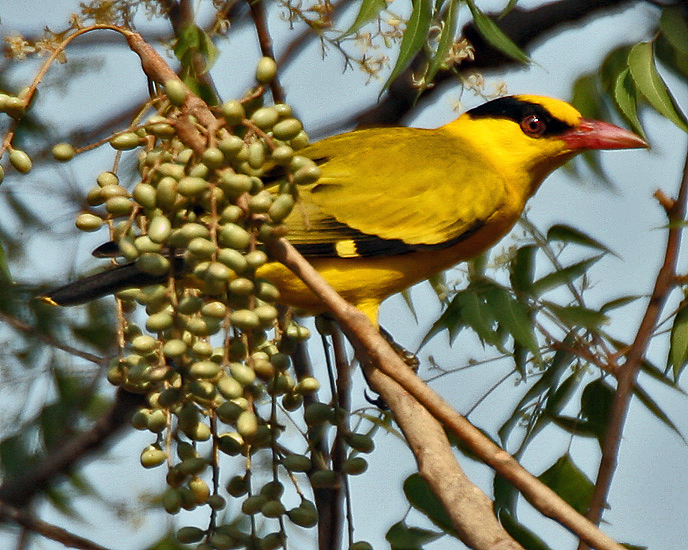 Black-naped OrioleOriolus chinensis
-
 Black-hooded OrioleOriolus xanthornus
-
 Indian Golden OrioleOriolus kundoo
-
 Black-headed OrioleOriolus larvatus
-
 Green OrioleOriolus flavocinctus
-
 African Golden OrioleOriolus auratus
-
 Isabela OrioleOriolus isabellae
Compare
Questions and answers
What is the scientific name of the Maroon Oriole?
The scientific name of the Maroon Oriole is Oriolus traillii. Written with its author, the full name is Oriolus traillii (Vigors, 1832).
Which family does the Maroon Oriole belong to?
Oriolus traillii belongs to the family Oriolidae, in the order Passeriformes and the class Aves.
Where is the Maroon Oriole found?
Checklists and occurrence records place Oriolus traillii in 12 countries, including Taiwan, India, Thailand, Nepal, Bhutan and China.
What is the conservation status of the Maroon Oriole?
The IUCN Red List category recorded for Oriolus traillii is Least Concern (LC).
What does the oriole bird eat?
The Maroon Oriole feeds on wild figs, berries, insects and nectar.[11]
Sources
Passages the profile rests on
- Adult males have glossy crimson-maroon plumage, a black head, neck and wings, and a chestnut-maroon tail. Source passage: “The adult male is glossy crimson-maroon, with black head, neck and wings and a chestnut-maroon tail.” — English Wikipedia
- Males have a bluish beak. Source passage: “Males have maroon and black plumage with a black head, neck and wings with a bluish beak.” — English Wikipedia
- The species is described as a pale-eyed songbird. Source passage: “Large, pale-eyed songbird of lower and middle elevations of montane forests.” — ebird.org
- Females and immature males have greyish-white underparts marked with black streaks. Source passage: “The females and immature males have a greyish-white underpart with black streaks.” — English Wikipedia
- Females have slightly darker bodies than males. Source passage: “The females have slightly darker bodies and the juveniles have lighter bodies.” — English Wikipedia
- Juveniles have lighter bodies than adults. Source passage: “The females have slightly darker bodies and the juveniles have lighter bodies.” — English Wikipedia
- Plumage coloration varies geographically, with Indian Subcontinent birds being duller and Southeast Asian birds being brighter and somewhat reddish. Source passage: “The colour varies somewhat across the range, with those in the Indian Subcontinent having duller colours, and those in Southeast Asia having brighter colours, also tending to somewhat reddish tones.” — English Wikipedia
- The maroon oriole measures 25–28 cm in length. Source passage: “The maroon oriole is 25–28 cm long.” — English Wikipedia
- Its natural habitat includes subtropical and tropical moist lowland forests. Source passage: “Its natural habitat is subtropical or tropical moist lowland forests.” — English Wikipedia
- The species inhabits montane forests at lower and middle elevations. Source passage: “Large, pale-eyed songbird of lower and middle elevations of montane forests.” — ebird.org
- The maroon oriole feeds on wild figs, berries, insects and nectar. Source passage: “The maroon oriole eats wild figs, berries, insects and nectar.” — English Wikipedia
- The species lives alone or in pairs. Source passage: “The maroon oriole lives alone or in pairs.” — English Wikipedia
- The nesting season occurs from April to May. Source passage: “The nesting season is from April to May.” — English Wikipedia
- The species builds a deep, massive cup-shaped nest made of bast fibre and bound with cobwebs. Source passage: “The nest is a deep massive cup of bast fibre that is bound with cobwebs.” — English Wikipedia
- Both sexes share parental responsibilities. Source passage: “Both male and female birds share the parental duties.” — English Wikipedia
- The maroon oriole was assessed as Least Concern on the IUCN Red List in 2018. Source passage: “Maroon Oriole Oriolus traillii has most recently been assessed for The IUCN Red List of Threatened Species in 2018. Oriolus traillii is listed as Least Concern.” — iucnredlist.org
- The silver oriole resembles the maroon oriole, but has silvery-white body plumage where the maroon oriole has red. Source passage: “it is very similar, except that the red in the body plumage of the maroon oriole is replaced by silvery white.” — English Wikipedia
Data
- Catalogue of Life, 2026-10-16 XR cc by
- Global Biodiversity Information Facility CC BY 4.0
- Wikidata CC0
- GeoNames CC BY 4.0
- Wikimedia Commons per image; credit shown with each image
- Within the Catalogue of Life, this name comes from The Integrated Taxonomic Information System cc0
References
- Gill, Frank, & and Minturn Wright. (2006). Birds of the World: Recommended English Names.
This species in other databases
Page built on 27 November 2026. See how the catalog is made and all sources and licences.
Cite this page
ScientificNames.org. (2026). Oriolus traillii (Maroon Oriole). Retrieved November 27, 2026, from https://scientificnames.org/species/oriolus-traillii
“Oriolus traillii (Maroon Oriole).” ScientificNames.org, 2026, scientificnames.org/species/oriolus-traillii. Accessed 27 Nov. 2026.
ScientificNames.org. “Oriolus traillii (Maroon Oriole).” Accessed November 27, 2026. https://scientificnames.org/species/oriolus-traillii.
@misc{scientificnames_oriolus_traillii_maroon_oriole,
  author = {{ScientificNames.org}},
  title = {Oriolus traillii (Maroon Oriole)},
  year = {2026},
  url = {https://scientificnames.org/species/oriolus-traillii},
  note = {Accessed 2026-11-27}
}