Species · Birds
Black-headed Oriole Oriolus larvatus
The scientific name of the Black-headed Oriole is Oriolus larvatus. It is a species of bird in the family Oriolidae (old world oriole), order Passeriformes. The name dates from 1823.
- Scientific name
- Oriolus larvatus Lichtenstein, 1823
- Common name
- Black-headed Oriole
- Genus
- Oriolus
- Family
- Oriolidae (Old World Oriole)
- Order
- Passeriformes
- Class
- Aves
- Red List category
- LC Least Concern
- Environment
- terrestrial
- Recorded in
- 27 countries
- Name status
- accepted in the Catalogue of Life

Overview
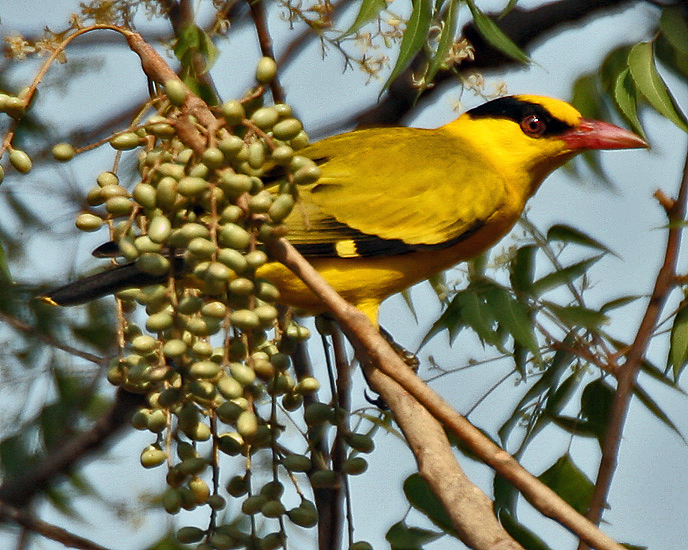
The Black-headed Oriole (Oriolus larvatus) is a bird belonging to the family Oriolidae. It breeds across much of sub-Saharan Africa, from South Sudan and Ethiopia to South Africa. It has predominantly golden-yellow plumage, a contrasting black head and a pink-orange bill.
Written 26 November 2026 from the sources listed below. Each statement was checked against the passage it cites; statements that could not be supported were removed.
Appearance
The Black-headed Oriole has a predominantly golden-yellow plumage, a contrasting black head and a pink-orange bill.[1]
Habitat
The species inhabits dry tropical forests, particularly acacia and broad-leaved woodlands. It also occurs in dense shrubland areas.[2][3]
The species breeds across much of sub-Saharan Africa, extending from South Sudan and Ethiopia to South Africa.[4]
The subspecies Oriolus larvatus rolleti occurs from southern Sudan and southern Ethiopia to eastern Democratic Republic of Congo and central Kenya. Oriolus larvatus reichenowi occurs from Somalia to eastern Tanzania.[5][6]
The subspecies Oriolus larvatus angolensis occurs from Angola and Namibia to western Tanzania and northern Mozambique. Oriolus larvatus tibicen occurs along the coast from southern Tanzania to southern Mozambique.[7][8]
The nominate subspecies Oriolus larvatus larvatus occurs from southern Zimbabwe to inland southern Mozambique and eastern South Africa. Oriolus larvatus additus has been reported from eastern South Africa and southern Mozambique.[9][10]
Diet
The Black-headed Oriole forages in the canopy, eating small fruits and large insects. Young birds are fed mostly caterpillars.[11][12]
Behaviour
Its vocalisations include liquid-sounding warbles, imitations and whistles. Despite its conspicuous plumage, the species is more often heard than seen in its habitat.[13][14]
Reproduction and life cycle
The Black-headed Oriole breeds across much of sub-Saharan Africa.[15]
Conservation
The number of mature individuals is unknown. The population trend is increasing.[16][17]
Similar species
Some authorities have treated the mountain oriole as a subspecies of the Black-headed Oriole.[18]
Classification of the Black-headed Oriole
| Kingdom | Animalia |
|---|---|
| Phylum | Chordata |
| Subphylum | Vertebrata |
| Infraphylum | Gnathostomata |
| Parvphylum | Osteichthyes |
| Megaclass | Tetrapoda |
| Class | Aves (Bird) |
| Order | Passeriformes (Passerine) |
| Family | Oriolidae (Old World Oriole) |
| Genus | Oriolus (Oriole) |
| Species | Oriolus larvatus Lichtenstein, 1823 |
Where the Black-headed Oriole is found
Checklists and occurrence records place Oriolus larvatus in 27 countries. GBIF holds 211,471 georeferenced records of it.
Countries
- Angola 502
- Botswana 2,439
- Burundi 13
- Cameroon 14
- Central African Republic 4
- Democratic Republic of the Congo 350
- Eswatini 3,218
- Ethiopia 873
- Gabon 7
- Kenya 17,906
- Lesotho 60
- Liberia 6
- Malawi 1,152
- Mozambique 2,341
- Namibia 1,031
- Nigeria 165
- Republic of the Congo 9
- Rwanda 448
- Sierra Leone 4
- Somalia 29
- South Africa 162,485
- South Sudan 9
- Sudan 8
- Tanzania 4,974
- Uganda 1,430
- Zambia 4,878
- Zimbabwe 7,116
Regions and cities with the most records
- KwaZulu-Natal, South Africa 40,211
- Limpopo, South Africa 35,589
- Mpumalanga, South Africa 33,529
- Eastern Cape, South Africa 21,660
- Western Cape, South Africa 9,235
- Gauteng, South Africa 8,736
- Pinetown, South Africa 6,617
- North West, South Africa 6,426
- Ntuzuma, South Africa 6,231
- Pietermaritzburg, South Africa 5,518
- Mpophomeni, South Africa 5,177
- Howick, South Africa 5,007
- Mpumalanga, South Africa 4,409
- George, South Africa 3,810
- Nakuru County, Kenya 3,621
- Kilifi County, Kenya 3,212
- Gqeberha, South Africa 2,903
- Plettenberg Bay, South Africa 2,897
- Mbombela, South Africa 2,890
- Durban, South Africa 2,819
- Bela Bela, South Africa 2,817
- Knysna, South Africa 2,773
- Motherwell, South Africa 2,546
- Arusha, Tanzania 2,529
- Watamu, Kenya 2,499
- Gonubie, South Africa 2,384
- Port Shepstone, South Africa 2,327
- Matsulu, South Africa 2,322
- Ga-Malakhe, South Africa 2,301
- Pretoria, South Africa 2,236
- Margate, South Africa 2,207
- Modimolle, South Africa 2,193
- Centurion, South Africa 2,072
- Despatch, South Africa 2,031
- Komatipoort, South Africa 2,000
- East London, South Africa 1,995
A number beside a place is its count of GBIF occurrence records. A place without a number comes from a checklist alone. Records show where a species has been observed or collected, which can include escapes and vagrants.
Common names
English
- Black-headed Oriole
- African Black-headed Oriole
- BHOR
- Blackhead Oriole
- Eastern Black-headed Oriole
Names in 29 other languages
- Afrikaans
- Swartkopwielewaal
- Catalan
- oriol capnegre oriental
- Chinese
- 东非黑头黄鹂, 東非黑頭黃鸝
- Croatian
- maslinastorepa vuga
- Czech
- žluva škrabošková
- Danish
- Østafrikansk Hættepirol
- Dutch
- maskerwielewaal
- Esperanto
- Maskita oriolo, nigrakapa oriolo
- Estonian
- akaatsiapeoleo
- Finnish
- akaasiakuhankeittäjä, akasiakuhankeittäjä
- French
- Loriot à tête noire oriental, loriot masqué
- German
- Maskenpirol
- Hungarian
- feketefejű sárgarigó
- Italian
- Oriolo testanera
- Japanese
- アフリカズキンコウライウグイス
- Lithuanian
- rytinė juodagalvė volungė
- Norwegian
- savannepirol
- Polish
- wilga czarnogłowa
- Portuguese
- papa-figos-de-cabeça-preta, papa-figos-de-cabeça-preta-oriental, papa-figos-mascarado
- Russian
- Масковая иволга
- Serbian
- Afrička crnoglava vuga
- Slovak
- vlha čiernohlavá
- Spanish
- Oropéndola Enmascarado, Oropéndola enmascarada
- Swedish
- svarthuvad gylling
- Thai
- นกขมิ้นหัวดำแอฟริกา
- Turkish
- Afrika Kara Başlı Sarıasması
- Ukrainian
- вивільга південна
- Welsh
- euryn penddu'r Dwyrain
- Zulu
- umBhicongo, umQoqgongo
Synonyms
3 other scientific names have been used for this species and are now treated as synonyms of Oriolus larvatus.
- Oriolus africanus Wilkes, J, 1820
- Oriolus coudougnan Temminck, CJ, 1810
- Oriolus monachus Wagler, JG, 1827
Subspecies and varieties
- Oriolus larvatus additus (Eastern Blackhead Oriole) subspecies
- Oriolus larvatus angolensis (Blackheaded Golden Oriole) subspecies
- Oriolus larvatus larvatus (Southern Blackhead Oriole) subspecies
- Oriolus larvatus reichenowi subspecies
- Oriolus larvatus rolleti subspecies
- Oriolus larvatus tibicen subspecies
- Oriolus monachus permistus subspecies
Related species
-
 Eurasian Golden OrioleOriolus oriolus
-
 Black-naped OrioleOriolus chinensis
-
 Black-hooded OrioleOriolus xanthornus
-
 Indian Golden OrioleOriolus kundoo
-
 Maroon OrioleOriolus traillii
-
 Green OrioleOriolus flavocinctus
-
 African Golden OrioleOriolus auratus
-
 Isabela OrioleOriolus isabellae
Compare
Questions and answers
What is the scientific name of the Black-headed Oriole?
The scientific name of the Black-headed Oriole is Oriolus larvatus. Written with its author, the full name is Oriolus larvatus Lichtenstein, 1823.
Which family does the Black-headed Oriole belong to?
Oriolus larvatus belongs to the family Oriolidae, in the order Passeriformes and the class Aves.
Where is the Black-headed Oriole found?
Checklists and occurrence records place Oriolus larvatus in 27 countries, including South Africa, Kenya, Zimbabwe, Tanzania, Zambia and Eswatini.
What is the conservation status of the Black-headed Oriole?
The IUCN Red List category recorded for Oriolus larvatus is Least Concern (LC).
What other names does the Black-headed Oriole have?
Oriolus larvatus is also known in English as African Black-headed Oriole, BHOR, Blackhead Oriole and Eastern Black-headed Oriole.
Sources
Passages the profile rests on
- The bird has a predominantly golden-yellow plumage, a black head and a pink-orange bill. Source passage: “A spectacular mostly golden-yellow bird with a black head and a pink-orange bill.” — ebird.org
- The species inhabits dry tropical forests, particularly acacia and broad-leaved woodlands. Source passage: “It inhabits dry tropical forests, especially acacia and broad-leaved woodlands” — English Wikipedia
- The species also occurs in dense shrubland areas. Source passage: “and dense shrubland areas” — English Wikipedia
- The species breeds across much of sub-Saharan Africa, extending from South Sudan and Ethiopia to South Africa. Source passage: “It breeds in much of sub-Saharan Africa from South Sudan and Ethiopia in the north to South Africa in the south.” — English Wikipedia
- The subspecies Oriolus larvatus rolleti occurs from southern Sudan and southern Ethiopia to eastern Democratic Republic of Congo and central Kenya. Source passage: “Found from southern Sudan and southern Ethiopia to eastern Democratic Republic of Congo and central Kenya” — English Wikipedia
- The subspecies Oriolus larvatus reichenowi occurs from Somalia to eastern Tanzania. Source passage: “Found from Somalia to eastern Tanzania” — English Wikipedia
- The subspecies Oriolus larvatus angolensis occurs from Angola and Namibia to western Tanzania and northern Mozambique. Source passage: “Found from Angola and Namibia to western Tanzania and northern Mozambique” — English Wikipedia
- The subspecies Oriolus larvatus tibicen occurs along the coast from southern Tanzania to southern Mozambique. Source passage: “Found from coastal southern Tanzania to coastal southern Mozambique” — English Wikipedia
- The nominate subspecies Oriolus larvatus larvatus occurs from southern Zimbabwe to inland southern Mozambique and eastern South Africa. Source passage: “Found from southern Zimbabwe to inland southern Mozambique and eastern South Africa” — English Wikipedia
- Oriolus larvatus additus has been reported from eastern South Africa and southern Mozambique. Source passage: “Found in Eastern South African and southern Mozambique.” — English Wikipedia
- The species forages in the canopy and eats small fruits and large insects. Source passage: “The black-headed oriole forages in the canopy, feeding on small fruit as well as large insects.” — English Wikipedia
- Young birds are fed mostly caterpillars. Source passage: “The young are fed mostly with caterpillars.” — English Wikipedia
- Its vocalisations include liquid-sounding warbles, imitations and whistles. Source passage: “The voice is a liquid-sounding warble, accompanied by imitations and whistles.” — English Wikipedia
- The species is more often heard than seen in its habitat despite its conspicuous plumage. Source passage: “where it is more often heard than seen despite the brightness of its plumage.” — English Wikipedia
- The species breeds across much of sub-Saharan Africa. Source passage: “It breeds in much of sub-Saharan Africa” — English Wikipedia
- The number of mature individuals is unknown. Source passage: “Number of mature individuals Unknown” — datazone.birdlife.org
- The population trend is increasing. Source passage: “Population trend Increasing” — datazone.birdlife.org
- Some authorities have treated the mountain oriole as a subspecies of the black-headed oriole. Source passage: “Some authorities have considered the mountain oriole to be a subspecies of the black-headed oriole.” — English Wikipedia
Data
- Catalogue of Life, 2026-10-16 XR cc by
- Global Biodiversity Information Facility CC BY 4.0
- Wikidata CC0
- GeoNames CC BY 4.0
- Wikimedia Commons per image; credit shown with each image
- iNaturalist per image; credit shown with each image
- Within the Catalogue of Life, this name comes from The Integrated Taxonomic Information System cc0
References
- Gill, Frank, & and Minturn Wright. (2006). Birds of the World: Recommended English Names.
This species in other databases
- Catalogue of Life 6T7GC
- Wikidata Q1589193
- iNaturalist 7876
- WoRMS urn:lsid:marinespecies.org:taxname:221034
- Avibase abhori1
Page built on 27 November 2026. See how the catalog is made and all sources and licences.
Cite this page
ScientificNames.org. (2026). Oriolus larvatus (Black-headed Oriole). Retrieved November 27, 2026, from https://scientificnames.org/species/oriolus-larvatus
“Oriolus larvatus (Black-headed Oriole).” ScientificNames.org, 2026, scientificnames.org/species/oriolus-larvatus. Accessed 27 Nov. 2026.
ScientificNames.org. “Oriolus larvatus (Black-headed Oriole).” Accessed November 27, 2026. https://scientificnames.org/species/oriolus-larvatus.
@misc{scientificnames_oriolus_larvatus_black_headed_oriole,
  author = {{ScientificNames.org}},
  title = {Oriolus larvatus (Black-headed Oriole)},
  year = {2026},
  url = {https://scientificnames.org/species/oriolus-larvatus},
  note = {Accessed 2026-11-27}
}