Species · Birds
Isabela Oriole Oriolus isabellae
The scientific name of the Isabela Oriole is Oriolus isabellae. It is a species of bird in the family Oriolidae (old world oriole), order Passeriformes. The name dates from 1894.
- Scientific name
- Oriolus isabellae Ogilvie-Grant, 1894
- Common name
- Isabela Oriole
- Genus
- Oriolus
- Family
- Oriolidae (Old World Oriole)
- Order
- Passeriformes
- Class
- Aves
- Red List category
- CR Critically Endangered
- Recorded in
- 1 country
- Name status
- accepted in the Catalogue of Life

Overview
Oriolus isabellae is endemic to Luzon in the Philippines and currently confined to lowland forests in the Northern Sierra Madre mountain range of Luzon. It has primarily yellow plumage with olive upperparts, an exceptionally large grey bill, and no white coloration on its lores.
Written 26 November 2026 from the sources listed below. Each statement was checked against the passage it cites; statements that could not be supported were removed.
Similar species
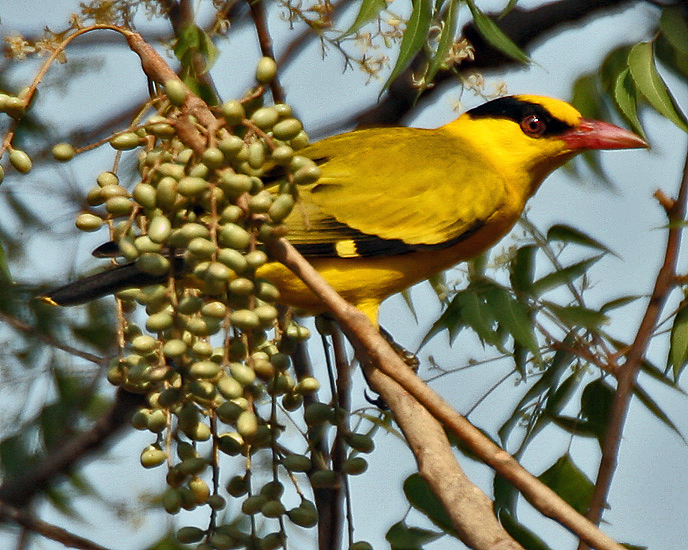
The Isabela Oriole is commonly confused with the White-lored Oriole and Black-naped Oriole. The White-lored Oriole is its closest relative, and both species are closely related to the Philippine Oriole.[1][2][3]
The Isabela Oriole is sometimes considered part of a superspecies with the Dark-throated Oriole and Philippine Oriole.[4]
Appearance
The Isabela Oriole has primarily yellow plumage with olive coloration on its upperparts. It has an exceptionally large grey bill and lacks white coloration on its lores.[5][6][7]
The Isabela Oriole is classified as a medium-sized bird.[8]
Habitat
The species frequently occupies the middle and canopy layers of forests.[9]
The Isabela Oriole is endemic to Luzon in the Philippines and is currently confined to lowland forests in the Northern Sierra Madre mountain range of Luzon.[10][11]
The species was historically recorded at three localities in Bataan province but has not been recorded there since 1947. Additional sightings have been documented in San Mariano, Isabela, and Baggao, Cagayan Valley.[12][13][14]
The species was rediscovered near Diffun, Quirino, in December 1993 and at Mansarong in September 1994. It had been presumed extinct for many years before its rediscovery in the 1990s.[15][16][17]
Diet
Fruit constitutes the main component of the Isabela Oriole's diet. It also consumes insects, including larvae and caterpillars.[18][19]
Behaviour
The Isabela Oriole is typically observed alone, in pairs, or in small groups. It also participates in mixed-species flocks with other forest birds.[20][21]
Its vocalizations include a repeated whistle with a descending first note followed by a rapidly rising second note. The species also produces a rattling call.[22][23]
Reproduction and life cycle
Breeding is believed to take place between April and June. The first record and photographs of a juvenile Isabela Oriole were released in 2022.[24][25]
Conservation
The Isabela Oriole is classified as Critically Endangered, with an estimated population of approximately 50–250 mature individuals. Its assessment is based on its extremely small and fragmented population.[26][27][28]
Habitat loss and hunting are identified as threats to the species.[29]
The Mabuwaya Foundation has implemented a research and conservation project for the species in Baggao since 2015. The Isabela Oriole also serves as a flagship species for North Sierra Madre National Park.[30][31]
Conservation initiatives include educational programmes and festivals celebrating the bird. Plans have been developed to designate the Isabela Oriole's site in Baggao as a Critical Habitat.[32][33]
Philippine law RA9147 prohibits hunting, capturing, and keeping Isabela Orioles as pets.[34]
Classification of the Isabela Oriole
| Kingdom | Animalia |
|---|---|
| Phylum | Chordata |
| Subphylum | Vertebrata |
| Infraphylum | Gnathostomata |
| Parvphylum | Osteichthyes |
| Megaclass | Tetrapoda |
| Class | Aves (Bird) |
| Order | Passeriformes (Passerine) |
| Family | Oriolidae (Old World Oriole) |
| Genus | Oriolus (Oriole) |
| Species | Oriolus isabellae Ogilvie-Grant, 1894 |
Where the Isabela Oriole is found
Checklists and occurrence records place Oriolus isabellae in 1 country. GBIF holds 37 georeferenced records of it.
Countries
A number beside a place is its count of GBIF occurrence records. A place without a number comes from a checklist alone. Records show where a species has been observed or collected, which can include escapes and vagrants.
Common names
English
- Isabela Oriole
- Isabella Oriole
Names in 29 other languages
- Breton
- Glazaour Isabela
- Catalan
- oriol d'Isabela
- Chinese
- 淡色鹂, 淡色黃鸝
- Croatian
- žuta vuga
- Czech
- žluva bambusová
- Danish
- Isabellapirol
- Dutch
- Isabelawielewaal, Isabella's wielewaal
- Esperanto
- izabela oriolo
- Estonian
- bambusepeoleo
- Finnish
- luzoninkuhankeittäjä
- French
- Loriot d'Isabela, Loriot d’Isabela
- German
- Isabell-Pirol, Isabellpirol
- Hungarian
- Izabella-málinkó
- Italian
- Oriolo di Isabela
- Japanese
- ヒメコウライウグイス
- Lithuanian
- Izabelės volungė
- Norwegian
- bambuspirol
- Persian
- پریشاهرخ ایزابلا
- Polish
- wilga żółtawa
- Portuguese
- papa-figos-de-isabela
- Russian
- Иволга Изабеллы, Лусонская иволга
- Slovak
- vlha bambusová
- Spanish
- Oropéndola de Isabel, Oropéndola de Isabela
- Swedish
- isabelagylling
- Thai
- นกขมิ้นอิซาเบลลา
- Turkish
- Isabela Sarıasması
- Ukrainian
- вивільга батанська
- Welsh
- euryn Isabella
- pnb
- ازابیلا بسنتی پنچھی
Related species
-
 Eurasian Golden OrioleOriolus oriolus
-
 Black-naped OrioleOriolus chinensis
-
 Black-hooded OrioleOriolus xanthornus
-
 Indian Golden OrioleOriolus kundoo
-
 Black-headed OrioleOriolus larvatus
-
 Maroon OrioleOriolus traillii
-
 Green OrioleOriolus flavocinctus
-
 African Golden OrioleOriolus auratus
Compare
Questions and answers
What is the scientific name of the Isabela Oriole?
The scientific name of the Isabela Oriole is Oriolus isabellae. Written with its author, the full name is Oriolus isabellae Ogilvie-Grant, 1894.
Which family does the Isabela Oriole belong to?
Oriolus isabellae belongs to the family Oriolidae, in the order Passeriformes and the class Aves.
Where is the Isabela Oriole found?
Checklists and occurrence records place Oriolus isabellae in 1 country: Philippines.
What is the conservation status of the Isabela Oriole?
The IUCN Red List category recorded for Oriolus isabellae is Critically Endangered (CR).
What other names does the Isabela Oriole have?
Oriolus isabellae is also known in English as Isabella Oriole.
Where does the Isabela oriole live?
The Isabela Oriole is endemic to Luzon in the Philippines. It is currently confined to lowland forests in the Northern Sierra Madre mountain range of Luzon.[10][11]
What bird is mistaken for an Oriole?
The Isabela Oriole is commonly confused with the White-lored Oriole and Black-naped Oriole.[1]
What does the oriole bird eat?
Fruit is the main component of the Isabela Oriole's diet. It also eats insects, including larvae and caterpillars.[18][19]
Are there orioles in the Philippines?
Yes. The Isabela Oriole is endemic to Luzon in the Philippines.[10]
Sources
Passages the profile rests on
- The Isabela Oriole is commonly confused with the White-lored Oriole and Black-naped Oriole. Source passage: “The Isabela oriole is commonly confused with the much more common white-lored orioles and black-naped orioles.” — English Wikipedia
- The White-lored Oriole is identified as the closest relative of the Isabela Oriole. Source passage: “The Isabela oriole is most closely related to the white-lored oriole.” — English Wikipedia
- The Isabela Oriole and White-lored Oriole are both closely related to the Philippine Oriole. Source passage: “Both species are closely related to the paraphyletic Philippine oriole.” — English Wikipedia
- The Isabela Oriole is sometimes considered part of a superspecies with the Dark-throated Oriole and Philippine Oriole. Source passage: “The Isabela oriole is sometimes considered to form a superspecies with the dark-throated oriole and the Philippine oriole.” — English Wikipedia
- The Isabela Oriole has primarily yellow plumage with olive coloration on its upperparts. Source passage: “It is primarily yellow with a hint of olive on its upper parts.” — English Wikipedia
- The species has an exceptionally large grey bill. Source passage: “It is differentiated by its extremely large grey bill” — English Wikipedia
- The species lacks white coloration on its lores. Source passage: “and lack of white on its lores.” — English Wikipedia
- The Isabela Oriole is classified as a medium-sized bird. Source passage: “It is a medium sized bird of the lowland forest of Northern Luzon.” — English Wikipedia
- The species frequently occupies the middle and canopy layers of forests. Source passage: “It is frequently seen in the canopy and middle storeys of forests” — English Wikipedia
- The Isabela Oriole is endemic to Luzon in the Philippines. Source passage: “Oriolus isabellae is endemic to Luzon in the Philippines” — datazone.birdlife.org
- The species is currently confined to lowland forests in the Northern Sierra Madre mountain range of Luzon. Source passage: “The Isabela oriole is now confined to the lowland forests in the Northern Sierra Madre mountain range in Luzon.” — English Wikipedia
- The species was historically recorded at three localities in Bataan province. Source passage: “It is known historically from three localities in Bataan province” — datazone.birdlife.org
- The Isabela Oriole has not been recorded in Bataan province since 1947. Source passage: “It has not been recorded in Bataan province since 1947” — English Wikipedia
- Additional sightings of the species have been documented in San Mariano, Isabela, and Baggao, Cagayan Valley. Source passage: “Additional sightings were made in San Mariano, Isabela. and Baggao, Cagayan Valley” — English Wikipedia
- The species was rediscovered near Diffun, Quirino, in December 1993. Source passage: “until its rediscovery in December 1993 near Diffun, Quirino” — English Wikipedia
- The species was rediscovered at Mansarong in September 1994. Source passage: “and in Mansarong in September 1994.” — English Wikipedia
- The Isabela Oriole was presumed extinct for many years before its rediscovery in the 1990s. Source passage: “This species was presumed to be extinct for many years” — English Wikipedia
- Fruit constitutes the main component of the Isabela Oriole's diet. Source passage: “Feeds mostly on fruit” — English Wikipedia
- The species also consumes insects, including larvae and caterpillars. Source passage: “but also insects such as larvae and caterpillars.” — English Wikipedia
- The Isabela Oriole is typically observed alone, in pairs, or in small groups. Source passage: “Typically seen alone, in pairs or small groups” — English Wikipedia
- The species participates in mixed-species flocks with other forest birds. Source passage: “It is seen in mixed flocks with other birds” — English Wikipedia
- Its vocalizations include a repeated whistle with a descending first note followed by a rapidly rising second note. Source passage: “One call is a repeated whistle with descending first note followed by a quick rising second note.” — English Wikipedia
- The species also produces a rattling call. Source passage: “It also has a rattling call.” — English Wikipedia
- Breeding is believed to take place between April and June. Source passage: “Breeding believed to occur during April to June.” — English Wikipedia
- The first record and photographs of a juvenile Isabela Oriole were released in 2022. Source passage: “In 2022, the first record and photographs of a juvenile were released.” — English Wikipedia
- The Isabela Oriole is classified as Critically Endangered. Source passage: “It is critically endangered” — English Wikipedia
- The estimated population consists of approximately 50–250 mature individuals. Source passage: “estimates of just 50 to 250 mature individuals remaining.” — English Wikipedia
- The species' Critically Endangered assessment is based on its extremely small and fragmented population. Source passage: “assessed as Critically Endangered based on its extremely small and fragmented population.” — English Wikipedia
- Habitat loss and hunting are identified as threats to the species. Source passage: “It is threatened by habitat loss and hunting.” — English Wikipedia
- The Mabuwaya Foundation has implemented a research and conservation project for the species in Baggao since 2015. Source passage: “Since 2015, a research and conservation project for the Isabela Oriole has been implemented in Baggao by the Mabuwaya Foundation.” — English Wikipedia
- The Isabela Oriole serves as a flagship species for North Sierra Madre National Park. Source passage: “The oriole is now a Flagship species for the North Sierra Madre National Park.” — English Wikipedia
- Conservation initiatives for the species include educational programmes and festivals celebrating the bird. Source passage: “Organisations such as Buhay-Ilang, ORIS Project and the Mabuwaya Foundation are working to conserve them with educational programs and festivals celebrating this bird.” — English Wikipedia
- Plans have been developed to designate the Isabela Oriole's site in Baggao as a Critical Habitat. Source passage: “Plans are underway to declare the oriole site in Baggao a Critical Habitat” — English Wikipedia
- Philippine law RA9147 prohibits hunting, capturing, and keeping Isabela Orioles as pets. Source passage: “Under the Philippine law RA9147, it is completely illegal to hunt these birds or to capture and keep them as pets.” — English Wikipedia
Data
- Catalogue of Life, 2026-10-16 XR cc by
- Global Biodiversity Information Facility CC BY 4.0
- Wikidata CC0
- GeoNames CC BY 4.0
- Wikimedia Commons per image; credit shown with each image
- Within the Catalogue of Life, this name comes from The Integrated Taxonomic Information System cc0
References
- Ogilvie-Grant, W. R. 1894 b. [Mr. W. R. Ogilvie- Grant exhibited a series of specimens of birds collected by Mr. John Whitehead in the mountains of northern Luzon. Two species appeared to be undescribed]. Bulletin of the British Ornithologists' Club 4: 2. where the name was published
- Gill, Frank, & and Minturn Wright. (2006). Birds of the World: Recommended English Names.
This species in other databases
Page built on 27 November 2026. See how the catalog is made and all sources and licences.
Cite this page
ScientificNames.org. (2026). Oriolus isabellae (Isabela Oriole). Retrieved November 27, 2026, from https://scientificnames.org/species/oriolus-isabellae
“Oriolus isabellae (Isabela Oriole).” ScientificNames.org, 2026, scientificnames.org/species/oriolus-isabellae. Accessed 27 Nov. 2026.
ScientificNames.org. “Oriolus isabellae (Isabela Oriole).” Accessed November 27, 2026. https://scientificnames.org/species/oriolus-isabellae.
@misc{scientificnames_oriolus_isabellae_isabela_oriole,
  author = {{ScientificNames.org}},
  title = {Oriolus isabellae (Isabela Oriole)},
  year = {2026},
  url = {https://scientificnames.org/species/oriolus-isabellae},
  note = {Accessed 2026-11-27}
}