Species · Birds
Olive-backed Oriole Oriolus sagittatus
The scientific name of the Olive-backed Oriole is Oriolus sagittatus. It is a species of bird in the family Oriolidae (old world oriole), order Passeriformes. The name dates from 1802.
- Scientific name
- Oriolus sagittatus (Latham, 1802)
- Common name
- Olive-backed Oriole
- Genus
- Oriolus
- Family
- Oriolidae (Old World Oriole)
- Order
- Passeriformes
- Class
- Aves
- Recorded in
- 2 countries
- Name status
- accepted in the Catalogue of Life
Overview
The Olive-backed Oriole is a medium-sized passerine bird. It is native to northern and eastern Australia and south-central New Guinea. It has an olive-coloured back with small dark streaks and a pale chest marked by black streaks.
Written 27 November 2026 from the sources listed below. Each statement was checked against the passage it cites; statements that could not be supported were removed.
Appearance
The Olive-backed Oriole has olive-green upperparts and pale underparts, with dark streaks on its chest and belly. Its bill is pinkish or reddish, and its eyes are red.[1][2][3][4]
Females have cinnamon-edged wings. Juvenile and immature birds are browner than adults.[5][6]
Behaviour
The Olive-backed Oriole is noisy and conspicuous.[7]
Some Olive-backed Orioles migrate south to breed during the southern summer.[8]
Reproduction and life cycle
Most Olive-backed Orioles breed during the tropical wet season.[9]
Habitat
The Olive-backed Oriole prefers relatively open woodland environments. It tolerates drier climates but does not inhabit deserts.[10][11]
Classification of the Olive-backed Oriole
| Kingdom | Animalia |
|---|---|
| Phylum | Chordata |
| Subphylum | Vertebrata |
| Infraphylum | Gnathostomata |
| Parvphylum | Osteichthyes |
| Megaclass | Tetrapoda |
| Class | Aves (Bird) |
| Order | Passeriformes (Passerine) |
| Family | Oriolidae (Old World Oriole) |
| Genus | Oriolus (Oriole) |
| Species | Oriolus sagittatus (Latham, 1802) |
Where the Olive-backed Oriole is found
Checklists and occurrence records place Oriolus sagittatus in 2 countries. GBIF holds 339,193 georeferenced records of it.
Countries
Regions and cities with the most records
- Queensland, Australia 131,356
- New South Wales, Australia 125,141
- Victoria, Australia 40,734
- Brisbane, Australia 37,136
- Logan City, Australia 16,992
- Australian Capital Territory, Australia 16,987
- Canberra, Australia 16,825
- Narangba, Australia 15,549
- Capalaba, Australia 14,337
- Tuggeranong, Australia 13,025
- Northern Territory, Australia 9,604
- Hornsby, Australia 9,003
- Parramatta, Australia 8,938
- Sydney, Australia 8,457
- Western Australia, Australia 7,092
- Burwood, Australia 5,724
- Balwyn North, Australia 5,674
- Liverpool, Australia 5,628
- Port Macquarie, Australia 5,116
- Sunshine Coast, Australia 4,677
- Central Coast, Australia 4,474
- Toowoomba, Australia 3,863
- Wollongong, Australia 3,857
- Newcastle, Australia 3,830
- Gold Coast, Australia 3,799
- Maitland, Australia 3,749
- Bundaberg, Australia 3,675
- Townsville, Australia 3,572
- Palmerston, Australia 2,781
- Melbourne, Australia 2,676
- Darwin, Australia 2,487
- Caloundra, Australia 2,045
- Bendigo, Australia 1,898
- Coffs Harbour, Australia 1,527
- Cessnock, Australia 1,449
- Bairnsdale, Australia 1,337
1 more country has a few records outside this range
These countries hold a few records of Oriolus sagittatus but lie outside the range the checklists give for it. Such records are often zoo or garden specimens, museum material or vagrants, so the species is not counted as occurring there.
A number beside a place is its count of GBIF occurrence records. A place without a number comes from a checklist alone. Records show where a species has been observed or collected, which can include escapes and vagrants.
Common names
English
- Olive-backed Oriole
Names in 27 other languages
- Catalan
- oriol estriat
- Chinese
- 橄綠背黃鸝, 綠背黃鸝, 绿背黄鹂
- Croatian
- maslinastoleđa vuga
- Czech
- žluva olivovohřbetá
- Danish
- Olivenrygget Pirol
- Dutch
- Olijfrugwielewaal
- Esperanto
- olivdorsa oriolo
- Estonian
- tähnikpeoleo
- Finnish
- oliivikuhankeittäjä
- French
- Loriot sagittal
- German
- Streifenpirol
- Indonesian
- Kepudang tunggir-zaitun
- Italian
- Oriolo dorsoliva, Rigogolo dorso oliva
- Japanese
- シロハラコウライウグイス
- Lithuanian
- žalsvanugarė volungė
- Norwegian
- tårepirol
- Polish
- wilga oliwkowa
- Portuguese
- papa-figos-estriado
- Russian
- Полосатая иволга, Пёстрая иволга
- Serbian
- Vuga maslinastih leđa
- Slovak
- vlha olivová
- Spanish
- Oropéndola estriada
- Swedish
- grönryggig gylling
- Thai
- นกขมิ้นโอลีฟแบ็ก
- Turkish
- Zeytin Sırtlı Sarıasma
- Ukrainian
- вивільга оливкова
- Welsh
- euryn cefnwyrdd
Synonyms
One other scientific name has been used for this species and is now treated as a synonym of Oriolus sagittatus.
- Coracias sagittata Latham, J, 1801
Subspecies and varieties
- Oriolus sagittatus affinis (Northwestern Olive-backed Oriole) subspecies
- Oriolus sagittatus blaauwi subspecies
- Oriolus sagittatus grisescens (Cape York Olive-backed Oriole) subspecies
- Oriolus sagittatus magnirostris (Papuan Olive-backed Oriole) subspecies
- Oriolus sagittatus sagittatus (Southeastern Olive-backed Oriole) subspecies
- Oriolus sagittatus subaffinis subspecies
Related species
-
 Eurasian Golden OrioleOriolus oriolus
-
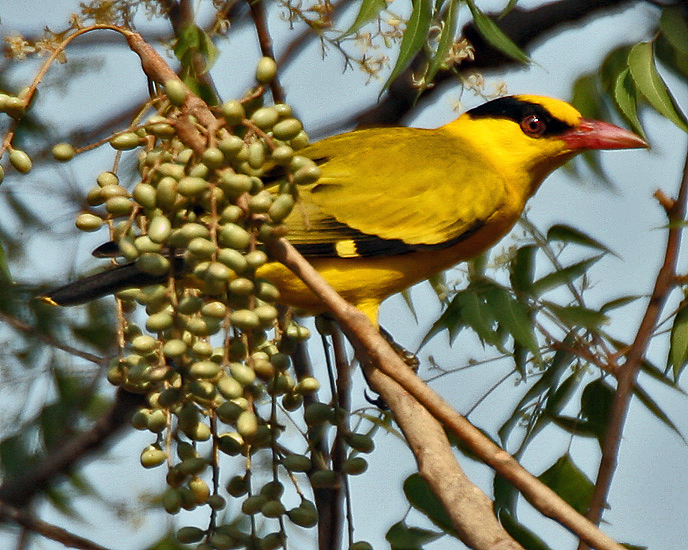 Black-naped OrioleOriolus chinensis
-
 Black-hooded OrioleOriolus xanthornus
-
 Indian Golden OrioleOriolus kundoo
-
 Black-headed OrioleOriolus larvatus
-
 Maroon OrioleOriolus traillii
-
 Green OrioleOriolus flavocinctus
-
 African Golden OrioleOriolus auratus
Compare
Questions and answers
What is the scientific name of the Olive-backed Oriole?
The scientific name of the Olive-backed Oriole is Oriolus sagittatus. Written with its author, the full name is Oriolus sagittatus (Latham, 1802).
Which family does the Olive-backed Oriole belong to?
Oriolus sagittatus belongs to the family Oriolidae, in the order Passeriformes and the class Aves.
Where is the Olive-backed Oriole found?
Checklists and occurrence records place Oriolus sagittatus in 2 countries: Australia and Papua New Guinea.
Sources
Passages the profile rests on
- Both sexes have reddish bills and eyes. Source passage: “both sexes have reddish bills and eyes.” — English Wikipedia
- The Olive-backed Oriole has a long pinkish bill and red eyes. Source passage: “Medium-sized songbird with long pinkish bill and red eye.” — ebird.org
- The Olive-backed Oriole has olive-green upperparts and pale underparts. Source passage: “Olive-green above, pale below” — ebird.org
- The Olive-backed Oriole has dark streaks on its chest and belly. Source passage: “with dark streaks on chest and belly.” — ebird.org
- Female Olive-backed Orioles have cinnamon-edged wings. Source passage: “Females have cinnamon-edged wings” — English Wikipedia
- Juvenile and immature Olive-backed Orioles are browner than adult birds. Source passage: “Juvenile and immature browner” — ebird.org
- The Olive-backed Oriole is noisy and conspicuous. Source passage: “it is noisy and conspicuous.” — English Wikipedia
- Some Olive-backed Orioles migrate south to breed during the southern summer. Source passage: “some migrate south to breed in the southern summer.” — English Wikipedia
- Most Olive-backed Orioles breed during the tropical wet season. Source passage: “Most birds breed during the tropical wet season” — English Wikipedia
- The Olive-backed Oriole prefers relatively open woodland environments. Source passage: “preferring more open woodland environments” — English Wikipedia
- The Olive-backed Oriole tolerates drier climates but does not inhabit deserts. Source passage: “tolerating drier climates (but not desert).” — English Wikipedia
Data
- Catalogue of Life, 2026-10-16 XR cc by
- Global Biodiversity Information Facility CC BY 4.0
- Wikidata CC0
- GeoNames CC BY 4.0
- Within the Catalogue of Life, this name comes from The Integrated Taxonomic Information System cc0
References
- Gill, Frank, & and Minturn Wright. (2006). Birds of the World: Recommended English Names.
This species in other databases
Page built on 29 November 2026. See how the catalog is made and all sources and licences.
Cite this page
ScientificNames.org. (2026). Oriolus sagittatus (Olive-backed Oriole). Retrieved November 29, 2026, from https://scientificnames.org/species/oriolus-sagittatus
“Oriolus sagittatus (Olive-backed Oriole).” ScientificNames.org, 2026, scientificnames.org/species/oriolus-sagittatus. Accessed 29 Nov. 2026.
ScientificNames.org. “Oriolus sagittatus (Olive-backed Oriole).” Accessed November 29, 2026. https://scientificnames.org/species/oriolus-sagittatus.
@misc{scientificnames_oriolus_sagittatus_olive_backed_oriole,
  author = {{ScientificNames.org}},
  title = {Oriolus sagittatus (Olive-backed Oriole)},
  year = {2026},
  url = {https://scientificnames.org/species/oriolus-sagittatus},
  note = {Accessed 2026-11-29}
}