Species · Flowering plants
Diablo Canyon Blue Grass Poa diaboli
The scientific name of the Diablo Canyon Blue Grass is Poa diaboli. It is a species of flowering plant in the family Poaceae (turf), order Poales.
- Scientific name
- Poa diaboli Soreng & Keil
- Common name
- Diablo Canyon Blue Grass
- Genus
- Poa
- Family
- Poaceae (Turf)
- Order
- Poales
- Class
- Liliopsida
- Recorded in
- 1 country
- Name status
- accepted in the Catalogue of Life
Overview
Diablo canyon blue grass is a rhizomatous or stoloniferous perennial grass that grows in mounds. It is endemic to San Luis Obispo County, California, and is known from approximately five occurrences in the San Luis Mountains near the California coast. It has a breeding system involving female and bisexual flowers, whose proportions change during the flowering season.
Written 27 November 2026 from the sources listed below. Each statement was checked against the passage it cites; statements that could not be supported were removed.
Appearance
Diablo canyon blue grass grows in mounds and has rhizomes or stolons. Its stems can reach half a meter in height.[1][2]
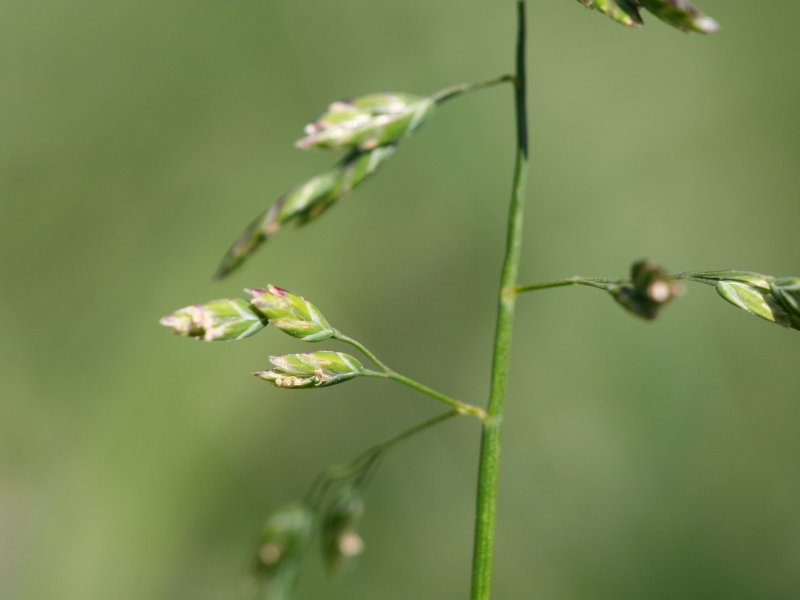
Its inflorescence is a panicle with upright or spreading branches that can reach 10 centimeters in length. Its spikelets are green and have webby fibers.[3][4][5]
Habitat
Diablo canyon blue grass grows on rugged mountaintops and north-facing slopes. It occurs in thin soils covering shale rock within a few kilometers of the coastline.[6][7]
Its habitats include chaparral, oak woodland, coastal sage scrub, and Bishop pine forest. The species is endemic to San Luis Obispo County, California, and is known from approximately five occurrences in the San Luis Mountains near the California coast.[8][9][10]
Reproduction and life cycle
Diablo canyon blue grass flowers in March and April. It is dioecious, with male and female flowers occurring on separate individuals.[11][12]
Some female plants produce bisexual flowers with functional male and female parts. The proportion of female and bisexual flowers changes during the flowering season.[13][14]
The species exhibits sequentially-adjusted gynomonoecism, a breeding system described as unique or intermediate between breeding systems.[15]
Conservation
Diablo canyon blue grass is a rare grass species. Invasion by non-native grasses threatens it, including purple veldtgrass (Ehrharta calycina).[16][17][18]
Similar species
Other bluegrass species occurring where diablo canyon blue grass is found are easily distinguished from it.[19]
Classification of the Diablo Canyon Blue Grass
| Kingdom | Plantae |
|---|---|
| Subkingdom | Pteridobiotina |
| Phylum | Tracheophyta |
| Class | Liliopsida |
| Order | Poales |
| Family | Poaceae (Turf) |
| Genus | Poa (Bluegrass) |
| Species | Poa diaboli Soreng & Keil |
Where the Diablo Canyon Blue Grass is found
Checklists and occurrence records place Poa diaboli in 1 country across North America. GBIF holds 39 georeferenced records of it.
Countries
Regions and cities with the most records
A number beside a place is its count of GBIF occurrence records. A place without a number comes from a checklist alone. Records show where a species has been observed or collected, which can include escapes and vagrants.
Common names
English
- Diablo Canyon Blue Grass
Related species
-
 Kentucky BluegrassPoa pratensis
-
 Annual BluegrassPoa annua
-
 Rough BluegrassPoa trivialis
-
 Common Tussock-grassPoa labillardierei
-
 Bulbous BluegrassPoa bulbosa
-
 Alpine Meadow GrassPoa alpina
-
 Tussac GrassPoa flabellata
-
 Sandberg BluegrassPoa secunda
Compare
Questions and answers
What is the scientific name of the Diablo Canyon Blue Grass?
The scientific name of the Diablo Canyon Blue Grass is Poa diaboli. Written with its author, the full name is Poa diaboli Soreng & Keil.
Which family does the Diablo Canyon Blue Grass belong to?
Poa diaboli belongs to the family Poaceae, in the order Poales and the class Liliopsida.
Where is the Diablo Canyon Blue Grass found?
Checklists and occurrence records place Poa diaboli in 1 country: United States.
What is the scientific name of blue grass?
The scientific name of diablo canyon blue grass is Poa diaboli.[8]
Sources
Passages the profile rests on
- Poa diaboli is a rhizomatous or stoloniferous perennial grass that grows in mounds. Source passage: “This species is a rhizomatous or stoloniferous perennial grass growing in mounds” — English Wikipedia
- Its stems can reach half a meter in height. Source passage: “with stems up to half a meter tall.” — English Wikipedia
- Its inflorescence is a panicle of flowers with upright or spreading branches. Source passage: “The inflorescence is a panicle of flowers up to 10 centimeters long with upright or spreading branches.” — English Wikipedia
- Its flower panicles can reach 10 centimeters in length. Source passage: “The inflorescence is a panicle of flowers up to 10 centimeters long” — English Wikipedia
- Its spikelets are green and have webby fibers. Source passage: “the spikelets green with webby fibers.” — English Wikipedia
- The species grows on rugged mountaintops and north-facing slopes. Source passage: “The grass occurs on rugged mountaintops and north-facing slopes” — English Wikipedia
- The species grows in thin soils covering shale rock within a few kilometers of the coastline. Source passage: “in thin soils covering shale rock within a few kilometers of the coastline.” — English Wikipedia
- Poa diaboli is endemic to San Luis Obispo County, California. Source passage: “It is endemic to San Luis Obispo County, California” — English Wikipedia
- The species is known from approximately five occurrences in the San Luis Mountains near the California coast. Source passage: “known from about five occurrences in the San Luis Mountains near the coast.” — English Wikipedia
- Its habitats include chaparral, oak woodland, coastal sage scrub, and Bishop pine forest. Source passage: “Its habitat includes chaparral, oak woodland, coastal sage scrub, and Bishop pine forest.” — English Wikipedia
- The species flowers in March and April. Source passage: “It flowers in March and April” — English Wikipedia
- The species is dioecious, with male and female flowers occurring on separate individuals. Source passage: “The species is dioecious, with male and female flowers occurring on separate individuals” — English Wikipedia
- Some female plants produce bisexual flowers with functional male and female parts. Source passage: “there sometimes occur female plants that have some bisexual flowers, with working male and female parts” — English Wikipedia
- The proportion of female and bisexual flowers changes during the flowering season. Source passage: “this particular grass shifts its ratio, at times producing more bisexual flowers.” — English Wikipedia
- The species exhibits sequentially-adjusted gynomonoecism, a breeding system described as unique or intermediate between breeding systems. Source passage: “sequentially-adjusted gynomonoecism", a unique breeding system or intermediate between breeding systems.” — English Wikipedia
- Poa diaboli is described as a rare grass species. Source passage: “Poa diaboli is a rare species of grass” — English Wikipedia
- Invasion by non-native grasses is a threat to the species. Source passage: “Threats to this rare species include the invasion of non-native grasses” — English Wikipedia
- Purple veldtgrass (Ehrharta calycina) is identified as a non-native grass threatening the species. Source passage: “such as purple veldtgrass (Ehrharta calycina).” — English Wikipedia
- Other bluegrass species occurring where Poa diaboli is found are reported to be easily distinguished from it. Source passage: “there are few other blue grass species where P. diaboli is found and the other species are easily distinguished from Diablo Canyon blue grass” — fieldguide.mt.gov
Data
- Catalogue of Life, 2026-10-16 XR cc by
- Global Biodiversity Information Facility CC BY 4.0
- Wikidata CC0
- GeoNames CC BY 4.0
- Within the Catalogue of Life, this name comes from The World Checklist of Vascular Plants (WCVP) cc by
References
- Madroño 50: 306 (2003) where the name was published
This species in other databases
Page built on 28 November 2026. See how the catalog is made and all sources and licences.
Cite this page
ScientificNames.org. (2026). Poa diaboli (Diablo Canyon Blue Grass). Retrieved November 28, 2026, from https://scientificnames.org/species/poa-diaboli
“Poa diaboli (Diablo Canyon Blue Grass).” ScientificNames.org, 2026, scientificnames.org/species/poa-diaboli. Accessed 28 Nov. 2026.
ScientificNames.org. “Poa diaboli (Diablo Canyon Blue Grass).” Accessed November 28, 2026. https://scientificnames.org/species/poa-diaboli.
@misc{scientificnames_poa_diaboli_diablo_canyon_blue_grass,
  author = {{ScientificNames.org}},
  title = {Poa diaboli (Diablo Canyon Blue Grass)},
  year = {2026},
  url = {https://scientificnames.org/species/poa-diaboli},
  note = {Accessed 2026-11-28}
}