Species · Flowering plants
Douglas' Bluegrass Poa douglasii
The scientific name of the Douglas' Bluegrass is Poa douglasii. It is a species of flowering plant in the family Poaceae (turf), order Poales.
- Scientific name
- Poa douglasii Nees
- Common name
- Douglas' Bluegrass
- Genus
- Poa
- Family
- Poaceae (Turf)
- Order
- Poales
- Class
- Liliopsida
- Recorded in
- 1 country
- Name status
- accepted in the Catalogue of Life

Overview
Poa douglasii forms small, dense clumps and has an interconnected network of rhizomes and stolons.
Written 27 November 2026 from the sources listed below. Each statement was checked against the passage it cites; statements that could not be supported were removed.
Appearance
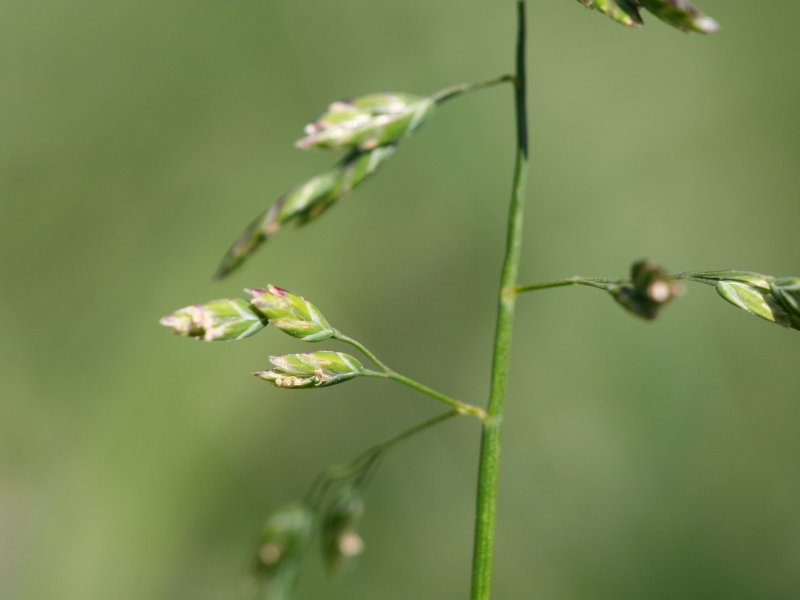
Douglas' bluegrass forms small, dense clumps and reaches a maximum height of approximately 30 centimeters. Its inflorescence consists of a dense, oval-shaped arrangement of overlapping spikelets.[1][2][3]
The grass grows from an interconnected network of long rhizomes and stolons that can reach approximately one meter in length. This network anchors the grass in loose sandy substrate.[4][5][6]
Habitat
Douglas' bluegrass grows in shifting sand dunes along the California coastline. It is endemic to the California coastline, occurring mainly along California's Central Coast and Channel Islands.[7][8][9]
The species also occurs occasionally along California's North Coast north of Mendocino.[10]
Reproduction and life cycle
Douglas' bluegrass is dioecious, with male and female individuals producing different flower types.[11]
Conservation
Douglas' bluegrass is threatened by invasive species.[12]
Classification of the Douglas' Bluegrass
| Kingdom | Plantae |
|---|---|
| Subkingdom | Pteridobiotina |
| Phylum | Tracheophyta |
| Class | Liliopsida |
| Order | Poales |
| Family | Poaceae (Turf) |
| Genus | Poa (Bluegrass) |
| Species | Poa douglasii Nees |
Where the Douglas' Bluegrass is found
Checklists and occurrence records place Poa douglasii in 1 country across North America. GBIF holds 973 georeferenced records of it.
Countries
Regions and cities with the most records
- California, United States 556
- Marina, United States 247
- Seaside, United States 233
- Pacific Grove, United States 231
- Monterey, United States 230
- Salinas, United States 202
- Prunedale, United States 196
- Bayview-Hunters Point, United States 66
- San Francisco, United States 65
- Daly City, United States 63
- South San Francisco, United States 62
- San Bruno, United States 59
- Pacifica, United States 48
- Oakland, United States 46
- Alameda, United States 45
- Idaho, United States 44
- Albany, United States 43
- Millbrae, United States 39
- Richmond, United States 39
- Berkeley, United States 36
- El Cerrito, United States 30
- Arcata, United States 28
- McKinleyville, United States 24
- Bayside, United States 22
- Watsonville, United States 20
- Burlingame, United States 19
- Eureka, United States 18
- San Rafael, United States 15
- San Pablo, United States 12
- Lompoc, United States 6
- Ashland, United States 4
- San Leandro, United States 4
- San Lorenzo, United States 4
A number beside a place is its count of GBIF occurrence records. A place without a number comes from a checklist alone. Records show where a species has been observed or collected, which can include escapes and vagrants.
Common names
English
- Douglas' Bluegrass
- Sanddune Bluegrass
Synonyms
3 other scientific names have been used for this species and are now treated as synonyms of Poa douglasii.
- Brizopyrum douglasii Hook. & Arn.
- Poa douglasii subsp. douglasii
- Poa californica Steud. ambiguous synonym
Related species
-
 Kentucky BluegrassPoa pratensis
-
 Annual BluegrassPoa annua
-
 Rough BluegrassPoa trivialis
-
 Common Tussock-grassPoa labillardierei
-
 Bulbous BluegrassPoa bulbosa
-
 Alpine Meadow GrassPoa alpina
-
 Tussac GrassPoa flabellata
-
 Sandberg BluegrassPoa secunda
Compare
Questions and answers
What is the scientific name of the Douglas' Bluegrass?
The scientific name of the Douglas' Bluegrass is Poa douglasii. Written with its author, the full name is Poa douglasii Nees.
Which family does the Douglas' Bluegrass belong to?
Poa douglasii belongs to the family Poaceae, in the order Poales and the class Liliopsida.
Where is the Douglas' Bluegrass found?
Checklists and occurrence records place Poa douglasii in 1 country: United States.
What other names does the Douglas' Bluegrass have?
Poa douglasii is also known in English as Sanddune Bluegrass.
Sources
Passages the profile rests on
- Poa douglasii forms small, dense clumps. Source passage: “It is a perennial grass growing small, dense clumps up to about 30 centimeters in maximum height.” — English Wikipedia
- The inflorescence consists of a dense, oval-shaped arrangement of overlapping spikelets. Source passage: “The inflorescence is a dense, oval-shaped series of overlapping spikelets.” — English Wikipedia
- The grass reaches a maximum height of approximately 30 centimeters. Source passage: “up to about 30 centimeters in maximum height.” — English Wikipedia
- Its network of rhizomes and stolons can reach approximately one meter in length. Source passage: “this network may be up to one meter long.” — English Wikipedia
- The grass grows from an interconnected network of long rhizomes and stolons. Source passage: “It grows from a network of long rhizomes and stolons” — English Wikipedia
- The rhizome and stolon network anchors the grass in loose sandy substrate. Source passage: “that anchor the grass to its loose sandy substrate” — English Wikipedia
- The species grows in shifting sand dunes along the California coastline. Source passage: “where it grows in shifting sand dunes.” — English Wikipedia
- Poa douglasii is endemic to the California coastline. Source passage: “It is endemic to the coastline of California” — English Wikipedia
- The species occurs mainly along California's Central Coast and Channel Islands. Source passage: “It can be found mostly along the Central Coast and Channel Islands” — English Wikipedia
- The species also occurs occasionally along California's North Coast north of Mendocino. Source passage: “and occasionally on the North Coast north of Mendocino.” — English Wikipedia
- Poa douglasii is dioecious, with male and female individuals producing different flower types. Source passage: “The grass is dioecious, with male and female individuals producing different types of flowers in their inflorescences.” — English Wikipedia
- The species is threatened by invasive species. Source passage: “This species, like many sand-dune endemic plants, is threatened by invasive species.” — English Wikipedia
Data
- Catalogue of Life, 2026-10-16 XR cc by
- Global Biodiversity Information Facility CC BY 4.0
- Wikidata CC0
- GeoNames CC BY 4.0
- Wikimedia Commons per image; credit shown with each image
- Within the Catalogue of Life, this name comes from The World Checklist of Vascular Plants (WCVP) cc by
References
- Ann. Nat. Hist. 1: 284 (1838) where the name was published
This species in other databases
Page built on 28 November 2026. See how the catalog is made and all sources and licences.
Cite this page
ScientificNames.org. (2026). Poa douglasii (Douglas' Bluegrass). Retrieved November 28, 2026, from https://scientificnames.org/species/poa-douglasii
“Poa douglasii (Douglas' Bluegrass).” ScientificNames.org, 2026, scientificnames.org/species/poa-douglasii. Accessed 28 Nov. 2026.
ScientificNames.org. “Poa douglasii (Douglas' Bluegrass).” Accessed November 28, 2026. https://scientificnames.org/species/poa-douglasii.
@misc{scientificnames_poa_douglasii_douglas_bluegrass,
  author = {{ScientificNames.org}},
  title = {Poa douglasii (Douglas' Bluegrass)},
  year = {2026},
  url = {https://scientificnames.org/species/poa-douglasii},
  note = {Accessed 2026-11-28}
}